
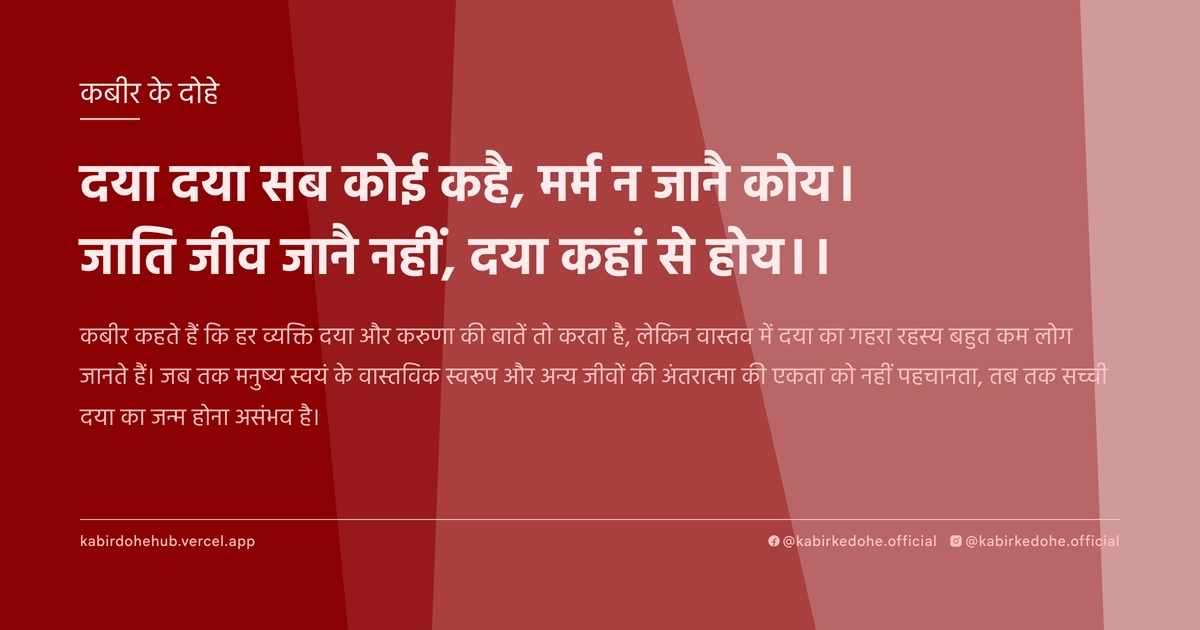
दया दया सब कोई कहै, मर्म न जानै कोय।
जाति जीव जानै नहीं, दया कहां से होय।।
Daya daya sab koi kahai, marm na jaanai koy. Jaati jeev jaanai nahi, daya kahan se hoye.
इस पृष्ठ पर इस कबीर दोहे का अर्थ (meaning), हिंदी व्याख्या और अंग्रेज़ी अनुवाद, दार्शनिक विश्लेषण और व्यावहारिक जीवन सीख दी गई है। यह दोहा करुणा (Compassion) विषय से जुड़ा है — Kabir doha meaning and explanation in Hindi and English.
अर्थ (Meaning):
कबीर कहते हैं कि हर व्यक्ति दया और करुणा की बातें तो करता है, लेकिन वास्तव में दया का गहरा रहस्य बहुत कम लोग जानते हैं। जब तक मनुष्य स्वयं के वास्तविक स्वरूप और अन्य जीवों की अंतरात्मा की एकता को नहीं पहचानता, तब तक सच्ची दया का जन्म होना असंभव है।
Kabir observes that while everyone speaks of mercy and compassion, very few understand its true essence. He asserts that genuine compassion cannot exist as long as one remains ignorant of the true nature of the soul and the fundamental unity shared by all living beings.
व्याख्या (Interpretation):
इस दोहे का शाब्दिक अर्थ है कि दया शब्द केवल जुबान पर है। गहरे स्तर पर, कबीर 'मर्म' यानी उस गुप्त सत्य की बात कर रहे हैं जहाँ 'मैं' और 'तू' का भेद मिट जाता है। यह निर्गुण भक्ति का सार है, जहाँ ईश्वर किसी मंदिर में नहीं बल्कि हर जीव की सांस में है। जब तक हम जीव को केवल शरीर या जाति के रूप में देखते हैं, हम माया के भ्रम में हैं। अद्वैत वेदांत के अनुसार, जब आत्मा को ब्रह्म के रूप में पहचाना जाता है, तब दया कोई बाहरी कार्य नहीं बल्कि एक स्वाभाविक अवस्था बन जाती है। यह विरोधाभास है कि हम जिसे दया कहते हैं, वह अक्सर अहंकार की तुष्टि होती है, जबकि वास्तविक दया अहंकार का पूर्ण विलोपन है।
Literally, the verse suggests that mercy is often a superficial claim. On a deeper level, Kabir refers to the 'marm' or the secret essence where the duality of 'I' and 'Thou' dissolves. This is the core of Nirgun Bhakti, where the Divine is not in a temple but in the breath of every creature. As long as we perceive a being only through the lens of body or caste, we remain trapped in Maya. According to Advaita Vedanta, when the Atman is recognized as Brahman, compassion ceases to be an external act and becomes a natural state of being. The paradox lies in the fact that what we call mercy is often an exercise of the ego, whereas true compassion is the complete annihilation of the ego.
दार्शनिक विश्लेषण (Philosophical Analysis):
कबीर का यह दोहा उस सामाजिक और धार्मिक पाखंड पर प्रहार करता है जहाँ बाहरी अनुष्ठान और शब्दों को आध्यात्मिकता मान लिया जाता था। उनके युग में, लोग दान और दया का प्रदर्शन करते थे ताकि समाज में उनकी प्रतिष्ठा बढ़े, लेकिन उनके भीतर जातिगत श्रेष्ठता और घृणा जीवित थी। कबीर यहाँ तर्क देते हैं कि सच्ची करुणा का आधार 'ज्ञान' है, न कि 'भावना'। यदि आप यह नहीं जानते कि सामने वाला व्यक्ति भी वही चेतना है जो आप हैं, तो आपकी दया केवल एक श्रेष्ठता का भाव है।
यह विचार सूफीवाद के 'वहदत-उल-वजूद' (अस्तित्व की एकता) से मेल खाता है, जहाँ ईश्वर को संपूर्ण सृष्टि में व्याप्त माना गया है। जब एक सूफी या एक भक्त यह देखता है कि हर कण में खुदा या राम है, तो वह किसी को चोट पहुँचाने की कल्पना भी नहीं कर सकता। यहाँ दया का अर्थ किसी पर उपकार करना नहीं, बल्कि यह पहचानना है कि दूसरा व्यक्ति वास्तव में 'मैं' ही हूँ।
अद्वैत वेदांत के परिप्रेक्ष्य में, यह दोहा माया के पर्दों को हटाने की बात करता है। माया हमें यह विश्वास दिलाती है कि हम अलग-अलग इकाइयाँ हैं। यह अलगाव ही दुख और क्रूरता का मूल कारण है। जब 'जीव' की वास्तविक जाति (अर्थात उसकी दिव्य प्रकृति) का बोध होता है, तब करुणा स्वतः स्फूर्त हो जाती है।
मनोवैज्ञानिक स्तर पर, कबीर अहंकार के उस सूक्ष्म जाल को उजागर कर रहे हैं जहाँ व्यक्ति 'दयालु' होने का मुखौटा पहनकर अपने अहंकार को पुष्ट करता है। वास्तविक परिवर्तन तब होता है जब 'दाता' और 'पाने वाले' का भेद समाप्त हो जाए। यह एक ऐसी मानसिक क्रांति है जो व्यक्ति को सामाजिक श्रेणियों से ऊपर उठाकर वैश्विक चेतना से जोड़ती है।
अंततः, कबीर यह स्पष्ट करते हैं कि बिना आत्म-साक्षात्कार के किया गया कोई भी परोपकार अधूरा है। यह केवल एक नैतिक उपदेश नहीं है, बल्कि एक आध्यात्मिक अनिवार्यता है। जब तक हम स्वयं को जान नहीं लेते, हम दूसरों को कभी नहीं जान सकते, और बिना जानने के, दया केवल एक शब्द बनकर रह जाती है।
Kabir's couplet strikes at the heart of the social and religious hypocrisy of his era, where external rituals and rhetoric were mistaken for spirituality. In his time, people performed acts of charity and mercy to enhance their social prestige, while harboring deep-seated caste superiority and hatred. Kabir argues that true compassion is rooted in 'Jnana' (knowledge), not merely in 'emotion'. If one does not realize that the other person is the same consciousness as oneself, then their mercy is merely an expression of superiority.
This perspective aligns with the Sufi concept of 'Wahdat-ul-Wujood' (Unity of Existence), where the Divine is seen as permeating the entire universe. When a Sufi or a devotee perceives God or Ram in every particle, the very idea of harming another becomes impossible. Here, mercy is not about doing a favor to someone, but about recognizing that the other person is, in essence, 'I'.
From the lens of Advaita Vedanta, this verse speaks of piercing the veils of Maya. Maya creates the illusion that we are separate entities, and this perceived separation is the root cause of all suffering and cruelty. When the true 'caste' of the soul—its divine nature—is realized, compassion becomes a spontaneous state of being.
Psychologically, Kabir exposes the subtle trap of the ego, where an individual reinforces their sense of self by wearing the mask of being 'merciful'. Real transformation occurs only when the distinction between the 'giver' and the 'receiver' vanishes. This is a mental revolution that elevates a person above social categories and connects them to a universal consciousness.
Ultimately, Kabir clarifies that any philanthropy performed without self-realization is incomplete. This is not merely a moral exhortation but a spiritual necessity. Until we know ourselves, we cannot truly know others, and without that knowing, mercy remains nothing more than a word.
मूल संदेश (Core Message):
- शब्दों की दया केवल एक मुखौटा है।
- सच्ची करुणा आत्म-ज्ञान से जन्म लेती है।
- जब 'मैं' मिटता है, तब वास्तविक दया शुरू होती है।
- सभी जीवों में एक ही चेतना का वास है।
- अहंकार रहित सेवा ही वास्तविक धर्म है।
- एकता का बोध ही दुखों का अंत है।
- Mercy in words is often a mere mask.
- True compassion is born from self-realization.
- Real mercy begins only when the 'I' dissolves.
- The same consciousness resides in all living beings.
- Service without ego is the only true religion.
- The realization of unity is the end of all suffering.
व्यावहारिक उदाहरण (Practical Example):
वाराणसी के घाटों पर रहने वाली एक वृद्ध विधवा, जानकी, अपनी पूरी जिंदगी दूसरों की सेवा और दान में बिता चुकी थी। वह शहर में सबसे 'दयालु' मानी जाती थी, लेकिन उसके मन में एक गहरा विभाजन था। वह केवल उन लोगों की मदद करती थी जो उसके जैसे ही धार्मिक संस्कारों का पालन करते थे। वह अक्सर उन लोगों को तुच्छ समझती थी जो समाज की नजरों में 'अपवित्र' थे।
एक दिन, जानकी ने देखा कि एक युवा लड़का, जिसे समाज 'अछूत' मानता था, एक घायल कुत्ते की सेवा कर रहा था। वह लड़का अपनी फटी हुई कमीज से कुत्ते के घाव पोंछ रहा था और उसकी आँखों में एक ऐसी शांति थी जो जानकी ने कभी अपने महंगे अनुष्ठानों में नहीं पाई थी।
जानकी ने उससे पूछा, 'तुम इस गंदे जानवर पर इतनी दया क्यों कर रहे हो?' उस लड़के ने सरलता से उत्तर दिया, 'माँ, इसमें गंदा क्या है? इसकी आँखों में वही दर्द है जो कभी मेरी आँखों में था। हम दोनों एक ही मिट्टी के हैं।'
यह वाक्य जानकी के हृदय पर बिजली की तरह गिरा। उसे एहसास हुआ कि उसकी 'दया' वास्तव में उसकी अपनी श्रेष्ठता का प्रमाण थी। वह दया नहीं, बल्कि एक व्यापार था—वह पुण्य खरीद रही थी।
उसने महसूस किया कि उसने कभी उस लड़के की 'जाति' या 'जीव' के वास्तविक स्वरूप को नहीं देखा, बल्कि केवल सामाजिक लेबल देखे थे। वह जिसे दया कह रही थी, वह वास्तव में उसके अहंकार का विस्तार था।
उस रात जानकी सो नहीं पाई। उसने अपनी पूरी जिंदगी के 'पुण्यों' की समीक्षा की और पाया कि वे सब बाहरी थे। उसने पहली बार महसूस किया कि वह वास्तव में कितनी अकेली और अज्ञानी थी।
अगले दिन से जानकी का व्यवहार बदल गया। उसने अब केवल 'योग्य' लोगों की मदद करना बंद कर दिया। उसने उन लोगों के साथ बैठना शुरू किया जिन्हें वह पहले अनदेखा करती थी।
उसने पाया कि जब वह सामने वाले को एक 'गरीब' या 'अपवित्र' व्यक्ति के रूप में नहीं, बल्कि अपनी ही आत्मा के एक प्रतिबिंब के रूप में देखने लगी, तो उसकी दया में एक नई गहराई आ गई।
अब उसकी सहायता में कोई अहंकार नहीं था, न ही कोई उम्मीद कि उसे पुण्य मिलेगा। वह केवल इसलिए मदद करती थी क्योंकि वह जान गई थी कि वह और सामने वाला अलग नहीं हैं।
जानकी की यह यात्रा बाहरी दान से आंतरिक एकता की ओर थी। उसने अंततः 'मर्म' को जान लिया था—कि सच्ची दया वही है जहाँ देने वाला और लेने वाला एक हो जाएं।
Janaki, an elderly widow living on the ghats of Varanasi, had spent her entire life in service and charity. She was regarded as the most 'merciful' woman in the city, yet a deep division existed within her heart. She helped only those who followed the same religious rituals as she did, often looking down upon those deemed 'impure' by society.
One day, Janaki observed a young boy, marginalized by caste, tending to a wounded dog. The boy was wiping the dog's wounds with his torn shirt, and his eyes held a serenity that Janaki had never found in her expensive rituals.
Janaki asked him, 'Why do you show such mercy to this filthy animal?' The boy replied simply, 'Mother, what is filthy here? The pain in its eyes is the same pain I once felt. We are both made of the same earth.'
These words struck Janaki like a bolt of lightning. She realized that her 'mercy' was actually a testament to her own perceived superiority. It wasn't compassion; it was a transaction—she was buying spiritual merit.
She realized she had never seen the true 'nature' of the boy or the animal, but only the social labels attached to them. What she called mercy was merely an extension of her ego.
Janaki could not sleep that night. She reviewed all the 'merits' of her life and found them to be superficial. For the first time, she felt how truly lonely and ignorant she had been.
From the next day, Janaki's behavior changed. She stopped helping only the 'worthy'. She began sitting and talking with those she had previously ignored.
She discovered that when she stopped seeing the other as a 'poor' or 'impure' person and instead saw them as a reflection of her own soul, her compassion acquired a new depth.
Now, there was no ego in her help, nor any expectation of reward. She helped simply because she understood that she and the other were not separate.
Janaki's journey was a transition from external charity to internal unity. She had finally understood the 'marm'—that true mercy is where the giver and the receiver become one.
अभ्यास मार्गदर्शन (Practice Guidance):
- दैनिक आत्म-निरीक्षण: दिन के अंत में विचार करें कि आपने जब किसी की मदद की, तो क्या आपके मन में 'मैं मदद कर रहा हूँ' का भाव था? यदि हाँ, तो वह अहंकार था, दया नहीं।
- समानता का अभ्यास: प्रतिदिन कम से कम एक ऐसे व्यक्ति से बात करें जिसे आप सामाजिक या वैचारिक रूप से अपने से भिन्न या 'नीचे' समझते हैं। उनके भीतर अपनी ही चेतना को खोजने का प्रयास करें।
- मौन चिंतन: 15 मिनट के लिए आँखें बंद करें और कल्पना करें कि आपकी आत्मा का प्रकाश हर जीवित प्राणी में प्रवाहित हो रहा है। महसूस करें कि कोई भी 'दूसरा' नहीं है।
- डायग्नोस्टिक चेकलिस्ट: क्या मेरी दया केवल उन लोगों के लिए है जो मुझे पसंद करते हैं? क्या मैं मदद करने के बाद प्रशंसा की उम्मीद करता हूँ? क्या मैं सामने वाले को उसकी स्थिति से पहचानता हूँ या उसकी आत्मा से?
- Daily Self-Inquiry: At the end of the day, reflect on your acts of kindness. Did you feel 'I am helping someone'? If yes, that was ego, not true compassion.
- Practice of Equality: Every day, engage with at least one person whom you perceive as socially or ideologically different or 'inferior'. Try to find your own consciousness within them.
- Silent Contemplation: For 15 minutes, close your eyes and visualize your soul's light flowing into every living being. Feel that there is no 'other'.
- Diagnostic Checklist: Is my mercy reserved only for those I like? Do I expect praise after helping? Do I identify the other by their social status or by their soul?
चिंतन प्रश्न (Reflection Questions):
- क्या मेरी दया वास्तव में दूसरे के लिए है, या यह मेरे स्वयं के 'अच्छे इंसान' होने के भ्रम को पुष्ट करने के लिए है?
- मैं किन लोगों को 'दया' के योग्य नहीं मानता, और वह निर्णय मेरे किस आंतरिक डर या पूर्वाग्रह से आता है?
- यदि मेरा सामाजिक पद और पहचान छीन ली जाए, तो क्या मेरी करुणा तब भी वैसी ही रहेगी?
- क्या मैं अपनी डिजिटल पहचान (सोशल मीडिया) पर दया का प्रदर्शन करता हूँ ताकि दुनिया मुझे दयालु समझे?
- मेरे जीवन में ऐसा कौन है जिसे मैं सबसे अधिक नापसंद करता हूँ? क्या मैं उसमें भी उसी ईश्वर को देख सकता हूँ जिसे मैं पूजता हूँ?
- Is my mercy truly for the other, or is it to reinforce the illusion of me being a 'good person'?
- Who are the people I deem unworthy of mercy, and from which internal fear or bias does that judgment stem?
- If my social status and identity were stripped away, would my compassion remain the same?
- Do I perform acts of mercy on my digital identity (social media) just so the world perceives me as compassionate?
- Who is the person I dislike the most in my life? Can I see the same Divine in them that I worship in the temple?