
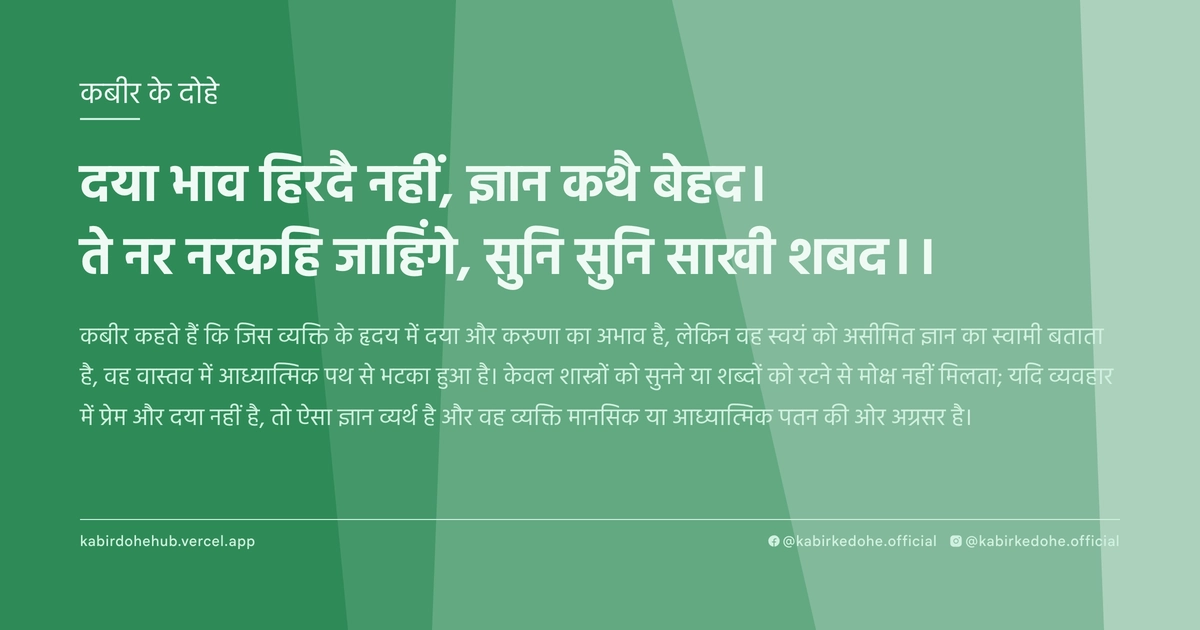
दया भाव हिरदै नहीं, ज्ञान कथै बेहद।
ते नर नरकहि जाहिंगे, सुनि सुनि साखी शबद।।
Daya bhaav hirdai nahi, gyan kathai behad. Te nar narakhi jaahinge, suni suni sakhi shabad.
इस पृष्ठ पर इस कबीर दोहे का अर्थ (meaning), हिंदी व्याख्या और अंग्रेज़ी अनुवाद, दार्शनिक विश्लेषण और व्यावहारिक जीवन सीख दी गई है। यह दोहा करुणा (Compassion) विषय से जुड़ा है — Kabir doha meaning and explanation in Hindi and English.
अर्थ (Meaning):
कबीर कहते हैं कि जिस व्यक्ति के हृदय में दया और करुणा का अभाव है, लेकिन वह स्वयं को असीमित ज्ञान का स्वामी बताता है, वह वास्तव में आध्यात्मिक पथ से भटका हुआ है। केवल शास्त्रों को सुनने या शब्दों को रटने से मोक्ष नहीं मिलता; यदि व्यवहार में प्रेम और दया नहीं है, तो ऐसा ज्ञान व्यर्थ है और वह व्यक्ति मानसिक या आध्यात्मिक पतन की ओर अग्रसर है।
Kabir asserts that a person who lacks compassion and mercy in their heart, yet claims to possess boundless knowledge, is spiritually bankrupt. Mere recitation of scriptures or listening to holy words does not lead to liberation; if the heart is devoid of love and empathy, such intellectual knowledge is useless and leads the soul toward spiritual degradation and suffering.
व्याख्या (Interpretation):
यह दोहा बाहरी पाखंड और आंतरिक शून्यता के बीच के विरोधाभास को उजागर करता है। 'दया' यहाँ केवल एक भावना नहीं, बल्कि ब्रह्म का जीवंत स्वरूप है। जब कबीर 'बेहद ज्ञान' की बात करते हैं, तो वे उस अहंकारपूर्ण बौद्धिक ज्ञान की आलोचना कर रहे हैं जो स्वयं को दूसरों से श्रेष्ठ मानता है। निर्गुण भक्ति में, ईश्वर किसी मंदिर या शास्त्र में नहीं, बल्कि प्राणी मात्र के प्रति करुणा में निवास करता है। माया का सबसे सूक्ष्म रूप वह 'अहंकार' है जो हमें विश्वास दिलाता है कि हम ज्ञानी हैं, जबकि हम प्रेम से वंचित हैं। आत्मा और परमात्मा का मिलन केवल तभी संभव है जब 'मैं' का विसर्जन हो और उसकी जगह 'करुणा' ले ले। अतः, बिना दया के ज्ञान केवल एक बोझ है जो मनुष्य को सत्य से दूर ले जाता है।
This couplet highlights the paradox between external pretension and internal emptiness. 'Daya' (compassion) here is not merely an emotion, but the living manifestation of the Divine. When Kabir speaks of 'boundless knowledge,' he critiques the arrogant intellectualism that views itself as superior to others. In Nirgun Bhakti, the Formless Divine resides not in temples or texts, but in empathy for all living beings. The most subtle form of Maya is the ego that convinces us we are enlightened while we remain devoid of love. The non-duality of Atman and Brahman is realized only when the 'I' is dissolved and replaced by universal compassion. Thus, knowledge without mercy is a burden that alienates the seeker from the Truth.
दार्शनिक विश्लेषण (Philosophical Analysis):
कबीर का यह संदेश उस समय के धार्मिक वातावरण पर एक तीखा प्रहार था, जहाँ पंडित और मुल्ला केवल शास्त्रों की व्याख्या करते थे, लेकिन उनके जीवन में मानवता का अभाव था। वे कर्मकांडीय ज्ञान के बजाय 'अनुभवजन्य ज्ञान' (Experiential Knowledge) पर बल देते हैं। यह दृष्टिकोण अद्वैत वेदांत के उस सिद्धांत से मेल खाता है जहाँ जीव और ब्रह्म एक हैं; यदि हम दूसरे में स्वयं को नहीं देखते, तो हमारा ज्ञान अधूरा है।
सूफी मत के 'इश्क-ए-हकीकी' (ईश्वरीय प्रेम) की तरह, कबीर भी मानते हैं कि बिना प्रेम के खुदा या राम की प्राप्ति असंभव है। ज्ञान जब तक हृदय में नहीं उतरता, वह केवल मस्तिष्क की कसरत है। कबीर यहाँ 'नरक' शब्द का प्रयोग किसी भौगोलिक स्थान के लिए नहीं, बल्कि उस मानसिक अवस्था के लिए कर रहे हैं जहाँ व्यक्ति अपने अहंकार और अलगाव में कैद रहता है।
वे जाति और धर्म की सीमाओं को तोड़ते हुए यह स्थापित करते हैं कि सच्ची आध्यात्मिकता का पैमाना 'दया' है, न कि जन्म या शास्त्र ज्ञान। यह एक मनोवैज्ञानिक रूपांतरण की मांग है—बौद्धिक संचय से भावनात्मक विस्तार की ओर।
अक्सर लोग इस दोहे को केवल नैतिक उपदेश मान लेते हैं, लेकिन यह वास्तव में 'अहंकार के विलोपन' की प्रक्रिया है। जब ज्ञान का उद्देश्य दूसरों को नीचा दिखाना या स्वयं को श्रेष्ठ सिद्ध करना होता है, तो वह ज्ञान वास्तव में अज्ञान का एक परिष्कृत रूप होता है।
अंततः, कबीर यह स्पष्ट करते हैं कि 'साखी' (साक्ष्य) और 'शबद' (शब्द) केवल तब सार्थक होते हैं जब वे आचरण में ढलें। ज्ञान का वास्तविक प्रमाण व्यक्ति की विनम्रता और उसकी करुणा है, न कि उसकी वाक्पटुता।
Kabir's message is a sharp critique of the religious climate of his era, where scholars and clerics interpreted scriptures while remaining devoid of basic humanity. He emphasizes 'Experiential Knowledge' over ritualistic learning. This aligns with Advaita Vedanta's principle that the individual soul and the Universal Soul are one; if we fail to see ourselves in others, our knowledge remains incomplete.
Similar to the Sufi concept of 'Ishq-e-Haqiqi' (Divine Love), Kabir believes that reaching the Divine is impossible without love. Knowledge that does not descend from the head to the heart is merely an intellectual exercise. Kabir uses the word 'Hell' not as a geographical location, but as a psychological state of isolation and ego-driven suffering.
By dismantling caste and religious barriers, he establishes 'compassion' as the only true metric of spirituality, regardless of birth or scholarly credentials. This calls for a psychological transformation—moving from intellectual accumulation to emotional expansion.
Common literalist interpretations view this as a simple moral lesson, but it is actually a process of 'ego annihilation.' When knowledge is used to belittle others or elevate the self, it becomes a sophisticated form of ignorance.
Ultimately, Kabir clarifies that 'Sakhi' (witness/evidence) and 'Shabad' (word) are meaningful only when embodied in action. The authentic proof of enlightenment is not eloquence, but humility and mercy.
मूल संदेश (Core Message):
- बौद्धिक अहंकार सत्य के मार्ग में सबसे बड़ी बाधा है।
- करुणा ही वास्तविक ज्ञान की एकमात्र कसौटी है।
- शास्त्रों का रटना मोक्ष नहीं, बल्कि आचरण का परिवर्तन मुक्ति है।
- ईश्वर शब्दों में नहीं, बल्कि जीव मात्र की सेवा में मिलता है।
- प्रेमविहीन ज्ञान एक सुंदर लेकिन खाली बर्तन के समान है।
- Intellectual ego is the greatest obstacle on the path to Truth.
- Compassion is the only authentic litmus test of real knowledge.
- Rote learning of scriptures is not liberation; transformation of conduct is.
- The Divine is found not in words, but in the service of all living beings.
- Knowledge without love is like a beautiful but empty vessel.
व्यावहारिक उदाहरण (Practical Example):
वाराणसी के एक पुराने घाट पर माधव नाम का एक वृद्ध बुनकर रहता था। माधव शास्त्रों का ज्ञाता नहीं था, लेकिन वह हर किसी से प्रेम से बात करता था। उसी गली में पंडित शिवदत्त रहते थे, जिन्होंने वेदों और पुराणों का गहन अध्ययन किया था और पूरे शहर में अपनी विद्वत्ता के लिए प्रसिद्ध थे। शिवदत्त अक्सर सभाओं में बैठकर धर्म और मोक्ष पर लंबे प्रवचन देते थे, लेकिन वे अपने घर में काम करने वाले सहायकों और सड़क पर मिलने वाले भिखारियों को तुच्छ समझते थे।
एक बार शहर में भीषण अकाल पड़ा। लोग दाने-दाने को तरस रहे थे। पंडित शिवदत्त ने अपने भंडार को ताला लगा दिया और तर्क दिया कि 'कर्म का सिद्धांत' कहता है कि जो भूखा है, वह अपने पिछले जन्मों के पाप भुगत रहा है। उन्होंने अपनी विद्वत्ता का उपयोग यह सिद्ध करने में किया कि सहायता न करना ही धर्मसंगत है।
दूसरी ओर, माधव के पास बहुत कम था, लेकिन उसने अपने छोटे से घर के बाहर एक बड़ा बर्तन रखा और उसमें जो कुछ भी उपलब्ध था, उसे पकाकर राहगीरों को खिलाने लगा। वह खुद आधा पेट सोता, लेकिन किसी और को भूखा नहीं देख सकता था।
एक दिन, एक उच्च कोटि के संत उस घाट पर आए। उन्होंने शिवदत्त के प्रवचनों को सुना और फिर माधव की सेवा को देखा। संत ने शिवदत्त को बुलाया और पूछा, 'आप मोक्ष के बारे में इतना जानते हैं, तो क्या आप इस भूखे व्यक्ति की पीड़ा महसूस कर सकते हैं?'
शिवदत्त ने गर्व से उत्तर दिया, 'मैं शास्त्रों के अनुसार जानता हूँ कि यह माया है और आत्मा अमर है, इसलिए शरीर की पीड़ा गौण है।'
संत मुस्कुराए और माधव की ओर इशारा करते हुए कहा, 'पंडित जी, आपका ज्ञान केवल शब्दों का ढेर है। माधव के पास शास्त्र नहीं हैं, लेकिन उसके हृदय में वह 'दया' है जो आपको वेदों में नहीं मिली। आप शब्दों के नरक में जी रहे हैं, जबकि यह साधारण बुनकर सत्य के स्वर्ग में है।'
शिवदत्त को पहली बार अपनी विद्वत्ता की रिक्तता का अहसास हुआ। उन्होंने देखा कि जिस ज्ञान पर उन्हें गर्व था, उसने उन्हें पत्थर दिल बना दिया था।
उस दिन के बाद, शिवदत्त ने प्रवचन देना कम कर दिया और माधव के साथ मिलकर गरीबों की सेवा करना शुरू किया। उन्होंने सीखा कि ज्ञान का असली अर्थ दूसरों के दुख को अपना दुख समझना है।
यह रूपांतरण तब हुआ जब उन्होंने समझा कि बिना करुणा के ज्ञान केवल एक मुखौटा है, जो आत्मा को सत्य से अलग करता है।
On an ancient ghat in Varanasi lived an elderly weaver named Madhav. Madhav was not a scholar of scriptures, but he spoke to everyone with profound love. In the same lane lived Pandit Shivdutt, who had deeply studied the Vedas and Puranas and was renowned throughout the city for his erudition. Shivdutt often held assemblies where he gave long discourses on Dharma and Moksha, yet he viewed his domestic helpers and street beggars as insignificant.
Once, a severe famine struck the city. People were starving. Pandit Shivdutt locked his granaries and argued that the 'Law of Karma' dictated that those who were hungry were merely suffering for the sins of their past lives. He used his scholarship to justify his indifference as being 'dharmic.'
Conversely, Madhav had very little, but he placed a large pot outside his small hut and cooked whatever he had to feed passersby. He slept on a half-empty stomach but could not bear to see another suffer hunger.
One day, a high-realized saint visited the ghat. He listened to Shivdutt's discourses and then observed Madhav's service. The saint called Shivdutt and asked, 'You know so much about liberation; can you feel the agony of this starving man?'
Shivdutt replied proudly, 'I know according to the scriptures that this is Maya and the soul is immortal; therefore, bodily suffering is secondary.'
The saint smiled and pointed toward Madhav, saying, 'Pandit ji, your knowledge is merely a pile of words. Madhav possesses no scriptures, but in his heart is the 'mercy' that you failed to find in the Vedas. You are living in a hell of words, while this simple weaver resides in the heaven of Truth.'
For the first time, Shivdutt realized the emptiness of his intellectualism. He saw that the knowledge he prided himself on had turned his heart into stone.
After that day, Shivdutt reduced his preaching and began serving the poor alongside Madhav. He learned that the true meaning of knowledge is to perceive the suffering of others as one's own.
This transformation occurred only when he understood that knowledge without compassion is merely a mask that separates the soul from the Truth.
अभ्यास मार्गदर्शन (Practice Guidance):
- दैनिक करुणा अभ्यास: प्रतिदिन कम से कम एक ऐसा कार्य करें जिसमें आपका कोई व्यक्तिगत लाभ न हो और वह केवल दूसरे की पीड़ा को कम करने के लिए हो।
- आत्म-निरीक्षण जर्नल: हर रात लिखें कि आज आपने कितनी बार अपने ज्ञान का उपयोग किसी को नीचा दिखाने या स्वयं को श्रेष्ठ सिद्ध करने के लिए किया।
- मौन चिंतन: 15 मिनट के लिए बैठें और विचार करें कि यदि आप उस व्यक्ति की स्थिति में होते जिससे आप घृणा करते हैं, तो आप कैसी करुणा की अपेक्षा करते।
- डायग्नोस्टिक चेकलिस्ट: क्या मैं दूसरों की मदद करते समय उनके प्रति श्रेष्ठता महसूस करता हूँ? क्या मेरा ज्ञान मुझे विनम्र बना रहा है या अहंकारी? यदि उत्तर 'श्रेष्ठता' है, तो आप अभी भी 'शब्दों के नरक' में हैं।
- Daily Compassion Practice: Perform at least one act daily that offers no personal gain and is solely intended to alleviate another's suffering.
- Self-Inquiry Journal: Every night, record instances where you used your knowledge to belittle someone or to establish your own superiority.
- Silent Contemplation: Sit for 15 minutes and reflect on how you would wish to be treated with mercy if you were in the position of someone you currently judge or dislike.
- Diagnostic Checklist: Do I feel a sense of superiority while helping others? Is my knowledge making me humble or arrogant? If the answer is 'superiority,' you are still residing in the 'hell of words.'
चिंतन प्रश्न (Reflection Questions):
- क्या मेरा 'आध्यात्मिक ज्ञान' मुझे वास्तव में अधिक दयालु बना रहा है, या यह केवल मेरे अहंकार को एक नया, 'पवित्र' रूप दे रहा है?
- मैं उन लोगों के प्रति कैसा व्यवहार करता हूँ जो मेरी सामाजिक या बौद्धिक स्थिति से बहुत नीचे हैं?
- क्या मैं धर्म की व्याख्या दूसरों को नियंत्रित करने के लिए करता हूँ या स्वयं को बदलने के लिए?
- मेरे जीवन का वह कौन सा हिस्सा है जहाँ मैं 'ज्ञानी' होने का ढोंग करता हूँ लेकिन वास्तव में करुणा शून्य हूँ?
- यदि आज मेरे पास कोई उपाधि या शास्त्र ज्ञान न रहे, तो क्या मेरी मानवता ही मेरी पहचान बनेगी?
- Is my 'spiritual knowledge' actually making me more compassionate, or is it merely giving my ego a new, 'sacred' form?
- How do I behave toward those who are significantly lower than me in social or intellectual status?
- Do I interpret religion to control others or to transform myself?
- In which area of my life do I pretend to be 'enlightened' while remaining devoid of actual mercy?
- If all my titles and scholarly knowledge were stripped away today, would my humanity be the only identity left?