
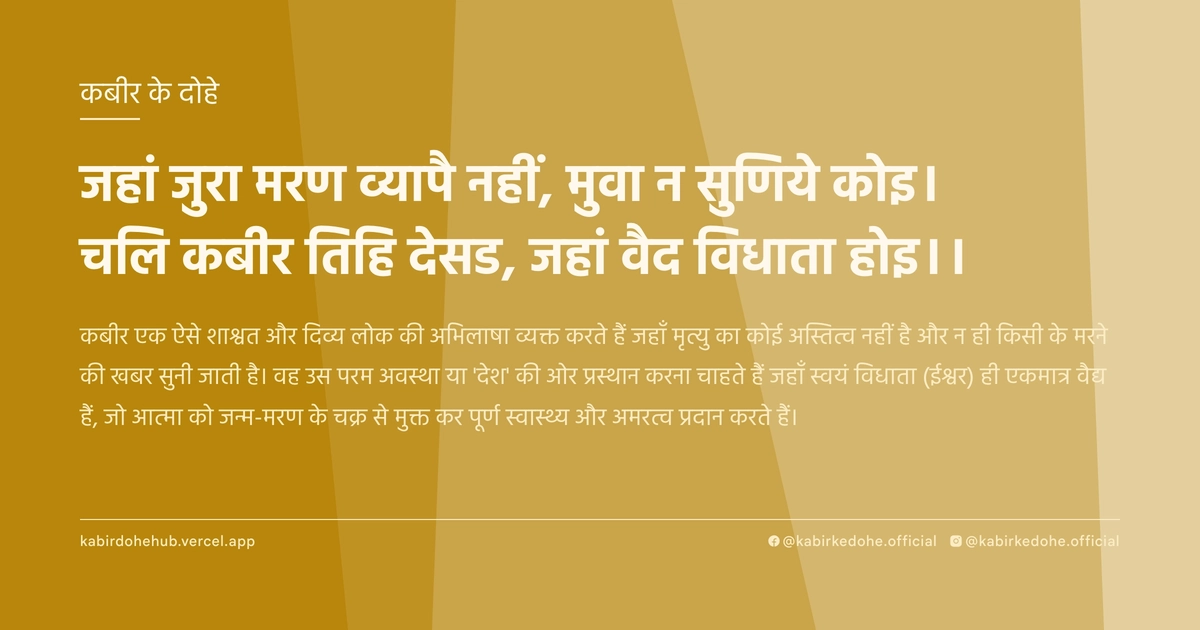
जहां जुरा मरण व्यापै नहीं, मुवा न सुणिये कोइ।
चलि कबीर तिहि देसड, जहां वैद विधाता होइ।।
Jaha jura maran vyapai nahi, muva na suniye koi. Chali kabir tihu desad, jaha vaid vidhata hoye.
इस पृष्ठ पर इस कबीर दोहे का अर्थ (meaning), हिंदी व्याख्या और अंग्रेज़ी अनुवाद, दार्शनिक विश्लेषण और व्यावहारिक जीवन सीख दी गई है। यह दोहा मुक्ति (Liberation) विषय से जुड़ा है — Kabir doha meaning and explanation in Hindi and English.
अर्थ (Meaning):
कबीर एक ऐसे शाश्वत और दिव्य लोक की अभिलाषा व्यक्त करते हैं जहाँ मृत्यु का कोई अस्तित्व नहीं है और न ही किसी के मरने की खबर सुनी जाती है। वह उस परम अवस्था या 'देश' की ओर प्रस्थान करना चाहते हैं जहाँ स्वयं विधाता (ईश्वर) ही एकमात्र वैद्य हैं, जो आत्मा को जन्म-मरण के चक्र से मुक्त कर पूर्ण स्वास्थ्य और अमरत्व प्रदान करते हैं।
Kabir expresses a profound longing for an eternal, divine realm where the concept of death does not exist, and no news of demise is ever heard. He seeks to journey toward that spiritual state or 'land' where the Creator Himself serves as the ultimate Physician, healing the soul from the cycle of birth and death to grant absolute immortality and liberation.
व्याख्या (Interpretation):
शाब्दिक रूप से यह दोहा एक मृत्यु-रहित स्थान की खोज है, परंतु आध्यात्मिक स्तर पर यह 'मोक्ष' और 'सहज अवस्था' का वर्णन है। यहाँ 'मरण' केवल शारीरिक अंत नहीं, बल्कि अज्ञान और अहंकार के कारण होने वाला बार-बार का पतन है। 'तिहि देस' वह चेतना है जहाँ द्वैत समाप्त हो जाता है और आत्मा अपने मूल स्वरूप (ब्रह्म) में विलीन हो जाती है। यह निर्गुण भक्ति का सार है, जहाँ ईश्वर किसी बाहरी मंदिर में नहीं, बल्कि उस आंतरिक शून्यता में है जहाँ समय और मृत्यु का प्रभाव समाप्त हो जाता है। विधाता का वैद्य होना यह दर्शाता है कि केवल आत्म-ज्ञान ही वह औषधि है जो माया के रोग को मिटा सकती है। यह विरोधाभास है कि मृत्यु को जीतने के लिए पहले 'अहं' की मृत्यु आवश्यक है।
Literally, this couplet seeks a land without death, but spiritually, it describes 'Moksha' and the state of 'Sahaja'. Here, 'death' is not merely physical cessation, but the recurring fall caused by ignorance and ego. The 'land' refers to that consciousness where duality vanishes and the Atman merges into its source, Brahman. This is the essence of Nirgun Bhakti, where the Divine is not in an external temple but in the internal void where time and mortality cease. The Creator acting as the Physician signifies that Self-realization is the only medicine capable of curing the disease of Maya. It presents the central paradox: to conquer death, one must first experience the death of the ego.
दार्शनिक विश्लेषण (Philosophical Analysis):
कबीर का यह दोहा मध्यकालीन भारत के उस संक्रमण काल की उपज है जब कर्मकांड और बाहरी आडंबर चरम पर थे। कबीर ने ritualism का खंडन करते हुए यह स्पष्ट किया कि मोक्ष किसी तीर्थयात्रा या बाहरी अनुष्ठान से नहीं, बल्कि आंतरिक रूपांतरण से मिलता है। यह विचार अद्वैत वेदांत के 'अहं ब्रह्मास्मि' से मेल खाता है, जहाँ जीव और ईश्वर के बीच का अंतर केवल माया का भ्रम है।
सूफी मत के 'फना' (अहंकार का विनाश) और 'बका' (ईश्वर में जीवित रहना) की अवधारणा यहाँ स्पष्ट झलकती है। कबीर जिस 'देश' की बात कर रहे हैं, वह कोई भौगोलिक स्थान नहीं, बल्कि एक मानसिक और आध्यात्मिक अवस्था है। जब साधक अपनी सीमित पहचान को त्याग देता है, तो वह उस अनंतता का हिस्सा बन जाता है जहाँ जन्म और मृत्यु के मायने समाप्त हो जाते हैं।
ऐतिहासिक रूप से, कबीर ने जाति और धर्म के भेदों को चुनौती दी क्योंकि मृत्यु सबको समान करती है, लेकिन उन्होंने एक ऐसी अवस्था की बात की जो मृत्यु से भी ऊपर है। यह केवल पलायनवाद नहीं है, बल्कि जीवन की नश्वरता को स्वीकार कर उससे परे जाने का साहस है।
मनोवैज्ञानिक स्तर पर, यह दोहा मानवीय भय—मृत्यु के भय—का समाधान प्रस्तुत करता है। कबीर सिखाते हैं कि भय तब तक है जब तक हम स्वयं को शरीर मानते हैं। जिस क्षण हम स्वयं को शुद्ध चेतना (Pure Consciousness) के रूप में पहचानते हैं, मृत्यु एक अर्थहीन शब्द बन जाती है।
अतः, यह दोहा हमें भौतिकता के मोह से हटाकर उस शाश्वत सत्य की ओर ले जाता है जहाँ विधाता का उपचार केवल प्रेम और ज्ञान है। यह संदेश देता है कि वास्तविक स्वास्थ्य शरीर का नहीं, बल्कि आत्मा का है, जो केवल परमात्मा के सानिध्य में संभव है।
This couplet emerged during a transitional period in medieval India when ritualism and external pomposity were at their peak. Kabir rejected these rituals, asserting that liberation is achieved not through pilgrimages or ceremonies, but through internal transformation. This aligns with the Advaita Vedanta principle of 'Aham Brahmasmi', where the separation between the individual soul and the Divine is merely an illusion of Maya.
The Sufi concepts of 'Fana' (annihilation of the ego) and 'Baqa' (subsistence in God) are vividly reflected here. The 'land' Kabir refers to is not a geographical location but a state of consciousness. When the seeker relinquishes their limited identity, they become part of the infinity where birth and death lose all meaning.
Historically, Kabir challenged caste and religious divisions, noting that while death equalizes all, there is a state beyond even death. This is not escapism, but the courage to acknowledge the transience of life and transcend it.
Psychologically, the verse addresses the primal human fear—the fear of death. Kabir teaches that fear persists only as long as we identify ourselves with the physical body. The moment we recognize ourselves as Pure Consciousness, death becomes a meaningless term.
Thus, the couplet shifts our focus from material attachment to the eternal truth where the Creator's cure is nothing but Love and Knowledge. It suggests that true health is not of the body, but of the soul, attainable only in the presence of the Divine.
मूल संदेश (Core Message):
- मृत्यु शरीर का अंत है, आत्मा का नहीं।
- अहंकार का विसर्जन ही वास्तविक अमरत्व है।
- ईश्वर ही एकमात्र उपचारक और अंतिम सत्य है।
- माया के भ्रम को तोड़कर शाश्वत चेतना में प्रवेश करें।
- प्रेम और करुणा ही उस दिव्य देश का मार्ग हैं।
- Death is the end of the body, not the soul.
- The dissolution of ego is the only true immortality.
- The Divine is the sole Healer and the ultimate Truth.
- Break the illusion of Maya to enter eternal consciousness.
- Love and compassion are the paths to that divine realm.
व्यावहारिक उदाहरण (Practical Example):
वाराणसी के एक पुराने घाट पर रहने वाले वृद्ध विधवा, जानकी, का जीवन केवल शोक और परंपराओं के इर्द-गिर्द सिमटा था। वह प्रतिदिन गंगा किनारे बैठकर अपने मृत पति और बीते समय को याद करती थीं, और उनका पूरा अस्तित्व 'खोने' के दुख में डूबा था। उनके लिए जीवन केवल मृत्यु की प्रतीक्षा था।
एक दिन उनकी मुलाकात एक घुमक्कड़ फकीर से हुई, जिसने कबीर का यह दोहा सुनाया। फकीर ने उनसे पूछा, "माई, तुम उस व्यक्ति के लिए रो रही हो जो मर गया, या उस सत्य के लिए जो कभी मरता ही नहीं?"
जानकी ने उत्तर दिया, "सब कुछ तो खत्म हो गया, अब बचा ही क्या है?"
फकीर ने मुस्कुराते हुए कहा, "जो खत्म हुआ वह शरीर था, जो बचा है वह वह 'देश' है जहाँ विधाता स्वयं वैद्य हैं। तुम शोक इसलिए कर रही हो क्योंकि तुम खुद को एक शरीर मानती हो जो समय की सीमा में बंधा है।"
शुरुआत में जानकी को यह बात समझ नहीं आई, लेकिन उन्होंने फकीर के कहे अनुसार प्रतिदिन मौन रहकर अपने भीतर की शांति को खोजने का प्रयास किया। उन्होंने महसूस किया कि उनकी पीड़ा वास्तव में उनके 'अहं' की थी, जो अपनी यादों को पकड़ कर रखना चाहता था।
धीरे-धीरे, जानकी ने घाट पर आने वाले अन्य दुखी लोगों की मदद करना शुरू किया। उन्होंने पाया कि जब वह दूसरों के दुख को हरने का प्रयास करती हैं, तो उनका अपना दुख गायब होने लगता है।
एक दिन, जब वह एक बीमार बच्चे की सेवा कर रही थीं, उन्हें अचानक एक गहरा अनुभव हुआ। उन्हें महसूस हुआ कि जीवन और मृत्यु केवल एक ही सिक्के के दो पहलू हैं और वास्तव में कुछ भी नष्ट नहीं होता।
उनकी आँखों में अब आंसू दुख के नहीं, बल्कि एक असीम आनंद के थे। उन्होंने महसूस किया कि उन्होंने उस 'देश' को पा लिया है जहाँ मृत्यु का कोई भय नहीं है, क्योंकि उन्होंने स्वयं को प्रेम और सेवा में विलीन कर दिया था।
जानकी अब केवल एक विधवा नहीं थीं, बल्कि वह उस शाश्वत शांति की गवाह बन गईं, जहाँ विधाता का उपचार उनके हृदय के करुणा रूप में प्रकट हुआ था।
इस प्रकार, कबीर के शब्दों ने एक शोकग्रस्त आत्मा को अमर चेतना के मार्ग पर अग्रसर कर दिया।
Janaki, an elderly widow living on an old ghat in Varanasi, had a life confined to grief and tradition. She spent her days by the Ganges, mourning her late husband and the passing of time; her entire existence was drowned in the sorrow of 'loss'. For her, life was merely a wait for death.
One day, she met a wandering fakir who recited this couplet of Kabir. The fakir asked her, "Mother, are you weeping for the one who died, or for the Truth that never dies?"
Janaki replied, "Everything is finished; what is left to weep for?"
The fakir smiled and said, "What finished was the body; what remains is that 'land' where the Creator Himself is the Physician. You grieve because you identify as a body bound by the limits of time."
At first, Janaki didn't understand, but following the fakir's advice, she began practicing daily silence to find the peace within. She realized that her pain was actually the pain of her 'ego', which wanted to cling to memories.
Gradually, Janaki started helping other grieving people who came to the ghat. She discovered that when she tried to alleviate the suffering of others, her own sorrow began to vanish.
One day, while tending to a sick child, she had a profound realization. She felt that life and death are merely two sides of the same coin and that, in reality, nothing is ever truly destroyed.
There were now tears in her eyes, not of sorrow, but of an infinite bliss. She felt she had found that 'land' where death has no fear, for she had dissolved herself in love and service.
Janaki was no longer just a widow; she became a witness to that eternal peace, where the Creator's healing manifested as the compassion in her own heart.
Thus, Kabir's words guided a grieving soul toward the path of immortal consciousness.
अभ्यास मार्गदर्शन (Practice Guidance):
- दैनिक ध्यान: प्रतिदिन 20 मिनट 'शून्य' का ध्यान करें, जहाँ आप स्वयं को शरीर, नाम और रिश्तों से अलग एक शुद्ध प्रकाश के रूप में देखें।
- आत्म-पूछताछ जर्नल: प्रतिदिन लिखें—"यदि मेरा शरीर और मेरी यादें मिट जाएं, तो मुझमें ऐसा क्या बचेगा जो कभी नहीं मरता?"
- व्यवहारिक परिवर्तन: मृत्यु के भय या किसी प्रियजन के खोने के दुख को 'अस्थायी' मानकर, उस शाश्वत तत्व की खोज करें जो हर जीव में समान है।
- डायग्नोस्टिक चेकलिस्ट: क्या मैं अभी भी खुद को केवल अपनी भौतिक पहचान (उम्र, पद, शरीर) से परिभाषित कर रहा हूँ? क्या मैं मृत्यु के विचार से भयभीत हूँ? यदि हाँ, तो मैं अभी भी 'माया' के प्रभाव में हूँ।
- Daily Meditation: Spend 20 minutes daily in 'Shunya' (void) meditation, visualizing yourself as pure light, detached from body, name, and relationships.
- Self-Inquiry Journal: Write daily—"If my body and memories were to vanish, what remains in me that is immortal?"
- Behavioral Shift: View the fear of death or the grief of loss as 'temporary' and seek the eternal element that is common to every living being.
- Diagnostic Checklist: Am I still defining myself solely by my physical identity (age, status, body)? Do I feel fear at the thought of death? If yes, I am still under the influence of Maya.
चिंतन प्रश्न (Reflection Questions):
- मेरा वह कौन सा हिस्सा है जिसे मैं कभी खोना नहीं चाहता, और क्या वह वास्तव में 'मैं' हूँ?
- क्या मेरी डिजिटल पहचान और सामाजिक छवि मेरे वास्तविक स्वरूप को ढक रही है?
- यदि आज मेरा अस्तित्व समाप्त हो जाए, तो दुनिया में मेरा कौन सा प्रभाव 'अमर' रहेगा?
- मैं मृत्यु से डरता हूँ या अपनी अधूरी इच्छाओं के खो जाने से?
- क्या मैं दूसरों के दुख में अपनी मुक्ति देख पा रहा हूँ?
- Which part of me do I never want to lose, and is that truly 'I'?
- Is my digital identity and social image masking my authentic self?
- If my existence ended today, what influence of mine would remain 'immortal' in the world?
- Do I fear death itself, or the loss of my unfulfilled desires?
- Am I able to see my own liberation through the suffering of others?