
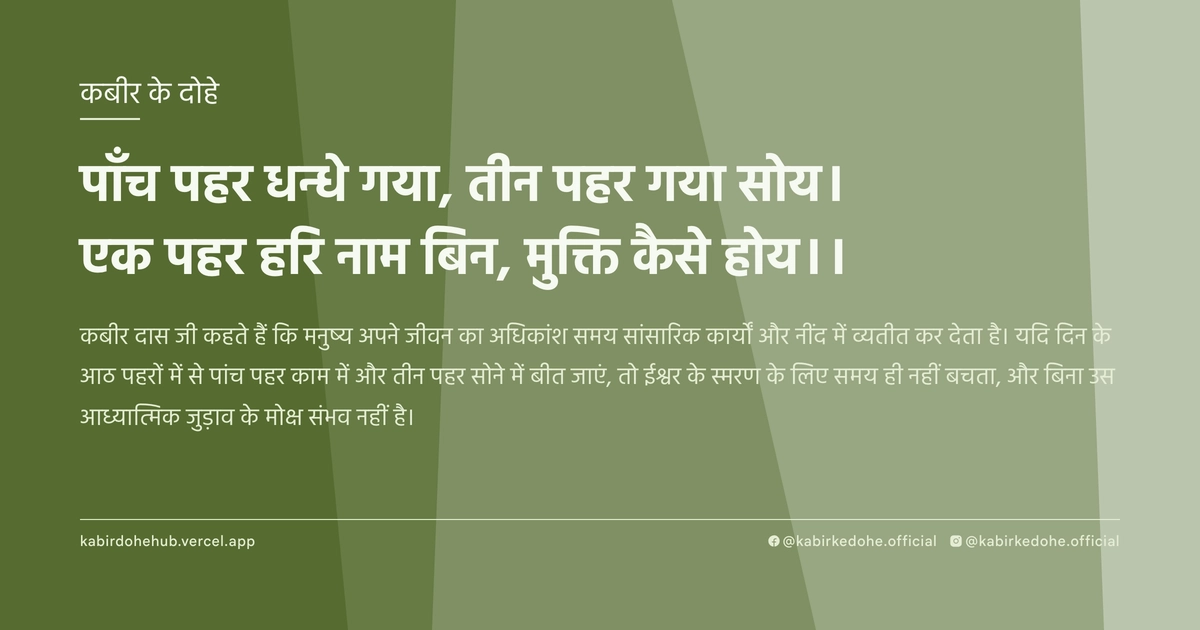
पाँच पहर धन्धे गया, तीन पहर गया सोय।
एक पहर हरि नाम बिन, मुक्ति कैसे होय।।
Paanch pahar dhandhe gaya, teen pahar gaya soy. Ek pahar Hari naam bin, mukti kaise hoye.
इस पृष्ठ पर इस कबीर दोहे का अर्थ (meaning), हिंदी व्याख्या और अंग्रेज़ी अनुवाद, दार्शनिक विश्लेषण और व्यावहारिक जीवन सीख दी गई है। यह दोहा मुक्ति (Liberation) विषय से जुड़ा है — Kabir doha meaning and explanation in Hindi and English.
अर्थ (Meaning):
कबीर दास जी कहते हैं कि मनुष्य अपने जीवन का अधिकांश समय सांसारिक कार्यों और नींद में व्यतीत कर देता है। यदि दिन के आठ पहरों में से पांच पहर काम में और तीन पहर सोने में बीत जाएं, तो ईश्वर के स्मरण के लिए समय ही नहीं बचता, और बिना उस आध्यात्मिक जुड़ाव के मोक्ष संभव नहीं है।
Kabir observes that a human spends the vast majority of their existence immersed in worldly chores and deep slumber. If five parts of the day are consumed by labor and three by sleep, no time remains for the remembrance of the Divine, and without that spiritual awakening, liberation remains an impossible dream.
व्याख्या (Interpretation):
शाब्दिक रूप से, यह दोहा समय प्रबंधन की बात करता है, लेकिन आध्यात्मिक स्तर पर यह 'चेतना' की कमी पर प्रहार है। 'धंधा' केवल नौकरी नहीं, बल्कि माया का वह जाल है जो मन को बाहरी दुनिया में उलझाए रखता है। 'सोना' केवल शारीरिक निद्रा नहीं, बल्कि अज्ञानता (अविद्या) की वह स्थिति है जहाँ आत्मा अपनी वास्तविक प्रकृति को भूल जाती है। निर्गुण भक्ति के अनुसार, हरि नाम का अर्थ किसी बाहरी देवता का जाप नहीं, बल्कि उस निराकार सत्य (ब्रह्म) के प्रति निरंतर जागरूकता है। जब तक हम द्वैत में फंसे हैं—यह शरीर, यह काम, यह अहंकार—तब तक हम उस अद्वैत सत्य से दूर हैं। मुक्ति का अर्थ मृत्यु के बाद कहीं जाना नहीं, बल्कि इसी क्षण में इस भ्रम से जागना है कि हम केवल यह शरीर और सामाजिक पहचान हैं।
Literally, the verse discusses time management, but spiritually, it critiques the lack of conscious awareness. 'Dhandha' (business/work) represents not just labor, but the intricate web of Maya that keeps the mind tethered to the external world. 'Sleep' symbolizes not merely physical rest, but the state of spiritual ignorance (Avidya) where the soul forgets its primordial nature. In the context of Nirgun Bhakti, 'Hari Naam' is not the ritualistic chanting of a deity's name, but a continuous state of alignment with the formless Truth (Brahman). As long as we remain trapped in duality—identifying solely with the body, the profession, and the ego—we remain estranged from the non-dual reality. Liberation (Mukti) is not a post-mortem destination, but the immediate awakening from the illusion that we are merely our social identities.
दार्शनिक विश्लेषण (Philosophical Analysis):
कबीर का यह दोहा उनके युग के उस सामाजिक ढांचे पर प्रहार करता है जहाँ धर्म केवल कर्मकांडों तक सीमित था। वे तर्क देते हैं कि यदि धर्म केवल मंदिर जाने या माला फेरने में है, तो वह 'धंधा' ही है। उनका दर्शन अद्वैत वेदांत और सूफी मत का संगम है, जहाँ 'फना' (अहंकार का विनाश) ही वास्तविक प्राप्ति है। वे बताते हैं कि मनुष्य की सबसे बड़ी त्रासदी यह है कि वह जीवित रहते हुए भी 'सोया' हुआ है, अर्थात वह अपनी आत्मा के प्रकाश से अनभिज्ञ है।
यहाँ 'हरि' शब्द का प्रयोग प्रतीकात्मक है। कबीर के लिए हरि वह तत्व है जो हर कण में व्याप्त है। जब वे कहते हैं कि 'एक पहर' भी समय नहीं मिला, तो वे समय की मात्रा की बात नहीं कर रहे, बल्कि 'गुणवत्ता' और 'उपस्थिति' की बात कर रहे हैं। यह मनोवैज्ञानिक विश्लेषण है कि कैसे हमारी इच्छाएं और आलस्य हमें वर्तमान क्षण से काट देते हैं।
सूफीवाद के 'ज़िक्र' की तरह, कबीर निरंतर स्मृति की बात करते हैं। उनके अनुसार, मुक्ति बाहरी अनुष्ठानों से नहीं, बल्कि आंतरिक रूपांतरण से आती है। वे जाति और वर्ग के भेदभाव को नकारते हुए यह स्पष्ट करते हैं कि आध्यात्मिक प्यास किसी विशेष वर्ग की जागीर नहीं है, बल्कि हर उस व्यक्ति की है जो अपनी नींद से जागना चाहता है।
यह दोहा हमें चेतावनी देता है कि भौतिक समृद्धि और शारीरिक सुख केवल अस्थायी आवरण हैं। यदि हम केवल पेट भरने और सोने के चक्र में फंसे रहे, तो हम उस 'परम सत्य' को कभी नहीं जान पाएंगे जो हमारे भीतर ही स्थित है। यह अहंकार के विसर्जन की प्रक्रिया है, जहाँ 'मैं' का विलोपन ही 'वह' का उदय है।
अंततः, कबीर यह समझाते हैं कि मोक्ष कोई पुरस्कार नहीं है जो मृत्यु के बाद मिलता है, बल्कि यह एक मानसिक अवस्था है। जब व्यक्ति काम करते हुए भी साक्षी (Witness) बना रहता है, तब उसका 'धंधा' ही 'भक्ति' बन जाता है। यही वह बिंदु है जहाँ सांसारिक जीवन और आध्यात्मिक जीवन का द्वैत समाप्त हो जाता है।
This couplet strikes at the heart of the social and religious structures of Kabir's era, where spirituality was often reduced to mere ritualism. He argues that if religion is limited to visiting temples or counting beads, it becomes just another 'dhandha' (business). His philosophy is a synthesis of Advaita Vedanta and Sufism, where the concept of 'Fana' (annihilation of the ego) is the ultimate achievement. He posits that the greatest human tragedy is being 'asleep' while physically awake—remaining oblivious to the inner light of the Atman.
The term 'Hari' is used symbolically here. For Kabir, Hari is the immanent principle pervading every atom. When he laments the lack of 'one pahar' (one unit of time), he is not referring to quantitative time, but to the quality of presence. This is a psychological analysis of how desires and spiritual lethargy disconnect us from the present moment.
Similar to the Sufi practice of 'Zikr' (remembrance), Kabir emphasizes constant mindfulness. He asserts that liberation does not stem from external rites but from internal transformation. By rejecting caste and class hierarchies, he clarifies that spiritual longing is not the monopoly of any elite group, but the birthright of anyone willing to awaken from their slumber.
The verse warns that material prosperity and physical comforts are merely temporary veils. If we remain trapped in the cycle of earning and sleeping, we will never encounter the 'Ultimate Truth' residing within. It is a process of ego-dissolution, where the disappearance of the 'I' leads to the emergence of the 'Universal Self'.
Ultimately, Kabir explains that Mukti is not a reward granted after death, but a state of consciousness. When a person remains a 'Witness' (Sakshi) even while engaged in worldly labor, their 'work' transforms into 'devotion'. This is the precise point where the duality between the mundane and the spiritual dissolves.
मूल संदेश (Core Message):
- बाहरी व्यस्तता अक्सर आंतरिक शून्यता को छिपाने का एक मुखौटा होती है।
- सच्ची मुक्ति समय निकालने में नहीं, बल्कि समय के साथ एकाकार होने में है।
- अज्ञानता की नींद भौतिक नींद से अधिक गहरी और खतरनाक होती है।
- जब कर्म और चेतना एक हो जाते हैं, तब कार्य ही साधना बन जाता है।
- आत्मा की स्मृति ही वह एकमात्र सेतु है जो हमें बंधन से मुक्त करता है।
- External busyness is often a mask hiding an internal void.
- True liberation is not in finding time, but in becoming one with Time.
- The sleep of ignorance is deeper and more perilous than physical slumber.
- When action and consciousness merge, work itself becomes a spiritual discipline.
- The remembrance of the Soul is the only bridge that leads us out of bondage.
व्यावहारिक उदाहरण (Practical Example):
वाराणसी के घाटों पर रहने वाला एक वृद्ध बुनकर था, जिसका नाम माधव था। माधव का पूरा जीवन केवल धागों को जोड़ने और कपड़ों को बेचने के संघर्ष में बीता। वह सुबह सूरज निकलने से पहले जागता और देर रात तक करघे पर काम करता। उसका जीवन एक मशीन की तरह था—काम, खाना और गहरी नींद। वह अक्सर कहता था कि उसके पास भगवान के लिए समय नहीं है क्योंकि उसकी गरीबी उसे चैन से बैठने नहीं देती।
एक दिन, माधव के करघे का एक तार टूट गया। वह झुंझलाया और गुस्से में चिल्लाया। तभी उसकी नज़र पास बैठे एक शांत साधु पर पड़ी, जो बिना कुछ किए बस मुस्कुरा रहे थे। माधव ने चिढ़कर पूछा, 'आप दिन भर खाली बैठे रहते हैं, क्या आपको भूख नहीं लगती? क्या आपको दुनिया की चिंता नहीं है?'
साधु ने शांति से उत्तर दिया, 'मैं खाली नहीं हूँ, माधव। मैं उस काम में लगा हूँ जिसे तुम नींद और धंधे के बीच भूल गए हो। तुम धागों को जोड़ रहे हो, लेकिन क्या तुमने कभी उस हाथ को महसूस किया जो इन धागों को चला रहा है?'
माधव को पहले तो यह बात समझ नहीं आई, लेकिन साधु के शब्दों ने उसके भीतर एक हलचल पैदा कर दी। उसने महसूस किया कि वह पिछले चालीस वर्षों से केवल 'कपड़ा' बना रहा था, लेकिन उसने कभी उस 'जीवन' को नहीं जिया जो उस कपड़े के पीछे था। वह केवल जीवित था, जागृत नहीं था।
अगले कुछ दिनों तक माधव ने एक प्रयोग किया। उसने अपने काम को नहीं छोड़ा, लेकिन उसने यह तय किया कि हर बार जब वह शटल (shuttle) को एक तरफ से दूसरी तरफ फेंकेगा, वह एक गहरी सांस लेगा और खुद से पूछेगा—'मैं कौन हूँ?'
शुरुआत में यह कठिन था। उसका मन उसे याद दिलाता था कि उसे और अधिक कपड़े बुनने हैं ताकि वह अधिक पैसे कमा सके। लेकिन धीरे-धीरे, वह 'एक पहर' का अंतराल उसके पूरे दिन में घुलने लगा। वह अब केवल धागों को नहीं देख रहा था, बल्कि वह उस लय को महसूस करने लगा जो ब्रह्मांड में व्याप्त है।
एक शाम, जब वह अपना काम समाप्त कर रहा था, उसे एक अद्भुत शांति का अनुभव हुआ। उसे एहसास हुआ कि उसकी गरीबी उसकी बाहरी स्थिति थी, लेकिन उसकी असली गरीबी वह 'अज्ञान' था जिसने उसे केवल काम और नींद का गुलाम बना रखा था।
माधव अब भी बुनकर था, लेकिन अब वह एक 'जागृत बुनकर' था। उसने पाया कि जब काम ही प्रार्थना बन जाता है, तो मुक्ति के लिए अलग से समय निकालने की आवश्यकता नहीं रहती। उसका जीवन अब केवल धंधा नहीं, बल्कि एक निरंतर उत्सव बन गया था।
In the ghats of Varanasi lived an elderly weaver named Madhav. Madhav's entire life had been a struggle of joining threads and selling fabrics. He woke before the sun and worked on his loom until late at night. His life was like a machine—work, food, and deep sleep. He often lamented that he had no time for God because his poverty never allowed him a moment of peace.
One day, a thread on Madhav's loom snapped. He grew frustrated and shouted in anger. His gaze then fell upon a serene monk sitting nearby, who was simply smiling without doing anything. Irritated, Madhav asked, 'You sit idle all day; do you not feel hunger? Do you not care for the world?'
The monk replied calmly, 'I am not idle, Madhav. I am engaged in the work that you have forgotten between your labor and your sleep. You are joining threads, but have you ever felt the Hand that moves these threads?'
At first, Madhav didn't understand, but the monk's words triggered a stir within him. He realized that for forty years, he had only been making 'cloth,' but he had never experienced the 'life' behind that cloth. He was merely surviving, not awakening.
Over the next few days, Madhav conducted an experiment. He did not quit his work, but he decided that every time he threw the shuttle from one side to the other, he would take a deep breath and ask himself—'Who am I?'
Initially, it was difficult. His mind reminded him that he needed to weave more to earn more. But gradually, that 'one unit' of awareness began to dissolve into his entire day. He was no longer seeing just threads; he began to feel the rhythm that pervades the universe.
One evening, as he finished his work, he experienced a profound peace. He realized that his poverty was an external condition, but his true poverty was the 'ignorance' that had made him a slave to the cycle of work and sleep.
Madhav remained a weaver, but he was now an 'awakened weaver.' He discovered that when work itself becomes prayer, there is no need to carve out separate time for liberation. His life was no longer just a business; it had become a continuous celebration.
अभ्यास मार्गदर्शन (Practice Guidance):
- सचेत अंतराल (Mindful Gaps): दिन भर के कार्यों के बीच 5-5 मिनट के छोटे अंतराल लें। इस दौरान न तो काम के बारे में सोचें और न ही भविष्य की योजना बनाएं; केवल अपनी सांसों और वर्तमान क्षण की उपस्थिति को महसूस करें।
- स्व-पूछताछ जर्नल (Self-Inquiry Journal): रात को सोने से पहले लिखें—'आज मेरा कितना समय 'धंधे' (अहंकार/तनाव) में गया और कितना समय मैं वास्तव में 'जागृत' रहा?'
- साक्षी भाव का अभ्यास: जब आप कोई नियमित कार्य कर रहे हों (जैसे बर्तन धोना या चलना), तो कल्पना करें कि आप स्वयं को एक तीसरे व्यक्ति की तरह देख रहे हैं। यह आपको 'कर्ता' के भ्रम से मुक्त करेगा।
- निदान चेकलिस्ट (Diagnostic Checklist): क्या मैं काम के दौरान तनाव महसूस करता हूँ? क्या मेरी नींद केवल थकान मिटाने के लिए है या वह एक गहरा विश्राम है? क्या मैं बिना किसी उद्देश्य के 10 मिनट शांत बैठ सकता हूँ? यदि उत्तर 'नहीं' है, तो आप अभी भी 'सोए' हुए हैं।
- Mindful Gaps: Incorporate 5-minute intervals throughout your workday. During these gaps, neither think of work nor plan for the future; simply feel your breath and your presence in the current moment.
- Self-Inquiry Journal: Before sleeping, record in a journal—'How much of my day was consumed by 'dhandha' (ego/stress), and how much of it was I truly 'awake'?'
- Practice of the Witness (Sakshi): While performing routine tasks (like washing dishes or walking), imagine you are observing yourself as a third person. This detaches you from the illusion of being the sole 'doer'.
- Diagnostic Checklist: Do I feel constant stress during work? Is my sleep merely to erase exhaustion or is it a deep restoration? Can I sit silently for 10 minutes without any objective? If the answer is 'no', you are still 'asleep'.
चिंतन प्रश्न (Reflection Questions):
- मेरे जीवन का वह कौन सा 'धंधा' है जिसे मैं धर्म या कर्तव्य मानकर अपनी आत्मा की उपेक्षा कर रहा हूँ?
- यदि आज मेरा सामाजिक पद और पेशा छीन लिया जाए, तो मेरे पास अपनी पहचान के रूप में क्या बचेगा?
- क्या मेरी डिजिटल व्यस्तता (सोशल मीडिया/नोटिफिकेशन) वास्तव में उत्पादकता है, या यह आधुनिक युग की वह 'नींद' है जो मुझे स्वयं से दूर रखती है?
- मैं अपनी शांति को बाहरी परिस्थितियों पर निर्भर क्यों रखता हूँ, जबकि शांति मेरा स्वभाव है?
- क्या मैं वास्तव में जाग रहा हूँ, या मैं केवल अपनी आदतों और कंडीशनिंग के ऑटो-पायलट मोड पर चल रहा हूँ?
- Which 'business' in my life am I masking as duty or religion to justify the neglect of my soul?
- If my social status and profession were stripped away today, what would remain as my core identity?
- Is my digital engagement (social media/notifications) true productivity, or is it the modern 'sleep' that keeps me estranged from myself?
- Why do I depend on external conditions for my peace, when peace is my inherent nature?
- Am I truly awake, or am I merely operating on the auto-pilot mode of my habits and conditioning?