
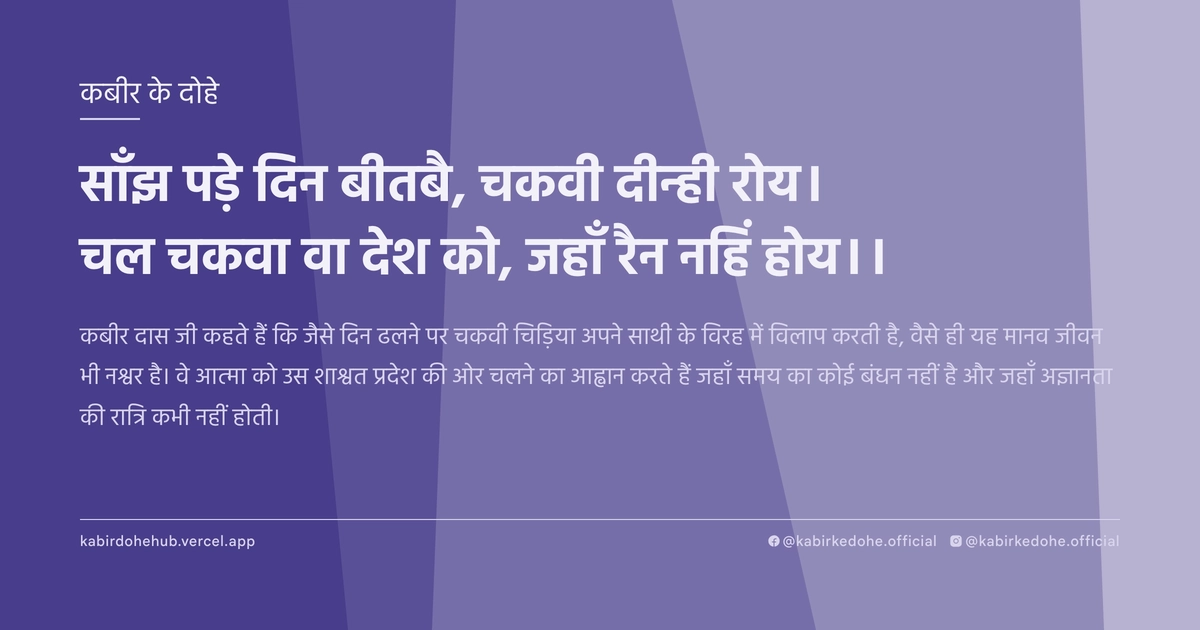
साँझ पड़े दिन बीतबै, चकवी दीन्ही रोय।
चल चकवा वा देश को, जहाँ रैन नहिं होय।।
Saanjh pade din beetbai, chakvi deenhi roy. Chal chakwa va desh ko, jahan rain nahin hoye.
इस पृष्ठ पर इस कबीर दोहे का अर्थ (meaning), हिंदी व्याख्या और अंग्रेज़ी अनुवाद, दार्शनिक विश्लेषण और व्यावहारिक जीवन सीख दी गई है। यह दोहा मुक्ति (Liberation) विषय से जुड़ा है — Kabir doha meaning and explanation in Hindi and English.
अर्थ (Meaning):
कबीर दास जी कहते हैं कि जैसे दिन ढलने पर चकवी चिड़िया अपने साथी के विरह में विलाप करती है, वैसे ही यह मानव जीवन भी नश्वर है। वे आत्मा को उस शाश्वत प्रदेश की ओर चलने का आह्वान करते हैं जहाँ समय का कोई बंधन नहीं है और जहाँ अज्ञानता की रात्रि कभी नहीं होती।
Kabir observes that as the day ends, the female ruddy duck (chakvi) cries in separation from her partner. Similarly, human life is fleeting. He urges the soul (the chakva) to journey toward that eternal realm where there is no night—a state of perpetual spiritual awakening and liberation from the cycle of time.
व्याख्या (Interpretation):
यहाँ 'साँझ' जीवन के अंत या बुढ़ापे का प्रतीक है, और 'दिन' हमारी सांसारिक यात्रा का। चकवी और चकवा केवल पक्षी नहीं, बल्कि जीवात्मा और परमात्मा के बीच के विरह का रूपक हैं। यह दोहा निरगुण भक्ति के उस सिद्धांत को दर्शाता है जहाँ आत्मा अपनी मूल अवस्था (ब्रह्म) को याद कर तड़पती है। 'रैन' या रात माया और अज्ञानता का प्रतीक है जिसने आत्मा को सत्य से दूर रखा है। जब कबीर 'उस देश' की बात करते हैं, तो वे किसी भौगोलिक स्थान की नहीं, बल्कि चेतना की उस अवस्था की बात कर रहे हैं जहाँ द्वैत समाप्त हो जाता है। यह अद्वैत वेदांत की उस स्थिति है जहाँ आत्मा और परमात्मा एक हो जाते हैं। इस प्रकार, यह विरह की पीड़ा को मुक्ति की प्रेरणा में बदलने का मार्ग है।
Here, 'evening' symbolizes the end of life or the onset of old age, while 'day' represents our worldly existence. The chakvi and chakva are not merely birds but metaphors for the longing between the individual soul (Jivatman) and the Supreme Soul (Paramatman). This doha reflects the core of Nirgun Bhakti, where the soul yearns for its original, formless source. 'Night' symbolizes Maya (illusion) and the darkness of ignorance that veils the truth. When Kabir speaks of 'that land,' he refers not to a physical geography but to a state of consciousness where duality vanishes. This aligns with Advaita Vedanta, where the perceived separation between the self and the Absolute is dissolved. Thus, the poem transforms the pain of separation into a catalyst for spiritual liberation.
दार्शनिक विश्लेषण (Philosophical Analysis):
कबीर का यह दोहा मध्यकालीन भारत के उस सामाजिक-धार्मिक परिवेश से उपजा है जहाँ कर्मकांडों और बाहरी आडंबरों का बोलबाला था। कबीर ने इन सबको नकारते हुए आंतरिक अनुभव पर जोर दिया। वे सूफी मत के 'इश्क-ए-हकीकी' (ईश्वरीय प्रेम) और वेदांत के 'अद्वैत' का समन्वय करते हैं। यहाँ विरह की भावना सूफी संतों की याद दिलाती है, जहाँ प्रेमी अपने प्रिय (ईश्वर) से मिलने के लिए तड़पता है।
दार्शनिक स्तर पर, यह दोहा समय की नश्वरता (Anicca) पर प्रहार करता है। कबीर समझाते हैं कि संसार में जो कुछ भी समय के अधीन है, वह अंततः दुख का कारण बनेगा। जिसे हम 'दिन' समझते हैं, वह केवल एक क्षणभंगुर भ्रम है। वास्तविक सत्य वह 'प्रकाश' है जो समय और स्थान से परे है।
कबीर जाति और धर्म के भेदों को मिटाकर केवल 'आत्मा' की बात करते हैं। उनके लिए मुक्ति किसी मंदिर या मस्जिद में नहीं, बल्कि अहंकार के विसर्जन में है। जब 'मैं' (अहंकार) समाप्त होता है, तभी उस देश का मार्ग खुलता है जहाँ रात नहीं होती।
यह विश्लेषण स्पष्ट करता है कि कबीर केवल एक कवि नहीं, बल्कि एक मनोवैज्ञानिक थे। वे जानते थे कि मनुष्य को तब तक बदलाव की प्रेरणा नहीं मिलती जब तक वह अपनी वर्तमान स्थिति की व्यर्थता को महसूस न कर ले। विरह की तड़प ही वह ईंधन है जो साधक को साधना की ओर ले जाती है।
अंततः, यह दोहा हमें सिखाता है कि भौतिक सुख क्षणिक हैं। वास्तविक शांति केवल उस चेतना में संभव है जो जन्म और मृत्यु के चक्र से मुक्त है। यह 'अमृत' की खोज है, जो मृत्यु के भय को समाप्त कर देती है।
This doha emerges from the socio-religious landscape of medieval India, a time dominated by rigid rituals and external piety. Kabir rejected these formalities, emphasizing internal realization. He synthesizes the Sufi concept of 'Ishq-e-Haqiqi' (Divine Love) with the Advaita Vedanta principle of non-duality. The theme of longing mirrors the Sufi path, where the seeker's agony of separation is the primary driver toward the Beloved.
Philosophically, the verse attacks the transience of time (Anicca). Kabir posits that anything subject to time is inevitably a source of suffering. What we perceive as the 'day' of our lives is merely a fleeting illusion. The ultimate reality is the 'Light' that exists beyond the constraints of time and space.
By focusing on the soul, Kabir bypasses the caste and religious divisions of his era. For him, liberation is not found in temples or mosques but in the annihilation of the ego. Only when the 'I' (the false ego) is dissolved does the path to the timeless realm open.
This analysis reveals Kabir as a spiritual psychologist. He understood that transformation only occurs when an individual realizes the futility of their current state. The pain of separation is the necessary fuel that propels the seeker toward rigorous spiritual practice.
Ultimately, the doha teaches that material pleasures are ephemeral. True peace is attainable only in a state of consciousness that has transcended the cycle of birth and death. It is a quest for the 'Amrit' (Nectar of Immortality) that erases the fear of mortality.
मूल संदेश (Core Message):
- सांसारिक मोह एक अंधेरी रात की तरह है जो सत्य को छुपाता है।
- समय की नश्वरता को पहचानना ही आध्यात्मिक जागृति की पहली सीढ़ी है।
- विरह की पीड़ा को ईश्वर से मिलन की तीव्र इच्छा में बदलें।
- अहंकार का विसर्जन ही उस शाश्वत प्रकाश का एकमात्र द्वार है।
- परमात्मा कहीं बाहर नहीं, बल्कि चेतना की उच्चतम अवस्था में स्थित है।
- Worldly attachment is a dark night that veils the ultimate truth.
- Recognizing the transience of time is the first step toward awakening.
- Transform the pain of separation into an intense longing for the Divine.
- The dissolution of ego is the only gateway to the eternal light.
- The Divine is not external but resides in the highest state of consciousness.
व्यावहारिक उदाहरण (Practical Example):
एक समय की बात है, वाराणसी के घाटों पर रहने वाले एक वृद्ध बुनकर थे, जिनका नाम माधव था। माधव जीवन भर केवल कपड़ों के धागों को जोड़ने में लगे रहे, लेकिन उनके मन में हमेशा एक अधूरापन था। वे मानते थे कि उनकी सारी मेहनत केवल पेट भरने के लिए है, जबकि आत्मा की भूख अनसुलझी है।
माधव के पास एक छोटा सा घर था जहाँ वे दिन भर करघे पर काम करते। उनके आस-पास के लोग उन्हें एक सफल बुनकर मानते थे, लेकिन माधव को लगता था कि वे समय की एक ऐसी दौड़ में हैं जिसका कोई अंत नहीं है। वे अक्सर सोचते कि क्या जीवन केवल इसी दिनचर्या का नाम है?
एक शाम, जब सूरज ढल रहा था और गंगा की लहरों पर लालिमा छाई थी, माधव ने एक साधु को देखा जो शांत मुद्रा में बैठे थे। माधव ने उनसे पूछा, 'बाबा, मैं जीवन भर मेहनत करता रहा, पर अब जब शाम (बुढ़ापा) आई है, तो मुझे लगता है कि मैंने कुछ पाया ही नहीं। यह खालीपन क्या है?'
साधु ने मुस्कुराते हुए कबीर का यह दोहा सुनाया। उन्होंने समझाया कि माधव का खालीपन वास्तव में उस 'शाश्वत देश' की पुकार है। उन्होंने कहा कि माधव ने अब तक केवल बाहरी धागों को बुना है, लेकिन अपनी आंतरिक चेतना के धागों को परमात्मा से नहीं जोड़ा।
माधव को पहली बार समझ आया कि उनकी बेचैनी कोई बीमारी नहीं, बल्कि एक आध्यात्मिक संकेत था। उन्होंने महसूस किया कि वे अब तक 'रात' (अज्ञानता) में जी रहे थे, जहाँ उन्हें लगता था कि वे और उनका परिवार अलग-अलग इकाइयाँ हैं।
अगले कुछ महीनों में, माधव ने अपना जीवन बदल लिया। उन्होंने काम करना नहीं छोड़ा, लेकिन अब वे काम को पूजा की तरह करने लगे। वे हर धागे में उस निराकार ईश्वर को देखने लगे। उनके मन का अहंकार कि 'मैं श्रेष्ठ बुनकर हूँ' धीरे-धीरे मिटने लगा।
उन्होंने अपने मोह को त्याग कर दूसरों की मदद करना शुरू किया। अब वे केवल अपने लिए नहीं, बल्कि सबके कल्याण के लिए बुनने लगे। उनके चेहरे पर एक ऐसी शांति आ गई जो पहले कभी नहीं थी।
अंत में, माधव ने पाया कि वह 'देश जहाँ रात नहीं होती' कहीं दूर नहीं, बल्कि उनके अपने हृदय के भीतर ही था। जब उन्होंने स्वयं को ईश्वर में विलीन कर दिया, तो विरह की वह तड़प एक अनंत आनंद में बदल गई।
Once, in the ghats of Varanasi, lived an elderly weaver named Madhav. For his entire life, Madhav had focused on intertwining threads of fabric, yet an enduring sense of incompleteness lingered in his heart. He felt his labor was merely for survival, while the hunger of his soul remained unaddressed.
Madhav lived in a small hut where he worked his loom day and night. To the world, he was a successful artisan, but to himself, he was caught in a relentless race with no finish line. He often wondered if life was nothing more than this repetitive cycle.
One evening, as the sun dipped below the horizon and cast a crimson glow over the Ganges, Madhav encountered a serene monk. Madhav asked, 'Baba, I have worked all my life, but now that the evening (old age) has arrived, I feel I have gained nothing. What is this void within me?'
The monk smiled and recited Kabir's doha. He explained that Madhav's void was actually a calling from the 'Eternal Realm.' He told him that while he had woven external threads, he had failed to weave the thread of his consciousness with the Divine.
For the first time, Madhav realized that his restlessness was not a malady but a spiritual signal. He understood that he had been living in the 'night' of ignorance, believing that he and his family were separate, isolated entities.
Over the following months, Madhav transformed his life. He did not abandon his work, but he began to treat weaving as a form of meditation. In every thread, he sought to perceive the Formless One. The ego of being a 'master weaver' slowly dissolved.
He let go of his attachments and began helping others without expectation. His weaving was no longer for profit but for the collective well-being. A profound peace settled upon his countenance, a stillness he had never known before.
Ultimately, Madhav discovered that the 'land where there is no night' was not a distant place, but resided within his own heart. When he merged his identity with the Divine, the agony of separation evolved into an eternal bliss.
अभ्यास मार्गदर्शन (Practice Guidance):
- प्रतिदिन 20 मिनट मौन ध्यान करें, जहाँ आप स्वयं को एक ऐसे प्रकाश के रूप में देखें जो समय और शरीर से परे है।
- एक डायरी लिखें जिसमें आप उन 'मानसिक रातों' (डर, ईर्ष्या, क्रोध) को दर्ज करें जो आपको आपकी आंतरिक शांति से दूर रखती हैं।
- व्यवहार परिवर्तन: दिन में कम से कम एक बार किसी ऐसे व्यक्ति की निस्वार्थ मदद करें जिससे आपका कोई व्यक्तिगत संबंध न हो, ताकि 'मैं' का भाव मिटे।
- नैदानिक चेकलिस्ट: क्या आप अभी भी भविष्य की चिंता या अतीत के दुख में हैं? यदि हाँ, तो आप अभी भी 'समय की रात' में हैं। क्या आप वर्तमान क्षण में पूर्णता महसूस करते हैं? यदि हाँ, तो आप उस शाश्वत देश की ओर बढ़ रहे हैं।
- Practice 20 minutes of silent meditation daily, visualizing yourself as a light that exists beyond the constraints of time and the physical body.
- Maintain a journal to document your 'mental nights'—the fears, jealousies, and angers that veil your inner peace.
- Behavioral Shift: Perform one act of selfless service daily for a complete stranger to dissolve the boundary of the 'I'.
- Diagnostic Checklist: Are you still anchored in future anxieties or past regrets? If so, you are still in the 'night of time.' Do you feel a sense of wholeness in the present moment? If yes, you are journeying toward the Eternal Realm.
चिंतन प्रश्न (Reflection Questions):
- मेरे जीवन की वह कौन सी 'रात' है जिसे मैं कभी खत्म नहीं होने देना चाहता, क्योंकि वह मुझे सुरक्षा का भ्रम देती है?
- यदि मेरा सामाजिक पद, नाम और संपत्ति छीन ली जाए, तो मेरे भीतर क्या बचेगा?
- मैं अपनी डिजिटल पहचान (सोशल मीडिया) के माध्यम से किस 'झूठे दिन' को जीवित रखने की कोशिश कर रहा हूँ?
- क्या मेरी भक्ति वास्तव में ईश्वर के लिए है, या मैं केवल अपने दुखों से बचने का रास्ता खोज रहा हूँ?
- मेरे भीतर का वह कौन सा हिस्सा है जो अभी भी द्वैत (मैं और तुम) में विश्वास करता है?
- Which 'night' in my life do I refuse to let end because it provides me with a false sense of security?
- If my social status, name, and wealth were stripped away, what would truly remain of me?
- What 'false day' am I trying to sustain through my digital identity and social media persona?
- Is my devotion truly for the Divine, or am I merely seeking an escape from my personal suffering?
- Which part of me still clings to the illusion of duality—the separation between 'I' and 'Thou'?