
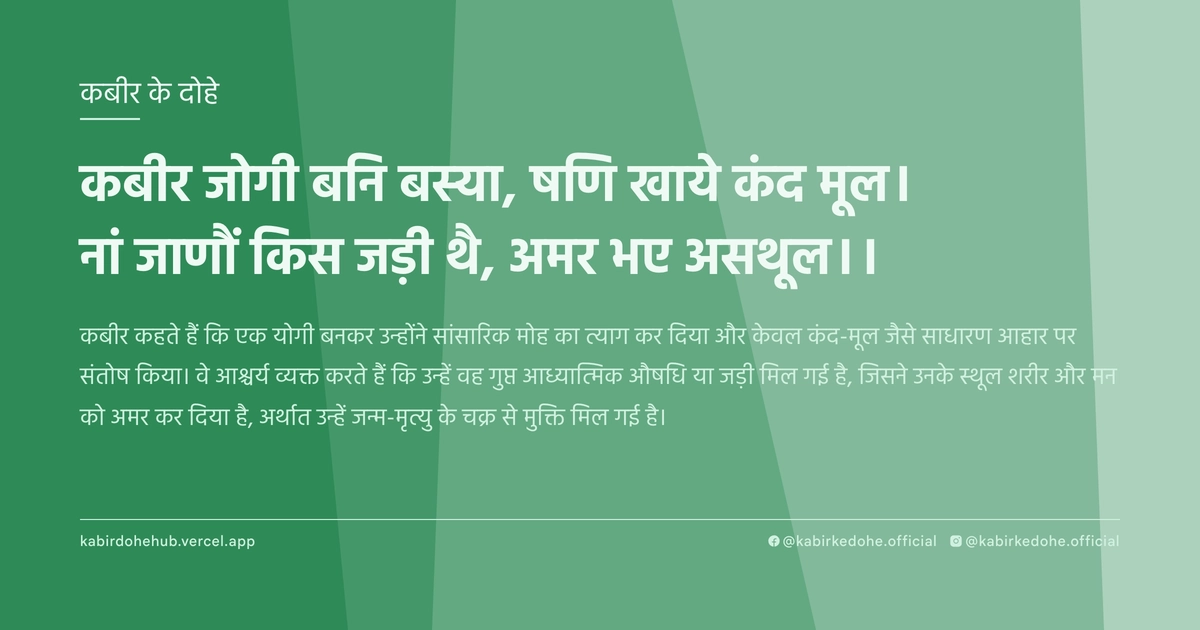
कबीर जोगी बनि बस्या, षणि खाये कंद मूल।
नां जाणौं किस जड़ी थै, अमर भए असथूल।।
Kabir jogi bani basya, shani khaye kand mool. Na jaanon kis jadi thai, amar bhaye asthool.
इस पृष्ठ पर इस कबीर दोहे का अर्थ (meaning), हिंदी व्याख्या और अंग्रेज़ी अनुवाद, दार्शनिक विश्लेषण और व्यावहारिक जीवन सीख दी गई है। यह दोहा वैराग्य (Detachment) विषय से जुड़ा है — Kabir doha meaning and explanation in Hindi and English.
अर्थ (Meaning):
कबीर कहते हैं कि एक योगी बनकर उन्होंने सांसारिक मोह का त्याग कर दिया और केवल कंद-मूल जैसे साधारण आहार पर संतोष किया। वे आश्चर्य व्यक्त करते हैं कि उन्हें वह गुप्त आध्यात्मिक औषधि या जड़ी मिल गई है, जिसने उनके स्थूल शरीर और मन को अमर कर दिया है, अर्थात उन्हें जन्म-मृत्यु के चक्र से मुक्ति मिल गई है।
Kabir describes the state of a Yogi who has renounced worldly attachments, sustaining himself on simple roots and tubers. He marvels at the discovery of a secret spiritual herb—not a physical plant, but a divine realization—that has rendered his coarse, material existence immortal, liberating him from the cycle of birth and death.
व्याख्या (Interpretation):
यहाँ 'जोगी' केवल एक बाहरी वेश नहीं, बल्कि मन की उस अवस्था का प्रतीक है जहाँ व्यक्ति संसार से विरक्त हो जाता है। 'कंद मूल' का सेवन भौतिक न्यूनतमता और इंद्रिय निग्रह को दर्शाता है। 'जड़ी' यहाँ उस 'सहज योग' या 'शब्द' का रूपक है जो अज्ञानता के रोग को मिटाता है। यह दोहा निरगुण भक्ति की उस पराकाष्ठा को दर्शाता है जहाँ साधक माया के मोह को त्यागकर आत्मा और परमात्मा की एकता (अद्वैत) का अनुभव करता है। 'अस्थूल' होने का अर्थ है कि अब वह केवल हाड़-मांस का पुतला नहीं रहा, बल्कि शुद्ध चेतना में परिवर्तित हो गया है। यह भौतिक मृत्यु पर नहीं, बल्कि अहंकार की मृत्यु पर आधारित अमरता है।
The 'Yogi' here is not merely a person in saffron robes, but a symbol of the mind's detachment from worldly illusions. Consuming 'roots and tubers' represents the mastery over senses and the embrace of minimalism. The 'herb' (jadi) is a metaphor for the 'Sahaj Yoga' or the Divine Word that cures the disease of ignorance. This verse reflects the peak of Nirgun Bhakti, where the seeker transcends the duality of 'I' and 'Thou' to realize the non-duality of Atman and Brahman. To become 'asthool' (non-coarse) means the practitioner is no longer identified with the physical body but has merged into pure consciousness. This immortality is not the persistence of the flesh, but the annihilation of the ego.
दार्शनिक विश्लेषण (Philosophical Analysis):
कबीर का यह दोहा मध्यकालीन भारत के उस सामाजिक-धार्मिक संघर्ष का प्रतिबिंब है जहाँ धर्म केवल कर्मकांडों और बाहरी आडंबरों तक सीमित था। कबीर ने 'जोगी' के रूप में उस आंतरिक यात्रा का समर्थन किया जो मंदिर, मस्जिद या तीर्थों से परे है। वे यहाँ अद्वैत वेदांत के उस सिद्धांत को पुष्ट करते हैं जहाँ ब्रह्म ही एकमात्र सत्य है और जगत माया है।
सूफी मत के 'फना' (अहंकार का विनाश) की अवधारणा यहाँ स्पष्ट दिखती है। जब साधक अपनी व्यक्तिगत पहचान को मिटा देता है, तभी वह उस सार्वभौमिक सत्य का हिस्सा बनता है। कबीर का 'अमर' होना वास्तव में 'जीवन्मुक्ति' की अवस्था है, जहाँ व्यक्ति जीवित रहते हुए भी सांसारिक बंधनों से मुक्त हो जाता है।
वे जाति और वर्ण व्यवस्था को नकारते हुए यह संदेश देते हैं कि मोक्ष किसी विशेष कुल या शास्त्र के ज्ञान से नहीं, बल्कि आंतरिक अनुभव और साधना से मिलता है। यह एक मनोवैज्ञानिक रूपांतरण है जहाँ 'मैं' का विसर्जन होता है और 'वह' का उदय होता है।
अक्सर लोग इस दोहे को भौतिक वैराग्य या जंगलों में जाने के रूप में गलत समझते हैं। वास्तव में, कबीर 'भीतर के जंगल' की बात कर रहे हैं, जहाँ वासनाओं और कामनाओं का अंत होता है। यह बाहरी त्याग नहीं, बल्कि आंतरिक शुद्धि की प्रक्रिया है।
अंततः, यह दोहा यह स्थापित करता है कि वास्तविक औषधि कोई बाहरी जड़ी-बूटी नहीं, बल्कि आत्म-साक्षात्कार है। जब मनुष्य अपनी मूल प्रकृति को पहचान लेता है, तो वह समय और मृत्यु के भय से ऊपर उठ जाता है, क्योंकि वह जान जाता है कि वह शरीर नहीं, बल्कि अविनाशी आत्मा है।
This verse reflects the socio-religious friction of medieval India, where spirituality had been reduced to empty rituals and outward displays. By evoking the image of the 'Yogi,' Kabir advocates for an internal journey that transcends temples, mosques, and pilgrimages. He reinforces the Advaita Vedanta principle that Brahman is the only reality and the world is Maya (illusion).
The Sufi concept of 'Fana' (the annihilation of the self) is evident here. Only when the seeker erases their individual identity can they merge with the Universal Truth. Kabir's 'immortality' is actually the state of 'Jivanmukti'—liberation while still inhabiting a physical body, remaining untouched by worldly bonds.
Rejecting caste and creed, Kabir asserts that liberation is not the prerogative of a specific lineage or scholarly knowledge, but the result of direct internal experience and rigorous spiritual practice. This is a psychological transformation where the 'I' is dissolved to make way for the 'All.'
Common literalist interpretations often mistake this for a call to physical asceticism or fleeing to the forests. In reality, Kabir speaks of the 'inner wilderness,' where desires and cravings are extinguished. It is not about external renunciation, but internal purification.
Ultimately, the verse establishes that the true 'herb' is not a botanical remedy but self-realization. Once a human recognizes their primordial nature, they rise above the fear of time and death, realizing they are not the perishable body, but the imperishable Spirit.
मूल संदेश (Core Message):
- बाहरी आडंबरों का त्याग ही आंतरिक सत्य की पहली सीढ़ी है।
- असली औषधि संतोष है, जो अहंकार के रोग को जड़ से मिटाती है।
- शरीर नश्वर है, लेकिन शुद्ध चेतना शाश्वत और अमर है।
- सादा जीवन केवल मजबूरी नहीं, बल्कि आध्यात्मिक स्वतंत्रता का मार्ग है।
- जब 'मैं' मिटता है, तभी 'ब्रह्म' का अनुभव संभव होता है।
- Renouncing external pretension is the first step toward internal truth.
- The true remedy is contentment, which eradicates the disease of ego.
- The body is perishable, but pure consciousness is eternal and immortal.
- A simple life is not a limitation, but a path to spiritual liberation.
- Only when the 'I' dissolves does the experience of the 'Universal' begin.
व्यावहारिक उदाहरण (Practical Example):
वाराणसी के एक पुराने घाट पर रहने वाले माधव नाम के एक वृद्ध व्यक्ति की कहानी है। माधव जीवन भर दूसरों के कपड़े धोने का काम करते थे। उनके पास न धन था, न समाज में कोई सम्मान, लेकिन उनके चेहरे पर एक ऐसी शांति थी जिसे बड़े-बड़े पंडित भी नहीं पा सके थे।
माधव का जीवन अत्यंत सरल था। वे दिन भर मेहनत करते और रात को एक छोटी सी कुटिया में केवल सूखी रोटी और पानी पीकर सो जाते। लोग उन्हें 'पागल' कहते थे क्योंकि वे कभी किसी से कुछ नहीं मांगते थे और न ही किसी की शिकायत करते थे।
एक दिन शहर का एक बहुत बड़ा व्यापारी, जो मानसिक तनाव और अनिद्रा से परेशान था, माधव के पास आया। व्यापारी ने पूछा, "तुम्हारे पास कुछ नहीं है, फिर भी तुम इतने खुश कैसे हो? क्या तुमने कोई गुप्त औषधि ली है?"
माधव मुस्कुराए और बोले, "साहब, मैंने एक ऐसी जड़ी खोजी है जो बाजार में नहीं मिलती। वह जड़ी है 'संतोष' और 'समर्पण'। जब मैंने यह मान लिया कि मेरा यह शरीर और मेरी यह गरीबी केवल एक लिबास है, और भीतर मैं उस परमात्मा का अंश हूँ, तब मेरा सारा दुख मिट गया।"
व्यापारी को लगा कि यह केवल शब्दों का खेल है। उसने माधव के साथ कुछ दिन बिताए और देखा कि माधव हर छोटे काम को ईश्वर की सेवा मानकर करते थे। वे कपड़े धोते समय भी एक मौन मंत्र का जाप करते थे, जिससे उनका काम बोझ नहीं, बल्कि ध्यान बन गया था।
धीरे-धीरे व्यापारी ने महसूस किया कि उसकी अपनी बेचैनी उसकी इच्छाओं के अंतहीन विस्तार के कारण थी। वह जितना अधिक पाने की कोशिश करता, उतना ही वह खुद से दूर होता जा रहा था।
माधव की सादगी ने व्यापारी के भीतर एक 'कबीर ट्विस्ट' पैदा किया। उसने महसूस किया कि असली 'अमरता' धन संचय में नहीं, बल्कि उस मानसिक स्थिति में है जहाँ व्यक्ति को किसी बाहरी वस्तु की आवश्यकता नहीं रहती।
व्यापारी ने अपने जीवन जीने का तरीका बदल दिया। उसने अपनी संपत्ति का एक बड़ा हिस्सा गरीबों के लिए समर्पित किया और अपने भीतर उस 'जड़ी' यानी संतोष को खोजने का प्रयास किया। उसने पाया कि जब अहंकार मरता है, तभी वास्तविक जीवन शुरू होता है।
In the ancient ghats of Varanasi lived an elderly man named Madhav. For decades, Madhav earned his living by washing clothes for others. He possessed neither wealth nor social status, yet his face radiated a serenity that the most learned scholars of the city could not attain.
Madhav's life was profoundly simple. He worked tirelessly all day and slept in a tiny hut, sustaining himself on nothing more than dry bread and water. People called him 'mad' because he never asked for anything and never complained about his hardships.
One day, a wealthy merchant, plagued by chronic stress and insomnia, approached Madhav. The merchant asked, "You have nothing to your name, yet you are so peaceful. Have you taken some secret medicine?"
Madhav smiled and replied, "Sir, I have found a herb that is not sold in any market. That herb is 'Contentment' and 'Surrender.' When I realized that this body and this poverty are merely costumes, and that within I am a spark of the Divine, all my suffering vanished."
The merchant initially thought this was mere wordplay. However, he stayed with Madhav for several days and observed that Madhav treated every menial task as an act of worship. While washing clothes, he chanted a silent mantra, turning labor into meditation.
Gradually, the merchant realized that his own restlessness stemmed from the endless expansion of his desires. The more he tried to acquire, the further he drifted from his own center.
Madhav's simplicity triggered a 'Kabir Twist' within the merchant. He understood that true 'immortality' lay not in the accumulation of assets, but in a state of mind where one no longer depends on external validations for happiness.
The merchant transformed his life. He dedicated a significant portion of his wealth to the poor and began the practice of seeking that internal 'herb' of contentment. He discovered that only when the ego dies does the true life begin.
अभ्यास मार्गदर्शन (Practice Guidance):
- प्रतिदिन 20 मिनट 'शून्य ध्यान' का अभ्यास करें, जहाँ आप अपने शरीर को केवल एक यंत्र मानें और अपनी चेतना को साक्षी भाव में लाएं।
- एक 'इच्छा-डायरी' बनाएँ। उन चीजों की सूची लिखें जिनकी आपको आवश्यकता महसूस होती है, और फिर विश्लेषण करें कि उनमें से कितनी वास्तव में आपकी आत्मा की जरूरत हैं और कितनी केवल सामाजिक दिखावा (माया) हैं।
- सप्ताह में एक दिन 'न्यूनतम जीवन' का पालन करें—सादा भोजन करें और विलासिता की वस्तुओं से दूरी बनाकर देखें कि क्या आपकी खुशी कम होती है।
- निदान चेकलिस्ट: क्या आप अभी भी अपनी पहचान अपने पद, धन या शरीर से जोड़ते हैं? क्या मृत्यु का विचार आपको भयभीत करता है? यदि हाँ, तो आप अभी भी 'स्थूल' अवस्था में हैं।
- Practice 20 minutes of 'Zero Meditation' daily, viewing the body as a mere instrument and positioning your consciousness as a detached witness.
- Maintain a 'Desire Journal.' List things you feel you need, then analyze how many are genuine soul-requirements versus social projections (Maya).
- Observe one day a week of 'Minimalist Living'—eat simple food and abstain from luxuries to observe if your inner happiness diminishes.
- Diagnostic Checklist: Do you still identify yourself by your title, wealth, or physical appearance? Does the thought of death evoke fear? If yes, you are still operating in the 'coarse' (sthool) state.
चिंतन प्रश्न (Reflection Questions):
- यदि आज आपकी सारी सामाजिक पहचान (नाम, पद, रिश्ता) छीन ली जाए, तो आपके भीतर क्या बचेगा?
- आप अपनी सुख-सुविधाओं को बढ़ाने के प्रयास में अपनी आत्मा की शांति का कितना बलिदान कर रहे हैं?
- क्या आपकी 'भक्ति' वास्तव में ईश्वर के लिए है, या वह आपके अपने अहंकार को 'धार्मिक' दिखाने का एक तरीका है?
- वह कौन सी 'जड़ी' या विचार है जिसे आप अपने जीवन में उतारने से डरते हैं क्योंकि वह आपकी सुख-सुविधाओं को चुनौती देता है?
- मृत्यु के भय के पीछे वास्तव में क्या है—जीवन का अंत, या उस 'अहंकार' का अंत जिसे आपने जीवन भर संजोया है?
- If all your social identities (name, title, relationships) were stripped away today, what would remain within you?
- How much of your soul's peace are you sacrificing in the pursuit of increasing your material comforts?
- Is your 'devotion' truly for the Divine, or is it a tool to make your ego appear 'religious' to others?
- What is that 'herb' or realization you are afraid to embrace because it challenges your current comforts?
- What truly lies behind the fear of death—the end of life, or the end of the 'ego' you have spent a lifetime nurturing?