
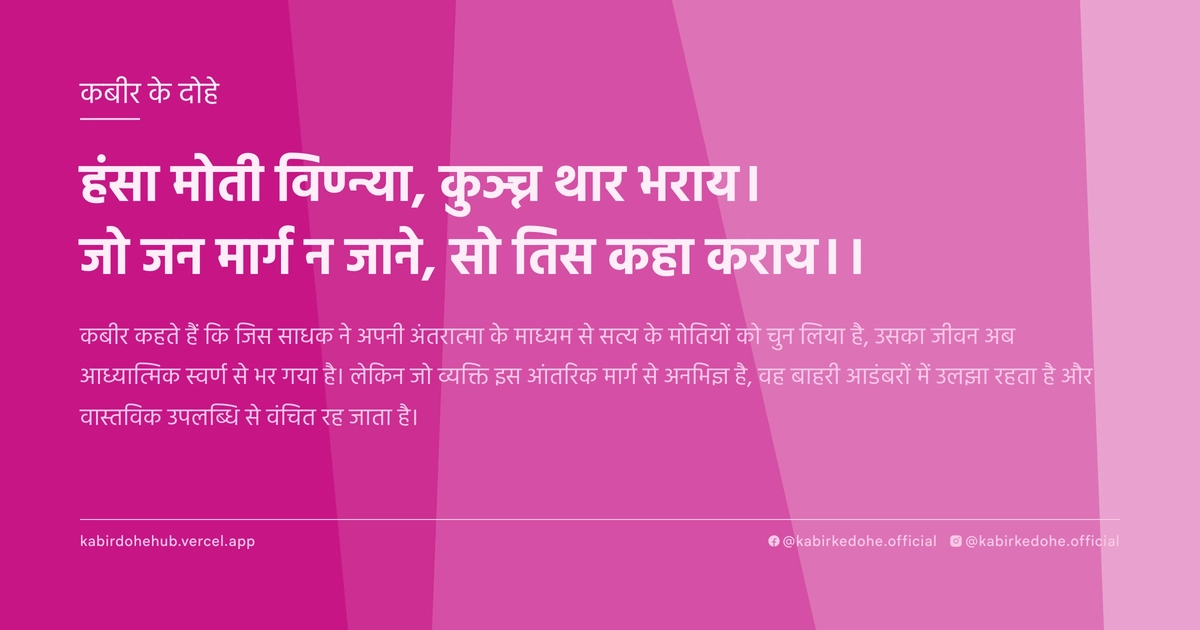
हंसा मोती विण्न्या, कुञ्च्न थार भराय।
जो जन मार्ग न जाने, सो तिस कहा कराय।।
Hansa moti vinnya, kunchan thar bharay. Jo jan maarg na jaane, so tis kaha karay.
इस पृष्ठ पर इस कबीर दोहे का अर्थ (meaning), हिंदी व्याख्या और अंग्रेज़ी अनुवाद, दार्शनिक विश्लेषण और व्यावहारिक जीवन सीख दी गई है। यह दोहा मुक्ति (Liberation) विषय से जुड़ा है — Kabir doha meaning and explanation in Hindi and English.
अर्थ (Meaning):
कबीर कहते हैं कि जिस साधक ने अपनी अंतरात्मा के माध्यम से सत्य के मोतियों को चुन लिया है, उसका जीवन अब आध्यात्मिक स्वर्ण से भर गया है। लेकिन जो व्यक्ति इस आंतरिक मार्ग से अनभिज्ञ है, वह बाहरी आडंबरों में उलझा रहता है और वास्तविक उपलब्धि से वंचित रह जाता है।
Kabir asserts that the seeker who has gathered the pearls of truth through inner realization has filled their life's platter with spiritual gold. Conversely, those who remain ignorant of this internal path continue to struggle in external rituals, unable to achieve true liberation.
व्याख्या (Interpretation):
यहाँ 'हंसा' केवल एक पक्षी नहीं, बल्कि शुद्ध आत्मा (जीवात्मा) का प्रतीक है जो माया के सागर से सत्य के मोती चुनती है। 'कंचन थार' उस अवस्था को दर्शाता है जहाँ साधक का चित्त पूर्णतः शुद्ध और दैवीय आनंद से परिपूर्ण हो चुका है। यह दोहा निर्गुण भक्ति के उस सिद्धांत पर आधारित है जहाँ ईश्वर बाहर नहीं, बल्कि भीतर खोजा जाता है। जब तक व्यक्ति 'मारग' यानी सही मार्ग (साधना) को नहीं पहचानता, वह केवल भ्रम की दुनिया में भटकता रहता है। यह अद्वैत वेदांत की उस स्थिति को दर्शाता है जहाँ ज्ञाता, ज्ञान और ज्ञेय का भेद मिट जाता है। अंततः, यह मानव स्थिति के उस विरोधाभास को उजागर करता है जहाँ सत्य सबके भीतर है, फिर भी अधिकांश लोग इसे बाहर खोजते हैं।
Here, the 'Hansa' (swan) is not merely a bird but a symbol of the purified soul (Jivatma) discerning the pearls of truth from the ocean of Maya. The 'golden platter' represents a state of consciousness where the seeker's mind is entirely purified and overflowing with divine bliss. This verse is rooted in the principle of Nirgun Bhakti, where the Divine is sought within rather than in external forms. Until one recognizes the 'Marag' or the true path of internal practice, they remain trapped in the illusions of the material world. It reflects the Advaita Vedanta concept where the distinction between the knower, the known, and knowledge dissolves. Ultimately, it highlights the central paradox of the human condition: truth resides within everyone, yet most spend their lives searching for it externally.
दार्शनिक विश्लेषण (Philosophical Analysis):
कबीर का यह दोहा उस समय के सामाजिक-धार्मिक परिवेश पर एक तीखा प्रहार है जहाँ धर्म केवल कर्मकांडों और बाहरी दिखावे तक सीमित था। कबीर ने स्पष्ट किया कि मोक्ष किसी मंदिर, मस्जिद या तीर्थ यात्रा से नहीं, बल्कि आत्म-साक्षात्कार से मिलता है। यह दृष्टिकोण सूफी मत के 'इश्क-ए-हकीकी' (ईश्वर के प्रति सच्चा प्रेम) और अद्वैत वेदांत के 'अहं ब्रह्मास्मि' से मेल खाता है, जहाँ आत्मा और परमात्मा की एकता पर बल दिया गया है।
यहाँ 'मोती चुनना' वास्तव में अहंकार के विसर्जन की प्रक्रिया है। जब तक 'मैं' (अहंकार) जीवित है, तब तक सत्य का अनुभव असंभव है। कबीर का तर्क है कि जो लोग केवल शास्त्रों को रटते हैं लेकिन अनुभव नहीं करते, वे उस व्यक्ति की तरह हैं जो नक्शे को ही रास्ता मान लेता है। वास्तविक आध्यात्मिक प्रगति मनोवैज्ञानिक रूपांतरण की मांग करती है, न कि केवल धार्मिक पहचान बदलने की।
यह शिक्षण जातिगत श्रेष्ठता और पुरोहितवाद के विरुद्ध एक सशक्त घोषणा है। कबीर कहते हैं कि सत्य किसी विशेष जाति या वर्ग की बपौती नहीं है; यह उस हर व्यक्ति के लिए उपलब्ध है जो आंतरिक मार्ग पर चलने का साहस करता है। यह 'सहज मार्ग' है, जो कृत्रिमता को त्यागकर स्वाभाविकता को अपनाने पर जोर देता है।
दार्शनिक स्तर पर, यह दोहा माया (भ्रम) और सत्य के बीच के अंतर को स्पष्ट करता है। कंचन थार (स्वर्ण थाली) भौतिक धन नहीं, बल्कि 'चित्त-शुद्धि' है। जब मन की गंदगी साफ हो जाती है, तो जो शेष बचता है, वही शुद्ध सोना है। यह एक ऐसी अवस्था है जहाँ साधक संसार में रहते हुए भी संसार से ऊपर उठ जाता है।
अंततः, कबीर हमें चेतावनी देते हैं कि बिना मार्गदर्शन या सही दृष्टि के, आध्यात्मिक प्रयास व्यर्थ हैं। 'मारग न जाने' का अर्थ है कि व्यक्ति अभी भी द्वैत (duality) में जी रहा है। जब तक वह यह नहीं समझता कि वह स्वयं ही वह मोती है जिसे वह खोज रहा है, उसकी खोज अधूरी रहेगी।
This verse is a sharp critique of the socio-religious climate of Kabir's era, where religion had devolved into mere rituals and external displays. Kabir clarifies that liberation is not attained through temples, mosques, or pilgrimages, but through self-realization. This perspective aligns with the Sufi concept of 'Ishq-e-Haqiqi' (divine love) and the Advaita Vedanta realization of 'Aham Brahmasmi,' emphasizing the oneness of the soul and the Absolute.
'Gathering pearls' is, in reality, the process of annihilating the ego. As long as the 'I' (ego) persists, the experience of Truth remains impossible. Kabir argues that those who merely memorize scriptures without experiential realization are like people who mistake a map for the actual journey. True spiritual progress requires a profound psychological transformation rather than a mere change in religious identity.
This teaching serves as a powerful declaration against caste superiority and priestly hegemony. Kabir asserts that Truth is not the monopoly of any specific caste or class; it is accessible to anyone with the courage to walk the internal path. He advocates for the 'Sahaj Marg' (the natural path), which emphasizes spontaneity and authenticity over artificiality.
On a philosophical level, the verse distinguishes between Maya (illusion) and Satya (Truth). The 'golden platter' is not material wealth but 'Chitta-Shuddhi' (purification of the mind). When the mental debris is cleared, what remains is the pure gold of consciousness. This is a state where the seeker lives in the world but is not of the world.
Ultimately, Kabir warns that without the correct vision or inner guidance, spiritual efforts are futile. 'Not knowing the path' signifies that the individual is still trapped in duality. Until they realize that they themselves are the pearl they seek, their quest will remain incomplete.
मूल संदेश (Core Message):
- बाहरी आडंबर केवल भ्रम हैं, सत्य भीतर है।
- अहंकार का त्याग ही वास्तविक समृद्धि की कुंजी है।
- सेवा और संतोष ही आत्मा के असली मोती हैं।
- बिना आंतरिक अनुभव के ज्ञान केवल बोझ है।
- आत्मा और परमात्मा का मिलन ही अंतिम लक्ष्य है।
- External rituals are mere illusions; Truth resides within.
- The surrender of ego is the only key to true prosperity.
- Service and contentment are the authentic pearls of the soul.
- Knowledge without internal experience is merely a burden.
- The union of the individual soul and the Absolute is the ultimate goal.
व्यावहारिक उदाहरण (Practical Example):
वाराणसी के एक पुराने घाट पर रामदीन नाम का एक वृद्ध नाविक रहता था। वह जीवन भर लोगों को गंगा पार कराता रहा, लेकिन उसका मन हमेशा इस बात से अशांत रहता था कि वह कितना गरीब है। वह देखता कि अमीर लोग सोने के गहने पहनकर आते हैं और वह उनसे ईर्ष्या करता था।
रामदीन का मानना था कि यदि उसके पास बहुत सारा धन होता, तो वह वास्तव में सुखी और सम्मानित होता। वह दिन-रात केवल धन कमाने और उसे संचित करने के तरीकों के बारे में सोचता रहता, जिससे उसकी नींद उड़ गई थी और स्वभाव चिड़चिड़ा हो गया था।
एक दिन, उसकी नाव में एक शांत स्वभाव का संन्यासी बैठा। संन्यासी ने देखा कि रामदीन की नजरें उसकी महंगी दिखने वाली माला पर टिकी थीं। संन्यासी ने मुस्कुराते हुए कहा, 'रामदीन, तुम इस नाव में लोगों को पार करा रहे हो, लेकिन क्या तुमने कभी अपनी आत्मा की नाव को पार कराया है?'
रामदीन हैरान रह गया। उसने पूछा, 'इसका क्या अर्थ है?' संन्यासी ने उसे समझाया कि असली सोना वह नहीं जो शरीर पर पहना जाए, बल्कि वह शांति है जो तब मिलती है जब हम अपनी इच्छाओं के बोझ को उतार देते हैं।
संन्यासी ने उसे एक प्रयोग बताया: 'अगले सात दिनों तक, जब तुम किसी को पार कराओ, तो यह मत सोचो कि तुम उनसे पैसे ले रहे हो, बल्कि यह सोचो कि तुम उन्हें उनकी मंजिल तक पहुँचाने में मदद कर रहे हो। अपनी सेवा में आनंद खोजो, न कि लाभ में।'
रामदीन ने वैसा ही किया। धीरे-धीरे, उसका ध्यान 'कितना मिला' से हटकर 'कितना दिया' पर केंद्रित हो गया। उसने महसूस किया कि जब वह निस्वार्थ भाव से सेवा करता था, तो उसके भीतर एक ऐसी खुशी पैदा होती थी जिसे वह पहले कभी महसूस नहीं कर पाया था।
एक महीने बाद, रामदीन की स्थिति बदल गई। वह अब भी वही गरीब नाविक था, लेकिन उसके चेहरे पर एक दिव्य चमक थी। उसने पाया कि उसकी ईर्ष्या समाप्त हो गई थी और वह अब वास्तव में 'समृद्ध' महसूस कर रहा था।
उसने महसूस किया कि वह अब तक बाहरी सोने की तलाश में था, जबकि उसके भीतर संतोष का असली मोती छिपा था। उसने बाहरी दुनिया की दौड़ छोड़ दी और अपनी वर्तमान स्थिति में ही पूर्णता पा ली।
यह 'कबीर ट्विस्ट' था—जब रामदीन ने बाहरी लाभ (माया) के बजाय आंतरिक सेवा और संतोष (सत्य) के मार्ग को चुना, तो उसका जीवन वास्तव में स्वर्णमय हो गया।
अब वह घाट का सबसे सम्मानित व्यक्ति था, इसलिए नहीं कि उसके पास धन था, बल्कि इसलिए क्योंकि उसके पास वह शांति थी जिसे अमीर लोग भी खरीदने की कोशिश करते थे।
On an old ghat in Varanasi lived an elderly boatman named Ramdeen. He spent his entire life ferrying people across the Ganges, but his mind was perpetually troubled by his poverty. He watched wealthy pilgrims arrive adorned in gold and felt a deep sense of envy.
Ramdeen believed that if he possessed immense wealth, he would finally be happy and respected. He spent his days and nights obsessing over ways to earn and accumulate money, which robbed him of his sleep and made his temperament irritable.
One day, a serene monk boarded his boat. The monk noticed Ramdeen's gaze fixed on his expensive-looking prayer beads. Smiling, the monk asked, 'Ramdeen, you ferry people across this river, but have you ever ferried your own soul across?'
Ramdeen was bewildered. He asked, 'What does that mean?' The monk explained that true gold is not what is worn on the body, but the peace that arrives when we shed the burden of our endless desires.
The monk suggested an experiment: 'For the next seven days, when you ferry someone, do not think about the money you are receiving. Instead, think that you are helping them reach their destination. Find joy in the service, not the profit.'
Ramdeen followed this advice. Gradually, his focus shifted from 'how much did I get' to 'how much did I give.' He discovered that when he served selflessly, a profound joy blossomed within him—a feeling he had never experienced before.
After a month, Ramdeen's state had transformed. He was still the same poor boatman, but there was a divine radiance on his face. He found that his envy had vanished, and he now felt truly 'wealthy.'
He realized that he had been searching for external gold, while the true pearl of contentment had been hidden within him all along. He stopped racing against the world and found wholeness in his present existence.
This was the 'Kabir Twist'—when Ramdeen chose the path of internal service and contentment (Truth) over external gain (Maya), his life actually became golden.
He became the most respected man on the ghat, not because he had money, but because he possessed the peace that the wealthy spent their lives trying to buy.
अभ्यास मार्गदर्शन (Practice Guidance):
- दैनिक ध्यान: प्रतिदिन 20 मिनट मौन बैठें और अपने भीतर के 'साक्षी' (Witness) को observing करें। यह देखें कि विचार कैसे आते हैं और जाते हैं, बिना उनसे जुड़े।
- आत्म-पूछताछ जर्नल: प्रतिदिन एक प्रश्न लिखें: 'आज मैंने किस क्षण में अपनी बाहरी पहचान (अहंकार) को सत्य के ऊपर रखा?' और उसका विश्लेषण करें।
- व्यवहार परिवर्तन: दिन में कम से कम एक कार्य ऐसा करें जिसमें कोई व्यक्तिगत लाभ न हो, केवल दूसरे की सहायता का भाव हो।
- डायग्नोस्टिक चेकलिस्ट: यदि आप अभी भी दूसरों की सफलता से जलते हैं या बाहरी प्रशंसा के लिए व्याकुल हैं, तो आप 'मारग' (मार्ग) से भटके हुए हैं। यदि आप अकेलेपन में भी पूर्ण महसूस करते हैं, तो आप मोती चुन रहे हैं।
- Daily Meditation: Sit in silence for 20 minutes daily and observe the 'Witness' within. Watch thoughts arise and dissolve without attaching yourself to them.
- Self-Inquiry Journal: Write one question daily: 'In which moment today did I place my external identity (ego) above the Truth?' and analyze the response.
- Behavioral Change: Perform at least one act daily that offers no personal gain, driven solely by the intent to help another.
- Diagnostic Checklist: If you still feel envy toward others' success or crave external validation, you have strayed from the 'Marag' (Path). If you feel whole even in solitude, you are gathering the pearls.
चिंतन प्रश्न (Reflection Questions):
- मेरी वह कौन सी 'सुनहरी थाली' (सामाजिक प्रतिष्ठा या संपत्ति) है जिसे मैं अपनी आत्मा की शांति से अधिक महत्व देता हूँ?
- क्या मेरा धर्म केवल दूसरों को दिखाने के लिए है, या यह मेरे आंतरिक रूपांतरण का साधन है?
- यदि मेरी सारी बाहरी उपलब्धियाँ छीन ली जाएँ, तो मेरे भीतर क्या बचेगा?
- मैं अपनी डिजिटल पहचान (सोशल मीडिया इमेज) को बनाए रखने के लिए अपनी वास्तविकता का कितना बलिदान कर रहा हूँ?
- क्या मैं वास्तव में सत्य की खोज कर रहा हूँ, या मैं केवल अपनी मान्यताओं की पुष्टि करना चाहता हूँ?
- What is the 'golden platter' (social status or wealth) that I value more than my inner peace?
- Is my spirituality merely a performance for others, or is it a tool for internal transformation?
- If all my external achievements were stripped away, what would remain within me?
- How much of my authenticity am I sacrificing to maintain my digital identity (social media image)?
- Am I truly seeking the Truth, or am I merely seeking confirmation of my own existing beliefs?