
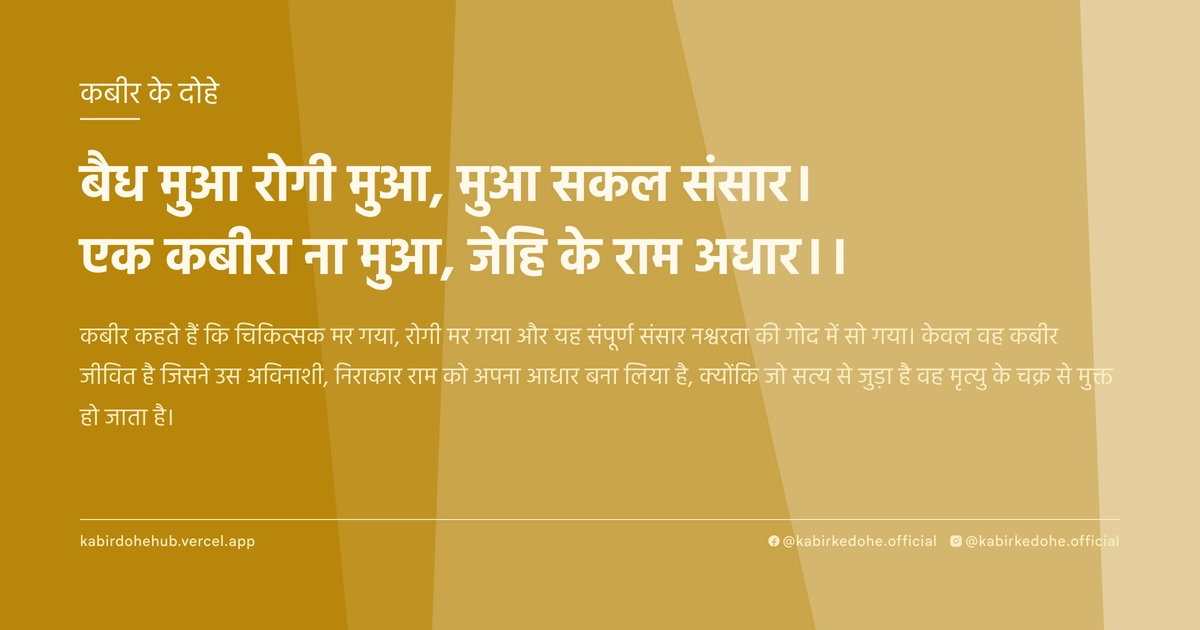
बैध मुआ रोगी मुआ, मुआ सकल संसार।
एक कबीरा ना मुआ, जेहि के राम अधार।।
Baidh mua rogi mua, mua sakal sansar. Ek kabira na mua, jehi ke ram adhar.
इस पृष्ठ पर इस कबीर दोहे का अर्थ (meaning), हिंदी व्याख्या और अंग्रेज़ी अनुवाद, दार्शनिक विश्लेषण और व्यावहारिक जीवन सीख दी गई है। यह दोहा मुक्ति (Liberation) विषय से जुड़ा है — Kabir doha meaning and explanation in Hindi and English.
अर्थ (Meaning):
कबीर कहते हैं कि चिकित्सक मर गया, रोगी मर गया और यह संपूर्ण संसार नश्वरता की गोद में सो गया। केवल वह कबीर जीवित है जिसने उस अविनाशी, निराकार राम को अपना आधार बना लिया है, क्योंकि जो सत्य से जुड़ा है वह मृत्यु के चक्र से मुक्त हो जाता है।
Kabir proclaims that the physician has perished, the patient has perished, and the entire world has succumbed to mortality. Only Kabir remains immortal, for he has anchored his existence in the Eternal, Formless Ram; he who aligns with the Absolute Truth transcends the cycle of death.
व्याख्या (Interpretation):
शाब्दिक रूप से यह दोहा मृत्यु की अनिवार्यता को दर्शाता है, जहाँ चिकित्सक और रोगी दोनों अंततः मिट्टी में मिल जाते हैं। आध्यात्मिक स्तर पर, 'बैद' उन गुरुओं या शास्त्रों का प्रतीक है जो केवल बाहरी उपचार देते हैं, और 'रोगी' उस जीव का जो माया के रोग से ग्रस्त है। कबीर यहाँ 'राम' शब्द का प्रयोग दशरथ पुत्र के लिए नहीं, बल्कि उस निर्गुण ब्रह्म के लिए करते हैं जो सर्वव्यापी है। यह अद्वैत वेदांत के उस सिद्धांत को पुष्ट करता है जहाँ आत्मा का परमात्मा में विलीनीकरण ही वास्तविक जीवन है। जब अहंकार (माया) मर जाता है, तब केवल शुद्ध चेतना बचती है। इस प्रकार, 'ना मुआ' का अर्थ शारीरिक अमरता नहीं, बल्कि आध्यात्मिक जागृति और मोक्ष है।
Literally, this couplet highlights the inevitability of death, where both the healer and the afflicted eventually return to dust. Metaphorically, the 'physician' represents those teachers or scriptures offering mere superficial cures, while the 'patient' symbolizes the soul afflicted by the disease of Maya (illusion). Kabir uses 'Ram' not as a historical deity, but as the Nirgun Brahman—the formless, omnipresent Absolute. This aligns with Advaita Vedanta, where the realization of non-duality between Atman and Brahman is the only enduring reality. When the ego—the false identity—perishes, only pure consciousness remains. Thus, 'not dying' does not imply physical immortality, but the attainment of liberation (Mukti) and the awakening of the eternal self.
दार्शनिक विश्लेषण (Philosophical Analysis):
कबीर का यह दोहा उनके युग के धार्मिक पाखंड और कर्मकांडीय उपचारों पर एक तीखा प्रहार है। उस समय समाज बाहरी आडंबरों और मृत ग्रंथों के सहारे मोक्ष खोजने का प्रयास कर रहा था, जिसे कबीर 'मृत बैद' कहते हैं। वे तर्क देते हैं कि जब तक रोग (अज्ञान) की जड़ नहीं काटी जाती, तब तक कोई भी बाहरी उपचार काम नहीं करेगा।
दार्शनिक रूप से, यह सूफी मत के 'फना' (अहंकार का विनाश) और वेदांत के 'अहं ब्रह्मास्मि' का संगम है। कबीर यह स्पष्ट करते हैं कि संसार की हर वस्तु, चाहे वह ज्ञान देने वाला हो या ज्ञान चाहने वाला, समय के साथ नष्ट हो जाएगी। केवल वह तत्व शाश्वत है जो समय और स्थान से परे है।
यहाँ 'राम' का आधार लेना वास्तव में अपनी व्यक्तिगत पहचान को मिटाकर सार्वभौमिक चेतना में विलीन होना है। यह मनोवैज्ञानिक रूपांतरण की प्रक्रिया है जहाँ साधक यह समझता है कि उसका 'मैं' एक भ्रम था। जब यह भ्रम टूटता है, तब मृत्यु का भय समाप्त हो जाता है क्योंकि मरने वाला 'मैं' कभी था ही नहीं।
कबीर जाति और धर्म की सीमाओं को तोड़कर एक ऐसे मार्ग की बात करते हैं जो केवल अनुभव पर आधारित है। वे बताते हैं कि शास्त्र पढ़ने से नहीं, बल्कि उस आंतरिक राम को अनुभव करने से अमरता प्राप्त होती है। यह मार्ग कठिन है क्योंकि यह पूर्ण समर्पण की मांग करता है।
अंततः, यह दोहा हमें सिखाता है कि जीवन की सार्थकता भौतिक उपलब्धियों या बौद्धिक ज्ञान में नहीं, बल्कि उस शाश्वत सत्य के साथ एकाकार होने में है जो जन्म और मृत्यु के द्वंद्व से ऊपर है। यह एक आह्वान है कि हम नश्वरता के शोक से ऊपर उठकर अविनाशी सत्य की खोज करें।
This couplet serves as a piercing critique of the religious hypocrisy and ritualistic 'cures' prevalent during Kabir's era. Society was attempting to find liberation through external adornments and dead scriptures, which Kabir metaphorically labels as the 'dead physician.' He argues that as long as the root of the disease—ignorance (Avidya)—remains, no external remedy can be effective.
Philosophically, this is a convergence of the Sufi concept of 'Fana' (annihilation of the self) and the Vedantic realization of 'Aham Brahmasmi' (I am Brahman). Kabir asserts that every entity in the phenomenal world, whether the giver of knowledge or the seeker, is subject to decay. Only that which is beyond time and space is eternal.
Anchoring oneself in 'Ram' is, in reality, the process of dissolving the individual ego into the universal consciousness. This is a psychological transformation where the seeker realizes that the 'I' was merely a construct of Maya. When this illusion shatters, the fear of death vanishes because the 'ego' that feared death never truly existed.
Kabir transcends the boundaries of caste and creed, proposing a path based solely on direct experiential realization. He emphasizes that immortality is not achieved through the rote learning of scriptures, but through the lived experience of the internal Absolute. This path is rigorous, demanding total surrender of the self.
Ultimately, the verse teaches that the purpose of life is not found in material accumulation or intellectual prowess, but in unifying with the eternal truth that exists above the duality of birth and death. It is a call to rise above the grief of transience and seek the Indestructible.
मूल संदेश (Core Message):
- बाहरी उपचार और शास्त्र केवल अस्थायी सांत्वना देते हैं।
- अहंकार का विनाश ही वास्तविक आध्यात्मिक जीवन की शुरुआत है।
- नश्वरता का स्वीकार ही अमरता का एकमात्र द्वार है।
- निराकार ब्रह्म में लीन होना ही अंतिम आश्रय है।
- व्यक्तिगत पहचान एक भ्रम है; सार्वभौमिक सत्य ही एकमात्र वास्तविकता है।
- External remedies and scriptures offer only temporary solace.
- The annihilation of the ego is the true beginning of spiritual life.
- Acceptance of transience is the only gateway to immortality.
- Merging with the Formless Absolute is the ultimate refuge.
- Personal identity is an illusion; universal truth is the only reality.
व्यावहारिक उदाहरण (Practical Example):
वाराणसी के एक पुराने घाट पर माधव नाम का एक वृद्ध बुनकर रहता था। माधव ने अपना पूरा जीवन बेहतरीन रेशमी साड़ियाँ बुनने में बिताया था। उसे अपनी कला पर बहुत गर्व था और वह मानता था कि उसकी कला ही उसकी पहचान है।
एक समय ऐसा आया जब माधव की आँखों की रोशनी कम होने लगी और उसके हाथ कांपने लगे। जिस करघे ने उसे समाज में सम्मान दिलाया था, अब वही करघा उसके लिए बोझ बन गया। वह गहरे अवसाद में डूब गया क्योंकि उसकी 'पहचान' मिट रही थी।
वह अक्सर घाट पर बैठकर अन्य बुनकरों को काम करते देखता और सोचता कि उसकी मृत्यु के बाद उसकी कला का क्या होगा। उसे लगता था कि उसकी कला के साथ ही उसका अस्तित्व समाप्त हो जाएगा।
एक दिन उसकी मुलाकात एक फकीर से हुई जिसने माधव की व्यथा सुनी। फकीर ने मुस्कुराते हुए कहा, 'माधव, तुम उस धागे से चिपके हो जो टूटने वाला है, जबकि तुम उस बुनकर को भूल गए जिसने इस पूरे ब्रह्मांड को बुना है।'
माधव ने पूछा, 'वह बुनकर कौन है?' फकीर ने उत्तर दिया, 'वह निराकार राम है, जो न जन्म लेता है न मरता है। तुम्हारी साड़ियाँ फट जाएंगी, तुम्हारा शरीर मिट्टी हो जाएगा, लेकिन वह चेतना जो तुम्हें देख रही है, वह कभी नहीं मरती।'
इस बात ने माधव के भीतर एक हलचल मचा दी। उसने महसूस किया कि उसने जीवन भर केवल 'बुनकर' होने का अहंकार पाला था, जबकि वह स्वयं उस अनंत चेतना का एक छोटा सा हिस्सा था।
उसने अपनी कला को अपनी पहचान मानना छोड़ दिया और उसे ईश्वर की सेवा का एक माध्यम बना लिया। अब वह साड़ियाँ इसलिए नहीं बुनता था कि लोग उसकी तारीफ करें, बल्कि इसलिए कि वह उस सृजन की प्रक्रिया का आनंद ले सके।
जब माधव की मृत्यु आई, तो उसके चेहरे पर एक असीम शांति थी। वह अब उस 'रोगी' की तरह नहीं था जो जीवन से लिपटा था, बल्कि वह उस 'कबीर' की तरह था जिसने शाश्वत राम को अपना आधार बना लिया था।
उसका मोह समाप्त हो चुका था और वह जान गया था कि असली जीत कला की अमरता में नहीं, बल्कि स्वयं के अहंकार के विसर्जन में है।
माधव की यह यात्रा एक भौतिक कलाकार से एक आध्यात्मिक साधक में बदलने की कहानी थी, जहाँ उसने नश्वरता को स्वीकार कर अमरता को पाया।
On an ancient ghat in Varanasi lived an elderly weaver named Madhav. Madhav had spent his entire life crafting exquisite silk sarees. He took immense pride in his craft, believing that his skill was his sole identity.
There came a time when Madhav's eyesight began to fail and his hands started to tremble. The loom that had brought him social prestige now became a burden. He sank into a deep depression because his 'identity' was eroding.
He would often sit by the ghat, watching other weavers work, wondering what would happen to his art after his death. He felt that his existence would vanish along with his craftsmanship.
One day, he encountered a wandering dervish who heard Madhav's grief. The dervish smiled and said, 'Madhav, you are clinging to the thread that is destined to break, while you have forgotten the Weaver who wove this entire universe.'
Madhav asked, 'Who is that Weaver?' The dervish replied, 'That is the Formless Ram, who neither is born nor dies. Your sarees will fray, your body will turn to dust, but the consciousness that observes you never perishes.'
These words triggered a profound shift within Madhav. He realized he had spent his life nurturing the ego of being a 'master weaver,' forgetting that he was but a tiny spark of that infinite consciousness.
He stopped viewing his art as his identity and began seeing it as a medium of divine service. He no longer wove sarees for praise, but to experience the joy of the creative process itself.
When Madhav's time finally came, there was an infinite peace on his face. He was no longer like the 'patient' clinging to life, but like 'Kabir,' who had anchored himself in the Eternal Ram.
His attachments had dissolved, and he understood that true victory lay not in the immortality of his art, but in the dissolution of his ego.
Madhav's journey was a transformation from a material artisan to a spiritual seeker, where by accepting transience, he discovered the Eternal.
अभ्यास मार्गदर्शन (Practice Guidance):
- प्रतिदिन 20 मिनट मौन ध्यान करें, जहाँ आप अपने शरीर, नाम और पद को एक वस्त्र की तरह उतारकर देखें और केवल 'साक्षी' भाव में रहें।
- एक डायरी लिखें जिसमें आप उन चीजों की सूची बनाएं जिनसे आप सबसे अधिक जुड़ाव महसूस करते हैं, और फिर विचार करें कि यदि वे कल समाप्त हो जाएं, तो आपके भीतर क्या शेष रहेगा।
- व्यवहार परिवर्तन: जब भी अहंकार या गर्व महसूस हो, स्वयं को याद दिलाएं कि 'मैं' एक अस्थायी भूमिका है, और वास्तविक आधार वह निराकार चेतना है।
- निदान चेकलिस्ट: क्या आप मृत्यु के विचार से भयभीत हैं? क्या आप अपनी उपलब्धियों को अपनी पहचान मानते हैं? यदि हाँ, तो आप अभी भी 'रोगी' की स्थिति में हैं। यदि आप विदाई के विचार में भी शांत हैं, तो आप 'राम' के आधार की ओर बढ़ रहे हैं।
- Practice 20 minutes of silent meditation daily, visualizing your body, name, and status as garments you are shedding to remain only as the 'Witness'.
- Maintain a journal listing the things you are most attached to, then contemplate what would remain within you if they all vanished tomorrow.
- Behavioral Shift: Whenever ego or pride arises, remind yourself that 'I' is a temporary role, and the true foundation is the Formless Consciousness.
- Diagnostic Checklist: Do you fear the thought of death? Do you equate your achievements with your identity? If yes, you are still in the state of the 'patient'. If you remain peaceful even at the thought of departure, you are moving toward the foundation of Ram.
चिंतन प्रश्न (Reflection Questions):
- यदि आपकी सारी सामाजिक उपलब्धियां और डिजिटल पहचान छीन ली जाए, तो आप वास्तव में कौन हैं?
- आप किस 'बैद' (गुरु या विचार) पर भरोसा कर रहे हैं, और क्या वह आपको सत्य की ओर ले जा रहा है या केवल भ्रम को बढ़ा रहा है?
- आपके जीवन का वह कौन सा हिस्सा है जिसे आप मृत्यु के बाद भी बचाकर रखना चाहते हैं? क्या वह वास्तव में अमर है?
- क्या आपका 'राम' कोई बाहरी देवता है या आपके भीतर की वह शांति जो शोर के बीच भी स्थिर रहती है?
- आप अपनी मृत्यु की तैयारी कैसे कर रहे हैं—भय के साथ या विसर्जन के आनंद के साथ?
- If all your social achievements and digital identities were stripped away, who would you actually be?
- Which 'physician' (guru or ideology) are you relying on, and is it leading you toward truth or merely amplifying the illusion?
- What part of your life are you trying to preserve beyond death? Is that part truly immortal?
- Is your 'Ram' an external deity, or the inner silence that remains steady amidst the noise?
- How are you preparing for your departure—with fear, or with the joy of dissolution?