
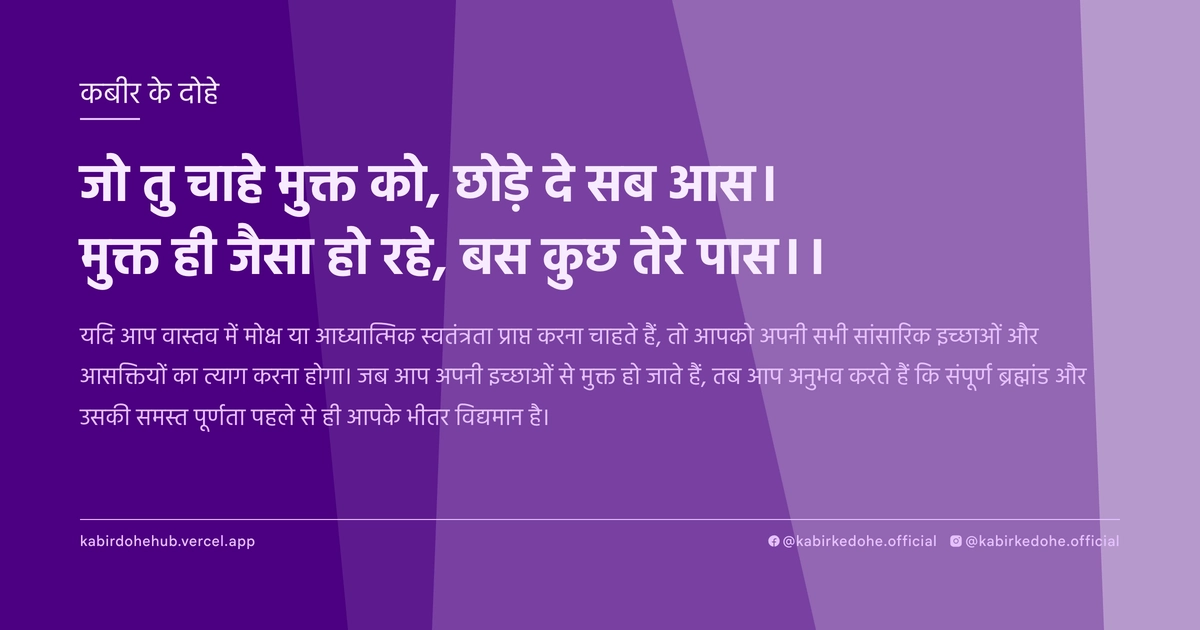
जो तु चाहे मुक्त को, छोड़े दे सब आस।
मुक्त ही जैसा हो रहे, बस कुछ तेरे पास।।
Jo tu chahe mukt ko, chhode de sab aas. Mukt hi jaisa ho rahe, bas kuch tere paas.
इस पृष्ठ पर इस कबीर दोहे का अर्थ (meaning), हिंदी व्याख्या और अंग्रेज़ी अनुवाद, दार्शनिक विश्लेषण और व्यावहारिक जीवन सीख दी गई है। यह दोहा मुक्ति (Liberation) विषय से जुड़ा है — Kabir doha meaning and explanation in Hindi and English.
अर्थ (Meaning):
यदि आप वास्तव में मोक्ष या आध्यात्मिक स्वतंत्रता प्राप्त करना चाहते हैं, तो आपको अपनी सभी सांसारिक इच्छाओं और आसक्तियों का त्याग करना होगा। जब आप अपनी इच्छाओं से मुक्त हो जाते हैं, तब आप अनुभव करते हैं कि संपूर्ण ब्रह्मांड और उसकी समस्त पूर्णता पहले से ही आपके भीतर विद्यमान है।
If you truly desire liberation or spiritual freedom, you must relinquish all worldly attachments and expectations. Once you become free from the grip of desire, you realize that the entire universe and its absolute fullness are already present within you.
व्याख्या (Interpretation):
कबीर यहाँ मुक्ति के विरोधाभास को समझा रहे हैं। शाब्दिक अर्थ यह है कि इच्छाओं का त्याग ही स्वतंत्रता का मार्ग है। रूपक के स्तर पर, 'आस' या आशा केवल बाहरी वस्तुओं की खोज है, जो आत्मा को भ्रम (माया) में रखती है। जब साधक यह समझ जाता है कि वह स्वयं ब्रह्म है, तो बाहरी खोज समाप्त हो जाती है। यह निर्गुण भक्ति का सार है, जहाँ ईश्वर किसी मंदिर या मस्जिद में नहीं, बल्कि शून्य और पूर्णता के मिलन में है। अद्वैत वेदांत के अनुसार, जब 'मैं' और 'मेरा' का भाव मिटता है, तब केवल शुद्ध चेतना बचती है। इस अवस्था में, व्यक्ति कुछ पाने की कोशिश नहीं करता, बल्कि वह स्वयं 'सब कुछ' बन जाता है।
Kabir explains the paradox of liberation here. Literally, the abandonment of desire is the path to freedom. Metaphorically, 'aas' or hope represents the external search for fulfillment, which keeps the soul trapped in Maya (illusion). When the seeker realizes they are essentially one with the Divine, the external pursuit ceases. This is the core of Nirgun Bhakti, where the Divine is not found in temples or mosques, but in the union of void and fullness. According to Advaita Vedanta, when the notion of 'I' and 'mine' dissolves, only pure consciousness remains. In this state, the individual stops trying to acquire and instead realizes they are the totality itself.
दार्शनिक विश्लेषण (Philosophical Analysis):
कबीर का यह दोहा उस युग की प्रतिक्रिया है जहाँ धर्म केवल कर्मकांडों और बाहरी दिखावों तक सीमित था। उन्होंने पुरोहितवाद और जाति व्यवस्था को नकारते हुए आंतरिक शुद्धि पर बल दिया। यहाँ 'मुक्ति' का अर्थ मृत्यु के बाद मिलने वाला स्वर्ग नहीं, बल्कि जीवित रहते हुए अहंकार का विसर्जन है।
यह दर्शन सूफीवाद के 'फना' (अहंकार का विनाश) के करीब है, जहाँ प्रेमी अपने अस्तित्व को ईश्वर में विलीन कर देता है। कबीर तर्क देते हैं कि जब तक हम किसी चीज़ की 'आशा' करते हैं, हम यह स्वीकार कर रहे होते हैं कि हम अधूरे हैं। यह अधूरापन ही दुख का मूल कारण है।
अद्वैत वेदांत के परिप्रेक्ष्य में, यह 'नेति-नेति' (यह नहीं, वह नहीं) की प्रक्रिया है। जब हम अपनी पहचान को पद, प्रतिष्ठा और संबंधों से अलग करते हैं, तो जो बचता है वह शुद्ध आत्मा है। कबीर इस सत्य को सरल भाषा में प्रस्तुत करते हैं कि पूर्णता बाहर नहीं, भीतर है।
मनोवैज्ञानिक स्तर पर, यह 'अटैचमेंट' (आसक्ति) और 'इंगेजमेंट' (जुड़ाव) के बीच का अंतर है। आसक्ति हमें बांधती है, जबकि जुड़ाव हमें मुक्त रखता है। जब हम फल की इच्छा छोड़ देते हैं, तो हम कर्म के बंधन से मुक्त हो जाते हैं।
अंततः, यह दोहा हमें सिखाता है कि मुक्ति कोई गंतव्य नहीं है जिसे प्राप्त करना है, बल्कि यह एक मानसिक स्थिति है। यह उस भ्रम का अंत है कि हम ब्रह्मांड से अलग कोई इकाई हैं। जब द्वैत समाप्त होता है, तब केवल अद्वैत शेष रहता है।
Kabir's couplet is a reaction to an era where religion was confined to rituals and outward displays. He rejected priesthood and the caste system, emphasizing internal purification. Here, 'Mukti' does not mean a heaven attained after death, but the dissolution of the ego while alive.
This philosophy aligns closely with the Sufi concept of 'Fana' (annihilation of the self), where the lover merges their existence into the Divine. Kabir argues that as long as we 'hope' or 'desire' for something, we are acknowledging our own incompleteness. This perceived lack is the root cause of all suffering.
From the perspective of Advaita Vedanta, this is the process of 'Neti-Neti' (not this, not that). When we detach our identity from status, prestige, and relationships, what remains is the pure Atman. Kabir presents this truth simply: fullness is not outside, but within.
Psychologically, this is the distinction between 'attachment' and 'engagement.' Attachment binds us, while engagement keeps us free. When we relinquish the desire for the fruit of our actions, we are liberated from the bonds of Karma.
Ultimately, this doha teaches that liberation is not a destination to be reached, but a state of consciousness. It is the end of the illusion that we are separate entities from the universe. When duality ends, only non-duality remains.
मूल संदेश (Core Message):
- इच्छा ही बंधन का सबसे सूक्ष्म और शक्तिशाली धागा है।
- मुक्ति कहीं बाहर से नहीं आती, यह केवल भ्रमों का अंत है।
- जब आप कुछ पाने की जिद छोड़ते हैं, तब आप स्वयं पूर्ण हो जाते हैं।
- बाहरी खोज वास्तव में आंतरिक रिक्तता को छिपाने का एक प्रयास है।
- अद्वैत का सत्य यह है कि आप और ब्रह्मांड एक ही चेतना हैं।
- Desire is the subtlest and most powerful thread of bondage.
- Liberation does not come from outside; it is simply the end of illusions.
- When you cease the insistence on acquiring, you become complete.
- External searching is actually an attempt to hide internal emptiness.
- The truth of non-duality is that you and the universe are one consciousness.
व्यावहारिक उदाहरण (Practical Example):
वाराणसी के एक पुराने घाट पर रहने वाले माधव एक कुशल बुनकर थे, जो रेशमी साड़ियों में अद्भुत बारीकी उकेरते थे। माधव का जीवन एक निरंतर दौड़ थी—बेहतर बाजार, अधिक मुनाफा और समाज में अपनी प्रतिष्ठा बढ़ाने की अंतहीन इच्छा। वे हमेशा इस तनाव में रहते थे कि उनके पास जो है वह पर्याप्त नहीं है।
एक दिन, माधव की मुलाकात एक फकीर से हुई जो नदी किनारे मौन बैठा था। माधव ने उनसे पूछा, 'मैं बहुत मेहनत करता हूँ, फिर भी मुझे शांति क्यों नहीं मिलती?' फकीर ने मुस्कुराते हुए कहा, 'तुम शांति को एक वस्तु की तरह खोज रहे हो जिसे बाजार से खरीदा जा सके। जिस दिन तुम यह मान लोगे कि तुम्हें कुछ और पाने की जरूरत नहीं है, उसी क्षण तुम सब कुछ पा लोगे।'
माधव को पहले यह बात समझ नहीं आई। उन्हें लगा कि यह केवल शब्दों का खेल है। लेकिन उन्होंने एक प्रयोग करने का निर्णय लिया। उन्होंने तय किया कि वे अगले एक महीने तक अपनी मेहनत तो करेंगे, लेकिन परिणाम की कोई 'आशा' नहीं रखेंगे। वे केवल बुनने की प्रक्रिया का आनंद लेंगे, न कि उस पैसे का जो उससे मिलेगा।
शुरुआत में यह बहुत कठिन था। उनका मन बार-बार उन्हें याद दिलाता था कि यदि वे लाभ के बारे में नहीं सोचेंगे, तो वे पिछड़ जाएंगे। लेकिन धीरे-धीरे, एक अद्भुत बदलाव आया। जब उन्होंने 'पाने की इच्छा' छोड़ी, तो उनकी एकाग्रता बढ़ गई। उनके काम में एक ऐसी दिव्यता आ गई जो पहले कभी नहीं थी।
अजीब बात यह थी कि जब उन्होंने लाभ की चिंता छोड़ दी, तो उनके काम की गुणवत्ता इतनी बढ़ गई कि ग्राहक खुद उनके पास आने लगे। लेकिन अब माधव को उस प्रसिद्धि की भूख नहीं थी। उन्हें महसूस हुआ कि उनकी खुशी अब बाहरी प्रशंसा पर निर्भर नहीं थी।
एक शाम, जब वे अपनी करघे पर बैठे थे, उन्हें अचानक एक गहरा अनुभव हुआ। उन्हें लगा कि वे केवल कपड़ा नहीं बुन रहे, बल्कि वे स्वयं उस अनंत धागे का हिस्सा हैं जिससे पूरा ब्रह्मांड बुना गया है। उन्हें महसूस हुआ कि जिस 'पूर्णता' को वे बाहर खोज रहे थे, वह उनके भीतर की शांति में ही छिपी थी।
माधव ने महसूस किया कि जब तक वे 'मुक्ति' की आशा कर रहे थे, वे वास्तव में बंधन में थे। जैसे ही उन्होंने उस आशा को छोड़ा, वे मुक्त हो गए। अब उनके पास भौतिक संपत्ति तो थी, लेकिन उस पर उनकी कोई पकड़ नहीं थी।
उन्होंने अपनी पूरी जीवनशैली बदल ली। वे अब केवल अपनी जरूरत भर कमाते और बाकी समय दूसरों की मदद और ध्यान में बिताते। उनके चेहरे पर एक ऐसी चमक थी जो पहले कभी नहीं देखी गई थी।
गाँव के लोग हैरान थे कि माधव अब पहले से अधिक खुश और शांत थे, जबकि उनकी महत्वाकांक्षाएं खत्म हो चुकी थीं। माधव ने सबको सिखाया कि असली अमीरी वह नहीं है जो हम जमा करते हैं, बल्कि वह है जो हम अपने भीतर महसूस करते हैं जब हम बाहरी दुनिया की उम्मीदें छोड़ देते हैं।
Madhav, a skilled weaver living on an old ghat in Varanasi, created exquisite detail in silk sarees. Madhav's life was a constant race—seeking better markets, higher profits, and an endless desire to increase his social prestige. He lived in constant stress, feeling that what he had was never enough.
One day, Madhav met a fakir sitting in silence by the river. Madhav asked, 'I work so hard, yet why do I find no peace?' The fakir smiled and replied, 'You are searching for peace as if it were an object to be bought from a market. The day you accept that you need nothing more, you will possess everything.'
At first, Madhav didn't understand. He thought it was merely a play on words. However, he decided to conduct an experiment. He resolved to continue his hard work for the next month but would relinquish all 'hope' or expectation of the result. He would enjoy only the process of weaving, not the money it would bring.
Initially, this was incredibly difficult. His mind constantly reminded him that if he didn't think about profit, he would fall behind. But gradually, a wonderful shift occurred. When he let go of the 'desire to acquire,' his concentration deepened. A divinity entered his work that was never there before.
Strangely, once he stopped worrying about profit, the quality of his work improved so much that customers began seeking him out. But Madhav no longer hungered for that fame. He realized his happiness was no longer dependent on external praise.
One evening, while sitting at his loom, he had a profound realization. He felt he wasn't just weaving cloth, but was himself a part of the infinite thread from which the entire universe is woven. He felt that the 'fullness' he had been searching for externally was hidden within his own inner peace.
Madhav realized that as long as he hoped for 'liberation,' he was actually in bondage. The moment he let go of that hope, he became free. He still possessed material wealth, but he no longer held onto it.
He transformed his entire lifestyle. He now earned only what was necessary for survival and spent the rest of his time helping others and in meditation. A radiance appeared on his face that had never been seen before.
Villagers were amazed that Madhav was now happier and calmer than ever, despite his ambitions having vanished. Madhav taught everyone that true richness is not what we accumulate, but what we feel within when we let go of the expectations of the outer world.
अभ्यास मार्गदर्शन (Practice Guidance):
- प्रतिदिन 20 मिनट 'शून्य ध्यान' का अभ्यास करें, जहाँ आप किसी भी इच्छा या लक्ष्य के बिना केवल अपनी श्वास को देखें।
- एक 'इच्छा-डायरी' बनाएँ। उन चीजों को लिखें जिन्हें आप पाना चाहते हैं, और फिर सचेत रूप से लिखें: 'यदि यह मुझे नहीं मिला, तो भी मैं पूर्ण हूँ'।
- दिन में कम से कम एक ऐसा कार्य करें जिसका कोई व्यक्तिगत लाभ न हो और जिसके फल की आप कोई अपेक्षा न रखें (निस्वार्थ सेवा)।
- निदान चेकलिस्ट: क्या मैं किसी की प्रशंसा के बिना भी खुश हूँ? क्या मैं भविष्य की चिंता के बजाय वर्तमान क्षण में उपस्थित हूँ? क्या मेरी शांति बाहरी परिस्थितियों पर निर्भर है?
- Practice 20 minutes of 'Shunya Meditation' daily, observing your breath without any desire or goal.
- Maintain a 'Desire Journal.' List things you wish to acquire, and then consciously write: 'Even if I do not attain this, I am complete.'
- Perform at least one act daily that offers no personal gain and for which you have no expectation of reward (selfless service).
- Diagnostic Checklist: Am I happy even without external praise? Am I present in the moment rather than worrying about the future? Is my peace dependent on external circumstances?
चिंतन प्रश्न (Reflection Questions):
- मेरी कौन सी ऐसी 'आशाएं' हैं जो मुझे वर्तमान क्षण में जीने से रोक रही हैं?
- यदि मेरी सभी सामाजिक पहचान (पद, रिश्ता, संपत्ति) छीन ली जाएं, तो मेरे भीतर क्या बचेगा?
- क्या मैं वास्तव में शांति चाहता हूँ, या मैं केवल अपनी इच्छाओं की पूर्ति के बाद मिलने वाले अस्थायी सुख को शांति समझ रहा हूँ?
- मेरा 'डिजिटल अहंकार' (सोशल मीडिया पर दिखना) मुझे वास्तविकता से कितना दूर ले जा रहा है?
- मैं किन चीजों को 'मेरा' कहता हूँ, और क्या वे वास्तव में मेरी हैं या मैं उनका गुलाम हूँ?
- Which of my 'hopes' are preventing me from living fully in the present moment?
- If all my social identities (status, relationships, assets) were stripped away, what would remain within me?
- Do I truly desire peace, or am I mistaking the temporary pleasure following the fulfillment of desires for peace?
- How far is my 'digital ego' (social media presence) distancing me from reality?
- What things do I call 'mine,' and are they truly mine, or am I a slave to them?