
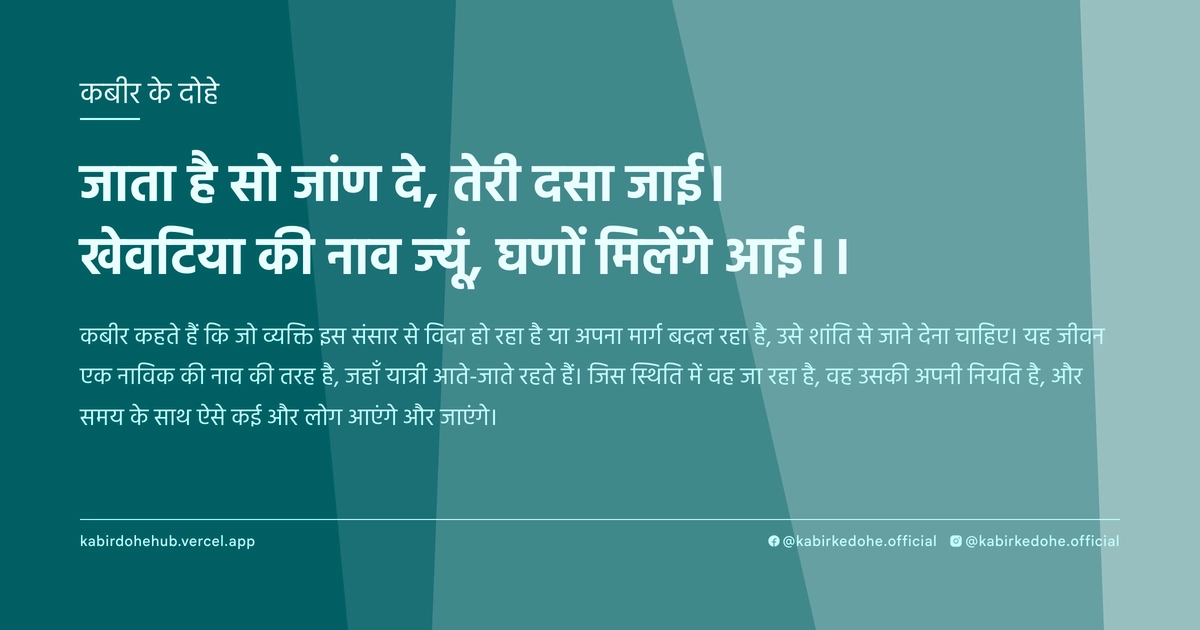
जाता है सो जांण दे, तेरी दसा जाई।
खेवटिया की नाव ज्यूं, घणों मिलेंगे आई।।
Jaata hai so jaan de, teri dasa jaai. Khevatiya ki naav jyun, ghano milenge aai.
इस पृष्ठ पर इस कबीर दोहे का अर्थ (meaning), हिंदी व्याख्या और अंग्रेज़ी अनुवाद, दार्शनिक विश्लेषण और व्यावहारिक जीवन सीख दी गई है। यह दोहा मृतुक्यता (Mortality) विषय से जुड़ा है — Kabir doha meaning and explanation in Hindi and English.
अर्थ (Meaning):
कबीर कहते हैं कि जो व्यक्ति इस संसार से विदा हो रहा है या अपना मार्ग बदल रहा है, उसे शांति से जाने देना चाहिए। यह जीवन एक नाविक की नाव की तरह है, जहाँ यात्री आते-जाते रहते हैं। जिस स्थिति में वह जा रहा है, वह उसकी अपनी नियति है, और समय के साथ ऐसे कई और लोग आएंगे और जाएंगे।
Kabir suggests that one who is departing from this world or leaving your life should be allowed to go without clinging. Life is likened to a boatman's vessel where passengers are transient. The state in which they depart is their own destiny, and in the vast flow of existence, countless others will arrive and depart in a similar cycle.
व्याख्या (Interpretation):
यह दोहा वैराग्य और अनासक्ति के गहरे सिद्धांत को दर्शाता है। 'जाता है सो जांण दे' का अर्थ केवल शारीरिक मृत्यु नहीं, बल्कि किसी भी भावनात्मक संबंध का अंत है। यहाँ 'खेवटिया' (नाविक) आत्मा या परमात्मा का प्रतीक है, और 'नाव' यह भौतिक शरीर या संसार है। यह निरगुण भक्ति का सार है, जहाँ यह माना जाता है कि आत्मा का बंधन अस्थायी है। माया हमें यह विश्वास दिलाती है कि संबंध स्थायी हैं, लेकिन वास्तव में हम सब केवल यात्री हैं। जब हम इस सत्य को स्वीकार करते हैं कि हम और सामने वाला दोनों केवल इस संसार रूपी नाव के मुसाफिर हैं, तब शोक और मोह का अंत होता है। यह अद्वैत वेदांत के उस विचार से मेल खाता है जहाँ व्यक्तिगत पहचान (अहंकार) का विसर्जन ही वास्तविक मुक्ति है।
This couplet embodies the profound principles of detachment and renunciation. 'Allow the one who departs to go' refers not only to physical death but to the cessation of any emotional bond. Here, the 'Khevatiya' (boatman) symbolizes the Soul or the Divine, and the 'boat' represents the physical body or the material world. This is the essence of Nirgun Bhakti, asserting that the soul's attachment is ephemeral. Maya creates the illusion of permanent bonds, yet we are all merely transient passengers. By realizing that both the observer and the departed are travelers on the same vessel of existence, grief and attachment dissolve. This aligns with Advaita Vedanta, where the dissolution of the individual ego is the only path to true liberation, recognizing the non-duality of the self and the absolute.
दार्शनिक विश्लेषण (Philosophical Analysis):
कबीर का यह दृष्टिकोण उनके समय के कट्टरपंथी सामाजिक और धार्मिक ढांचों के विरुद्ध एक मौन विद्रोह था। जहाँ समाज शोक और विलाप को धर्म का हिस्सा मानता था, कबीर ने इसे अज्ञानता कहा। वे सिखाते हैं कि विलाप करना वास्तव में उस व्यक्ति के प्रति प्रेम नहीं, बल्कि अपने स्वयं के मोह और अहंकार का विलाप है।
दार्शनिक रूप से, यह सूफी मत के 'फना' (अहंकार का विनाश) के करीब है। जब हम किसी को जाने देते हैं, तो हम वास्तव में अपनी उस धारणा को मारते हैं कि वह व्यक्ति 'हमारा' था। यह 'मेरे-तेरे' के द्वैत को समाप्त कर अद्वैत की ओर ले जाता है।
कबीर ने कर्मकांडों और बाहरी आडंबरों का विरोध किया क्योंकि वे आत्मा को शरीर के साथ बांध देते हैं। उनके लिए, मुक्ति का अर्थ है यह समझना कि आत्मा का कोई निश्चित घर नहीं है; वह केवल एक प्रवाह है।
मनोवैज्ञानिक स्तर पर, यह दोहा 'स्वीकृति' (Acceptance) की पराकाष्ठा है। यह सिखाता है कि प्रतिरोध ही दुख का कारण है। जब हम प्रवाह के साथ चलते हैं, तो मानसिक शांति प्राप्त होती है।
अंततः, यह संदेश देता है कि जीवन एक निरंतर परिवर्तन है। जो आज आया है, वह कल जाएगा। इस सार्वभौमिक सत्य को स्वीकार करना ही आध्यात्मिक परिपक्वता है, जो मनुष्य को सांसारिक दुखों से ऊपर उठाकर शून्य की स्थिति में ले जाता है।
Kabir's perspective was a silent rebellion against the rigid social and religious structures of his era. While society viewed mourning and lamentation as a virtue or a religious duty, Kabir identified it as a symptom of ignorance. He teaches that grieving is not truly love for the departed, but rather a lamentation of one's own attachment and ego.
Philosophically, this resonates with the Sufi concept of 'Fana' (the annihilation of the self). When we let someone go, we are essentially destroying the illusion that the person 'belonged' to us. This erases the duality of 'mine' and 'thine,' leading toward the non-dual realization of Advaita.
Kabir rejected rituals and external pomposity because they tether the soul to the physical form. For him, liberation is the understanding that the soul has no fixed abode; it is a continuous flow, a river returning to the ocean.
On a psychological level, this doha represents the pinnacle of 'Acceptance.' It posits that resistance to the inevitable is the primary source of human suffering. By aligning oneself with the natural flow of existence, one achieves an unshakable inner peace.
Ultimately, the message is that life is a state of perpetual flux. He who arrives today will depart tomorrow. Embracing this universal truth is the mark of spiritual maturity, elevating the human consciousness from worldly sorrow to the state of 'Shunya' or void.
मूल संदेश (Core Message):
- पकड़ना दुख का बीज है, छोड़ना मुक्ति का मार्ग।
- हम सब इस संसार रूपी नाव के अस्थायी यात्री हैं।
- प्रेम का उच्चतम रूप दूसरे को स्वतंत्र करना है।
- मृत्यु और विदाई केवल एक अवस्था से दूसरी अवस्था का संक्रमण है।
- अहंकार का विसर्जन ही वास्तविक शांति की कुंजी है।
- Clinging is the seed of sorrow; letting go is the path to liberation.
- We are all transient passengers on the vessel of this material world.
- The highest form of love is granting the other complete freedom.
- Death and departure are merely transitions from one state to another.
- The dissolution of the ego is the only key to enduring peace.
व्यावहारिक उदाहरण (Practical Example):
एक समय की बात है, वाराणसी के घाटों पर रहने वाला एक वृद्ध बुनकर था जिसका नाम माधव था। माधव ने अपना पूरा जीवन रेशमी धागों को बुनने में बिता दिया था, और उसका एकमात्र सहारा उसकी युवा पत्नी थी, जिससे वह अगाध प्रेम करता था।
एक दिन उसकी पत्नी एक गंभीर बीमारी की चपेट में आ गई। माधव ने अपनी सारी जमा पूँजी वैद्यों और पुजारियों पर खर्च कर दी, लेकिन उसकी स्थिति बिगड़ती गई। वह दिन-रात रोता और ईश्वर से प्रार्थना करता कि वह उसे न छीने।
एक शाम, जब वह घाट पर बैठा विलाप कर रहा था, उसकी मुलाकात एक घुमक्कड़ संत से हुई। संत ने माधव के आँसुओं को देखा और शांति से कहा, "माधव, तुम उस नाव को रोकने की कोशिश कर रहे हो जिसका समय पूरा हो चुका है। नाविक ने उसे किनारे लगा दिया है, अब उसे जाने दो।"
माधव को पहले यह बात बहुत कठोर लगी। उसने सोचा कि क्या कोई अपने प्रिय के जाने पर शांत रह सकता है? लेकिन संत ने उसे समझाया कि उसकी पत्नी की आत्मा अब एक नए सफर पर है, और उसका मोह उसे उस सफर में बाधा डाल रहा है।
उस रात, माधव ने अपनी पत्नी का हाथ थामा और पहली बार रोने के बजाय उसे धन्यवाद दिया कि उसने उसके जीवन को रंगों से भरा। उसने मन ही मन कहा, "तुम इस नाव की यात्री थी, अब तुम्हारी यात्रा आगे बढ़े।"
जैसे ही माधव ने इस सत्य को स्वीकार किया, उसके हृदय का भारीपन गायब हो गया। उसकी पत्नी ने एक शांत मुस्कान के साथ अंतिम सांस ली।
अगले कुछ महीनों में, माधव ने देखा कि वह अब पहले जैसा अकेला महसूस नहीं करता था। उसने अपने घर के दरवाजे उन अनाथ बच्चों के लिए खोल दिए जिन्हें सहारे की जरूरत थी।
उसने महसूस किया कि जब उसने 'पकड़ने' की जिद छोड़ी, तो उसका हृदय पूरी दुनिया के लिए खुल गया। वह अब केवल एक पत्नी का पति नहीं, बल्कि पूरी मानवता का सेवक बन गया था।
माधव का जीवन अब एक ऐसी नाव बन गया था जिसमें वह दूसरों को शांति और प्रेम की मंजिल तक पहुँचाने लगा। यह उसकी अपनी आंतरिक मुक्ति की शुरुआत थी।
उसने सीखा कि विदाई अंत नहीं, बल्कि एक नए विस्तार का प्रारंभ है, बशर्ते हम जाने वाले को मुक्त कर दें।
Once, in the bustling ghats of Varanasi, lived an elderly weaver named Madhav. Madhav had spent his entire life weaving intricate silk threads, and his sole emotional anchor was his young wife, whom he loved with an intensity that bordered on obsession.
One day, his wife fell prey to a severe illness. Madhav spent every coin of his savings on physicians and priests, but her condition only deteriorated. He spent his nights in agonizing prayer, begging the heavens not to take her away.
One evening, while weeping by the river, he encountered a wandering ascetic. The saint looked at Madhav's tears and spoke softly, "Madhav, you are trying to hold back a boat whose time has come. The boatman has reached the shore; let her go."
Initially, Madhav found these words cruel. He wondered how anyone could remain calm while losing their beloved. But the saint explained that his wife's soul was embarking on a new journey, and his clinging was merely a shackle preventing her transition.
That night, Madhav held his wife's hand and, for the first time, instead of sobbing, he thanked her for filling his life with color. He whispered in his heart, "You were a passenger on this boat; now, may your journey continue forward."
The moment Madhav accepted this truth, the crushing weight in his chest vanished. His wife passed away with a serene smile on her lips, undisturbed by his grief.
In the following months, Madhav noticed a strange change; he no longer felt the void of loneliness. He opened the doors of his home to orphaned children in the city who needed shelter and care.
He realized that when he stopped the desperate urge to 'possess,' his heart opened to the entire world. He was no longer just a husband to one woman, but a guardian to many.
Madhav's life became like a boat that now carried others toward a destination of peace and love. This was the beginning of his own internal liberation.
He learned that departure is not an end, but the start of a new expansion, provided we grant the departing soul the freedom to leave.
अभ्यास मार्गदर्शन (Practice Guidance):
- प्रतिदिन 15 मिनट मौन ध्यान करें, जिसमें आप अपने जीवन में आने वाले और जाने वाले लोगों की कल्पना एक नदी के प्रवाह के रूप में करें।
- एक 'अनासक्ति पत्रिका' (Detachment Journal) लिखें, जहाँ आप उन चीजों या लोगों की सूची बनाएँ जिनसे आप अत्यधिक चिपके हुए हैं, और लिखें कि उन्हें जाने देने पर आप कैसा महसूस करेंगे।
- जब भी किसी रिश्ते में तनाव या अलगाव महसूस हो, तो स्वयं से पूछें: "क्या मैं इस व्यक्ति से प्रेम करता हूँ, या मैं केवल इस बात से प्रेम करता हूँ कि यह व्यक्ति मेरे जीवन में है?"
- निदान चेकलिस्ट: यदि आप किसी की अनुपस्थिति में क्रोध, अत्यधिक अवसाद या नियंत्रण की इच्छा महसूस करते हैं, तो यह संकेत है कि आप अभी भी 'नाव' को पकड़ने की कोशिश कर रहे हैं।
- Practice 15 minutes of silent meditation daily, visualizing the people entering and leaving your life as a continuous flow of a river.
- Maintain a 'Detachment Journal' where you list the people or possessions you cling to most intensely, and describe the feeling of letting them go completely.
- Whenever you experience tension or separation in a relationship, ask yourself: "Do I love this person, or do I only love the fact that this person exists in my life?"
- Diagnostic Checklist: If you feel anger, extreme depression, or a desire to control someone's departure, it is a sign that you are still trying to hold onto the 'boat' instead of the flow.
चिंतन प्रश्न (Reflection Questions):
- आपकी पहचान उन लोगों से कितनी जुड़ी है जिन्हें आप 'अपना' कहते हैं? यदि वे सब चले जाएँ, तो आपका 'मैं' क्या बचेगा?
- क्या आपका प्रेम वास्तव में दूसरे की भलाई के लिए है, या वह आपकी अपनी भावनात्मक जरूरतों को पूरा करने का एक साधन है?
- आप अपनी डिजिटल पहचान (सोशल मीडिया) के माध्यम से किस तरह की 'छवि' को पकड़े हुए हैं जिसे आप कभी खोना नहीं चाहते?
- जब आप किसी को खोते हैं, तो क्या आप उस व्यक्ति के लिए दुखी होते हैं या अपनी उस कमी के लिए जो उनके जाने से पैदा हुई?
- क्या आप वास्तव में स्वतंत्र हैं, या आप उन यादों के कैदी हैं जो अब अस्तित्व में नहीं हैं?
- How much of your identity is tied to the people you call 'yours'? If they all departed, what would remain of your 'I'?
- Is your love truly for the well-being of the other, or is it a tool to satisfy your own emotional dependencies?
- What specific 'image' of yourself are you clinging to through your digital identity that you are terrified of losing?
- When you lose someone, are you grieving for the person, or for the void created in your own life by their absence?
- Are you truly free, or are you a prisoner of memories that no longer exist in the present moment?