
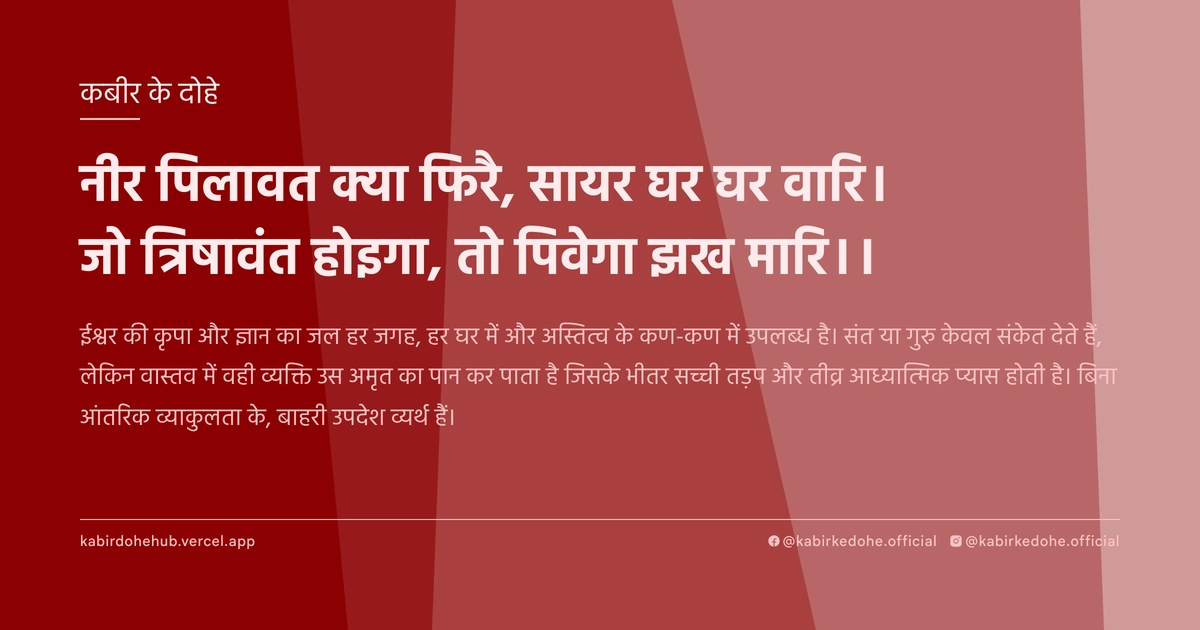
नीर पिलावत क्या फिरै, सायर घर घर वारि।
जो त्रिषावंत होइगा, तो पिवेगा झख मारि।।
Neer pilavat kya phire, sayar ghar ghar vari. Jo trishavant hoiga, to pivega jhakh mari.
इस पृष्ठ पर इस कबीर दोहे का अर्थ (meaning), हिंदी व्याख्या और अंग्रेज़ी अनुवाद, दार्शनिक विश्लेषण और व्यावहारिक जीवन सीख दी गई है। यह दोहा जागृति (The Wake-up Call) विषय से जुड़ा है — Kabir doha meaning and explanation in Hindi and English.
अर्थ (Meaning):
ईश्वर की कृपा और ज्ञान का जल हर जगह, हर घर में और अस्तित्व के कण-कण में उपलब्ध है। संत या गुरु केवल संकेत देते हैं, लेकिन वास्तव में वही व्यक्ति उस अमृत का पान कर पाता है जिसके भीतर सच्ची तड़प और तीव्र आध्यात्मिक प्यास होती है। बिना आंतरिक व्याकुलता के, बाहरी उपदेश व्यर्थ हैं।
The water of divine grace and spiritual knowledge is omnipresent, flowing through every home and every atom of existence. The teacher or saint merely points the way, but the nectar is truly tasted only by those who possess an intense, burning thirst for truth. Without internal longing, external guidance remains ineffective.
व्याख्या (Interpretation):
यह दोहा ज्ञान की सर्वव्यापकता और साधक की पात्रता के बीच के द्वंद्व को दर्शाता है। 'नीर' यहाँ केवल जल नहीं, बल्कि ब्रह्म-ज्ञान या आत्म-साक्षात्कार का प्रतीक है। 'सायर' का अर्थ है कि सत्य कहीं दूर नहीं, बल्कि हमारे अपने भीतर और परिवेश में व्याप्त है। निर्गुण भक्ति के अनुसार, परमात्मा किसी विशेष मंदिर या मस्जिद में नहीं, बल्कि चेतना के हर स्तर पर मौजूद है। यहाँ मुख्य विरोधाभास यह है कि जो वस्तु सबके पास है, वह सबको प्राप्त नहीं होती क्योंकि 'तृषा' यानी आध्यात्मिक प्यास का अभाव है। माया हमें यह विश्वास दिलाती है कि हम तृप्त हैं, जबकि हम वास्तव में अज्ञान की मरुभूमि में भटक रहे हैं। जब अहंकार मिटता है और आत्मा अपनी मूल स्थिति के लिए तड़पती है, तब वह 'झख मारि' यानी तुरंत और तीव्रता से उस सत्य को आत्मसात कर लेती है।
This couplet illustrates the tension between the omnipresence of knowledge and the readiness of the seeker. 'Water' here is not mere liquid, but a metaphor for Brahma-gyana or self-realization. 'Sayar' implies that Truth is not distant; it permeates our very being and surroundings. In the context of Nirgun Bhakti, the Divine does not reside in a specific temple or mosque but exists at every level of consciousness. The central paradox is that while the Truth is available to all, it is attained by few due to the lack of 'Trisha'—the intense spiritual longing. Maya creates a veil of perceived satisfaction, making us believe we are fulfilled while we wander in the desert of ignorance. Only when the ego dissolves and the soul yearns for its original state does it instantly absorb the Truth with urgency and passion.
दार्शनिक विश्लेषण (Philosophical Analysis):
कबीर का यह दर्शन अद्वैत वेदांत के इस सिद्धांत से मेल खाता है कि ब्रह्म सर्वव्यापी है। उनके समय में धर्म को कर्मकांडों, तीर्थयात्राओं और बाहरी आडंबरों में बांध दिया गया था। कबीर इस व्यवस्था पर प्रहार करते हुए कहते हैं कि यदि सत्य हर घर में है, तो गंगा जाने या कठिन तपस्या करने की आवश्यकता क्यों है? वे बताते हैं कि समस्या 'स्रोत' की नहीं, बल्कि 'पात्र' की है।
सूफी मत के 'इश्क-ए-हकीकी' (ईश्वर के प्रति प्रेम) की तरह, कबीर यहाँ 'तड़प' पर जोर देते हैं। बिना विरह और व्याकुलता के, परमात्मा का मिलन असंभव है। यह मनोवैज्ञानिक रूपांतरण की प्रक्रिया है जहाँ साधक को यह अहसास होना चाहिए कि वह अधूरा है। जब तक व्यक्ति यह नहीं मानता कि वह प्यासा है, वह पानी की तलाश नहीं करेगा।
यहाँ कबीर जाति और संप्रदाय के भेदभाव को पूरी तरह नकारते हैं। उनके लिए 'घर-घर' का अर्थ है कि ज्ञान किसी विशेष कुल या उच्च जाति की बपौती नहीं है। यह एक लोकतांत्रिक आध्यात्मिकता है जहाँ पात्रता का एकमात्र पैमाना 'प्यास' है, न कि जन्म या शास्त्र ज्ञान।
अहंकार (Ego) वह पर्दा है जो हमें यह देखने से रोकता है कि जल हमारे पैरों के नीचे है। जब व्यक्ति 'मैं' के भ्रम से मुक्त होता है, तब वह देखता है कि वह स्वयं ही वह जल है जिसे वह खोज रहा था। यह अद्वैत की पराकाष्ठा है—खोजने वाला और खोजा जाने वाला एक ही हैं।
अतः, यह दोहा हमें बाहरी खोज से हटाकर आंतरिक तैयारी की ओर ले जाता है। यह चेतावनी देता है कि बिना आंतरिक रूपांतरण के, दुनिया के सबसे महान गुरु भी हमें सत्य नहीं दे सकते, क्योंकि ज्ञान दिया नहीं जाता, बल्कि पात्रता होने पर प्रकट होता है।
Kabir's philosophy aligns with the Advaita Vedanta principle that Brahman is omnipresent. During his era, religion was confined to rituals, pilgrimages, and external displays. Kabir attacks this system, questioning why one needs to travel to the Ganges or perform rigorous penance if Truth resides in every home. He asserts that the problem is not the 'source,' but the 'vessel.'
Similar to the Sufi concept of 'Ishq-e-Haqiqi' (divine love), Kabir emphasizes 'longing.' Without the agony of separation and an intense yearning, union with the Divine is impossible. This is a psychological transformation where the seeker must first realize their own incompleteness. Until one acknowledges their thirst, they will never seek water.
Kabir completely rejects the divisions of caste and sect. By using the phrase 'ghar ghar' (every home), he implies that knowledge is not the monopoly of a specific lineage or high caste. This is a democratic spirituality where the only criterion for eligibility is 'thirst,' not birth or scriptural erudition.
Ego is the veil that prevents us from seeing that the water is beneath our very feet. When an individual is freed from the illusion of 'I,' they realize that they themselves are the water they were searching for. This is the pinnacle of non-duality—the seeker and the sought are one.
Thus, this couplet shifts our focus from external searching to internal preparation. It warns that without internal transformation, even the greatest gurus cannot bestow Truth, for knowledge is not 'given' but 'revealed' when the readiness is present.
मूल संदेश (Core Message):
- सत्य सर्वव्यापी है, लेकिन केवल पात्रता से प्राप्त होता है।
- बाहरी खोज अक्सर आंतरिक शून्यता को छिपाने का प्रयास होती है।
- अहंकार की तृप्ति ही आध्यात्मिक प्यास की सबसे बड़ी बाधा है।
- तड़प और व्याकुलता ही ज्ञान के द्वार खोलने वाली कुंजी हैं।
- जब 'मैं' मिटता है, तब 'वह' स्वतः प्रकट हो जाता है।
- Truth is omnipresent, but accessible only through readiness.
- External searching is often an attempt to mask internal emptiness.
- The satisfaction of the ego is the greatest barrier to spiritual thirst.
- Yearning and desperation are the keys that unlock the doors of knowledge.
- When the 'I' dissolves, the 'Divine' reveals itself spontaneously.
व्यावहारिक उदाहरण (Practical Example):
एक समय की बात है, वाराणसी के घाटों पर रहने वाला एक वृद्ध बुनकर था, जिसका नाम माधव था। माधव जीवन भर धर्मग्रंथों को पढ़ता रहा और बड़े-बड़े पंडितों के प्रवचन सुनता रहा, लेकिन उसके मन की अशांति कभी कम नहीं हुई। वह हमेशा इस खोज में रहता था कि 'परम सत्य' कहाँ मिलेगा। वह मीलों दूर तीर्थयात्राएं करता, महंगे अनुष्ठान करवाता, लेकिन उसे लगता था कि ईश्वर उससे बहुत दूर है।
उसी घाट पर एक साधारण सा फकीर बैठा करता था। वह कभी उपदेश नहीं देता था, बस मुस्कुराता रहता था। माधव अक्सर उसके पास जाकर पूछता, "महात्मन, मुझे वह रास्ता बताइये जिससे मुझे मोक्ष मिले। मैं सत्य की खोज में थक चुका हूँ।"
फकीर हमेशा एक ही जवाब देता, "बेटा, पानी तो हर जगह है, बस प्यास होनी चाहिए।"
माधव को यह बात समझ नहीं आती थी। उसे लगता था कि फकीर उसे घुमा रहा है। एक दिन माधव के जीवन में एक भारी संकट आया। उसकी एकमात्र बेटी गंभीर बीमार पड़ गई और उसकी सारी जमापूंजी इलाज में खर्च हो गई। वह पूरी तरह टूट गया। उसे अहसास हुआ कि उसकी सारी किताबें, उसके सारे तीर्थ और उसके सारे पंडित उसके दुख में साथ नहीं थे।
उस रात, माधव घाट की सीढ़ियों पर बैठकर फूट-फूट कर रोने लगा। पहली बार उसके भीतर एक ऐसी तड़प उठी जो उसने पहले कभी महसूस नहीं की थी। वह अब 'मोक्ष' की किताबी परिभाषा नहीं खोज रहा था, बल्कि वह अपने अस्तित्व के खालीपन को भरने के लिए तड़प रहा था। वह चिल्लाया, "हे ईश्वर! यदि तू है, तो मुझे अपनी शरण में ले ले, मैं अब और नहीं सह सकता!"
उसी क्षण, उसे महसूस हुआ कि जिस शांति और सत्य को वह मीलों दूर खोज रहा था, वह उसी की सांसों में, उसी के आंसुओं में और उसी के चारों ओर व्याप्त है। उसने महसूस किया कि वह अब तक 'ज्ञान' का संग्रह कर रहा था, लेकिन 'प्यास' नहीं पाला था।
जैसे ही उसके भीतर वह तीव्र व्याकुलता आई, फकीर की वह बात उसके हृदय में बिजली की तरह कौंधी—"पानी तो हर जगह है।"
माधव का अहंकार, जो उसे 'विद्वान' बनाता था, पूरी तरह ढह गया। उसने महसूस किया कि जब तक वह खुद को 'ज्ञानी' समझता रहा, वह प्यासा ही रहा। जिस दिन वह खुद को 'असहाय' और 'तड़पता हुआ' माना, उसे सत्य का अनुभव हो गया।
अब माधव ने तीर्थयात्राएं छोड़ दीं। वह अपने करघे पर कपड़ा बुनता, लेकिन उसका मन निरंतर उस अनंत जल में डूबा रहता। उसने जान लिया था कि सत्य कहीं बाहर नहीं, बल्कि आंतरिक पात्रता के जागने में है।
Once, in the ghats of Varanasi, lived an elderly weaver named Madhav. All his life, Madhav read scriptures and listened to the discourses of great pundits, yet the restlessness in his mind never subsided. He was forever searching for where the 'Ultimate Truth' could be found. He traveled miles on pilgrimages and performed expensive rituals, yet he felt that God was far away.
On the same ghat, a simple fakir used to sit. He never gave sermons; he only smiled. Madhav would often approach him and ask, "O Great Soul, show me the path to salvation. I am exhausted in my search for Truth."
The fakir always gave the same answer: "Son, water is everywhere; there only needs to be thirst."
Madhav could not comprehend this. He felt the fakir was mocking him. One day, a severe crisis struck Madhav's life. His only daughter fell gravely ill, and all his savings were spent on her treatment. He was completely broken. He realized that all his books, his pilgrimages, and his pundits were absent in his hour of grief.
That night, Madhav sat on the steps of the ghat and wept uncontrollably. For the first time, a longing arose within him that he had never felt before. He was no longer searching for a textbook definition of 'Moksha'; he was yearning to fill the void of his own existence. He cried out, "O Lord! If You exist, take me into Your refuge; I cannot bear this anymore!"
In that very moment, he felt that the peace and truth he had been searching for miles away were present in his own breath, in his tears, and all around him. He realized that until then, he had been collecting 'knowledge,' but he had not cultivated 'thirst.'
As that intense desperation surged within him, the fakir's words flashed like lightning in his heart—"Water is everywhere."
Madhav's ego, which had labeled him a 'scholar,' completely collapsed. He realized that as long as he considered himself 'learned,' he remained thirsty. The day he accepted himself as 'helpless' and 'yearning,' he experienced the Truth.
Madhav stopped his pilgrimages. He continued to weave cloth on his loom, but his mind remained immersed in that infinite water. He had learned that Truth is not found outside, but in the awakening of internal readiness.
अभ्यास मार्गदर्शन (Practice Guidance):
- प्रतिदिन 20 मिनट मौन बैठें और यह विचार करें कि सत्य आपके भीतर है, लेकिन आपका अहंकार उसे देखने नहीं दे रहा।
- एक डायरी लिखें जिसमें आप अपनी उन इच्छाओं को दर्ज करें जो भौतिक नहीं, बल्कि आध्यात्मिक हैं। स्वयं से पूछें: "मैं वास्तव में किस चीज के लिए प्यासा हूँ?"
- व्यवहार परिवर्तन: किसी भी बाहरी मदद या गुरु की तलाश करने से पहले, अपने भीतर की 'तड़प' और 'ईमानदारी' को विकसित करें।
- निदान चेकलिस्ट: क्या आप अभी भी सत्य को किसी किताब, व्यक्ति या स्थान में खोज रहे हैं? (यदि हाँ, तो आप अभी भी भ्रम में हैं)। क्या आप अपनी वर्तमान स्थिति से पूरी तरह असंतुष्ट होकर सत्य की खोज कर रहे हैं? (यदि हाँ, तो आपकी प्यास जाग रही है)।
- Sit in silence for 20 minutes daily and contemplate that Truth is within you, but your ego is preventing you from seeing it.
- Maintain a journal to record desires that are not material, but spiritual. Ask yourself: "What am I truly thirsty for?"
- Behavioral Change: Before seeking external help or a guru, cultivate an internal 'yearning' and 'absolute honesty' with yourself.
- Diagnostic Checklist: Are you still searching for Truth in a book, a person, or a place? (If yes, you are still in illusion). Are you seeking Truth out of a profound dissatisfaction with your current state of consciousness? (If yes, your thirst is awakening).
चिंतन प्रश्न (Reflection Questions):
- क्या मेरी आध्यात्मिक खोज वास्तव में सत्य के लिए है, या यह केवल मेरी सामाजिक छवि को 'पवित्र' बनाने का एक तरीका है?
- मैं किन भौतिक सुखों के पीछे अपनी उस वास्तविक प्यास को छिपा रहा हूँ जिसे मैं स्वीकार करने से डरता हूँ?
- यदि आज मेरे पास कोई गुरु या मार्गदर्शक न हो, तो क्या मेरे भीतर की तड़प मुझे सत्य तक ले जा सकती है?
- क्या मैं सत्य को 'पाने' की कोशिश कर रहा हूँ, या मैं उस 'अहंकार' को मिटाने की कोशिश कर रहा हूँ जो मुझे सत्य से अलग करता है?
- मेरे जीवन का वह कौन सा सबसे दुखद क्षण था जिसने मुझे वास्तव में ईश्वर की याद दिलाई?
- Is my spiritual quest truly for Truth, or is it merely a way to make my social image appear 'pious'?
- Behind which material comforts am I hiding that authentic thirst which I am afraid to acknowledge?
- If I had no guru or guide today, would the yearning within me be enough to lead me to the Truth?
- Am I trying to 'acquire' the Truth, or am I trying to dissolve the 'ego' that separates me from it?
- What was the most painful moment of my life that actually reminded me of the Divine?