
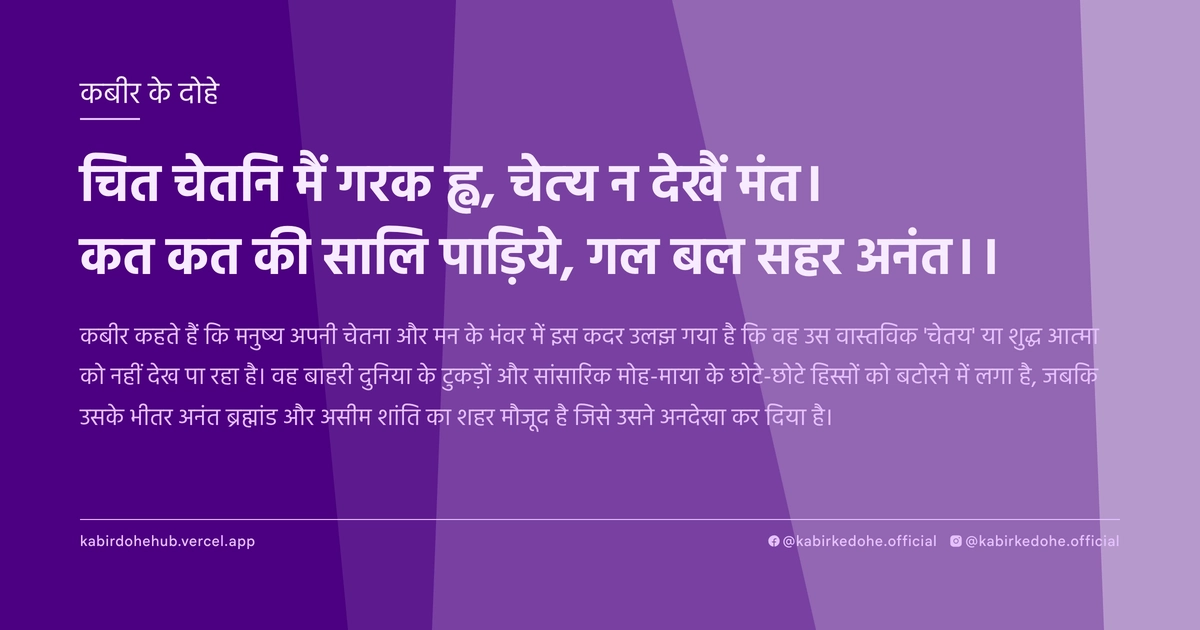
चित चेतनि मैं गरक ह्व, चेत्य न देखैं मंत।
कत कत की सालि पाड़िये, गल बल सहर अनंत।।
Chit chetani main garak hva, chetya na dekhein mant. Kat kat ki saali paadiye, gal bal sahar anant.
इस पृष्ठ पर इस कबीर दोहे का अर्थ (meaning), हिंदी व्याख्या और अंग्रेज़ी अनुवाद, दार्शनिक विश्लेषण और व्यावहारिक जीवन सीख दी गई है। यह दोहा अंतर ज्योति (The Inner Light) विषय से जुड़ा है — Kabir doha meaning and explanation in Hindi and English.
अर्थ (Meaning):
कबीर कहते हैं कि मनुष्य अपनी चेतना और मन के भंवर में इस कदर उलझ गया है कि वह उस वास्तविक 'चेतय' या शुद्ध आत्मा को नहीं देख पा रहा है। वह बाहरी दुनिया के टुकड़ों और सांसारिक मोह-माया के छोटे-छोटे हिस्सों को बटोरने में लगा है, जबकि उसके भीतर अनंत ब्रह्मांड और असीम शांति का शहर मौजूद है जिसे उसने अनदेखा कर दिया है।
Kabir observes that the human being has become so deeply immersed in the whirlpool of the mind and fluctuating consciousness that they fail to perceive the true 'Chetya' or the Pure Witness. The individual spends their entire existence gathering fragmented pieces of worldly desires and material attachments, completely oblivious to the fact that an infinite city of spiritual liberation and eternal peace resides within their own being.
व्याख्या (Interpretation):
इस दोहे का शाब्दिक अर्थ है कि मन की चंचलता ने सत्य को ढक लिया है। यहाँ 'गरक' शब्द डूबने का प्रतीक है, जो दर्शाता है कि हम विचारों के शोर में डूब चुके हैं। आध्यात्मिक स्तर पर, यह अद्वैत वेदांत के उस सिद्धांत को दर्शाता है जहाँ जीव स्वयं को शरीर और मन मान लेता है, जबकि वह वास्तव में ब्रह्म है। 'सालि' या टुकड़ों का संग्रह करना माया के प्रति आसक्ति है। कबीर यहाँ एक विरोधाभास प्रस्तुत करते हैं: हम बाहर छोटे शहरों और संपत्तियों की तलाश करते हैं, जबकि हमारे भीतर 'सहर अनंत' यानी अनंत चेतना का नगर है। यह निर्गुण भक्ति का सार है, जहाँ ईश्वर किसी मंदिर या मस्जिद में नहीं, बल्कि स्वयं के भीतर की शून्यता और पूर्णता में पाया जाता है।
Literally, the verse suggests that the turbulence of the mind has veiled the truth. The word 'garak' (drowning) serves as a powerful metaphor for how the soul is submerged in the noise of mental projections. Spiritually, this aligns with Advaita Vedanta, where the individual mistakenly identifies with the ego and body, forgetting their essence as Brahman. The act of gathering 'saali' (fragments) represents the futile pursuit of Maya, or cosmic illusion. Kabir presents a profound paradox: while the seeker wanders through the finite world searching for security, an 'infinite city' of consciousness exists within. This is the core of Nirgun Bhakti—the realization that the Formless Divine is not an external destination but the very ground of one's own existence, accessible only when the ego-mind is silenced.
दार्शनिक विश्लेषण (Philosophical Analysis):
कबीर का यह दोहा उस युग की प्रतिक्रिया है जहाँ धर्म केवल कर्मकांडों और बाहरी आडंबरों तक सीमित हो गया था। उन्होंने स्पष्ट किया कि मोक्ष किसी तीर्थ यात्रा या मंत्रोच्चार से नहीं, बल्कि आत्म-साक्षात्कार से मिलता है। यहाँ कबीर सूफी मत के 'फना' (अहंकार का विनाश) और वेदांत के 'अहं ब्रह्मास्मि' का संगम करते हैं। वे तर्क देते हैं कि जब तक मनुष्य 'चित' (मन) को ही सत्य मानता रहेगा, वह भ्रमित रहेगा।
सामाजिक रूप से, यह दोहा जाति और वर्ग के भेदों पर प्रहार करता है। यदि ईश्वर सबके भीतर 'अनंत शहर' के रूप में है, तो बाहरी भेदभाव निरर्थक हैं। कबीर का दर्शन मनोवैज्ञानिक रूपांतरण पर केंद्रित है; वे चाहते हैं कि साधक अपनी दृष्टि बाहर से हटाकर भीतर की ओर मोड़े।
यहाँ 'चेतय' शब्द का प्रयोग अत्यंत महत्वपूर्ण है। यह केवल जागरूकता नहीं, बल्कि वह शुद्ध चैतन्य है जो अपरिवर्तनीय है। कबीर समझाते हैं कि हम अपनी पहचान को अपनी उपलब्धियों, रिश्तों और शरीर से जोड़ लेते हैं, जो कि 'टुकड़ों' की तरह अस्थायी हैं।
यह विश्लेषण हमें बताता है कि आध्यात्मिक पतन का कारण अज्ञान नहीं, बल्कि 'गलत दिशा में प्रयास' है। हम सत्य को खोज रहे हैं, लेकिन वहाँ खोज रहे हैं जहाँ सत्य का अभाव है।
अंततः, कबीर का संदेश यह है कि जब अहंकार का पर्दा हटता है, तब व्यक्ति को पता चलता है कि वह जिसे खोज रहा था, वह स्वयं खोजकर्ता ही था। यह द्वैत से अद्वैत की ओर संक्रमण है।
This Doha emerges as a critique of an era dominated by rigid ritualism and superficial religious adherence. Kabir asserts that liberation is not achieved through pilgrimages or rote chanting, but through the direct experience of the Self. He synthesizes the Sufi concept of 'Fana' (annihilation of the ego) with the Vedantic realization of 'Aham Brahmasmi' (I am Brahman), suggesting that the mind is the primary veil between the seeker and the Truth.
Sociologically, this teaching dismantles caste and class hierarchies. If the Divine exists as an 'infinite city' within every human heart, then external distinctions based on birth or status are logically absurd. Kabir's focus is on a psychological shift: moving the locus of attention from the objective world to the subjective depths of consciousness.
The use of the term 'Chetya' is pivotal. It refers not to mere mental awareness, but to the Pure Witness—the unchanging consciousness that observes the flux of thoughts. Kabir argues that we mistakenly anchor our identity to transient fragments—achievements, relationships, and the physical body—which are as fleeting as dust.
This analysis reveals that spiritual failure is not due to a lack of effort, but a misdirection of it. We seek the Eternal in the realm of the ephemeral, attempting to find wholeness by accumulating fragments of the material world.
Ultimately, Kabir's message is that once the veil of the ego is lifted, the seeker discovers that the sought-after Divine was the seeker all along. This is the transition from duality (separation) to non-duality (unity), where the individual drop realizes it is the entire ocean.
मूल संदेश (Core Message):
- मन की चंचलता ही सत्य का सबसे बड़ा पर्दा है।
- बाहरी उपलब्धियाँ आत्मा की भूख को कभी नहीं मिटा सकतीं।
- आप वह नहीं हैं जो आप सोचते हैं, बल्कि वह हैं जो देख रहा है।
- पूर्णता बाहर जोड़ने से नहीं, बल्कि भीतर खोजने से आती है।
- अहंकार का विसर्जन ही अनंत चेतना का द्वार है।
- The turbulence of the mind is the greatest veil over Truth.
- External achievements can never satiate the hunger of the soul.
- You are not the one who thinks, but the one who witnesses the thought.
- Wholeness is not achieved by adding from outside, but by discovering within.
- The dissolution of the ego is the only gateway to infinite consciousness.
व्यावहारिक उदाहरण (Practical Example):
एक समय की बात है, वाराणसी के घाटों पर माधव नाम का एक वृद्ध बुनकर रहता था। माधव अपनी पूरी जिंदगी बेहतरीन रेशमी वस्त्र बनाने में लगा रहा। उसने अपनी कला में इतनी महारत हासिल की कि उसके वस्त्रों की मांग दूर-दराज के शहरों तक थी। वह दिन-रात केवल इस चिंता में रहता कि वह और अधिक धन कैसे कमाए, और अधिक सुंदर डिजाइन कैसे बनाए ताकि दुनिया उसे 'महानतम बुनकर' कहे।
माधव का जीवन 'टुकड़ों' को जोड़ने जैसा था—एक नया ऑर्डर, एक नया रंग, एक नई प्रशंसा। वह जितना अधिक कमाता, उसकी बेचैनी उतनी ही बढ़ती। उसे लगता था कि अभी कुछ और हासिल करना बाकी है, तभी वह पूर्ण होगा। वह अपने परिवार और स्वास्थ्य की अनदेखी कर केवल बाहरी सफलता के पीछे भागता रहा।
एक दिन, वह एक पुराने मंदिर की सीढ़ियों पर बैठा था, जहाँ एक फकीर शांत मुद्रा में आँखें बंद किए बैठा था। माधव ने उससे पूछा, "बाबा, मैंने जीवन भर श्रेष्ठता हासिल की, फिर भी मेरे भीतर एक खालीपन है जिसे मैं भर नहीं पा रहा। मैं और क्या जोड़ूँ अपने जीवन में?"
फकीर ने मुस्कुराते हुए माधव के हाथ में मौजूद रेशमी कपड़े के एक छोटे से टुकड़े की ओर इशारा किया और कहा, "तुम इस छोटे से टुकड़े को सहेजने में इतने व्यस्त हो कि तुमने उस अनंत करघे को भुला दिया है जिस पर तुम्हारा अपना जीवन बुना जा रहा है। तुम बाहर शहर बसा रहे हो, जबकि तुम्हारे भीतर एक पूरा साम्राज्य है जो तुम्हारी प्रतीक्षा कर रहा है।"
माधव को पहले तो यह बात समझ नहीं आई। लेकिन उस रात, उसने पहली बार अपनी आँखें बंद कीं और बाहरी दुनिया के शोर को शांत करने का प्रयास किया। उसने महसूस किया कि उसकी सारी दौड़ 'मैं' को बड़ा बनाने की थी।
जैसे ही उसने अपनी पहचान को 'बुनकर' से हटाकर केवल एक 'साक्षी' के रूप में देखना शुरू किया, उसे एक अजीब सी शांति महसूस हुई। उसे अहसास हुआ कि जिस पूर्णता को वह बाहर खोज रहा था, वह उसके भीतर की मौन उपस्थिति में पहले से ही मौजूद थी।
उसने अब भी कपड़े बुनना जारी रखा, लेकिन अब वह प्रशंसा के लिए नहीं, बल्कि आनंद के लिए बुनता था। उसकी बेचैनी खत्म हो गई क्योंकि उसने जान लिया था कि वह टुकड़ों का संग्रह नहीं, बल्कि स्वयं वह अनंत चेतना है।
माधव का जीवन अब एक संघर्ष नहीं, बल्कि एक उत्सव बन गया। उसने पाया कि जब हम बाहर की खोज छोड़ देते हैं, तभी भीतर का अनंत शहर प्रकट होता है।
Once, in the ghats of Varanasi, lived an elderly weaver named Madhav. Madhav spent his entire life crafting the finest silk garments. He attained such mastery that his work was sought after in distant cities. However, he lived in constant anxiety, obsessed with earning more wealth and creating more intricate designs so the world would recognize him as the 'Greatest Weaver'.
Madhav's life was like gathering 'fragments'—a new order, a new color, a new compliment. The more he accumulated, the deeper his restlessness grew. He felt that there was always something more to achieve before he could be truly complete, neglecting his health and family in the pursuit of external validation.
One day, while sitting on the steps of an ancient temple, he encountered a fakir sitting in profound stillness. Madhav asked, "Baba, I have achieved excellence in my craft, yet there is a void within me that I cannot fill. What more must I add to my life?"
The fakir smiled, pointed to a small scrap of silk in Madhav's hand, and said, "You are so preoccupied with preserving this tiny fragment that you have forgotten the infinite loom upon which your own life is being woven. You are trying to build a city outside, while an entire empire resides within you, waiting to be discovered."
At first, Madhav did not grasp the meaning. But that night, for the first time, he closed his eyes and attempted to silence the external noise of the world. He realized that his entire struggle had been an attempt to enlarge the 'I'—the ego.
As he shifted his identity from being a 'weaver' to being a 'witness', a strange and deep peace washed over him. He realized that the completeness he had been searching for externally was already present in the silent presence within.
He continued to weave silk, but no longer for praise; he wove for the sheer joy of creation. His restlessness vanished because he understood that he was not a collection of fragments, but the infinite consciousness itself.
Madhav's life ceased to be a struggle and became a celebration. He discovered that only when we stop the outward search does the infinite city within reveal itself.
अभ्यास मार्गदर्शन (Practice Guidance):
- प्रतिदिन 20 मिनट 'साक्षी भाव' का अभ्यास करें: अपने विचारों को ऐसे देखें जैसे आप सड़क किनारे खड़े होकर गुजरती हुई गाड़ियों को देख रहे हों।
- आत्म-पूछताछ जर्नल: हर शाम लिखें कि आज आपने कितनी बार अपनी पहचान को बाहरी उपलब्धियों या दूसरों की राय से जोड़ा।
- मौन का व्रत: सप्ताह में एक दिन कुछ घंटों के लिए पूर्ण मौन धारण करें, ताकि बाहरी 'टुकड़ों' का शोर कम हो और आंतरिक शांति सुनाई दे।
- निदान चेकलिस्ट: क्या आप अभी भी इस बात से परेशान हैं कि लोग आपके बारे में क्या सोचते हैं? क्या आप अपनी खुशी को भविष्य की किसी उपलब्धि पर टिकाए हुए हैं? यदि हाँ, तो आप अभी भी 'टुकड़ों' में उलझे हैं।
- Practice 'Witness Consciousness' for 20 minutes daily: Observe your thoughts as if you are standing on a sidewalk watching cars pass by, without attaching to them.
- Self-Inquiry Journaling: Every evening, record instances where you tied your identity to external achievements or the opinions of others.
- Vow of Silence: Observe complete silence for a few hours once a week to diminish the noise of external 'fragments' and hear the inner stillness.
- Diagnostic Checklist: Are you still distressed by how others perceive you? Is your happiness contingent upon a future achievement? If yes, you are still entangled in the 'fragments'.
चिंतन प्रश्न (Reflection Questions):
- यदि आपकी सारी डिग्रियाँ, पद और संपत्ति छीन ली जाए, तो 'आप' कौन बचेंगे?
- आप अपने जीवन के किन 'टुकड़ों' को सहेजने में इतने व्यस्त हैं कि आपने अपनी आंतरिक शांति को भुला दिया है?
- क्या आपका डिजिटल व्यक्तित्व (सोशल मीडिया) आपके वास्तविक स्वरूप को ढकने वाला एक नया 'भ्रम' बन गया है?
- वह कौन सा डर है जो आपको शांत बैठकर स्वयं के भीतर झांकने से रोकता है?
- क्या आप वास्तव में स्वतंत्र हैं, या आप अपनी इच्छाओं के गुलाम हैं जिन्हें आप 'अपनी पसंद' कहते हैं?
- If all your degrees, titles, and assets were stripped away, who would 'you' be?
- Which 'fragments' of life are you so busy collecting that you have ignored your inner peace?
- Has your digital persona become a new 'illusion' that masks your authentic self?
- What is the specific fear that prevents you from sitting in stillness and gazing within?
- Are you truly free, or are you a slave to desires that you mistakenly call 'your choices'?