
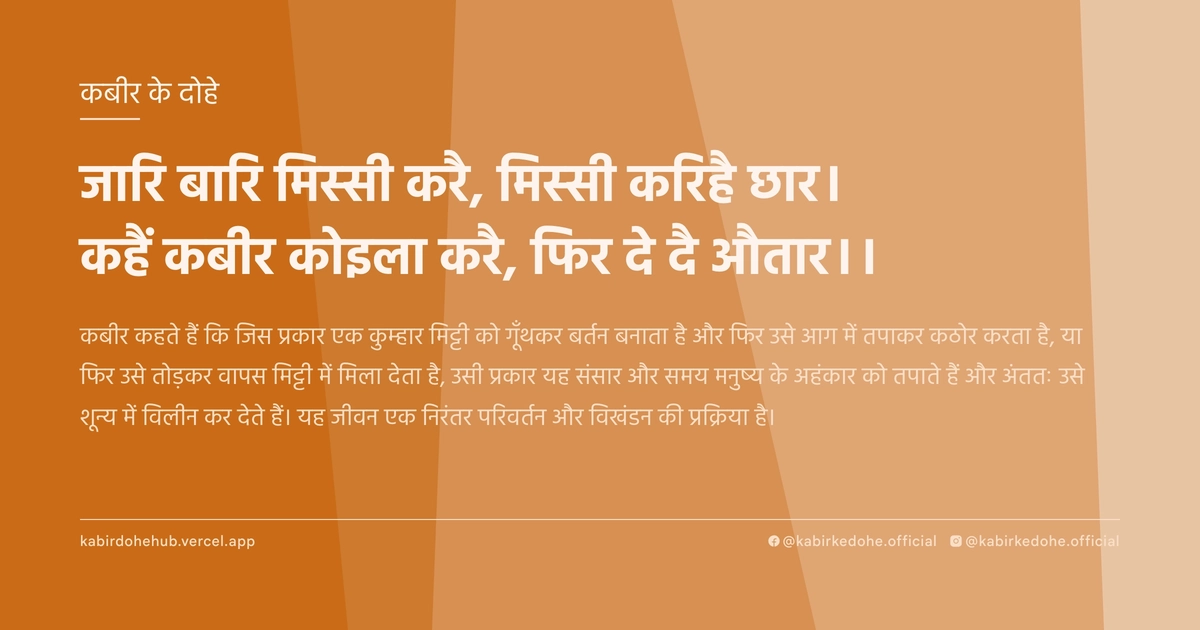
जारि बारि मिस्सी करै, मिस्सी करिहै छार।
कहैं कबीर कोइला करै, फिर दे दै औतार।।
Jaari baari missi karai, missi karihai chhaar. Kahain Kabir koila karai, phir de dai autaar.
इस पृष्ठ पर इस कबीर दोहे का अर्थ (meaning), हिंदी व्याख्या और अंग्रेज़ी अनुवाद, दार्शनिक विश्लेषण और व्यावहारिक जीवन सीख दी गई है। यह दोहा अनित्य (Impermanence) विषय से जुड़ा है — Kabir doha meaning and explanation in Hindi and English.
अर्थ (Meaning):
कबीर कहते हैं कि जिस प्रकार एक कुम्हार मिट्टी को गूँथकर बर्तन बनाता है और फिर उसे आग में तपाकर कठोर करता है, या फिर उसे तोड़कर वापस मिट्टी में मिला देता है, उसी प्रकार यह संसार और समय मनुष्य के अहंकार को तपाते हैं और अंततः उसे शून्य में विलीन कर देते हैं। यह जीवन एक निरंतर परिवर्तन और विखंडन की प्रक्रिया है।
Kabir observes that just as a potter kneads clay to shape a vessel and then fires it in a kiln to harden it, or eventually breaks it back into dust, so does the world and time treat the human ego. Life is a relentless cycle of shaping, hardening, and eventual dissolution, reminding us that all material forms are transient and destined to return to their primal state.
व्याख्या (Interpretation):
यहाँ 'मिस्सी' और 'छार' का प्रयोग भौतिक और आध्यात्मिक रूपांतरण के लिए किया गया है। शाब्दिक अर्थ में यह मिट्टी के बर्तन बनाने की प्रक्रिया है, लेकिन रूपक के तौर पर यह आत्मा के अहंकार के विनाश की यात्रा है। निर्गुण भक्ति के संदर्भ में, यह दर्शाता है कि परमात्मा (कुम्हार) हमें अनुभवों की आग में तपाता है ताकि हमारी अशुद्धियाँ जल जाएँ। माया वह भ्रम है जो हमें यह विश्वास दिलाता है कि हम 'बर्तन' (स्थिर पहचान) हैं, जबकि सत्य यह है कि हम केवल 'मिट्टी' (ब्रह्म) हैं। यह द्वैत से अद्वैत की ओर संक्रमण है, जहाँ व्यक्तिगत पहचान का विसर्जन ही वास्तविक मुक्ति है। अंत में, जब अहंकार पूरी तरह नष्ट हो जाता है, तब आत्मा अपने मूल स्वरूप में विलीन हो जाती है।
The terms 'missi' (kneading/mixing) and 'chhaar' (ash/dust) serve as metaphors for physical and spiritual transmutation. Literally, it describes pottery, but metaphorically, it depicts the annihilation of the human ego. In the context of Nirgun Bhakti, the Divine (the Potter) subjects the soul to the fire of worldly experiences to burn away impurities. Maya is the illusion that convinces us we are the 'vessel' (a fixed, separate identity), whereas the truth is that we are merely the 'clay' (Brahman). This represents the transition from duality to non-duality, where the dissolution of the individual persona is the only path to liberation. Ultimately, once the ego is completely shattered, the soul merges back into its primordial, formless essence.
दार्शनिक विश्लेषण (Philosophical Analysis):
कबीर का यह दोहा उनके समय के कट्टरपंथी धार्मिक अनुष्ठानों और बाहरी आडंबरों पर एक गहरा प्रहार है। वे यह समझाते हैं कि मोक्ष किसी मंदिर या मस्जिद में नहीं, बल्कि स्वयं के अहंकार के विसर्जन में है। यह विचार अद्वैत वेदांत के करीब है, जहाँ 'अहं ब्रह्मास्मि' का अर्थ केवल ज्ञान नहीं, बल्कि उस 'मैं' का पूर्ण विनाश है जो हमें दूसरों से अलग करता है।
सूफीवाद के 'फना' (Fana) के सिद्धांत की तरह, कबीर यहाँ आत्मा के पूर्ण समर्पण की बात कर रहे हैं। जिस प्रकार मिट्टी अपनी पहचान खोकर बर्तन बनती है और फिर धूल बनकर विलीन हो जाती है, उसी प्रकार साधक को अपनी सामाजिक और व्यक्तिगत पहचान को मिटाना पड़ता है। कबीर का तर्क है कि जो व्यक्ति अपनी कठोर पहचान (पकी हुई मिट्टी) से चिपका रहता है, वह दुख पाता है, क्योंकि परिवर्तन प्रकृति का नियम है।
ऐतिहासिक रूप से, कबीर ने जाति व्यवस्था और वर्ण व्यवस्था को चुनौती दी क्योंकि ये व्यवस्थाएं मनुष्य को एक 'निश्चित सांचे' या 'बर्तन' में कैद कर देती थीं। वे चाहते थे कि मनुष्य इन कृत्रिम श्रेणियों को तोड़कर अपनी मूल मानवता और दिव्यता को पहचाने। उनके लिए, ईश्वर कोई बाहरी सत्ता नहीं, बल्कि वह कुम्हार है जो हमारे भीतर ही सक्रिय है।
मनोवैज्ञानिक स्तर पर, यह दोहा संज्ञानात्मक विखंडन की प्रक्रिया को दर्शाता है। हम अक्सर अपनी उपलब्धियों, पद और प्रतिष्ठा को अपनी स्थायी पहचान मान लेते हैं। कबीर चेतावनी देते हैं कि समय की आग इन सबको भस्म कर देगी। यह बोध व्यक्ति को विनम्र बनाता है और उसे वर्तमान क्षण में जीने के लिए प्रेरित करता है।
अंततः, यह दर्शन सिखाता है कि विनाश वास्तव में सृजन का पूर्वगामी है। जब तक पुराना 'मैं' नहीं टूटता, तब तक नया, दिव्य स्वरूप प्रकट नहीं हो सकता। यह 'शून्य' की अवस्था है, जहाँ न कोई कर्ता है और न कोई कर्म, केवल शुद्ध चेतना शेष रहती है।
This couplet is a profound critique of the rigid religious rituals and external pomposity prevalent during Kabir's era. He posits that liberation is found not in temples or mosques, but in the systematic dissolution of the ego. This aligns closely with Advaita Vedanta, where 'Aham Brahmasmi' is not merely an intellectual realization but the total eradication of the 'I' that perceives separation from the Whole.
Parallel to the Sufi concept of 'Fana' (annihilation), Kabir speaks of the soul's absolute surrender. Just as clay loses its identity to become a pot and then returns to dust, the seeker must shed their social and personal identities. Kabir argues that those who cling to their hardened identity (the fired pot) suffer, for transmutation is the only cosmic constant.
Historically, Kabir challenged the caste system and social hierarchies because these structures forced individuals into 'fixed molds' or 'vessels.' He urged humanity to break these artificial categories to rediscover their primordial divinity. For him, God is not an external entity but the internal Potter actively shaping the soul through experience.
Psychologically, the verse illustrates the process of cognitive dismantling. Humans often mistake their achievements, titles, and status for a permanent identity. Kabir warns that the fire of time inevitably consumes these constructs. This realization fosters humility and anchors the individual in the present moment, stripping away the vanity of permanence.
Ultimately, this philosophy teaches that destruction is the precursor to creation. Until the old 'self' is shattered, the divine essence cannot emerge. This is the state of 'Shunya' (Void), where the duality of the doer and the deed vanishes, leaving only pure, unadulterated consciousness.
मूल संदेश (Core Message):
- अहंकार एक कठोर खोल है जिसे समय की आग में जलना होगा।
- स्थिरता एक भ्रम है; परिवर्तन ही एकमात्र शाश्वत सत्य है।
- अपनी पहचान को 'बर्तन' नहीं, बल्कि 'मिट्टी' के रूप में देखें।
- विनाश अंत नहीं, बल्कि मूल स्वरूप में लौटने की प्रक्रिया है।
- जब 'मैं' मिटता है, तभी 'परमात्मा' का अनुभव संभव होता है।
- The ego is a rigid shell that must be consumed by the fire of time.
- Stability is an illusion; transmutation is the only eternal truth.
- View your identity not as the 'vessel,' but as the 'clay.'
- Destruction is not an end, but a return to the primordial essence.
- Only when the 'I' is annihilated does the experience of the Divine begin.
व्यावहारिक उदाहरण (Practical Example):
वाराणसी के एक पुराने मोहल्ले में माधव नाम का एक अत्यंत कुशल लेकिन अहंकारी मूर्तिकार रहता था। वह अपनी बनाई मूर्तियों की बारीकियों पर इतना गर्व करता था कि वह खुद को ईश्वर के समान समझने लगा था। वह मानता था कि उसकी कला अमर है और वह अपनी श्रेष्ठता से समय को भी मात दे सकता है।
एक बार उसने एक ऐसी मूर्ति बनाई जिसे उसने अपना 'सर्वश्रेष्ठ कार्य' कहा। उसने उस मूर्ति को शहर के सबसे बड़े उत्सव में प्रदर्शित किया। लेकिन उत्सव की रात, एक भीषण दुर्घटना हुई और एक भारी बीम गिरकर उसकी उस अद्भुत मूर्ति को चकनाचूर कर दिया। माधव टूट गया; उसे लगा कि उसकी पूरी पहचान और अस्तित्व उस मिट्टी के ढेर के साथ बिखर गया है।
वह हताश होकर गंगा के किनारे बैठा था, तभी उसकी मुलाकात एक वृद्ध संन्यासी से हुआ। संन्यासी ने उसकी टूटी हुई मूर्ति के टुकड़ों की ओर इशारा करते हुए कहा, 'माधव, तू उस बर्तन के टूटने पर रो रहा है जिसे तूने अपनी पहचान बना लिया था, लेकिन क्या तूने गौर किया कि मिट्टी अब भी वही है? वह मुक्त हो गई है।'
माधव को कबीर की बात याद आई कि कुम्हार मिट्टी को गूँथता है और फिर उसे धूल कर देता है। उसे अहसास हुआ कि उसका अहंकार उस 'बर्तन' की तरह था जो उसे यह भ्रम दे रहा था कि वह दूसरों से अलग और श्रेष्ठ है। वह मूर्ति उसकी कला नहीं, बल्कि उसके अहंकार का प्रतीक थी।
इस घटना ने माधव के भीतर एक गहरा परिवर्तन किया। उसने फिर से मूर्तियाँ बनाना शुरू किया, लेकिन अब वह अपनी कला को 'अमर' बनाने की कोशिश नहीं करता था। वह अब हर मूर्ति को इस भाव से बनाता था कि यह एक दिन मिट्टी में मिल जाएगी, और इसी नश्वरता में उसे असली सुंदरता दिखने लगी।
उसने अपनी कार्यशाला के दरवाजे गरीब बच्चों के लिए खोल दिए और उन्हें निःशुल्क कला सिखानी शुरू की। अब वह अपनी प्रशंसा की खोज नहीं करता था, बल्कि दूसरों की प्रगति में आनंद लेने लगा। उसका 'मैं' अब एक विशाल 'हम' में बदल चुका था।
वह अब केवल एक मूर्तिकार नहीं था, बल्कि एक साधक बन गया था। उसने सीखा कि असली सृजन वह नहीं है जो टिका रहे, बल्कि वह है जो हमें हमारे अहंकार से मुक्त कर दे।
वर्षों बाद, जब लोग उससे उसकी सफलता का राज पूछते, तो वह बस मुस्कुराकर अपनी मिट्टी की ओर इशारा करता और कहता, 'मैं बस इस मिट्टी का एक छोटा सा हिस्सा हूँ, जो समय आने पर वापस इसी में मिल जाएगा।'
In an ancient alley of Varanasi lived Madhav, a master sculptor of immense skill but equal arrogance. He took such pride in the intricate details of his idols that he began to perceive himself as a peer to the Divine. He believed his art was immortal and that his superiority could outwit time itself.
Once, he crafted a sculpture he deemed his 'magnum opus.' He displayed it at the city's grandest festival. However, on the night of the celebration, a catastrophic accident occurred; a heavy beam collapsed, shattering his masterpiece into a thousand jagged shards. Madhav was devastated; he felt his entire identity and existence had crumbled along with that pile of clay.
Despondent, he sat by the banks of the Ganges, where he encountered an elderly monk. Pointing to the broken fragments, the monk remarked, 'Madhav, you weep for the breaking of a vessel you mistook for your identity, but have you noticed that the clay remains? It has finally been set free.'
Madhav recalled Kabir's words about the potter who kneads the clay only to eventually return it to dust. He realized that his ego was like that 'vessel,' creating the illusion that he was separate and superior to others. The sculpture was not a testament to his art, but a monument to his vanity.
This epiphany triggered a profound transformation. He resumed sculpting, but he no longer sought to make his work 'immortal.' He began crafting every piece with the conscious awareness that it would one day return to earth, and in this transience, he discovered true beauty.
He opened the doors of his studio to underprivileged children, teaching them the art for free. He ceased searching for praise and instead found joy in the growth of others. His narrow 'I' had expanded into a universal 'We.'
He was no longer just a sculptor; he had become a seeker. He learned that true creation is not that which lasts, but that which liberates us from the prison of the ego.
Years later, when people asked the secret of his peace, he would simply smile, point to the raw clay, and say, 'I am but a small fragment of this earth, destined to merge back into it when the time is right.'
अभ्यास मार्गदर्शन (Practice Guidance):
- दैनिक चिंतन: प्रतिदिन 15 मिनट मौन बैठें और विचार करें कि आपकी कौन सी पहचान (पद, रिश्ता, छवि) सबसे अधिक 'कठोर' या 'अहंकारी' हो गई है।
- स्व-पूछताछ जर्नल: लिखें कि जब आपकी किसी योजना या मान्यता का 'विनाश' होता है, तो आपको कैसा महसूस होता है? क्या आप उस टूटन में किसी नई संभावना को देख पा रहे हैं?
- व्यवहार परिवर्तन: किसी ऐसे व्यक्ति की मदद करें जिससे आपका वैचारिक मतभेद हो, यह महसूस करते हुए कि आप दोनों अंततः एक ही 'मिट्टी' (चेतना) के हिस्से हैं।
- निदान चेकलिस्ट: यदि आप छोटी आलोचनाओं पर अत्यधिक क्रोधित होते हैं या अपनी उपलब्धियों का बार-बार बखान करते हैं, तो समझें कि आपका 'बर्तन' अभी बहुत कठोर है और उसे टूटने की आवश्यकता है।
- Daily Contemplation: Spend 15 minutes in silence identifying which part of your identity (status, relationship, image) has become too 'rigid' or 'hardened' by ego.
- Self-Inquiry Journal: Document your emotional response when a plan or belief is 'shattered.' Ask yourself: Can I perceive a new possibility within this dissolution?
- Behavioral Shift: Perform an act of service for someone with whom you have a deep ideological conflict, acknowledging that you both originate from the same 'clay' (universal consciousness).
- Diagnostic Checklist: If you react with intense anger to minor criticisms or feel a compulsive need to broadcast your achievements, recognize that your 'vessel' is too rigid and requires the fire of humility to break.
चिंतन प्रश्न (Reflection Questions):
- यदि आज आपकी सारी सामाजिक प्रतिष्ठा और उपलब्धियां छीन ली जाएं, तो आपके भीतर क्या बचेगा?
- आप अपनी छवि को बचाने के लिए झूठ या दिखावे का सहारा कहाँ लेते हैं? वह 'बर्तन' आपको कैसे कैद कर रहा है?
- क्या आप वास्तव में बदलाव चाहते हैं, या आप केवल अपनी वर्तमान पहचान के 'सजावटी' संस्करण को बेहतर बनाना चाहते हैं?
- आपके जीवन का वह कौन सा 'टूटा हुआ हिस्सा' है जिसने आपको सबसे अधिक आध्यात्मिक गहराई दी है?
- क्या आप अपनी मृत्यु को एक अंत के रूप में देखते हैं या एक महान विसर्जन के रूप में?
- If all your social prestige and achievements were stripped away today, what would remain of you?
- Where do you employ lies or pretension to protect your image? How is that 'vessel' imprisoning you?
- Do you truly desire transformation, or are you merely trying to create a more 'decorative' version of your current identity?
- Which 'shattered' part of your life has provided you with the most profound spiritual depth?
- Do you perceive your eventual death as a finality or as a grand dissolution into the Whole?