
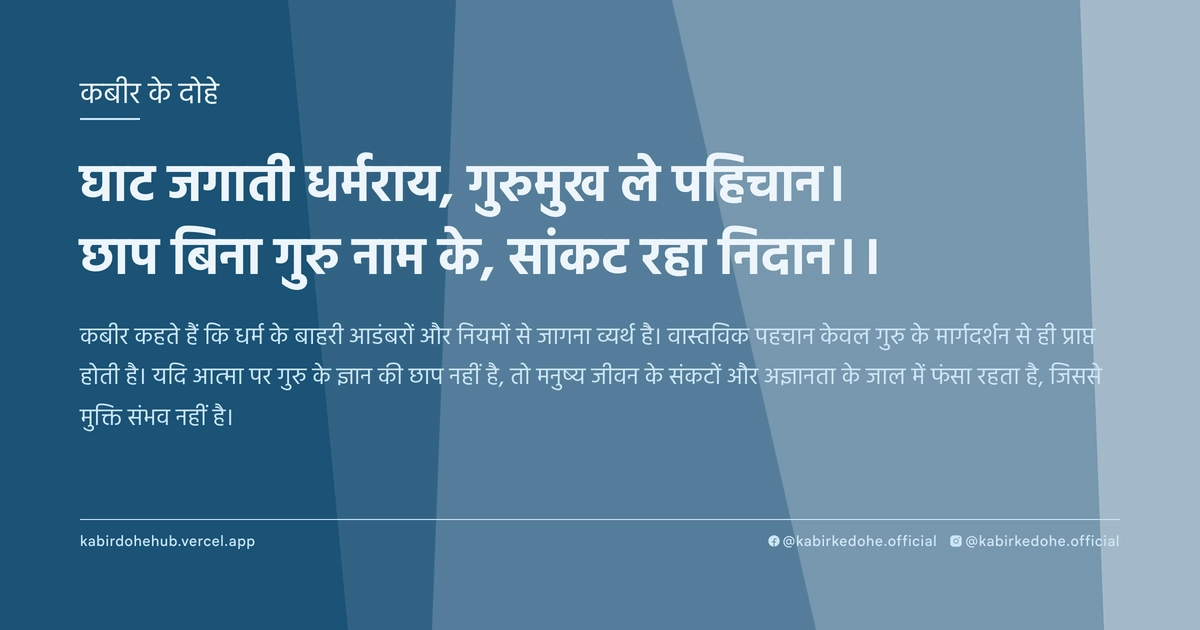
घाट जगाती धर्मराय, गुरुमुख ले पहिचान।
छाप बिना गुरु नाम के, सांकट रहा निदान।।
Ghaat jagati dharmray, gurmukh le pahichaan. Chhaap bina guru naam ke, saankat raha nidaan.
इस पृष्ठ पर इस कबीर दोहे का अर्थ (meaning), हिंदी व्याख्या और अंग्रेज़ी अनुवाद, दार्शनिक विश्लेषण और व्यावहारिक जीवन सीख दी गई है। यह दोहा गुरु महत्व (The Guru's Importance) विषय से जुड़ा है — Kabir doha meaning and explanation in Hindi and English.
अर्थ (Meaning):
कबीर कहते हैं कि धर्म के बाहरी आडंबरों और नियमों से जागना व्यर्थ है। वास्तविक पहचान केवल गुरु के मार्गदर्शन से ही प्राप्त होती है। यदि आत्मा पर गुरु के ज्ञान की छाप नहीं है, तो मनुष्य जीवन के संकटों और अज्ञानता के जाल में फंसा रहता है, जिससे मुक्ति संभव नहीं है।
Kabir asserts that awakening through the superficial rituals of organized religion is futile. True recognition of the self is attained only through the grace and guidance of a Satguru. Without the indelible imprint of the Guru's wisdom upon the soul, one remains trapped in the cycle of existential crises and ignorance, unable to find liberation.
व्याख्या (Interpretation):
यहाँ 'धर्मराय' बाहरी धार्मिक कानूनों का प्रतीक है जो अक्सर बंधन बन जाते हैं। कबीर का तर्क है कि केवल शास्त्रों को पढ़ने से नहीं, बल्कि गुरुमुख (गुरु की ओर उन्मुख) होने से आत्म-साक्षात्कार होता है। 'छाप' शब्द यहाँ आध्यात्मिक रूपांतरण को दर्शाता है—जैसे मोहर लगने से दस्तावेज़ प्रमाणित होता है, वैसे ही गुरु का ज्ञान अहंकार को मिटाकर आत्मा को प्रमाणित करता है। यह निर्गुण भक्ति का सार है जहाँ ईश्वर किसी मूर्ति में नहीं, बल्कि गुरु द्वारा जगाई गई आंतरिक चेतना में है। माया हमें बाहरी पहचानों में उलझाती है, जबकि गुरु हमें उस अद्वैत सत्य से मिलाता है जहाँ भक्त और भगवान एक हो जाते हैं। यह विरोधाभास है कि जिसे हम अपना 'धर्म' कहते हैं, वही अक्सर सत्य के मार्ग में सबसे बड़ी बाधा बन जाता है।
Here, 'Dharmarai' symbolizes the external religious laws and dogmas that often become shackles rather than bridges. Kabir argues that awakening does not occur through the mere recitation of scriptures, but by becoming 'Gurumukh'—facing the Guru. The term 'Chhap' (imprint) signifies a profound spiritual transmutation; just as a seal authenticates a document, the Guru's wisdom authenticates the soul by erasing the ego. This is the essence of Nirgun Bhakti, where the Divine is not found in idols but in the inner consciousness awakened by the Master. Maya entangles us in social and religious identities, while the Guru leads us toward the non-dual truth of Advaita, where the distinction between the seeker and the Sought vanishes. It is a poignant paradox that the very 'religion' we cling to often becomes the primary obstacle to realizing Truth.
दार्शनिक विश्लेषण (Philosophical Analysis):
कबीर का यह दोहा उनके युग के सामाजिक और धार्मिक पाखंड पर एक तीखा प्रहार है। उस समय धर्म केवल कर्मकांडों और जातिगत श्रेष्ठता का साधन बन गया था। कबीर ने 'धर्मराय' के माध्यम से यह स्पष्ट किया कि संस्थागत धर्म अक्सर सत्य को ढक देता है। वे यहाँ सूफी मत के 'पीर' और भारतीय परंपरा के 'गुरु' के संश्लेषण को प्रस्तुत करते हैं, जहाँ गुरु केवल एक व्यक्ति नहीं, बल्कि वह दिव्य ऊर्जा है जो शिष्य के भीतर के अंधकार को मिटाती है।
अद्वैत वेदांत के परिप्रेक्ष्य में, यह दोहा 'अविद्या' (अज्ञान) के विनाश की बात करता है। जब तक व्यक्ति अपनी पहचान शरीर, नाम या जाति से जोड़ता है, वह माया के प्रभाव में रहता है। गुरु की 'छाप' वास्तव में वह बोध है कि 'अहं ब्रह्मास्मि' (मैं ही ब्रह्म हूँ)। यह प्रक्रिया अहंकार के पूर्ण विलोपन की मांग करती है, क्योंकि अहंकार और ज्ञान एक साथ नहीं रह सकते।
सूफीवाद के 'फना' (स्वयं को मिटाना) के सिद्धांत के समान, कबीर यहाँ शिष्य को अपनी पुरानी पहचान को नष्ट करने का आह्वान करते हैं। जब तक 'मैं' जीवित है, तब तक गुरु का नाम केवल शब्दों का समूह है। जब 'मैं' मिटता है, तब गुरु का ज्ञान एक जीवंत अनुभव बन जाता है।
कबीर का विरोध केवल बाहरी पूजा से नहीं, बल्कि उस मानसिक स्थिति से है जो स्वयं को दूसरों से श्रेष्ठ मानती है। वे तर्क देते हैं कि बिना आंतरिक रूपांतरण के, कोई भी धार्मिक क्रिया केवल एक प्रदर्शन है। वास्तविक धर्म वह है जो मनुष्य को उसके मूल स्वरूप से मिलाए।
अंततः, यह विश्लेषण हमें बताता है कि मुक्ति का मार्ग बौद्धिक नहीं, बल्कि अनुभवात्मक है। गुरु वह माध्यम है जो हमें तर्क से परे ले जाकर उस मौन में स्थापित करता है जहाँ सारे द्वंद्व समाप्त हो जाते हैं और केवल शुद्ध चेतना शेष रहती है।
This couplet is a sharp critique of the social and religious hypocrisy prevalent during Kabir's era. At that time, religion had devolved into a tool for ritualistic performance and caste-based superiority. Through 'Dharmarai,' Kabir clarifies that institutionalized religion often obscures the Truth rather than revealing it. He presents a synthesis of the Sufi 'Pir' and the Indian 'Guru,' where the teacher is not merely a person but a divine catalyst that dissolves the disciple's inner darkness.
From the perspective of Advaita Vedanta, this Doha addresses the annihilation of 'Avidya' (ignorance). As long as an individual identifies with the body, name, or caste, they remain under the spell of Maya. The 'imprint' of the Guru is, in reality, the realization of 'Aham Brahmasmi' (I am Brahman). This process demands the total dissolution of the ego, for the ego and true knowledge cannot coexist in the same space.
Parallel to the Sufi concept of 'Fana' (annihilation of the self), Kabir calls upon the seeker to destroy their conditioned identity. As long as the 'I' persists, the Guru's name remains a mere collection of words. When the 'I' vanishes, the Guru's wisdom becomes a living, breathing experience.
Kabir's opposition is not merely to external worship, but to the psychological state of spiritual pride. He argues that without internal transformation, any religious act is a mere performance. True religion is that which reconnects the human being with their primordial essence.
Ultimately, this analysis reveals that the path to liberation is not intellectual but experiential. The Guru is the medium who leads the seeker beyond logic into that profound silence where all dualities cease and only pure consciousness remains.
मूल संदेश (Core Message):
- बाहरी कर्मकांड केवल शरीर को व्यस्त रखते हैं, आत्मा को नहीं।
- सच्ची पहचान अहंकार के विसर्जन के बाद ही प्रकट होती है।
- गुरु का ज्ञान वह कुंजी है जो माया के तालों को खोलती है।
- बिना आंतरिक रूपांतरण के धर्म केवल एक सामाजिक मुखौटा है।
- अद्वैत का अनुभव ही जीवन के समस्त संकटों का अंतिम समाधान है।
- External rituals occupy the body, but they do not awaken the soul.
- True identity emerges only after the dissolution of the ego.
- The Guru's wisdom is the key that unlocks the shackles of Maya.
- Religion without internal transformation is merely a social mask.
- The experience of non-duality is the ultimate resolution to all existential crises.
व्यावहारिक उदाहरण (Practical Example):
वाराणसी के घाटों पर रहने वाले एक वृद्ध विधवा, जानकी, का जीवन केवल कठोर नियमों और सामाजिक वर्जनाओं के इर्द-गिर्द घूमता था। वह प्रतिदिन घंटों मंत्र जाप करती और शुद्धता के कड़े नियमों का पालन करती, फिर भी उसके मन में एक गहरी बेचैनी और दूसरों के प्रति निर्णय लेने की प्रवृत्ति बनी रहती थी। वह मानती थी कि धर्म का अर्थ है इन नियमों का पालन करना।
एक दिन उसकी मुलाकात एक साधारण से फकीर से हुई जो घाट की सीढ़ियों पर चुपचाप बैठा था। जानकी ने उसे अपने कठिन तप और नियमों के बारे में बताया, यह उम्मीद करते हुए कि फकीर उसकी प्रशंसा करेगा। फकीर ने केवल मुस्कुराकर पूछा, 'माई, इन नियमों ने तुम्हारे भीतर के क्रोध और अहंकार को कम किया या उन्हें और बढ़ा दिया?'
जानकी स्तब्ध रह गई। उसने महसूस किया कि उसके 'धर्म' ने उसे पवित्र तो बना दिया था, लेकिन वह उसे दूसरों से अलग और श्रेष्ठ महसूस कराने का एक साधन बन गया था। वह धर्म केवल एक बाहरी आवरण था, उसके भीतर का शून्य अब भी वैसा ही था।
फकीर ने उसे समझाया कि असली धर्म वह नहीं जो तुम्हें दुनिया से अलग करे, बल्कि वह है जो तुम्हें दुनिया के साथ एक कर दे। उसने कहा, 'जब तक तुम खुद को एक 'पवित्र विधवा' मानती रहोगी, तुम कभी उस परमात्मा को नहीं जान पाओगी जो गंदे नाले और पवित्र गंगा दोनों में समान रूप से बहता है।'
यह शब्द जानकी के लिए उस 'गुरु की छाप' की तरह थे। उसने महसूस किया कि वह अब तक केवल 'धर्मराय' (धार्मिक कानूनों) की गुलामी कर रही थी, जबकि वास्तविक पहचान तो प्रेम और करुणा में छिपी थी।
धीरे-धीरे जानकी ने अपने कठोर नियमों को छोड़ दिया। उसने उन लोगों की मदद करना शुरू किया जिन्हें समाज 'अपवित्र' मानता था। उसने पाया कि जब वह दूसरों के दुखों में खुद को देखती है, तो उसका मानसिक तनाव गायब हो जाता है।
उसका जीवन अब प्रदर्शन नहीं, बल्कि एक साधना बन गया था। वह अब मंत्रों को केवल पढ़ती नहीं थी, बल्कि उन्हें अपने व्यवहार में उतारने लगी। उसकी आँखों में अब निर्णय नहीं, बल्कि एक असीम करुणा थी।
अंत में, जानकी को समझ आया कि गुरु कोई व्यक्ति नहीं, बल्कि वह बोध है जिसने उसे उसके अहंकार के पिंजरे से मुक्त किया। वह अब वास्तव में 'जाग' चुकी थी, क्योंकि उसने बाहरी धर्म को छोड़कर आंतरिक सत्य को अपना लिया था।
Janaki, an elderly widow living on the ghats of Varanasi, spent her life revolving around rigid rules and social taboos. She spent hours daily chanting mantras and adhering to strict purity laws, yet a deep restlessness and a tendency to judge others persisted within her. She believed that religion meant the flawless execution of these rituals.
One day, she encountered a simple Fakir sitting silently on the steps of the ghat. Janaki described her rigorous austerities and adherence to rules, expecting the Fakir to praise her devotion. The Fakir simply smiled and asked, 'Mother, have these rules diminished the anger and ego within you, or have they only amplified them?'
Janaki was stunned. She realized that her 'religion' had made her appear pure, but it had also become a tool to make her feel separate and superior to others. Her faith was merely an external shell; the inner void remained untouched.
The Fakir explained that true religion is not that which separates you from the world, but that which unites you with it. He said, 'As long as you identify as a "holy widow," you will never know the Divine that flows equally through the filthy gutter and the sacred Ganges.'
These words acted as the 'Guru's imprint' for Janaki. She realized she had been a slave to 'Dharmarai' (religious laws), while true identity lay hidden in love and compassion.
Gradually, Janaki let go of her rigid restrictions. She began helping those whom society deemed 'impure.' She discovered that when she saw herself in the suffering of others, her mental anguish vanished.
Her life ceased to be a performance and became a living meditation. She no longer just recited mantras; she embodied them in her behavior. The judgment in her eyes was replaced by an infinite compassion.
In the end, Janaki understood that the Guru is not necessarily a person, but the awakening that liberates one from the cage of ego. She had finally 'awakened' because she had traded external dogma for internal truth.
अभ्यास मार्गदर्शन (Practice Guidance):
- दैनिक आत्म-निरीक्षण: प्रतिदिन 20 मिनट मौन बैठें और देखें कि क्या आपकी धार्मिक या नैतिक मान्यताएं आपको दूसरों से श्रेष्ठ महसूस करा रही हैं।
- अहंकार की पहचान: एक जर्नल लिखें जिसमें उन क्षणों को दर्ज करें जब आपने अपनी 'पहचान' (जाति, पद, धर्म) का उपयोग दूसरों को नीचा दिखाने के लिए किया।
- सेवा का अभ्यास: किसी ऐसे व्यक्ति की निस्वार्थ मदद करें जिसके प्रति आपके मन में कोई पूर्वाग्रह हो, ताकि आप अपनी आंतरिक सीमाओं को तोड़ सकें।
- डायग्नोस्टिक चेकलिस्ट: क्या मैं नियमों के पालन पर अधिक ध्यान दे रहा हूँ या प्रेम के विस्तार पर? क्या मेरी शांति बाहरी परिस्थितियों पर निर्भर है? क्या मैं खुद को 'पवित्र' मानकर दूसरों को 'पापी' देख रहा हूँ?
- Daily Self-Inquiry: Sit in silence for 20 minutes daily and observe whether your religious or moral beliefs are making you feel superior to others.
- Ego Mapping: Keep a journal recording moments where you used your 'identity' (caste, position, religion) to subtly belittle or distance yourself from others.
- Compassion Practice: Perform a selfless act of service for someone toward whom you hold a subconscious bias, breaking your internal boundaries.
- Diagnostic Checklist: Am I focusing more on the adherence to rules or the expansion of love? Is my peace dependent on external validation? Do I perceive myself as 'pure' and others as 'sinners'?
चिंतन प्रश्न (Reflection Questions):
- यदि आपसे आपकी धार्मिक, सामाजिक और व्यावसायिक पहचान छीन ली जाए, तो आपके पास क्या बचेगा?
- क्या आपका 'धर्म' आपको अधिक विनम्र बना रहा है, या यह आपके अहंकार को एक नया और 'पवित्र' आधार दे रहा है?
- आप किन गुप्त पूर्वाग्रहों को अपनी नैतिकता के पीछे छिपाते हैं?
- क्या आप सत्य की खोज कर रहे हैं, या केवल अपनी मौजूदा मान्यताओं की पुष्टि करना चाहते हैं?
- आपके जीवन में 'गुरु' का अर्थ क्या है—एक व्यक्ति, एक पुस्तक, या एक आंतरिक बोध?
- If your religious, social, and professional identities were stripped away, what would remain of you?
- Is your 'religion' making you more humble, or is it providing a new, 'holy' foundation for your ego?
- What hidden biases do you conceal behind the veil of your morality?
- Are you truly seeking the Truth, or are you merely seeking confirmation of your existing beliefs?
- What does 'Guru' mean in your life—a person, a book, or an internal awakening?