
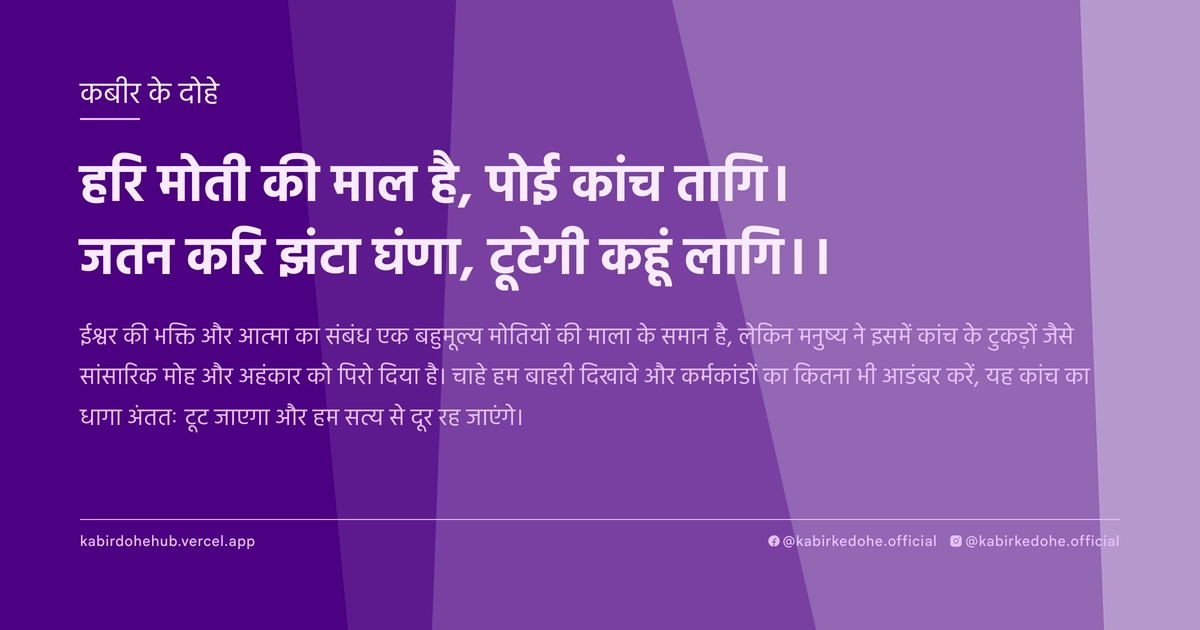
हरि मोती की माल है, पोई कांच तागि।
जतन करि झंटा घंणा, टूटेगी कहूं लागि।।
Hari moti ki maal hai, poi kaanch taagi. Jatan kari jhanta ghanna, tootegi kahun laagi.
इस पृष्ठ पर इस कबीर दोहे का अर्थ (meaning), हिंदी व्याख्या और अंग्रेज़ी अनुवाद, दार्शनिक विश्लेषण और व्यावहारिक जीवन सीख दी गई है। यह दोहा अनित्य (Impermanence) विषय से जुड़ा है — Kabir doha meaning and explanation in Hindi and English.
अर्थ (Meaning):
ईश्वर की भक्ति और आत्मा का संबंध एक बहुमूल्य मोतियों की माला के समान है, लेकिन मनुष्य ने इसमें कांच के टुकड़ों जैसे सांसारिक मोह और अहंकार को पिरो दिया है। चाहे हम बाहरी दिखावे और कर्मकांडों का कितना भी आडंबर करें, यह कांच का धागा अंततः टूट जाएगा और हम सत्य से दूर रह जाएंगे।
The divine connection is like a necklace of priceless pearls, yet humans have strung it with shards of glass—representing worldly attachments and ego. No matter how much outward effort or ritualistic ornamentation we add to this structure, the fragile glass thread of illusion will inevitably break, leaving the seeker empty.
व्याख्या (Interpretation):
यहाँ 'मोती' शुद्ध चेतना और परमात्मा का प्रतीक है, जबकि 'कांच' माया और मिथ्या अहंकार को दर्शाता है। कबीर कहते हैं कि हमने सत्य (मोती) को असत्य (कांच) के साथ जोड़ दिया है। यह द्वैत का वह भ्रम है जहाँ साधक ईश्वर को बाहरी रूप, नाम या जाति में खोजता है। निर्गुण भक्ति के अनुसार, जब तक 'मैं' (अहंकार) का कांच मौजूद है, तब तक आत्मा और ब्रह्म का अद्वैत मिलन संभव नहीं है। यह विरोधाभास है कि हम जिसे बचाने की कोशिश कर रहे हैं, वही हमारे पतन का कारण है।
In this metaphor, 'pearls' symbolize pure consciousness and the Divine, while 'glass' represents Maya and the false ego. Kabir suggests that we have entwined the Eternal Truth with transient illusions. This reflects the duality where a seeker searches for God in external forms, labels, or castes. According to Nirgun Bhakti, as long as the 'glass' of the ego persists, the non-duality of Atman and Brahman remains obscured. The central paradox is that the very structures we build to 'protect' our spirituality are the fragile threads that ensure its collapse.
दार्शनिक विश्लेषण (Philosophical Analysis):
कबीर का यह दोहा उनके युग के धार्मिक पाखंड और कर्मकांडीय कठोरता पर एक तीखा प्रहार है। उन्होंने देखा कि लोग तीर्थयात्रा, लंबी मालाओं और बाहरी दिखावे (झंटा) के माध्यम से मोक्ष पाने की कोशिश कर रहे थे, जबकि उनके भीतर घृणा और अहंकार का कांच भरा था। यह दृष्टिकोण अद्वैत वेदांत के उस सिद्धांत से मेल खाता है जहाँ 'अविद्या' (अज्ञान) ही बंधन का कारण है।
सूफी मत के 'फना' के सिद्धांत की तरह, कबीर यहाँ अहंकार के पूर्ण विनाश की बात कर रहे हैं। यदि माला का धागा कांच का है, तो वह दबाव पड़ने पर टूट जाएगा। इसी तरह, यदि भक्ति का आधार केवल सामाजिक प्रतिष्ठा या डर है, तो वह संकट के समय काम नहीं आएगी। कबीर का तर्क है कि सत्य को किसी बाहरी आवरण की आवश्यकता नहीं है; वह स्वयं प्रकाशमान है।
ऐतिहासिक रूप से, कबीर ने जाति व्यवस्था को चुनौती दी क्योंकि यह समाज को 'कांच के टुकड़ों' में विभाजित करती थी। वे सिखाते हैं कि ईश्वर किसी विशेष समुदाय का नहीं, बल्कि सार्वभौमिक है। यह विश्लेषण हमें बताता है कि आध्यात्मिक प्रगति बाहरी संचय में नहीं, बल्कि आंतरिक विसर्जन में है।
मनोवैज्ञानिक स्तर पर, यह दोहा हमारी 'पहचान' (Identity) के संकट को दर्शाता है। हम अपनी उपलब्धियों और उपाधियों को मोतियों की तरह सजाते हैं, लेकिन वे वास्तव में कांच हैं जो हमें वास्तविकता से अलग करते हैं। जब मृत्यु या विफलता का प्रहार होता है, तो यह कृत्रिम पहचान बिखर जाती है।
अंततः, कबीर यह संदेश देते हैं कि केवल 'प्रेम' और 'साधना' ही वह वास्तविक धागा हो सकते हैं जो आत्मा को परमात्मा से जोड़ सकें। बिना अहंकार के विसर्जन के, हर आध्यात्मिक प्रयास केवल एक सजावटी दिखावा है जो अंततः विफल होगा।
This couplet is a sharp critique of the religious hypocrisy and ritualistic rigidity of Kabir's era. He observed people attempting to attain salvation through pilgrimages, long prayer beads, and outward displays (jhanta), while their inner selves were filled with the 'glass' of hatred and ego. This aligns with the Advaita Vedanta principle where 'Avidya' (ignorance) is the primary cause of bondage.
Mirroring the Sufi concept of 'Fana' (annihilation), Kabir advocates for the total dissolution of the ego. If the thread of the necklace is made of glass, it will shatter under pressure. Similarly, if devotion is based merely on social prestige or fear, it will fail during the ultimate crisis of existence. Kabir argues that Truth requires no external ornamentation; it is self-luminous.
Historically, Kabir challenged the caste system because it fragmented society into 'shards of glass.' He taught that the Divine is not the property of a specific community but is universal. This analysis reveals that spiritual progress lies not in external accumulation but in internal surrender.
Psychologically, the Doha addresses the crisis of identity. We decorate our lives with achievements and titles like pearls, but these are actually glass fragments that alienate us from our true nature. When the strike of death or failure occurs, this artificial identity shatters instantly.
Ultimately, Kabir suggests that only selfless love and sincere 'Sadhana' can serve as the authentic thread connecting the soul to the Divine. Without the annihilation of the ego, every spiritual endeavor is merely a decorative facade destined for collapse.
मूल संदेश (Core Message):
- बाहरी आडंबर केवल आत्मा के वास्तविक प्रकाश को ढकने वाला कांच है।
- सच्ची भक्ति अहंकार के विसर्जन में है, न कि धार्मिक प्रतीकों के संचय में।
- जब 'मैं' मिटता है, तभी 'वह' (परमात्मा) प्रकट होता है।
- प्रेम ही वह एकमात्र धागा है जो अविनाशी और सत्य है।
- आध्यात्मिक यात्रा बाहरी सजावट से आंतरिक शुद्धि की ओर एक संक्रमण है।
- सत्य सरल है; जटिलता केवल हमारे अहंकार की रचना है।
- External rituals are merely glass shards obscuring the soul's true light.
- True devotion lies in the dissolution of ego, not in the accumulation of religious symbols.
- Only when the 'I' vanishes does the 'Divine' manifest.
- Love is the only thread that is indestructible and true.
- The spiritual journey is a transition from external decoration to internal purification.
- Truth is simple; complexity is merely a creation of our ego.
व्यावहारिक उदाहरण (Practical Example):
वाराणसी के एक पुराने घाट पर माधव नाम का एक वृद्ध नाविक रहता था। माधव अपनी ईमानदारी और विनम्रता के लिए जाना जाता था, लेकिन उसके मन में एक गहरा दुख था। वह वर्षों से गंगा आरती में शामिल होता, महंगे वस्त्र पहनता और दान-पुण्य करता, यह सोचकर कि इससे उसे समाज में सम्मान मिलेगा और ईश्वर प्रसन्न होंगे। उसने अपने जीवन को एक 'धार्मिक पहचान' के रूपे में सजाया था, जैसे मोतियों की माला में कांच पिरोया गया हो।
एक दिन, एक युवा सन्यासी उसके पास आया और माधव की बाहरी सज्जा को देखकर मुस्कुराया। सन्यासी ने पूछा, "माधव, तुम्हारी माला सुंदर है, लेकिन क्या तुम्हारा मन भी उतना ही पारदर्शी है?"
माधव ने गर्व से कहा, "मैं प्रतिदिन घंटों पूजा करता हूँ और शहर के सबसे बड़े दानदाताओं में से एक हूँ।"
तभी एक घटना घटी। एक गरीब मछुआरे की नाव पलट गई और वह डूबने लगा। माधव ने देखा, लेकिन वह अपनी महंगी रेशमी धोती को गंदा होने देने के डर से हिचकिचाया। उसने सोचा कि यदि वह कीचड़ में उतरेगा, तो उसकी 'पवित्र' छवि धूमिल हो जाएगी।
उस क्षण, सन्यासी ने माधव की आँखों में देखा और कहा, "यही वह कांच है माधव, जिसने तुम्हारे मोतियों को ढक रखा है। तुम्हारी भक्ति केवल एक दिखावा है, एक कांच का धागा है जो केवल तुम्हारी प्रशंसा के लिए बना है।"
माधव को गहरा धक्का लगा। उसे एहसास हुआ कि उसकी सारी पूजा, उसके दान और उसकी धार्मिक पहचान वास्तव में उसके अहंकार को पोषण दे रहे थे। वह जिसे मोक्ष का मार्ग समझ रहा था, वह वास्तव में उसकी अपनी छवि का मोह था।
उस रात माधव सो नहीं सका। उसने अपनी रेशमी धोती उतारी और अगले दिन से बिना किसी दिखावे के लोगों की सेवा में लग गया। उसने जाना कि असली मोती 'करुणा' है, न कि 'कर्मकांड'।
अब वह किसी को यह नहीं बताता था कि वह कितना दान करता है। उसने अपनी पहचान का वह कांच का धागा तोड़ दिया।
जब उसने दूसरों के दुख को अपना माना, तब उसे पहली बार उस शांति का अनुभव हुआ जिसे वह वर्षों से मंदिरों और मालाओं में खोज रहा था।
माधव का जीवन अब एक सच्ची मोतियों की माला बन गया था, जहाँ हर मोती निस्वार्थ सेवा और प्रेम का था, जिसे अब कोई भी अहंकार नहीं तोड़ सकता था।
On an ancient ghat in Varanasi lived an elderly boatman named Madhav. Madhav was known for his honesty, but he carried a hidden sorrow. For years, he attended the Ganga Aarti, wore expensive clothes, and gave lavish donations, believing this would earn him social respect and please the Divine. He had decorated his life as a 'religious identity,' much like stringing glass shards into a pearl necklace.
One day, a young monk approached him and smiled at Madhav's outward ornamentation. The monk asked, "Madhav, your necklace is beautiful, but is your mind equally transparent?"
Madhav replied with pride, "I pray for hours daily and am one of the city's greatest donors."
Suddenly, an incident occurred. A poor fisherman's boat capsized, and he began to drown. Madhav saw this, but he hesitated, fearing his expensive silk dhoti would get soiled. He thought that if he stepped into the mud, his 'pure' image would be tarnished.
In that moment, the monk looked into Madhav's eyes and said, "This is the glass, Madhav, that has hidden your pearls. Your devotion is merely a facade, a thread of glass created only for your own praise."
Madhav was deeply shaken. He realized that all his prayers, donations, and religious identity were actually feeding his ego. What he perceived as the path to liberation was merely an attachment to his own image.
Madhav could not sleep that night. He discarded his silk dhoti and, from the next day, began serving people without any pretense.
He stopped telling others how much he donated. He broke the glass thread of his social identity.
Only when he embraced the suffering of others as his own did he experience the peace he had spent years searching for in temples and beads.
Madhav's life now became a true necklace of pearls, where every bead was made of selfless service and love, which no ego could ever shatter.
अभ्यास मार्गदर्शन (Practice Guidance):
- प्रतिदिन 20 मिनट मौन ध्यान करें, जहाँ आप अपने विचारों को केवल एक दर्शक की तरह देखें, बिना उन्हें सही या गलत ठहराए।
- एक 'अहंकार पत्रिका' (Ego Journal) बनाएँ। दिन भर में जब भी आपको अपनी प्रशंसा सुनकर अच्छा लगे या किसी की आलोचना करने का मन करे, उसे लिखें और विश्लेषण करें कि वहाँ कौन सा 'कांच' काम कर रहा है।
- सचेत सेवा: सप्ताह में एक बार ऐसा कार्य करें जिसमें आपकी पहचान गुप्त रहे और आपको कोई श्रेय न मिले। यह आपके 'छवि-मोह' को तोड़ने का अभ्यास है।
- निदान चेकलिस्ट: क्या मैं दूसरों की मदद इसलिए करता हूँ ताकि मैं 'अच्छा' दिखूँ? क्या मेरी शांति मेरी प्रशंसा पर निर्भर है? क्या मैं धर्म को नियमों के रूप में देखता हूँ या प्रेम के रूप में? यदि उत्तर 'हाँ' है, तो आप अभी भी कांच के धागे से बंधे हैं।
- Practice 20 minutes of silent meditation daily, observing your thoughts as a detached witness without judging them as right or wrong.
- Maintain an 'Ego Journal.' Whenever you feel a surge of pleasure from praise or an urge to criticize others, record it and analyze which 'glass shard' of ego is operating.
- Conscious Service: Once a week, perform an act of kindness where your identity remains anonymous and you receive no credit. This is an exercise to break the attachment to image.
- Diagnostic Checklist: Do I help others primarily to look 'good'? Is my inner peace dependent on external validation? Do I view spirituality as a set of rules or as an expression of love? If the answer is 'yes,' you are still bound by the glass thread.
चिंतन प्रश्न (Reflection Questions):
- मेरे जीवन में वे कौन से 'मोती' हैं जिन्हें मैं वास्तव में संजो रहा हूँ, और वे कौन से 'कांच' हैं जिन्हें मैं मोती समझ बैठा हूँ?
- यदि मेरी सारी सामाजिक उपाधियाँ और धार्मिक पहचान छीन ली जाएँ, तो मेरे भीतर क्या बचेगा?
- क्या मेरी आध्यात्मिकता मुझे दूसरों के प्रति अधिक विनम्र बना रही है, या यह मुझे दूसरों से 'श्रेष्ठ' महसूस कराने का साधन बन गई है?
- मैं अपनी डिजिटल पहचान (सोशल मीडिया) पर जिस छवि को गढ़ता हूँ, वह सत्य है या केवल एक सजावटी कांच का धागा?
- मेरे भीतर का वह कौन सा डर है जो मुझे पूरी तरह से निस्वार्थ होने से रोकता है?
- क्या मैं ईश्वर को खोज रहा हूँ, या मैं केवल उस ईश्वर की खोज में लगे एक 'आदर्श व्यक्ति' की छवि खोज रहा हूँ?
- What are the true 'pearls' I am cherishing in my life, and which 'glass shards' have I mistaken for pearls?
- If all my social titles and religious identities were stripped away, what would remain within me?
- Is my spirituality making me more humble toward others, or has it become a tool to feel 'superior' to them?
- The image I curate for my digital identity—is it truth, or merely a decorative thread of glass?
- What is the fear within me that prevents me from being completely selfless?
- Am I searching for the Divine, or am I merely searching for the image of an 'ideal person' who is searching for the Divine?