
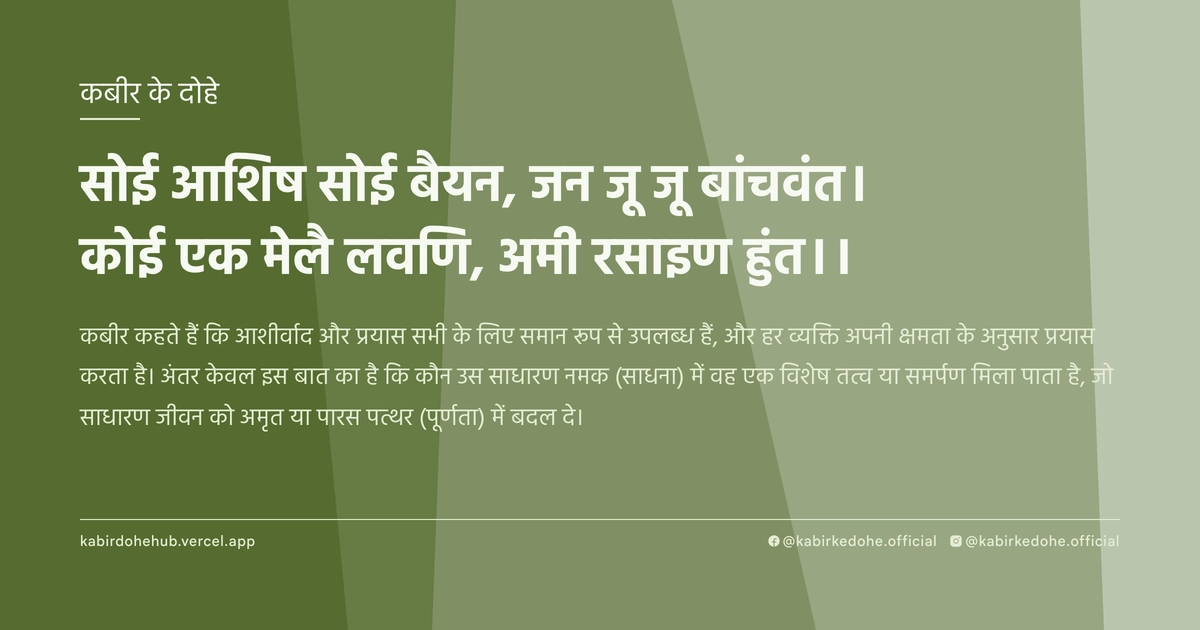
सोई आशिष सोई बैयन, जन जू जू बांचवंत।
कोई एक मेलै लवणि, अमी रसाइण हुंत।।
Soi aashish soi baiyan, jan ju ju baanchwant. Koi ek melai lavani, ami rasayin hunt.
इस पृष्ठ पर इस कबीर दोहे का अर्थ (meaning), हिंदी व्याख्या और अंग्रेज़ी अनुवाद, दार्शनिक विश्लेषण और व्यावहारिक जीवन सीख दी गई है। यह दोहा सहज योग (Sahaja Yoga) विषय से जुड़ा है — Kabir doha meaning and explanation in Hindi and English.
अर्थ (Meaning):
कबीर कहते हैं कि आशीर्वाद और प्रयास सभी के लिए समान रूप से उपलब्ध हैं, और हर व्यक्ति अपनी क्षमता के अनुसार प्रयास करता है। अंतर केवल इस बात का है कि कौन उस साधारण नमक (साधना) में वह एक विशेष तत्व या समर्पण मिला पाता है, जो साधारण जीवन को अमृत या पारस पत्थर (पूर्णता) में बदल दे।
Kabir asserts that divine grace and the means to achieve it are equally accessible to all, and everyone strives according to their own capacity. The fundamental difference lies in the one who knows how to blend a pinch of true devotion—like salt in a dish—to transform the mundane existence into a nectar of immortality or a philosopher's stone of spiritual realization.
व्याख्या (Interpretation):
यहाँ 'आशिष' और 'बैयन' (हाथ/साधन) का समान होना इस बात का संकेत है कि आध्यात्मिक मार्ग पर कोई भी जन्मजात श्रेष्ठ नहीं है। कबीर एक रासायनिक रूपक का उपयोग करते हैं जहाँ 'लवणि' (नमक) साधारण मानवीय प्रयास का प्रतीक है और 'अमी रसाइण' (अमृत रसायन) उस उच्चतम अवस्था का, जहाँ आत्मा परमात्मा में विलीन हो जाती है। यह निर्गुण भक्ति का सार है: ईश्वर किसी विशेष जाति या कर्मकांड में नहीं, बल्कि उस सूक्ष्म 'परिवर्तन' में है जो अहंकार के मिटने से आता है। जब साधक अपनी व्यक्तिगत इच्छाओं को ईश्वरीय इच्छा में मिला देता है, तो वह साधारण मनुष्य से 'रसायण' बन जाता है। यह अद्वैत वेदांत की उस स्थिति को दर्शाता है जहाँ द्वैत समाप्त हो जाता है और केवल शुद्ध चेतना शेष रहती है।
The equality of 'aashish' (blessing) and 'baiyan' (means/hands) signifies that no one is inherently superior on the spiritual path. Kabir employs a chemical metaphor where 'lavani' (salt) represents ordinary human effort, and 'ami rasain' (divine elixir) represents the state of ultimate liberation. This is the essence of Nirgun Bhakti: the Divine is not found in specific castes or rituals, but in the subtle 'transformation' triggered by the dissolution of the ego. When the seeker blends their individual will into the Divine Will, the mundane self is transmuted into a spiritual catalyst. This mirrors the Advaita Vedanta state where duality vanishes, leaving only pure, non-dual consciousness (Brahman), transforming the leaden heart into spiritual gold.
दार्शनिक विश्लेषण (Philosophical Analysis):
कबीर का यह दोहा उस युग की प्रतिक्रिया है जहाँ धर्म केवल बाहरी आडंबरों और जन्म आधारित श्रेष्ठता तक सीमित था। वे स्पष्ट करते हैं कि मोक्ष का साधन किसी विशेष पुरोहित या मंदिर के पास नहीं, बल्कि स्वयं मनुष्य के भीतर है। यह विचार सूफीवाद के 'फना' (अहंकार का विनाश) और अद्वैत वेदांत के 'अहं ब्रह्मास्मि' के बीच एक सेतु बनाता है। कबीर का तर्क है कि यदि हम केवल बाहरी नियमों का पालन करते हैं, तो हम केवल 'नमक' की तरह स्वाद बदल रहे हैं, लेकिन यदि हम आंतरिक रूपांतरण (Alchemy) करते हैं, तो हम स्वयं अमृत बन जाते हैं।
यहाँ 'रसायण' शब्द का प्रयोग अत्यंत महत्वपूर्ण है। प्राचीन रसायन शास्त्र में रसाइण वह पदार्थ था जो किसी भी धातु को सोने में बदल दे। आध्यात्मिक संदर्भ में, यह 'गुरु-तत्त्व' या 'सच्ची लगन' है। कबीर यह समझाते हैं कि अधिकांश लोग केवल कर्मकांडों की ऊपरी परत पर चलते हैं, जबकि वास्तविक परिवर्तन उस एक बिंदु पर होता है जहाँ मनुष्य अपनी पहचान को पूरी तरह त्याग देता है।
यह विश्लेषण हमें बताता है कि भक्ति केवल प्रार्थना नहीं, बल्कि एक मनोवैज्ञानिक सर्जरी है। जब तक 'मैं' (अहंकार) मौजूद है, तब तक हम केवल साधारण नमक हैं। जैसे ही वह 'मैं' ईश्वरीय प्रेम में घुल जाता है, वह साधारण नमक ही अमृत बन जाता है। यह विरोधाभास है कि जिसे हम खोज रहे हैं, वह हमारे भीतर ही है, बस उसे पहचानने की दृष्टि चाहिए।
कबीर जाति और धर्म के भेदों को नकारते हुए यह स्थापित करते हैं कि ईश्वर की कृपा सार्वभौमिक है। वे कहते हैं कि साधन सबके पास हैं, लेकिन परिणाम केवल उनके लिए है जो 'तप' और 'तन्मयता' के साथ उस मिश्रण को तैयार करते हैं। यह एक आह्वान है कि हम बाहरी खोज को छोड़कर आंतरिक रसायन विज्ञान पर ध्यान दें।
अंततः, यह दोहा हमें सिखाता है कि आध्यात्मिक पूर्णता किसी चमत्कार से नहीं, बल्कि सचेत जागरूकता और पूर्ण समर्पण से आती है। यह उस बिंदु की बात करता है जहाँ प्रयास (Effort) और कृपा (Grace) एक हो जाते हैं, और साधक स्वयं वह मार्ग बन जाता है जिस पर वह चल रहा था।
This couplet is a profound reaction to an era where religion was confined to external rituals and birth-based superiority. Kabir clarifies that the means to liberation are not held by a specific priest or temple but reside within the individual. This perspective creates a bridge between the Sufi concept of 'Fana' (annihilation of the self) and the Advaita Vedanta realization of 'Aham Brahmasmi' (I am Brahman). Kabir argues that following external rules is merely adjusting the 'salt' of existence, but internal transmutation is what creates the elixir.
The use of the term 'Rasain' (Alchemy/Elixir) is pivotal. In ancient alchemy, a 'rasayan' was a substance capable of turning base metals into gold. Spiritually, this represents the 'Guru-element' or 'True Longing.' Kabir explains that while most people skim the surface of ritualism, true transformation occurs at the precise point where the human ego is completely surrendered.
This analysis reveals that Bhakti is not mere prayer, but a psychological surgery. As long as the 'I' (ego) exists, we remain as common salt. The moment this 'I' dissolves into divine love, the salt itself becomes the nectar. This is the central paradox: the goal we seek is already within us, awaiting only the vision to recognize it.
By rejecting caste and sectarian divides, Kabir establishes that divine grace is universal. He posits that while the tools are available to all, the result is reserved for those who prepare the mixture with 'Tapas' (discipline) and total absorption. It is a call to cease the external search and focus on the internal alchemy of the soul.
Ultimately, the doha teaches that spiritual perfection is not a miracle but a result of conscious awareness and total surrender. It speaks of the intersection where human effort and divine grace merge, and the seeker becomes the very path they were once traversing.
मूल संदेश (Core Message):
- साधन सबके पास हैं, दृष्टि की कमी है।
- बाहरी कर्मकांड केवल नमक हैं, आंतरिक प्रेम अमृत है।
- अहंकार का विसर्जन ही वास्तविक रसायण है।
- साधारण जीवन को सेवा से असाधारण बनाया जा सकता है।
- ईश्वर किसी विशेष वर्ग के लिए नहीं, सबके लिए उपलब्ध है।
- The means are universal; only the vision is lacking.
- External rituals are mere salt; internal love is the nectar.
- The dissolution of ego is the only true alchemy.
- A mundane life can be made extraordinary through selfless service.
- The Divine is not reserved for a few, but accessible to all.
व्यावहारिक उदाहरण (Practical Example):
एक समय की बात है, वाराणसी के घाटों पर माधव नाम का एक वृद्ध नाविक रहता था। माधव का जीवन अत्यंत साधारण था; वह दिन भर पर्यटकों को नाव की सैर कराता और शाम को जो कुछ मिलता, उससे अपना गुजारा करता। वह खुद को बहुत छोटा और अज्ञानी मानता था, जबकि उसके पास आने वाले कई विद्वान पंडित और धनी व्यापारी अपनी श्रेष्ठता का प्रदर्शन करते थे।
माधव ने देखा कि लोग गंगा में डुबकी लगाते हैं, मंत्र पढ़ते हैं और महंगे दान देते हैं, फिर भी उनके चेहरों पर शांति नहीं थी। वह अक्सर सोचता कि क्या ईश्वर केवल उन लोगों के लिए है जो संस्कृत जानते हैं या जिनके पास सोने के गहने हैं? वह अपनी साधारणता से दुखी था और सोचता था कि उसके पास तो कोई 'विशेष' साधन नहीं है।
एक दिन, एक फकीर उसकी नाव पर सवार हुआ। फकीर ने माधव की आँखों में वह तड़प देखी और मुस्कुराते हुए कहा, "बेटा, सब नाव चला रहे हैं, लेकिन कुछ केवल किनारे तक पहुँचने के लिए और कुछ लहरों के संगीत को सुनने के लिए। साधन सबके पास एक ही नाव है, अंतर केवल नीयत का है।"
माधव ने पूछा, "बाबा, मैं तो अनपढ़ हूँ, मेरे पास क्या साधन है?"
फकीर ने जवाब दिया, "जैसे नमक बिना स्वाद के बेकार है, वैसे ही कर्म बिना प्रेम के बोझ है। तू अपनी नाव चलाने के काम को ही प्रार्थना बना ले। जब तू किसी बीमार यात्री को सहारा देता है या किसी भूखे को अपनी रोटी देता है, तो तू उस साधारण नमक में अमृत मिला रहा होता है।"
माधव के जीवन में एक सूक्ष्म बदलाव आया। उसने अब नाव चलाना केवल पैसा कमाने का जरिया नहीं समझा। उसने तय किया कि वह हर यात्री की सेवा ऐसे करेगा जैसे वह स्वयं ईश्वर की सेवा कर रहा हो। उसने अपनी छोटी सी कमाई का एक हिस्सा चुपचाप उन लोगों को देना शुरू किया जो घाटों पर लाचार थे।
समय बीतता गया। लोग माधव की नाव की ओर आकर्षित होने लगे, न केवल उसकी कुशलता के कारण, बल्कि उस असीम शांति के कारण जो उसके व्यक्तित्व से झलकती थी। जो पंडित पहले उसे तुच्छ समझते थे, अब वे उसके पास बैठकर जीवन की सरलता सीखने लगे।
माधव ने महसूस किया कि उसने कोई नया मंत्र नहीं सीखा, न ही किसी तीर्थ की यात्रा की। उसने बस अपने साधारण जीवन के 'नमक' में 'सेवा और प्रेम' का वह एक तत्व मिला दिया था, जिसने उसके साधारण अस्तित्व को एक आध्यात्मिक रसायण में बदल दिया था।
उसकी नाव अब केवल पानी पर नहीं, बल्कि चेतना के उच्च स्तर पर तैर रही थी। उसने जान लिया था कि ईश्वर किसी विशेष विधि में नहीं, बल्कि उस शुद्ध भाव में है जो साधारण को असाधारण बना देता है।
Once in the ghats of Varanasi, there lived an elderly boatman named Madhav. Madhav's life was profoundly simple; he spent his days rowing tourists across the river and lived on whatever meager earnings he gathered. He viewed himself as small and ignorant, especially when compared to the learned pundits and wealthy merchants who often flaunted their superiority in his boat.
Madhav observed that while people took dips in the Ganges, chanted complex mantras, and gave lavish donations, their faces remained devoid of peace. He often wondered if God was reserved only for those who knew Sanskrit or possessed gold ornaments. He felt burdened by his own simplicity, believing he lacked the 'special' means to reach the Divine.
One day, a wandering Sufi dervish boarded his boat. The dervish noticed the longing in Madhav's eyes and smiled, saying, "Son, everyone is rowing a boat, but some do it only to reach the shore, while others do it to listen to the music of the waves. The means—the boat—is the same for all; the difference lies only in the intention."
Madhav asked, "Baba, I am illiterate. What means do I possess?"
The dervish replied, "Just as salt is useless without taste, action is a burden without love. Make the act of rowing your boat your very prayer. When you support a sick traveler or share your bread with the hungry, you are mixing the nectar into the ordinary salt of your life."
A subtle shift occurred in Madhav's life. He stopped viewing boat-rowing as a mere means of survival. He decided to serve every passenger as if he were serving the Divine itself. He began quietly sharing a portion of his small earnings with the destitute living along the riverbanks.
As time passed, people were drawn to Madhav's boat—not just for his skill, but for the immense peace that radiated from his presence. The pundits who once looked down upon him now sought his company to learn the art of simplicity.
Madhav realized that he hadn't learned any new mantra nor traveled to any distant pilgrimage. He had simply added the element of 'selfless love' to the 'salt' of his daily routine, transforming his ordinary existence into a spiritual elixir.
His boat was no longer just gliding on water, but on a higher plane of consciousness. He understood that God is not found in a specific method, but in the pure intention that turns the mundane into the extraordinary.
अभ्यास मार्गदर्शन (Practice Guidance):
- दैनिक चिंतन: प्रतिदिन 15 मिनट मौन बैठें और विचार करें कि आपके जीवन का 'साधारण नमक' (दैनिक कार्य) क्या है और आप उसमें 'प्रेम' का तत्व कैसे मिला सकते हैं।
- आत्म-पूछताछ जर्नल: लिखें कि किन क्षणों में आपका अहंकार आपको दूसरों से श्रेष्ठ या निम्न महसूस कराता है। इस द्वैत को मिटाने का प्रयास करें।
- व्यवहारिक परिवर्तन: दिन भर में कम से कम एक ऐसा कार्य करें जिसका कोई श्रेय आपको न मिले, केवल निस्वार्थ भाव से करें।
- निदान चेकलिस्ट: क्या मैं अभी भी बाहरी प्रतीकों (पद, ज्ञान, धन) में शांति खोज रहा हूँ? क्या मेरा व्यवहार दूसरों के प्रति करुणा से प्रेरित है या केवल कर्तव्य से? यदि उत्तर 'बाहरी' है, तो आप अभी भी केवल नमक के स्तर पर हैं।
- Daily Contemplation: Sit in silence for 15 minutes daily and reflect on what constitutes the 'ordinary salt' (daily chores) of your life and how you can infuse it with the element of 'divine love'.
- Self-Inquiry Journal: Document moments where your ego makes you feel superior or inferior to others. Actively work to dissolve this duality.
- Behavioral Shift: Perform at least one act of service daily where you seek no credit or recognition, acting from a place of pure selflessness.
- Diagnostic Checklist: Am I still seeking peace in external symbols (status, knowledge, wealth)? Is my behavior driven by genuine compassion or mere duty? If the answer is 'external', you are still operating at the level of salt.
चिंतन प्रश्न (Reflection Questions):
- क्या मेरी आध्यात्मिक खोज वास्तव में मुक्ति के लिए है, या यह मेरे अहंकार को 'पवित्र' दिखाने का एक तरीका है?
- मैं अपनी दिनचर्या के किन कार्यों को 'पूजा' में बदल सकता हूँ, बिना किसी बाहरी दिखावे के?
- यदि मुझसे मेरी सारी उपाधियाँ और पहचान छीन ली जाएँ, तो क्या मेरे भीतर कोई ऐसा 'अमृत' बचेगा जो मुझे पूर्ण महसूस कराए?
- मैं अक्सर दूसरों को उनकी जाति, शिक्षा या स्थिति से आंकता हूँ; यह पूर्वाग्रह मेरे और सत्य के बीच की कितनी बड़ी दीवार है?
- क्या मैं केवल 'नमक' (नियमों) का पालन कर रहा हूँ, या मैं उस 'रसायण' (परिवर्तन) को महसूस कर रहा हूँ जो मुझे बदल दे?
- Is my spiritual quest truly for liberation, or is it a way to make my ego appear 'holy'?
- Which parts of my daily routine can I transform into 'worship' without any external display?
- If all my titles and identities were stripped away, would there be an 'elixir' within me that makes me feel complete?
- How often do I judge others by their caste, education, or status, and how high is this wall between me and the Truth?
- Am I merely following the 'salt' (rules), or am I experiencing the 'alchemy' (transformation) that actually changes me?