
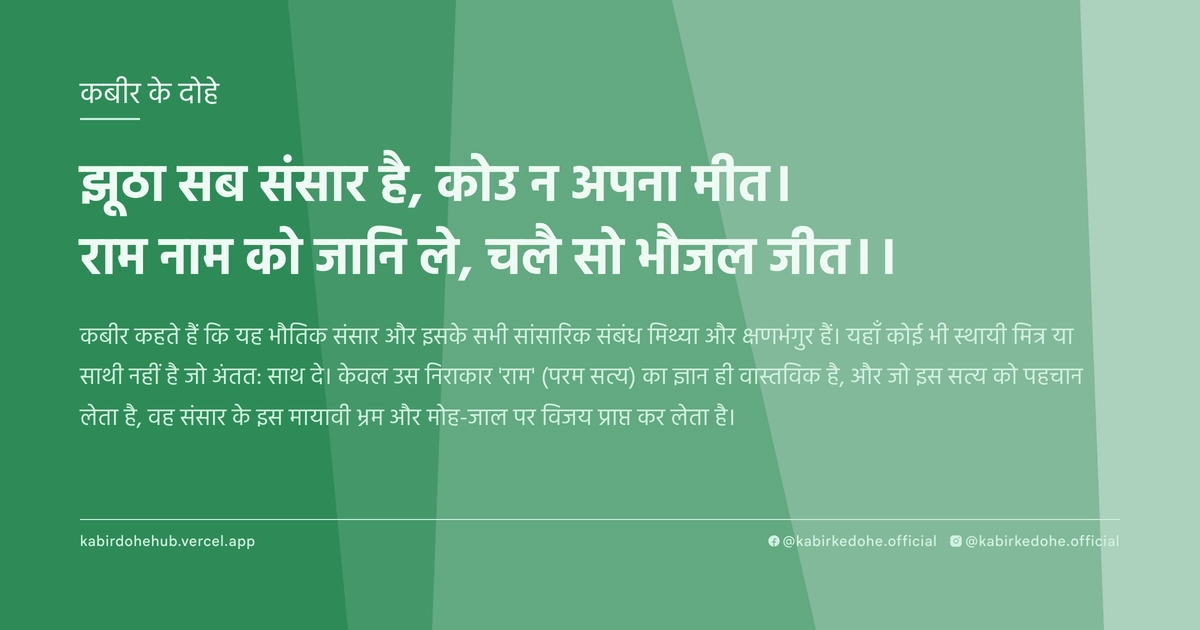
झूठा सब संसार है, कोउ न अपना मीत।
राम नाम को जानि ले, चलै सो भौजल जीत।।
Jhootha sab sansaar hai, kou na apna meet. Ram naam ko jaani le, chalai so bhaujal jeet.
इस पृष्ठ पर इस कबीर दोहे का अर्थ (meaning), हिंदी व्याख्या और अंग्रेज़ी अनुवाद, दार्शनिक विश्लेषण और व्यावहारिक जीवन सीख दी गई है। यह दोहा माया (Maya) विषय से जुड़ा है — Kabir doha meaning and explanation in Hindi and English.
अर्थ (Meaning):
कबीर कहते हैं कि यह भौतिक संसार और इसके सभी सांसारिक संबंध मिथ्या और क्षणभंगुर हैं। यहाँ कोई भी स्थायी मित्र या साथी नहीं है जो अंतत: साथ दे। केवल उस निराकार 'राम' (परम सत्य) का ज्ञान ही वास्तविक है, और जो इस सत्य को पहचान लेता है, वह संसार के इस मायावी भ्रम और मोह-जाल पर विजय प्राप्त कर लेता है।
Kabir asserts that the entire material world and its perceived relationships are illusory and transient. No worldly companion is truly permanent or an eternal friend. Only the realization of the 'Ram'—the formless, universal consciousness—is authentic. He who recognizes this primordial truth transcends the deceptive web of Maya and emerges victorious over the cycle of worldly suffering.
व्याख्या (Interpretation):
इस दोहे का शाब्दिक अर्थ संसार की नश्वरता को दर्शाता है, लेकिन इसका गहरा आध्यात्मिक अर्थ 'माया' के विखंडन में निहित है। कबीर यहाँ 'राम' शब्द का प्रयोग किसी व्यक्ति या मूर्ति के रूप में नहीं, बल्कि 'निरुपाधिक' ब्रह्म या शुद्ध चेतना के लिए कर रहे हैं। 'झूठा संसार' का अर्थ यह नहीं है कि दुनिया अस्तित्वहीन है, बल्कि यह है कि हमारी धारणाएँ और आसक्तियाँ झूठी हैं। यह अद्वैत वेदांत के उस सिद्धांत की ओर संकेत करता है जहाँ जीव स्वयं को शरीर और अहंकार मानता है, जबकि वह वास्तव में अनंत आत्मा है। जब साधक इस भ्रम को तोड़ता है, तो वह 'भौजल' यानी मोह के दलदल से बाहर निकल आता है। यह विरोधाभास है कि संसार में रहते हुए भी उससे विरक्त होना ही वास्तविक जीत है। अंततः, यह दोहा आत्मा और परमात्मा की अभिन्नता को पहचानने का आह्वान है।
While the literal meaning highlights the transience of the world, the deeper metaphorical layer focuses on the dismantling of 'Maya'. Kabir uses 'Ram' not as a sectarian deity, but as the 'Nirgun' (formless) Absolute or Pure Consciousness. The 'falsehood' of the world does not imply non-existence, but rather the falsity of our attachments and perceptions. This aligns with Advaita Vedanta, where the illusion is the belief in a separate ego. By identifying with the universal consciousness rather than the transient body, the seeker escapes the 'bhaujal'—the swamp of emotional entanglement. The central paradox presented is that true victory is achieved not by conquering others, but by conquering the illusion of separation. It is a call to shift identity from the finite 'I' to the infinite 'All'.
दार्शनिक विश्लेषण (Philosophical Analysis):
कबीर का यह दर्शन उनके युग के कट्टरपंथी धार्मिक अनुष्ठानों और बाहरी आडंबरों के विरुद्ध एक सशक्त प्रतिक्रिया था। उन्होंने देखा कि लोग तीर्थयात्राओं और कर्मकांडों में उलझे हुए हैं, जबकि वास्तविक सत्य उनके भीतर ही विद्यमान है। यह दोहा 'निर्गुण भक्ति' का सार है, जहाँ ईश्वर को किसी आकार, रंग या मंदिर में नहीं, बल्कि श्वास और चेतना में खोजा जाता है।
दार्शनिक स्तर पर, यह सूफीवाद के 'फना' (अहंकार का विलीनीकरण) और वेदांत के 'माया' सिद्धांत का संगम है। कबीर तर्क देते हैं कि सामाजिक संबंध, जाति और पद केवल मानसिक प्रपंच हैं। जब तक मनुष्य बाहरी दुनिया में 'मीत' (मित्र) खोजता है, वह अधूरा रहता है क्योंकि बाहरी संबंध मृत्यु और समय के अधीन हैं।
अहंकार का विलोपन ही वह कुंजी है जिससे सत्य का द्वार खुलता है। कबीर यहाँ मनोवैज्ञानिक रूपांतरण की बात कर रहे हैं; वे चाहते हैं कि साधक अपनी पहचान को सामाजिक भूमिकाओं से हटाकर ब्रह्मांडीय चेतना से जोड़े। यह केवल वैराग्य नहीं है, बल्कि एक उच्चतर जागरूकता है।
ऐतिहासिक रूप से, कबीर ने समाज के सबसे निचले तबके को यह एहसास दिलाया कि आध्यात्मिक मुक्ति किसी पुरोहित या शास्त्र के अधीन नहीं है। उन्होंने लोकतंत्रिकृत आध्यात्मिकता का मार्ग प्रशस्त किया, जहाँ केवल 'अनुभव' (Experience) ही प्रमाण है।
अतः, 'राम नाम' का अर्थ मंत्रोच्चार नहीं, बल्कि उस सत्य का साक्षात् अनुभव करना है जो हर कण में व्याप्त है। यह ज्ञान ही मनुष्य को भय और मोह से मुक्त कर उसे पूर्णता की ओर ले जाता है।
Kabir’s philosophy serves as a potent reaction against the rigid ritualism and external piety of his era. He observed that people were trapped in pilgrimages and ceremonies while the ultimate truth remained dormant within them. This doha encapsulates the essence of 'Nirgun Bhakti', where the Divine is sought not in idols or temples, but within the breath and consciousness.
Philosophically, this is a confluence of the Sufi concept of 'Fana' (annihilation of the ego) and the Vedantic theory of 'Maya'. Kabir argues that social hierarchies, caste, and worldly titles are mere mental constructs. As long as a human seeks a 'meet' (companion) in the external world, they remain incomplete, for all external bonds are subject to decay and time.
The dissolution of the ego is the only key to unlocking the truth. Kabir is advocating for a psychological transformation; he urges the seeker to shift their identity from social roles to cosmic consciousness. This is not mere asceticism or escapism, but a higher state of awareness.
Historically, Kabir empowered the marginalized by asserting that spiritual liberation is not the monopoly of priests or scholars. He pioneered a democratized spirituality where direct 'Anubhava' (experience) is the only valid proof of truth.
Therefore, 'Ram Naam' does not refer to the mechanical repetition of a word, but to the actual realization of the omnipresent Truth. This realization liberates the individual from fear and attachment, leading them toward absolute wholeness.
मूल संदेश (Core Message):
- सांसारिक आसक्तियाँ केवल क्षणिक भ्रम हैं।
- बाहरी संबंधों में स्थायी सुख की खोज व्यर्थ है।
- परम सत्य (राम) का अनुभव ही एकमात्र वास्तविक उपलब्धि है।
- अहंकार का त्याग ही मोह के जाल से मुक्ति का मार्ग है।
- आत्मा की अनंतता को पहचानना ही जीवन की वास्तविक जीत है।
- Worldly attachments are merely transient illusions.
- Seeking permanent happiness in external bonds is futile.
- Realizing the Absolute Truth (Ram) is the only authentic achievement.
- Renouncing the ego is the path to liberation from the web of Maya.
- Recognizing the infinity of the Soul is the ultimate victory of life.
व्यावहारिक उदाहरण (Practical Example):
वाराणसी के घाटों पर रहने वाले एक वृद्ध बुनकर, माधव, की कहानी है। माधव ने अपना पूरा जीवन रेशमी वस्त्रों की बुनाई में बिताया। उसने अपनी संपत्ति और संबंधों को ही अपनी असली पूँजी माना। उसने अपने बेटों को बहुत लाड़ किया और अपनी पत्नी के साथ एक अटूट बंधन महसूस किया।
समय बीता और माधव वृद्ध हो गया। एक समय ऐसा आया जब उसके बेटे संपत्ति के विवाद में उससे दूर हो गए और उसकी पत्नी का देहांत हो गया। माधव गहरे अवसाद में डूब गया। उसे लगा कि उसका पूरा संसार 'झूठा' था। वह घंटों गंगा किनारे बैठकर रोता और सोचता कि जिस दुनिया को उसने अपना 'मीत' माना, उसने उसे अंत में अकेला छोड़ दिया।
एक दिन उसकी मुलाकात एक फकीर से हुई, जिसने माधव से कहा, 'तू उस धागे को पकड़ रहा है जो टूट चुका है, जबकि तू स्वयं उस बुनकर का हिस्सा है जो कभी नहीं मरता।' इस वाक्य ने माधव के भीतर एक हलचल पैदा कर दी। उसने महसूस किया कि वह अपनी पहचान केवल एक पिता, पति और बुनकर के रूप में देख रहा था।
माधव ने अब बाहरी संबंधों की तलाश छोड़कर अंतर्मुखी होने का प्रयास किया। उसने ध्यान लगाया और यह अनुभव किया कि जिस शांति को वह दूसरों में खोज रहा था, वह उसके भीतर ही है। उसने पाया कि 'राम' कोई बाहरी व्यक्ति नहीं, बल्कि वह मौन है जो उसके हृदय की धड़कन में बसा है।
उसने अपनी शेष संपत्ति गरीबों में बाँट दी, लेकिन इस बार वह दुखी नहीं था। उसने देखा कि जब उसने 'अपना' होने का मोह छोड़ा, तो पूरा संसार ही उसका मित्र बन गया। वह अब किसी एक व्यक्ति से नहीं, बल्कि हर जीव से प्रेम करने लगा।
उसकी व्यवहारिक प्रतिक्रिया यह थी कि उसने अब शिकायत करना बंद कर दिया। वह अब अपने काम को केवल पैसे के लिए नहीं, बल्कि एक सेवा के रूप में करने लगा। उसके चेहरे पर एक ऐसी शांति थी जो पहले कभी नहीं देखी गई थी।
गाँव के लोग हैरान थे कि जिस व्यक्ति ने सब कुछ खो दिया, वह सबसे अधिक खुश कैसे दिख रहा है। माधव ने उन्हें समझाया कि उसने वास्तव में कुछ नहीं खोया, बल्कि उस भ्रम को खोया है जिसने उसे कैद कर रखा था।
अंततः, माधव ने यह जान लिया कि वास्तविक 'जीत' संपत्ति या संबंधों को बचाने में नहीं, बल्कि इस बोध में है कि आत्मा अविनाशी है। वह अब मृत्यु के भय से मुक्त हो चुका था और पूर्ण शांति में लीन था।
Consider the story of Madhav, an elderly weaver living on the ghats of Varanasi. Madhav spent his entire life weaving exquisite silk fabrics. He believed his wealth and his family ties were his only true assets. He showered his sons with affection and shared a deep, possessive bond with his wife.
As time passed, Madhav grew old. A period came when his sons distanced themselves from him due to property disputes, and his wife passed away. Madhav sank into a profound depression. He felt that his entire world was 'false' (jhootha). He would sit by the Ganges for hours, weeping over the fact that the people he called his 'meet' (friends) had abandoned him in the end.
One day, he met a wandering mystic who told him, 'You are clinging to a thread that has already snapped, while you yourself are a part of the Weaver who never dies.' This sentence triggered a shift within Madhav. He realized he had defined his identity solely as a father, a husband, and a weaver.
Madhav stopped seeking validation from external relationships and began the practice of introspection. Through meditation, he experienced that the peace he sought in others resided within his own core. He discovered that 'Ram' was not an external entity, but the silence dwelling in his own heartbeat.
He distributed his remaining wealth among the poor, but this time, he did so without grief. He realized that by letting go of the illusion of 'mine', the entire universe became his companion. He began to love every living being unconditionally.
His behavioral change was evident; he stopped complaining. He no longer wove fabrics for mere profit, but as a form of selfless service. A serenity settled upon his face that had never been seen before.
Villagers were puzzled as to how a man who had lost everything could appear the happiest of all. Madhav explained that he hadn't lost anything; rather, he had lost the illusion that had kept him imprisoned.
Ultimately, Madhav understood that true 'victory' is not in preserving possessions or relationships, but in the realization that the Soul is indestructible. He became free from the fear of death and lived in absolute peace.
अभ्यास मार्गदर्शन (Practice Guidance):
- दैनिक चिंतन: प्रतिदिन 20 मिनट मौन बैठें और विचार करें कि आपकी कौन सी पहचान (नाम, पद, रिश्ता) स्थायी है और कौन सी अस्थायी।
- आत्म-पूछताछ जर्नल: एक डायरी लिखें जिसमें उन क्षणों का विवरण हो जब आपने किसी बाहरी व्यक्ति से उम्मीद की और निराश हुए। फिर लिखें कि उस निराशा में आपकी अपनी चेतना ने आपको कैसे संभाला।
- व्यवहारिक परिवर्तन: दिन में कम से कम एक बार किसी ऐसे व्यक्ति की निस्वार्थ मदद करें जिससे आपका कोई व्यक्तिगत संबंध न हो, ताकि 'अपना-पराया' का भाव मिट सके।
- डायग्नोस्टिक चेकलिस्ट: क्या मैं किसी के व्यवहार से अत्यधिक विचलित हो रहा हूँ? क्या मैं अपनी खुशी को किसी दूसरे की उपस्थिति पर निर्भर मान रहा हूँ? यदि हाँ, तो मैं अभी भी 'माया' के प्रभाव में हूँ।
- Daily Contemplation: Sit in silence for 20 minutes daily and analyze which of your identities (name, title, relationship) are permanent and which are transient.
- Self-Inquiry Journal: Maintain a journal documenting moments where you expected something from others and were disappointed. Reflect on how your inner consciousness supported you during that void.
- Behavioral Shift: Perform one act of selfless service daily for a complete stranger to dissolve the boundary between 'mine' and 'others'.
- Diagnostic Checklist: Am I overly distressed by someone's behavior? Am I anchoring my happiness to another person's presence? If yes, I am still operating under the influence of 'Maya'.
चिंतन प्रश्न (Reflection Questions):
- यदि आज आपकी सभी सामाजिक पहचानें (आपका पेशा, आपका परिवार, आपकी संपत्ति) छीन ली जाएँ, तो आपके पास क्या बचेगा?
- आप जिन लोगों को अपना 'मीत' कहते हैं, क्या आप वास्तव में उन्हें प्रेम करते हैं, या आप उस प्रेम के माध्यम से अपनी किसी कमी को पूरा कर रहे हैं?
- आपका 'डिजिटल ईगो' (सोशल मीडिया इमेज) किस हद तक आपको इस भ्रम में रखता है कि आप दुनिया के लिए महत्वपूर्ण हैं?
- क्या आप अकेलेपन से डरते हैं, या आप एकांत के आनंद को पहचानते हैं?
- आपके जीवन का वह कौन सा सबसे गहरा डर है जो केवल इस भ्रम पर टिका है कि आप इस संसार में अलग और अकेले हैं?
- If all your social identities (profession, family, wealth) were stripped away today, what would remain of you?
- Do you truly love the people you call your 'meet', or are you using them to fill a void within yourself?
- To what extent does your 'digital ego' (social media image) sustain the illusion that you are indispensable to the world?
- Do you fear loneliness, or have you recognized the sublime joy of solitude?
- What is the deepest fear in your life that rests solely on the illusion that you are separate and alone in this universe?