
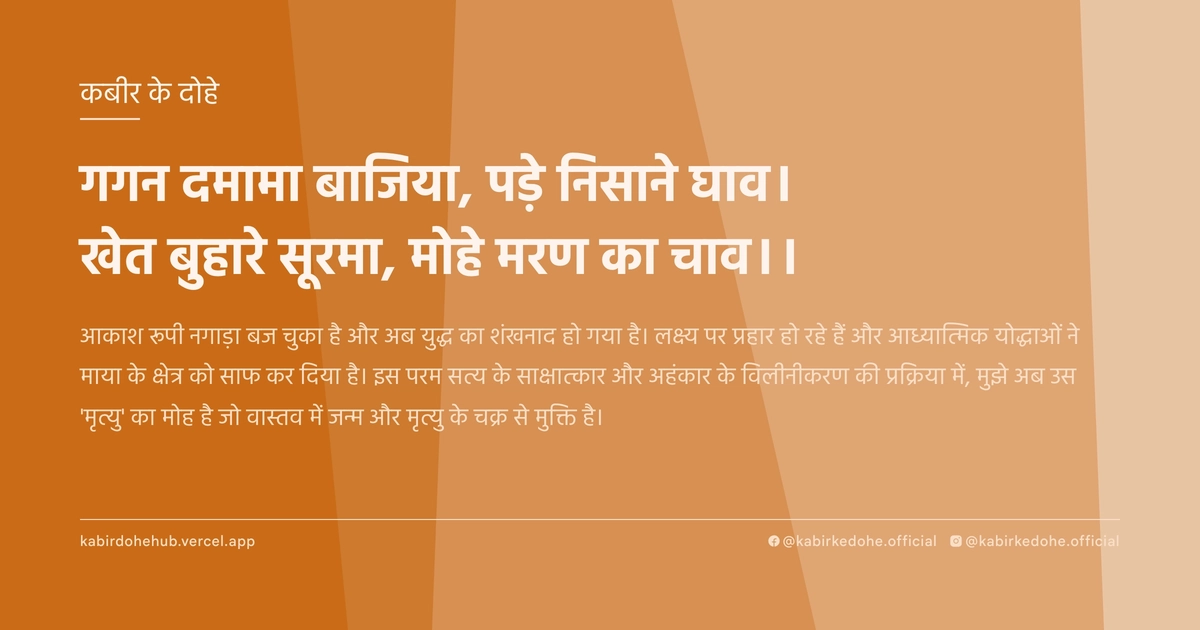
गगन दमामा बाजिया, पड़े निसाने घाव।
खेत बुहारे सूरमा, मोहे मरण का चाव।।
Gagan damama baajiya, pade nisaane ghaav. Khet buhare surma, mohe maran ka chaav.
इस पृष्ठ पर इस कबीर दोहे का अर्थ (meaning), हिंदी व्याख्या और अंग्रेज़ी अनुवाद, दार्शनिक विश्लेषण और व्यावहारिक जीवन सीख दी गई है। यह दोहा मृतुक्यता (Mortality) विषय से जुड़ा है — Kabir doha meaning and explanation in Hindi and English.
अर्थ (Meaning):
आकाश रूपी नगाड़ा बज चुका है और अब युद्ध का शंखनाद हो गया है। लक्ष्य पर प्रहार हो रहे हैं और आध्यात्मिक योद्धाओं ने माया के क्षेत्र को साफ कर दिया है। इस परम सत्य के साक्षात्कार और अहंकार के विलीनीकरण की प्रक्रिया में, मुझे अब उस 'मृत्यु' का मोह है जो वास्तव में जन्म और मृत्यु के चक्र से मुक्ति है।
The celestial drum of the sky has sounded, signaling the commencement of the ultimate spiritual battle. Arrows of divine truth are striking their marks, and the brave seekers have cleared the field of worldly illusions. In this state of absolute surrender, I long for that 'death' which is not the end of the body, but the annihilation of the ego and the end of the cycle of rebirth.
व्याख्या (Interpretation):
यहाँ 'गगन दमामा' केवल एक ध्वनि नहीं, बल्कि ब्रह्मांडीय चेतना की जागृति का प्रतीक है। 'निशाने घाव' का अर्थ है कि जब सत्य का प्रहार होता है, तो वह सीधे अहंकार की जड़ों पर चोट करता है। 'खेत बुहारे' का तात्पर्य है कि साधक ने अपने भीतर के विकारों और सांसारिक मोह-माया की गंदगी को पूरी तरह साफ कर लिया है। यह दोहा निर्गुण भक्ति की उस पराकाष्ठा को दर्शाता है जहाँ साधक द्वैत से ऊपर उठकर अद्वैत की स्थिति में पहुँच जाता है। 'मरण का चाव' यहाँ शारीरिक मृत्यु नहीं, बल्कि 'जीवमृत्यु' है—अर्थात वह स्थिति जहाँ 'मैं' का अस्तित्व समाप्त हो जाता है और केवल ब्रह्म शेष रहता है। यह विरोधाभास है कि जिसे दुनिया अंत मानती है, वह वास्तव में अनंत की शुरुआत है। यह आत्मा का परमात्मा में विलीनीकरण है, जैसे एक बूंद सागर में गिरकर सागर हो जाती है।
The 'celestial drum' (Gagan Damama) is not a mere sound but a symbol of the awakening of cosmic consciousness. 'Striking the mark' refers to the precision of divine truth as it shatters the illusions of the ego. 'Clearing the field' signifies the seeker's process of purifying the inner landscape from the debris of worldly desires and mental impurities. This verse epitomizes the peak of Nirgun Bhakti, where the practitioner transcends duality to reach the state of Advaita (non-duality). The 'longing for death' is not a morbid desire for physical cessation, but a yearning for 'spiritual death'—the annihilation of the individual 'I' to reveal the universal 'Self'. It is a profound paradox: what the world perceives as an end is actually the beginning of infinity. It represents the merging of the Atman into Brahman, akin to a drop of water losing its identity to become the ocean.
दार्शनिक विश्लेषण (Philosophical Analysis):
कबीर का यह दोहा मध्यकालीन भारत के उस सामाजिक-धार्मिक परिवेश में रचा गया था जहाँ कर्मकांड और बाहरी आडंबर चरम पर थे। कबीर ने इन बाहरी ढाँचों को नकारते हुए आंतरिक युद्ध (Inner War) पर बल दिया। यहाँ 'युद्ध' का अर्थ किसी अन्य व्यक्ति से संघर्ष नहीं, बल्कि अपने स्वयं के अहंकार और माया के साथ संघर्ष है। यह सूफीवाद के 'फना' (Fana) के सिद्धांत से गहराई से जुड़ा है, जहाँ साधक ईश्वर में विलीन होने के लिए अपने अस्तित्व को मिटा देता है।
अद्वैत वेदांत के परिप्रेक्ष्य में, यह दोहा माया के पर्दे को हटाने की प्रक्रिया है। जब तक 'मैं' जीवित है, तब तक सत्य का अनुभव असंभव है। कबीर तर्क देते हैं कि जब तक हम अपनी पहचान (नाम, जाति, पद) से चिपके रहते हैं, हम सत्य के मार्ग में बाधा बन जाते हैं। इसलिए, इस पहचान की 'मृत्यु' अनिवार्य है।
ritualism के प्रति कबीर का विरोध यहाँ स्पष्ट है; वे मंदिर या मस्जिद जाने के बजाय 'आकाश' (शून्य या चेतना) को अपना रणक्षेत्र बनाते हैं। उनके लिए मोक्ष किसी बाहरी स्वर्ग की प्राप्ति नहीं, बल्कि वर्तमान क्षण में स्वयं के मिथ्या स्वरूप का विनाश है। यह मनोवैज्ञानिक रूपांतरण की वह अवस्था है जहाँ भय समाप्त हो जाता है क्योंकि भय केवल 'अस्तित्व' के खोने का डर है।
ऐतिहासिक रूप से, कबीर ने जाति व्यवस्था को चुनौती दी क्योंकि उन्होंने देखा कि सत्य किसी विशेष कुल या वर्ण की जागीर नहीं है। यह 'युद्ध' सबके लिए खुला है, चाहे वह बुनकर हो या ब्राह्मण। यह सार्वभौमिक मानवता का आह्वान है जो केवल आत्म-साक्षात्कार के माध्यम से संभव है।
अंततः, यह दोहा हमें सिखाता है कि आध्यात्मिक प्रगति का अर्थ कुछ नया प्राप्त करना नहीं, बल्कि उस सब को छोड़ देना है जो हम वास्तव में नहीं हैं। यह 'नकारात्मक मार्ग' (Via Negativa) है—अंधेरे को हटाकर प्रकाश को प्रकट करना, न कि प्रकाश को बाहर से लाना।
This verse was composed during a period of intense ritualism and religious orthodoxy in medieval India. Kabir rejects these external structures, emphasizing instead the 'Inner War'. The 'battle' described here is not a conflict with another human being, but a struggle against one's own ego and the veils of Maya. This aligns closely with the Sufi concept of 'Fana' (annihilation), where the seeker dissolves their individual identity to merge with the Divine.
From the perspective of Advaita Vedanta, this doha describes the process of removing the veil of ignorance. As long as the 'I' (the egoic self) persists, the realization of the Absolute is impossible. Kabir argues that clinging to identities—name, caste, or status—creates a barrier to truth. Therefore, the 'death' of this false identity is an absolute necessity for liberation.
Kabir's rejection of ritualism is evident; he chooses the 'sky' (the void or pure consciousness) as his battlefield rather than a temple or mosque. For him, salvation is not the attainment of a distant heaven, but the dissolution of the illusory self in the present moment. This is a psychological transformation where fear vanishes, for fear only exists as long as there is an 'I' to be threatened.
Historically, Kabir challenged the caste system by demonstrating that spiritual truth is not the monopoly of any specific lineage or varna. This 'war' is open to all, whether a weaver or a priest. It is a call for universal humanity, achievable only through self-realization and the stripping away of social constructs.
Ultimately, the verse teaches that spiritual progress is not about acquiring something new, but about shedding everything that we are not. It is the 'Via Negativa'—the path of negation—where light is revealed not by adding it, but by removing the darkness of the ego.
मूल संदेश (Core Message):
- बाहरी शोर को शांत कर आंतरिक शंखनाद को सुनें।
- अहंकार की मृत्यु ही वास्तविक जीवन का प्रारंभ है।
- माया के क्षेत्र को साफ करना ही सच्ची वीरता है।
- द्वैत का अंत ही अद्वैत की प्राप्ति है।
- परमात्मा में विलीन होना ही अंतिम लक्ष्य है।
- Silence the external noise to hear the inner clarion call.
- The death of the ego is the birth of true existence.
- True bravery lies in clearing the field of worldly illusions.
- The end of duality is the attainment of non-duality.
- Merging into the Divine is the ultimate destination.
व्यावहारिक उदाहरण (Practical Example):
वाराणसी के एक पुराने घाट पर रहने वाली एक वृद्ध विधवा, जानकी, का जीवन केवल परंपराओं और शोक के इर्द-गिर्द घूमता था। वह सफेद साड़ी पहनती और दिन भर केवल इस बात का शोक मनाती कि उसने अपना सब कुछ खो दिया है। उसके लिए 'मृत्यु' एक डरावना अंत था और जीवन एक बोझ।
एक दिन उसने एक फकीर को सुना जो कबीर के इसी दोहे का वर्णन कर रहा था। फकीर ने कहा, 'माँ, तुम शरीर की मृत्यु से डरती हो, लेकिन क्या तुमने कभी उस 'मैं' को मारने की कोशिश की जो तुम्हें दुखी रखता है?'
जानकी को पहले यह बात समझ नहीं आई। उसने सोचा कि वह तो पहले से ही सब कुछ खो चुकी है, तो अब क्या मारना बाकी है? लेकिन धीरे-धीरे उसने महसूस किया कि उसका 'दुख' ही उसकी नई पहचान बन गया था। वह खुद को 'एक दुखी विधवा' के रूप में देख रही थी और इसी पहचान से उसे मोह हो गया था।
उसने अभ्यास करना शुरू किया कि जब भी वह अपने अतीत के बारे में सोचे, वह खुद से पूछे, 'यह कौन है जो याद कर रहा है?' उसने पाया कि वह 'मैं' जो दुखी था, वह केवल एक विचार था, सत्य नहीं।
जैसे-जैसे उसने अपनी इस 'दुखी पहचान' को मारना शुरू किया, उसके भीतर एक अजीब सी शांति छा गई। उसने देखा कि घाट पर आने वाले अन्य दुखी लोगों की सेवा करने में उसे आनंद मिल रहा है।
उसका जीवन अब शोक का नहीं, बल्कि सेवा का केंद्र बन गया। उसने अपनी सफेद साड़ी को अब शोक का प्रतीक नहीं, बल्कि पवित्रता और वैराग्य का प्रतीक माना।
एक दिन, जब वह एक बीमार अजनबी की सेवा कर रही थी, उसे महसूस हुआ कि वह और वह अजनबी अलग नहीं हैं। उसकी 'मैं' पूरी तरह मिट चुकी थी।
यही वह 'मरण का चाव' था—अपनी सीमित पहचान की मृत्यु और असीम करुणा में विलीनीकरण। जानकी अब मृत्यु से नहीं डरती थी, क्योंकि उसने जीवन रहते ही उस अहंकार को मार दिया था जो डर पैदा करता है।
Janaki, an elderly widow living on an ancient ghat in Varanasi, spent her days enveloped in tradition and grief. Clad in white, her existence revolved around the mourning of what she had lost. To her, 'death' was a terrifying end, and life was a heavy burden.
One day, she overheard a wandering dervish explaining this specific doha of Kabir. The dervish asked, 'Mother, you fear the death of the body, but have you ever tried to kill the "I" that keeps you in sorrow?'
Janaki was initially confused. She felt she had already lost everything; what was left to kill? However, she gradually realized that her 'sorrow' had become her new identity. She had identified herself as 'a grieving widow,' and she was subconsciously clinging to this identity.
She began a practice: whenever a wave of grief hit, she would ask herself, 'Who is it that is feeling this grief?' She discovered that the 'I' who suffered was merely a mental construct, not the ultimate truth.
As she began to 'kill' this identity of the sufferer, a profound peace descended upon her. She found immense joy in serving other distressed souls who visited the ghats.
Her life shifted from a center of mourning to a center of selfless service. She no longer viewed her white saree as a shroud of grief, but as a symbol of purity and detachment.
One afternoon, while tending to a sick stranger, she experienced a flash of realization: there was no distinction between her and the stranger. Her individual 'I' had completely vanished.
This was the 'longing for death'—the death of the limited ego and the merging into infinite compassion. Janaki no longer feared death, for she had died to her ego while still alive, erasing the very root of fear.
अभ्यास मार्गदर्शन (Practice Guidance):
- दैनिक ध्यान: प्रतिदिन 20 मिनट 'शून्य' का ध्यान करें। कल्पना करें कि आपका नाम, पद और संबंध एक-एक कर मिट रहे हैं, जब तक कि केवल शुद्ध जागरूकता न बचे।
- आत्म-पूछताछ (Journaling): प्रतिदिन लिखें—'आज मैंने अपनी किस पहचान (Ego-identity) को सबसे अधिक महत्व दिया और वह सत्य से कैसे दूर ले जा रही है?'
- व्यवहार परिवर्तन: दिन में कम से कम एक बार ऐसा कार्य करें जिसमें आपका कोई व्यक्तिगत लाभ न हो और जहाँ आप अपनी पहचान पूरी तरह गुप्त रखें।
- निदान चेकलिस्ट (Diagnostic Checklist): क्या मैं अभी भी अपनी उपलब्धियों पर गर्व कर रहा हूँ? क्या मैं दूसरों की आलोचना अपनी श्रेष्ठता सिद्ध करने के लिए करता हूँ? क्या मैं मृत्यु के विचार से भयभीत हूँ? यदि हाँ, तो 'अहंकार' अभी जीवित है।
- Daily Meditation: Spend 20 minutes meditating on the 'Void'. Visualize your name, status, and relationships dissolving one by one until only pure awareness remains.
- Self-Inquiry (Journaling): Write daily—'Which identity (ego-construct) did I cling to most today, and how did it distance me from the Truth?'
- Behavioral Shift: Perform at least one act of service daily where there is no personal gain and your identity remains completely anonymous.
- Diagnostic Checklist: Do I still take pride in my achievements? Do I criticize others to prove my superiority? Do I fear the thought of death? If yes, the 'ego' is still alive and functioning.
चिंतन प्रश्न (Reflection Questions):
- यदि आपकी सारी सामाजिक पहचान (नाम, पेशा, रिश्ता) छीन ली जाए, तो आपके भीतर क्या बचेगा?
- आप अपनी छवि (Image) को बचाने के लिए कितनी बार झूठ बोलते हैं या सच को दबाते हैं?
- क्या आपका 'आध्यात्मिक होना' भी आपके अहंकार का एक नया रूप तो नहीं है?
- आप किस ऐसी चीज़ से सबसे अधिक चिपके हुए हैं जिसे आप 'मैं' कहते हैं?
- क्या आप वास्तव में मुक्त होना चाहते हैं, या आप केवल मुक्ति के विचार से प्रेम करते हैं?
- If all your social identities (name, profession, relationships) were stripped away, what would remain within you?
- How often do you lie or suppress the truth simply to protect your curated image?
- Could your 'spirituality' be just another sophisticated mask for your ego?
- What is the one thing you cling to most fiercely that you call 'I'?
- Do you truly desire liberation, or are you merely in love with the idea of being liberated?