
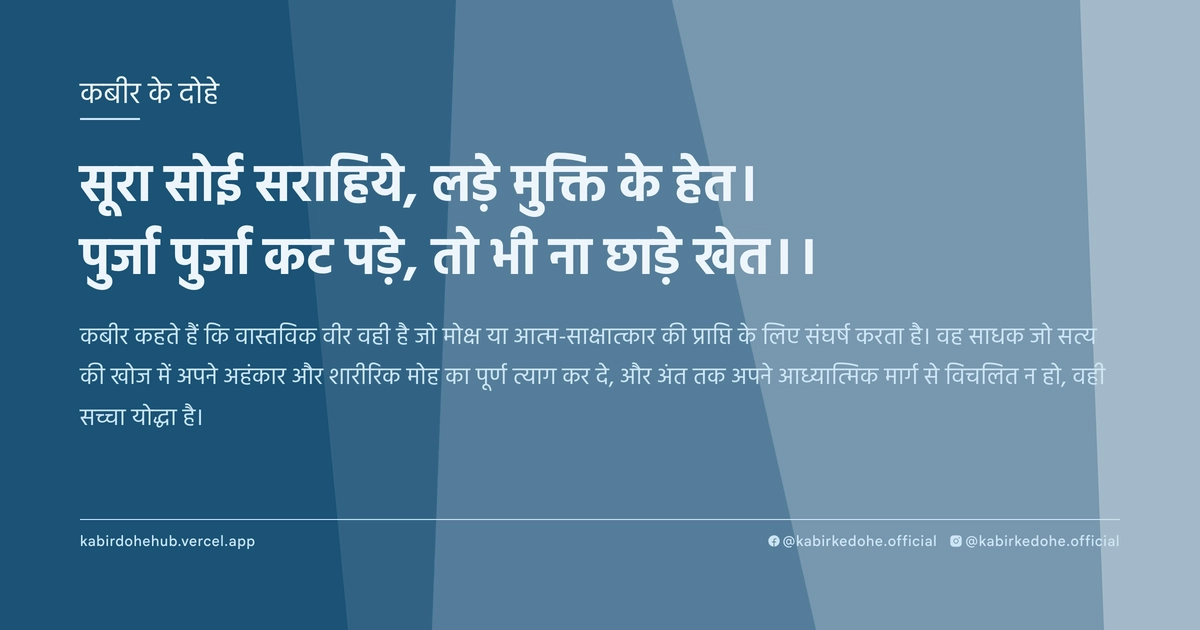
सूरा सोई सराहिये, लड़े मुक्ति के हेत।
पुर्जा पुर्जा कट पड़े, तो भी ना छाड़े खेत।।
Sura soi sarahiye, lade mukti ke het. Purja purja kat pade, to bhi na chhade khet.
इस पृष्ठ पर इस कबीर दोहे का अर्थ (meaning), हिंदी व्याख्या और अंग्रेज़ी अनुवाद, दार्शनिक विश्लेषण और व्यावहारिक जीवन सीख दी गई है। यह दोहा मुक्ति (Liberation) विषय से जुड़ा है — Kabir doha meaning and explanation in Hindi and English.
अर्थ (Meaning):
कबीर कहते हैं कि वास्तविक वीर वही है जो मोक्ष या आत्म-साक्षात्कार की प्राप्ति के लिए संघर्ष करता है। वह साधक जो सत्य की खोज में अपने अहंकार और शारीरिक मोह का पूर्ण त्याग कर दे, और अंत तक अपने आध्यात्मिक मार्ग से विचलित न हो, वही सच्चा योद्धा है।
Kabir asserts that a true warrior is not one who fights earthly battles, but one who struggles for liberation (Mukti). The genuine seeker is he who remains steadfast in the pursuit of Truth, even if he is shattered piece by piece, refusing to abandon the battlefield of spiritual awakening.
व्याख्या (Interpretation):
यहाँ 'सूरा' (वीर) शब्द का प्रयोग भौतिक युद्ध के लिए नहीं, बल्कि आंतरिक युद्ध के लिए किया गया है। 'मुक्ति' का अर्थ केवल मृत्यु के बाद का मोक्ष नहीं, बल्कि जीवित रहते हुए अज्ञानता से मुक्ति है। 'पुर्जा पुर्जा कटना' अहंकार के खंडन का प्रतीक है; जब तक व्यक्ति का 'मैं' पूरी तरह नष्ट नहीं होता, तब तक सत्य का उदय नहीं होता। 'खेत' यहाँ संसार या साधना के क्षेत्र को दर्शाता है। यह दोहा निर्गुण भक्ति के उस कठिन मार्ग को रेखांकित करता है जहाँ साधक को माया के प्रलोभनों और मानसिक पीड़ाओं का सामना करना पड़ता है। यह अद्वैत वेदांत के उस सिद्धांत से मेल खाता है जहाँ आत्मा को ब्रह्म में विलीन होने के लिए पहले अपनी सीमित पहचान को मिटाना पड़ता है। अंततः, यह विरोधाभास है कि पूर्ण विनाश (अहंकार का) ही वास्तविक विजय (आत्म-ज्ञान) है।
The term 'Sura' (warrior) is employed here not for physical combat, but for the internal psychic struggle. 'Mukti' refers not merely to post-mortem liberation, but to the liberation from ignorance while alive. 'Being cut piece by piece' symbolizes the systematic dismantling of the ego; until the 'I' is completely shattered, Truth cannot emerge. The 'field' (khet) represents the arena of spiritual practice or the world itself. This couplet highlights the rigorous path of Nirgun Bhakti, where the seeker faces the onslaught of Maya and mental anguish. It aligns with Advaita Vedanta, where the Atman must shed its limited identity to realize its non-duality with Brahman. Ultimately, it presents the paradox that total annihilation of the ego is the only path to absolute victory.
दार्शनिक विश्लेषण (Philosophical Analysis):
कबीर का यह दोहा उस युग की उपज है जहाँ धर्म बाहरी कर्मकांडों और जातिगत श्रेष्ठता में जकड़ा हुआ था। कबीर ने 'वीरता' की परिभाषा को बदलकर उसे सामाजिक प्रतिष्ठा से हटाकर आंतरिक रूपांतरण से जोड़ दिया। उन्होंने यह स्पष्ट किया कि असली युद्ध मंदिर, मस्जिद या युद्धभूमि में नहीं, बल्कि मनुष्य के अपने भीतर चलता है।
दार्शनिक स्तर पर, यह सूफीवाद के 'फना' (Fana) के सिद्धांत के करीब है, जहाँ साधक ईश्वर में विलीन होने के लिए अपने अस्तित्व को मिटा देता है। यह 'अहं ब्रह्मास्मि' की अनुभूति की पूर्व शर्त है। जब तक व्यक्ति अपनी सामाजिक पहचान, पद और अहंकार को पकड़े रहता है, वह 'खेत' को छोड़ चुका होता है, क्योंकि वह सत्य के बजाय भ्रम से लड़ रहा होता है।
कबीर ritualism का विरोध करते हैं क्योंकि कर्मकांड अहंकार को पोषण देते हैं, जबकि वास्तविक साधना उसे नष्ट करती है। उनके लिए मुक्ति कोई पुरस्कार नहीं है, बल्कि एक निरंतर चलने वाली प्रक्रिया है जिसमें साधक को अपनी सुख-सुविधाओं का बलिदान देना पड़ता है।
मनोवैज्ञानिक रूप से, यह 'cognitive dissonance' को पार करने की बात है। जब सत्य हमारे पुराने विश्वासों से टकराता है, तो मानसिक पीड़ा होती है। कबीर कहते हैं कि इस पीड़ा से भागने के बजाय, इसे स्वीकार करें और अपने पुराने स्वरूप को बिखरने दें।
अंततः, यह दोहा हमें सिखाता है कि आध्यात्मिक मार्ग पर 'समर्पण' का अर्थ कमजोरी नहीं, बल्कि सर्वोच्च साहस है। जो अपनी पूरी सत्ता को सत्य की वेदी पर होम कर सकता है, वही वास्तव में मुक्त होने का अधिकारी है।
This couplet emerges from an era where religion was shackled by external rituals and caste hierarchies. Kabir redefines 'valor,' shifting it from social prestige to internal transformation. He clarifies that the real war is not fought in temples, mosques, or physical battlefields, but within the depths of the human psyche.
Philosophically, this mirrors the Sufi concept of 'Fana' (annihilation), where the seeker erases their individual existence to merge with the Divine. This is the prerequisite for the realization of 'Aham Brahmasmi' (I am Brahman). As long as an individual clings to social identity, status, and ego, they have effectively abandoned the 'field,' for they are fighting illusions rather than Truth.
Kabir rejects ritualism because rituals often feed the ego, whereas genuine spiritual practice dismantles it. For him, liberation is not a reward to be won, but a continuous process of shedding the false self, requiring the sacrifice of comfort and certainty.
Psychologically, this describes the process of overcoming cognitive dissonance. When Truth clashes with long-held beliefs, mental agony ensues. Kabir urges the seeker not to flee from this pain but to embrace it, allowing the old version of the self to shatter completely.
Ultimately, the couplet teaches that 'surrender' on the spiritual path is not a sign of weakness, but the highest form of courage. Only he who can offer his entire existence upon the altar of Truth is worthy of liberation.
मूल संदेश (Core Message):
- आध्यात्मिक मार्ग सुखद नहीं, बल्कि एक कठिन युद्ध है।
- अहंकार का पूर्ण विनाश ही वास्तविक विजय है।
- बाहरी कर्मकांडों के बजाय आंतरिक रूपांतरण को चुनें।
- पीड़ा से भागना नहीं, बल्कि उसे सत्य की सीढ़ी बनाना सीखें।
- व्यक्तिगत पहचान का अंत ही सार्वभौमिक सत्य का आरंभ है।
- The spiritual path is not a comfort, but a rigorous war.
- The total annihilation of ego is the only true victory.
- Choose internal transformation over external ritualism.
- Do not flee from pain; learn to use it as a ladder to Truth.
- The end of personal identity is the beginning of universal truth.
व्यावहारिक उदाहरण (Practical Example):
वाराणसी के एक पुराने मोहल्ले में माधव नाम का एक वृद्ध बुनकर रहता था। वह अपनी कला में निपुण था, लेकिन उसका अहंकार उसकी कला से भी बड़ा था। वह मानता था कि उसके जैसा कपड़ा पूरे शहर में कोई नहीं बुन सकता। वह दूसरों को तुच्छ समझता और अपनी श्रेष्ठता के मद में चूर रहता।
एक दिन उसकी मुलाकात एक घुमक्कड़ फकीर से हुई, जिसने माधव के कपड़ों की तारीफ नहीं की, बल्कि उसकी आत्मा के खालीपन पर प्रहार किया। फकीर ने कहा, 'तेरी कला सुंदर है, लेकिन तेरा अहंकार तुझे सत्य से दूर रख रहा है। तू इस दुनिया के खेत में तो है, पर मुक्ति के युद्ध से भागा हुआ है।'
माधव को पहले तो बहुत क्रोध आया। उसने फकीर को अपमानित करने की कोशिश की, लेकिन फकीर शांत रहा। धीरे-धीरे माधव को महसूस हुआ कि उसकी श्रेष्ठता की भावना उसे अकेला कर रही है। उसने तय किया कि वह अपने अहंकार को मिटाएगा।
उसने अपनी सबसे महंगी साड़ियों को उन लोगों को दान करना शुरू किया जिन्हें वह पहले तुच्छ समझता था। शुरुआत में उसे बहुत मानसिक पीड़ा हुई; उसे लगा जैसे उसकी पहचान छिन रही है। उसे महसूस हुआ कि उसका 'पुर्जा-पुर्जा' कट रहा है—उसका गर्व, उसकी सामाजिक प्रतिष्ठा, उसका 'मैं' सब बिखर रहा था।
एक समय ऐसा आया जब उसके परिवार और समाज ने उसे पागल समझना शुरू कर दिया। उसकी आर्थिक स्थिति बिगड़ने लगी। लेकिन माधव ने 'खेत' नहीं छोड़ा। उसने अपनी पीड़ा को साधना बना लिया।
वह अब केवल कपड़े नहीं बुनता था, बल्कि हर धागे के साथ अपने अहंकार को काटता था। उसने सीखा कि असली खुशी दूसरों को नीचा दिखाने में नहीं, बल्कि उनके साथ एकाकार होने में है।
वर्षों बाद, माधव के चेहरे पर एक ऐसी शांति थी जो उसने अपनी सबसे महंगी साड़ियों में भी नहीं पाई थी। वह अब एक कुशल बुनकर ही नहीं, बल्कि एक मुक्त आत्मा बन चुका था।
उसने जान लिया था कि जब तक वह 'बुनकर' होने के अहंकार में था, वह बंधन में था। जब वह केवल एक 'साधक' बना, तब वह वास्तव में स्वतंत्र हुआ।
यह माधव का 'कबीर ट्विस्ट' था: अपनी पहचान को पूरी तरह नष्ट करके उसने उस अनंत पहचान को पा लिया जो कभी नष्ट नहीं होती।
In an old neighborhood of Varanasi lived an elderly weaver named Madhav. He was a master of his craft, but his ego was even larger than his skill. He believed no one in the city could weave like him, viewing others with contempt and basking in his own perceived superiority.
One day, he encountered a wandering fakir who did not praise Madhav's fabrics but instead pointed out the emptiness of his soul. The fakir said, 'Your art is beautiful, but your ego keeps you from the Truth. You are in the field of this world, but you are a deserter in the war for liberation.'
Initially, Madhav was enraged. He tried to insult the fakir, but the fakir remained serene. Gradually, Madhav realized that his sense of superiority was isolating him. He decided to dismantle his ego.
He began donating his most expensive sarees to those he had previously deemed insignificant. At first, he suffered immense mental agony; it felt as if his identity was being stripped away. He felt himself being 'cut piece by piece'—his pride, his social status, and his 'I' were all shattering.
Eventually, his family and society began to view him as mad. His financial stability dwindled. Yet, Madhav did not abandon the 'field.' He transformed his suffering into a spiritual discipline.
He no longer just wove fabric; with every thread, he cut away a piece of his ego. He learned that true joy lay not in belittling others, but in becoming one with them.
Years later, a peace radiated from Madhav's face that he had never found in his most luxurious creations. He was no longer just a skilled weaver, but a liberated soul.
He realized that as long as he clung to the ego of being a 'weaver,' he was bound. When he became merely a 'seeker,' he became truly free.
This was Madhav's 'Kabir Twist': by completely destroying his limited identity, he discovered the infinite identity that can never be destroyed.
अभ्यास मार्गदर्शन (Practice Guidance):
- प्रतिदिन 20 मिनट मौन रहकर यह विचार करें कि आपकी कौन सी पहचान (पद, रिश्ता, छवि) आपको सत्य से दूर रख रही है।
- एक 'अहंकार डायरी' लिखें: दिन भर में जब भी आपको श्रेष्ठता या हीनता का अनुभव हो, उसे लिखें और विश्लेषण करें कि वह किस 'झूठे मैं' से उपजा है।
- सेवा का अभ्यास: किसी ऐसे व्यक्ति की निस्वार्थ सेवा करें जिसे आप मानसिक रूप से अपने से छोटा समझते हैं, ताकि आपका सामाजिक अहंकार टूटे।
- डायग्नोस्टिक चेकलिस्ट: क्या आप आलोचना सुनकर विचलित होते हैं? क्या आप अपनी उपलब्धियों का श्रेय केवल स्वयं को देते हैं? यदि हाँ, तो आप अभी भी 'पुर्जा-पुर्जा' कटने की प्रक्रिया से बच रहे हैं।
- Spend 20 minutes daily in silence, contemplating which identity (status, relationship, image) is distancing you from the Truth.
- Maintain an 'Ego Journal': Record every instance of feeling superior or inferior during the day, and analyze which 'false I' triggered the emotion.
- Practice selfless service: Serve someone you mentally perceive as 'lower' than yourself to systematically break your social ego.
- Diagnostic Checklist: Do you become agitated by criticism? Do you take sole credit for your achievements? If yes, you are still avoiding the process of being 'cut piece by piece.'
चिंतन प्रश्न (Reflection Questions):
- यदि आज आपकी सारी सामाजिक उपलब्धियां और उपाधियां छीन ली जाएं, तो आपके भीतर क्या बचेगा?
- आप किस 'छवि' को बचाने के लिए सबसे अधिक संघर्ष कर रहे हैं, और वह छवि आपको किस सत्य से रोक रही है?
- क्या आप वास्तव में मुक्त होना चाहते हैं, या आप केवल मुक्ति का विचार पसंद करते हैं?
- आपके जीवन का वह कौन सा 'पुर्जा' (अहंकार का हिस्सा) है जिसे आप काटने से सबसे ज्यादा डरते हैं?
- क्या आपकी भक्ति आपको दूसरों के प्रति अधिक विनम्र बनाती है, या यह आपके आध्यात्मिक अहंकार को बढ़ा रही है?
- If all your social achievements and titles were stripped away today, what would remain within you?
- Which 'image' of yourself are you fighting hardest to protect, and what truth is that image obscuring?
- Do you truly desire liberation, or do you merely enjoy the idea of being liberated?
- Which 'piece' of your ego are you most terrified of losing?
- Does your devotion make you more humble toward others, or is it fueling a spiritual ego?