
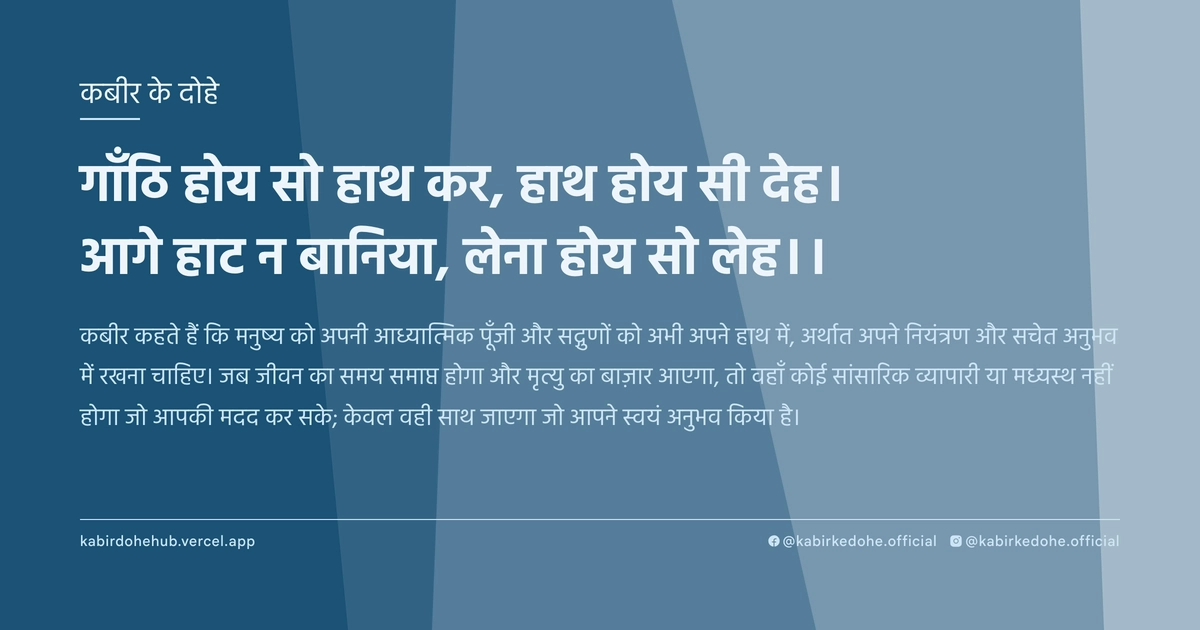
गाँठि होय सो हाथ कर, हाथ होय सी देह।
आगे हाट न बानिया, लेना होय सो लेह।।
Gaanthi hoye so haath kar, haath hoye si deh. Aage haat na baaniya, lena hoye so leh.
इस पृष्ठ पर इस कबीर दोहे का अर्थ (meaning), हिंदी व्याख्या और अंग्रेज़ी अनुवाद, दार्शनिक विश्लेषण और व्यावहारिक जीवन सीख दी गई है। यह दोहा समय का महत्व (The Value of Time) विषय से जुड़ा है — Kabir doha meaning and explanation in Hindi and English.
अर्थ (Meaning):
कबीर कहते हैं कि मनुष्य को अपनी आध्यात्मिक पूँजी और सद्गुणों को अभी अपने हाथ में, अर्थात अपने नियंत्रण और सचेत अनुभव में रखना चाहिए। जब जीवन का समय समाप्त होगा और मृत्यु का बाज़ार आएगा, तो वहाँ कोई सांसारिक व्यापारी या मध्यस्थ नहीं होगा जो आपकी मदद कर सके; केवल वही साथ जाएगा जो आपने स्वयं अनुभव किया है।
Kabir asserts that one must secure their spiritual wealth and virtues within their own grasp—meaning through conscious experience and realization—while they still possess a physical body. When the final market of life arrives at the moment of death, there will be no worldly merchant or mediator to trade for you; you can only carry what you have truly internalized and realized within yourself.
व्याख्या (Interpretation):
इस दोहे में 'गाँठि' (पोटली) का अर्थ संचित आध्यात्मिक ज्ञान और आत्म-साक्षात्कार है। कबीर एक गहरे विरोधाभास का उपयोग करते हैं जहाँ शरीर को एक अस्थायी दुकान और मृत्यु को एक अंतिम बाज़ार के रूप में दर्शाया गया है। यहाँ 'हाथ' का अर्थ केवल शारीरिक अंग नहीं, बल्कि 'साधना' और 'अनुभव' है। यह निरगुण भक्ति का सार है, जहाँ ईश्वर किसी बाहरी कर्मकांड में नहीं, बल्कि स्वयं के भीतर के बोध में मिलता है। माया हमें यह भ्रम देती है कि हम बाहरी संपत्तियां जमा कर रहे हैं, जबकि वास्तव में केवल आंतरिक रूपांतरण ही स्थायी है। यह अद्वैत वेदांत के उस सत्य की ओर संकेत करता है जहाँ आत्मा और ब्रह्म एक हैं, लेकिन अहंकार की गाँठें हमें इस सत्य से अलग करती हैं। अंततः, यह दोहा चेतावनी देता है कि आध्यात्मिक तैयारी का समय 'अभी' है, क्योंकि मृत्यु के समय कोई उधार या बाहरी सहारा काम नहीं आता।
In this couplet, the 'Gaanthi' (bundle) symbolizes accumulated spiritual wisdom and self-realization. Kabir employs a profound paradox, depicting the physical body as a transient shop and death as the ultimate marketplace. Here, 'hand' does not merely refer to a physical limb, but to 'Sadhana' (disciplined practice) and direct experiential knowledge. This is the essence of Nirgun Bhakti, where the Divine is found not in external rituals, but in the internal awakening of the self. Maya creates the illusion that we are accumulating external assets, whereas only internal transformation is permanent. It points toward the truth of Advaita Vedanta, where the Atman and Brahman are non-dual, yet the knots of ego separate us from this realization. Ultimately, the verse warns that the time for spiritual preparation is 'now,' for at the moment of transition, no borrowed merit or external mediator can assist the soul.
दार्शनिक विश्लेषण (Philosophical Analysis):
कबीर का यह दृष्टिकोण उनके युग के धार्मिक पाखंड और कर्मकांडीय जटिलताओं के विरुद्ध एक सशक्त प्रहार है। उस समय समाज में यह धारणा थी कि मोक्ष केवल विशिष्ट अनुष्ठानों, तीर्थयात्राओं या पुरोहितों के माध्यम से प्राप्त किया जा सकता है। कबीर इस 'मध्यस्थता' (mediation) को पूरी तरह नकारते हैं। वे तर्क देते हैं कि यदि सत्य का अनुभव स्वयं के भीतर नहीं हुआ है, तो बाहरी धार्मिक पहचान केवल एक खाली खोल है। यह विचार सूफीवाद के 'फना' (अहंकार का विलीनीकरण) और अद्वैत वेदांत के 'स्व-साक्षात्कार' के समानांतर है।
दार्शनिक स्तर पर, कबीर यहाँ 'कर्म' और 'फल' के संबंध को पुनर्गठित कर रहे हैं। वे कहते हैं कि संचय (accumulation) भौतिक नहीं, बल्कि चेतना का होना चाहिए। जब वे 'बानिया' (व्यापारी) का उल्लेख करते हैं, तो वे उन सभी धार्मिक गुरुओं और पाखंडियों पर कटाक्ष कर रहे हैं जो मोक्ष का व्यापार करते हैं। उनके अनुसार, आध्यात्मिक यात्रा अत्यंत व्यक्तिगत है; कोई दूसरा व्यक्ति आपकी जगह जागृत नहीं हो सकता।
यह दोहा मनोवैज्ञानिक रूपांतरण की बात करता है। मनुष्य अक्सर भविष्य के लिए योजना बनाता है, लेकिन अपनी मृत्यु और उसके बाद की चेतना की उपेक्षा करता है। कबीर 'वर्तमान क्षण' की महत्ता पर जोर देते हैं। उनके लिए, शरीर एक साधन है, साध्य नहीं। यदि शरीर का उपयोग आत्म-ज्ञान के लिए नहीं किया गया, तो यह केवल मिट्टी का एक ढेर है।
यहाँ 'गाँठि' का प्रतीक यह भी दर्शाता है कि ज्ञान केवल सूचना नहीं होनी चाहिए, बल्कि वह 'गाँठ' की तरह मजबूती से अनुभव में बंधा होना चाहिए। केवल ग्रंथों को पढ़ना पर्याप्त नहीं है; उस ज्ञान का आचरण में उतरना ही वास्तविक पूँजी है। यह बौद्ध धर्म के 'सति' (mindfulness) और योग के 'साक्षी भाव' से मेल खाता है।
अंततः, कबीर का संदेश यह है कि मनुष्य को अपनी आध्यात्मिक जिम्मेदारी स्वयं लेनी होगी। जाति, धर्म या कुल की पहचान उस अंतिम बाज़ार में निरर्थक है। केवल वह 'प्रेम' और 'बोध' जो आत्मा ने स्वयं अर्जित किया है, वही एकमात्र मुद्रा (currency) है जो वहां स्वीकार्य होगी। यह पूर्णतः एक व्यक्तिवादी और आंतरिक क्रांति का आह्वान है।
Kabir's perspective here is a powerful assault on the religious hypocrisy and ritualistic complexities of his era. At the time, there was a prevailing belief that liberation (Moksha) could only be achieved through specific rituals, pilgrimages, or the mediation of priests. Kabir completely rejects this notion of 'mediation.' He argues that if the experience of Truth has not occurred within oneself, external religious identity is merely an empty shell. This thought parallels the Sufi concept of 'Fana' (annihilation of the ego) and the Advaita Vedanta pursuit of 'Self-realization.'
On a philosophical level, Kabir is restructuring the relationship between 'Karma' and its 'Fruit.' He posits that accumulation should not be material, but of consciousness. When he mentions the 'Baaniya' (merchant), he is satirizing those religious guides and charlatans who trade in the promise of salvation. According to him, the spiritual journey is intensely personal; no other person can awaken in your stead.
This verse speaks to a psychological transformation. Humans often plan for the distant future but neglect their own mortality and the state of their consciousness. Kabir emphasizes the urgency of the 'present moment.' For him, the body is a means, not the end. If the body is not utilized for self-knowledge, it remains nothing more than a heap of clay.
The symbol of the 'Gaanthi' (bundle) also suggests that knowledge should not be mere information, but should be firmly tied to experience. Reading scriptures is insufficient; the embodiment of that knowledge in action is the only true capital. This aligns with the Buddhist concept of 'Sati' (mindfulness) and the Yogic state of the 'Witness.'
Ultimately, Kabir's message is that an individual must take full responsibility for their spiritual evolution. Identities of caste, religion, or lineage are irrelevant in that final marketplace. Only the 'Love' and 'Awareness' that the soul has earned through its own effort is the only currency acceptable there. It is a call for a completely individualistic and internal revolution.
मूल संदेश (Core Message):
- बाहरी संचय भ्रम है, आंतरिक बोध ही सत्य है।
- मोक्ष कोई व्यापार नहीं, बल्कि स्वयं का रूपांतरण है।
- मृत्यु के समय केवल अनुभव किया हुआ ज्ञान साथ जाता है।
- अहंकार की गाँठें ही आत्मा और परमात्मा के बीच की बाधा हैं।
- वर्तमान क्षण ही एकमात्र अवसर है अपनी आध्यात्मिक पूँजी बनाने का।
- प्रेम और करुणा ही वह एकमात्र मुद्रा है जो सार्वभौमिक है।
- External accumulation is an illusion; internal realization is the only truth.
- Liberation is not a transaction, but a total transformation of self.
- Only experienced wisdom accompanies the soul at the moment of death.
- The knots of ego are the only barriers between the soul and the Divine.
- The present moment is the only opportunity to build spiritual capital.
- Love and compassion are the only currencies that are truly universal.
व्यावहारिक उदाहरण (Practical Example):
वाराणसी के घाटों पर रहने वाले एक वृद्ध बुनकर, माधव, का जीवन केवल कपड़ों की बुनाई और अपनी छोटी सी दुकान चलाने तक सीमित था। माधव अपनी पूरी उम्र इस विश्वास में बिता चुके थे कि यदि वे बहुत अधिक धन जमा कर लेंगे और अंत में बड़े दान करेंगे, तो उनका मोक्ष निश्चित हो जाएगा। उन्होंने अपनी पूरी ऊर्जा भौतिक संपत्तियों को जोड़ने में लगा दी, जबकि अपने परिवार और स्वयं की आंतरिक शांति की उपेक्षा की।
एक दिन, माधव की मुलाकात एक घुमक्कड़ फकीर से हुई, जिसने उन्हें कबीर का यह दोहा सुनाया। फकीर ने माधव से पूछा, "यदि आज रात तुम्हारी सांसें रुक जाएं, तो उस अंतिम बाज़ार में तुम क्या लेकर जाओगे? क्या तुम्हारी रेशमी साड़ियाँ तुम्हारी आत्मा का बोझ हल्का करेंगी?"
माधव को पहली बार यह अहसास हुआ कि उन्होंने जीवन भर केवल 'बाहरी पोटली' भरी थी, जबकि उनकी 'आंतरिक पोटली' पूरी तरह खाली थी। उनके भीतर क्रोध, लोभ और अहंकार की गाँठें थीं, लेकिन करुणा और शांति का कोई नामोनिशान नहीं था।
इस बोध ने माधव के जीवन में एक 'कबीर ट्विस्ट' ला दिया। उन्होंने अपनी धन संचय की आदत को बदला। अब वे केवल लाभ के लिए नहीं बुनते थे, बल्कि अपनी कला में ध्यान (meditation) को शामिल करने लगे। उन्होंने अपनी कमाई का एक बड़ा हिस्सा उन बच्चों की शिक्षा पर लगाना शुरू किया जो पढ़ नहीं सकते थे।
उन्होंने महसूस किया कि जब वे किसी भूखे को भोजन कराते या किसी दुखी की मदद करते, तो उनके भीतर एक ऐसी शांति पैदा होती थी जो किसी भी रेशमी कपड़े से अधिक मूल्यवान थी। यह उनका वास्तविक 'अनुभव' था, जिसे वे अपने साथ ले जा सकते थे।
माधव ने अब बाहरी दिखावे और सामाजिक प्रतिष्ठा की दौड़ छोड़ दी। उन्होंने अपने भीतर के अहंकार को धीरे-धीरे गलाया और यह समझा कि असली पूँजी वह प्रेम है जो हम दूसरों के प्रति रखते हैं।
उनके व्यवहार में एक गहरा ठहराव आ गया। अब वे घाटों पर बैठने वाले अन्य लोगों के लिए केवल एक अमीर बुनकर नहीं, बल्कि एक शांत और करुणामय मार्गदर्शक बन गए थे।
जब वर्षों बाद माधव की मृत्यु का समय आया, तो उनके चेहरे पर कोई डर या पछतावा नहीं था। उन्होंने अपनी 'आंतरिक पोटली' को सद्गुणों और प्रेम से भर लिया था।
उनके परिवार ने देखा कि माधव अब किसी बाहरी सहारे या पुरोहित के मंत्रों के मोहताज नहीं थे; वे स्वयं एक गहरे संतोष और प्रकाश में विलीन हो रहे थे।
माधव की कहानी यह सिखाती है कि वास्तविक तैयारी मृत्यु के बाद की नहीं, बल्कि जीवित रहते हुए स्वयं को बदलने की है।
Madhav, an elderly weaver living on the ghats of Varanasi, spent his entire life focused on weaving fabrics and running his small shop. Madhav lived under the conviction that if he accumulated vast wealth and made grand donations at the end of his life, his salvation would be guaranteed. He poured all his energy into gathering material assets, neglecting his family and his own inner peace.
One day, Madhav encountered a wandering fakir who recited this specific Doha of Kabir. The fakir asked him, "If your breath ceases tonight, what will you carry into that final marketplace? Will your silk sarees lighten the burden of your soul?"
For the first time, Madhav realized that he had spent his whole life filling an 'external bundle,' while his 'internal bundle' remained completely empty. Within him were knots of anger, greed, and ego, but there was no trace of compassion or peace.
This realization brought a 'Kabir Twist' to Madhav's life. He changed his habit of hoarding wealth. He no longer wove merely for profit; instead, he began integrating meditation into his craft. He started dedicating a significant portion of his earnings to the education of children who could not afford school.
He discovered that whenever he fed a hungry person or helped someone in distress, a peace emerged within him that was more valuable than any silk fabric. This was his true 'experience,' the only thing he could actually take with him.
Madhav abandoned the race for external show and social prestige. He slowly dissolved his inner ego and understood that the real capital is the love we hold for others.
A profound stillness descended upon his behavior. He was no longer just a wealthy weaver to the people on the ghats, but a calm and compassionate guide.
When the time for Madhav's passing arrived years later, there was no fear or regret on his face. He had filled his 'internal bundle' with virtues and love.
His family observed that Madhav was no longer dependent on external supports or the chants of priests; he was merging into a state of deep contentment and light.
Madhav's story teaches that true preparation is not for the afterlife, but for the transformation of oneself while still alive.
अभ्यास मार्गदर्शन (Practice Guidance):
- दैनिक आत्म-निरीक्षण: प्रतिदिन 20 मिनट मौन बैठें और विचार करें कि आज आपने कौन से ऐसे कार्य किए जो आपकी 'आंतरिक पूँजी' (करुणा, क्षमा, धैर्य) को बढ़ाते हैं।
- अहंकार की पहचान: जब भी आप अपनी किसी उपलब्धि पर गर्व महसूस करें, स्वयं से पूछें—'क्या यह उपलब्धि मेरी आत्मा को मुक्त कर रही है या मेरे अहंकार की गाँठ को और मजबूत कर रही है?'
- सेवा का अभ्यास: सप्ताह में एक बार बिना किसी अपेक्षा के किसी ऐसे व्यक्ति की मदद करें जिससे आपको कोई सामाजिक लाभ न मिले।
- डायग्नोस्टिक चेकलिस्ट: यदि आप अभी भी बाहरी प्रशंसा, पद या धन के खोने के डर से व्याकुल हैं, तो इसका अर्थ है कि आपकी पूँजी अभी भी 'बाहरी पोटली' में है। यदि आप अकेलेपन में भी आनंदित हैं, तो आपकी पूँजी आपके 'हाथ' (अनुभव) में है।
- Daily Self-Inquiry: Sit in silence for 20 minutes daily and reflect on which actions today increased your 'internal capital' (compassion, forgiveness, patience).
- Ego Identification: Whenever you feel pride in an achievement, ask yourself—'Is this achievement liberating my soul or tightening the knot of my ego?'
- Practice of Service: Once a week, help someone without any expectation of reward, specifically someone from whom you gain no social advantage.
- Diagnostic Checklist: If you are still distressed by the fear of losing external praise, status, or wealth, your capital is still in the 'external bundle.' If you find joy even in solitude, your capital is in your 'hand' (realized experience).
चिंतन प्रश्न (Reflection Questions):
- यदि आज आपकी सारी सामाजिक पहचान (नाम, पद, रिश्ता) छीन ली जाए, तो आपके पास 'स्वयं' के रूप में क्या बचेगा?
- आप अपनी डिजिटल पहचान (सोशल मीडिया) को संवारने में जितना समय लगाते हैं, क्या उसका एक अंश अपनी आंतरिक शांति के लिए समर्पित करते हैं?
- क्या आपके धार्मिक विश्वास वास्तव में आपको विनम्र बना रहे हैं, या वे आपको दूसरों से श्रेष्ठ महसूस कराने का साधन बन गए हैं?
- वह कौन सी 'गाँठ' (पुरानी कड़वाहट या पूर्वाग्रह) है जिसे आप आज भी पकड़ कर बैठे हैं और जो आपकी आध्यात्मिक प्रगति को रोक रही है?
- क्या आप ईश्वर को पाने के लिए किसी मध्यस्थ पर भरोसा करते हैं, या आपने स्वयं के भीतर उस मौन को खोजने का साहस किया है?
- If all your social identities (name, title, relationships) were stripped away today, what would remain of 'you' as a pure essence?
- Do you dedicate even a fraction of the time you spend polishing your digital identity (social media) to cultivating your inner peace?
- Are your religious beliefs actually making you humble, or have they become tools to make you feel superior to others?
- What is that 'knot' (old resentment or prejudice) that you are still clinging to, which is hindering your spiritual progress?
- Do you rely on a mediator to reach the Divine, or have you dared to seek that silence within yourself?