
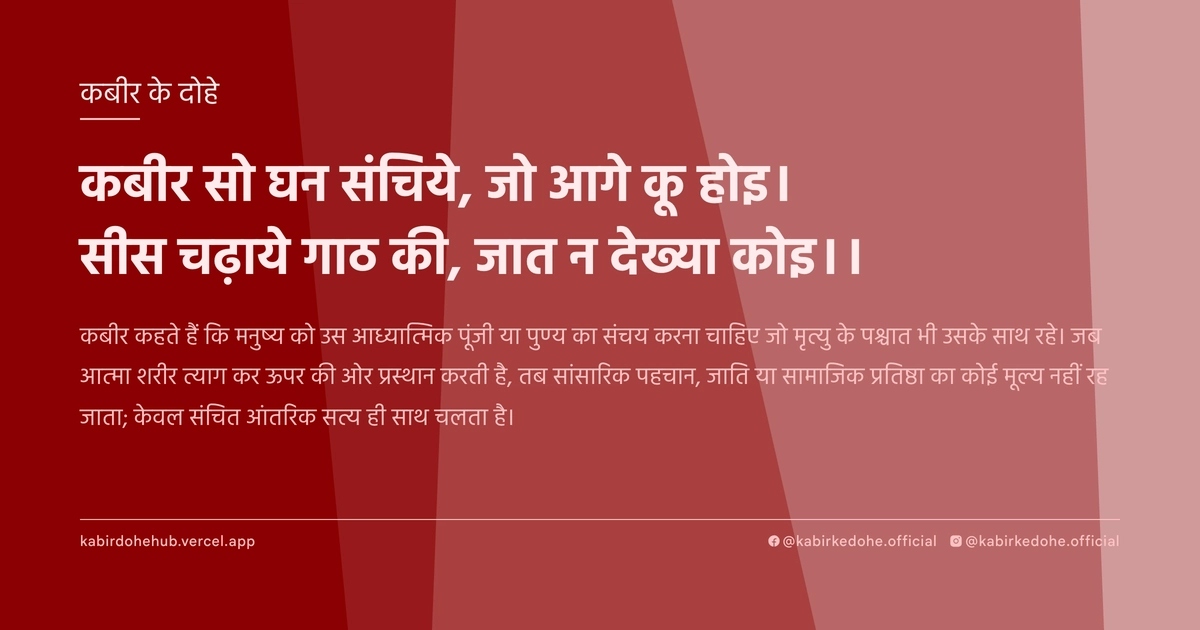
कबीर सो घन संचिये, जो आगे कू होइ।
सीस चढ़ाये गाठ की, जात न देख्या कोइ।।
Kabir so ghan sanchiye, jo aage ku hoi. Sees chadhaye gaath ki, jaat na dekhya koi.
इस पृष्ठ पर इस कबीर दोहे का अर्थ (meaning), हिंदी व्याख्या और अंग्रेज़ी अनुवाद, दार्शनिक विश्लेषण और व्यावहारिक जीवन सीख दी गई है। यह दोहा समय का महत्व (The Value of Time) विषय से जुड़ा है — Kabir doha meaning and explanation in Hindi and English.
अर्थ (Meaning):
कबीर कहते हैं कि मनुष्य को उस आध्यात्मिक पूंजी या पुण्य का संचय करना चाहिए जो मृत्यु के पश्चात भी उसके साथ रहे। जब आत्मा शरीर त्याग कर ऊपर की ओर प्रस्थान करती है, तब सांसारिक पहचान, जाति या सामाजिक प्रतिष्ठा का कोई मूल्य नहीं रह जाता; केवल संचित आंतरिक सत्य ही साथ चलता है।
Kabir advises the seeker to accumulate that spiritual wealth which remains viable beyond the threshold of death. When the soul departs the physical vessel and ascends, the bundles of worldly identity, caste, and social status vanish; only the essence of inner truth and realized consciousness accompanies the traveler.
व्याख्या (Interpretation):
इस दोहे का शाब्दिक अर्थ है कि हमें वह धन जमा करना चाहिए जो भविष्य (परलोक) में काम आए, क्योंकि मृत्यु के समय जाति-पाति का कोई महत्व नहीं होता। रूपकात्मक स्तर पर, 'घन' या 'धन' यहाँ सांसारिक मुद्रा नहीं, बल्कि 'नाम स्मरण' और 'आत्म-साक्षात्कार' है। यह निर्गुण भक्ति का सार है, जहाँ ईश्वर किसी बाहरी कर्मकांड में नहीं, बल्कि हृदय की शुद्धता में बसता है। माया हमें यह विश्वास दिलाती है कि हमारी सामाजिक स्थिति स्थायी है, जबकि अद्वैत वेदांत के अनुसार, केवल आत्मा (ब्रह्म) ही शाश्वत है। यहाँ 'सीस चढ़ाये गाठ' का अर्थ है कि जब अहंकार का बोझ समाप्त होता है और आत्मा मुक्त होती है, तब वह अपनी वास्तविक पहचान में विलीन हो जाती है, जहाँ द्वैत समाप्त हो जाता है।
Literally, the verse urges the accumulation of wealth for the afterlife, noting that caste is irrelevant at the moment of death. Metaphorically, 'wealth' refers not to currency, but to 'Nam Simran' and the realization of the Self. This aligns with Nirgun Bhakti, where the Divine is not found in rituals but in the purity of the heart. Maya creates the illusion that social standing is permanent, whereas Advaita Vedanta posits that only the Atman (Brahman) is eternal. The phrase 'bundles upon the head' symbolizes the shedding of the ego's baggage; as the soul ascends, it transcends the artificial constructs of identity, resolving the paradox of the human condition—the struggle between the transient ego and the eternal spirit.
दार्शनिक विश्लेषण (Philosophical Analysis):
कबीर का यह दोहा उनके युग के कट्टर सामाजिक विभाजन और कर्मकांडीय पाखंड पर एक गहरा प्रहार है। उस समय समाज जाति और वर्ण व्यवस्था में जकड़ा हुआ था, जहाँ व्यक्ति की पहचान उसके जन्म से तय होती थी। कबीर ने इस कृत्रिम विभाजन को नकारते हुए यह स्थापित किया कि मृत्यु सबसे बड़ा समतावादी (Equalizer) है। वे तर्क देते हैं कि यदि ईश्वर निराकार और सर्वव्यापी है, तो वह किसी विशेष जाति का पक्ष नहीं ले सकता।
दार्शनिक रूप से, यह विचार सूफी मत के 'फना' (अहंकार का विनाश) और अद्वैत वेदांत के 'अहं ब्रह्मास्मि' के करीब है। कबीर यहाँ 'सांसारिक संचय' और 'आध्यात्मिक संचय' के बीच अंतर कर रहे हैं। भौतिक धन केवल शरीर की भूख मिटाता है, लेकिन आत्म-ज्ञान आत्मा की प्यास बुझाता है। वे चेतावनी देते हैं कि जो व्यक्ति जीवन भर केवल बाहरी दिखावे और सामाजिक प्रतिष्ठा (माया) को संचित करता है, वह मृत्यु के समय रिक्त हाथ रह जाता है।
यह विश्लेषण हमें मनोवैज्ञानिक रूपांतरण की ओर ले जाता है। जब मनुष्य यह स्वीकार कर लेता है कि उसकी सामाजिक पहचान एक मुखौटा है, तब वह वास्तविक 'स्व' की खोज शुरू करता है। कबीर का संदेश यह है कि मोक्ष किसी मंदिर या मस्जिद में नहीं, बल्कि अहंकार के विसर्जन में है। वे ritualism को एक बाधा मानते हैं क्योंकि यह व्यक्ति को आंतरिक गहराई के बजाय बाहरी प्रदर्शन की ओर ले जाता है।
यहाँ 'घन संचिये' का अर्थ है प्रेम और करुणा का संचय। सूफीवाद में जिसे 'इश्क-ए-इलाही' कहा गया है, कबीर उसे ही वास्तविक पूंजी मानते हैं। जब हृदय में प्रेम का वास होता है, तो जाति, धर्म और वर्ग की दीवारें गिर जाती हैं। यह एक ऐसी अवस्था है जहाँ साधक स्वयं को ब्रह्मांडीय चेतना के साथ एकाकार महसूस करता है।
अंततः, कबीर हमें यह समझाते हैं कि जीवन का वास्तविक उद्देश्य बाहरी दुनिया में अपनी छाप छोड़ना नहीं, बल्कि आंतरिक दुनिया में शून्य होना है। जब हम 'कुछ नहीं' बन जाते हैं, तभी हम 'सब कुछ' (ब्रह्म) बन पाते हैं। यह विरोधाभास ही आध्यात्मिक यात्रा का मूल है, जहाँ खोना ही वास्तव में पाना है।
This couplet is a profound critique of the rigid social stratifications and ritualistic hypocrisies of Kabir's era. During a time when identity was strictly dictated by birth and caste, Kabir asserted that death is the ultimate equalizer. He argues that if the Divine is formless (Nirgun) and omnipresent, it cannot possibly favor one caste over another, rendering social hierarchies spiritually irrelevant.
Philosophically, this mirrors the Sufi concept of 'Fana' (annihilation of the ego) and the Advaita Vedanta realization of 'Aham Brahmasmi' (I am Brahman). Kabir distinguishes between 'material accumulation' and 'spiritual accumulation.' While material wealth satisfies the transient body, self-realization satiates the eternal soul. He warns that those who spend their lives gathering social prestige (Maya) will find themselves utterly bankrupt at the moment of transition.
This analysis leads toward a psychological transformation. Once a human accepts that their social identity is merely a mask, the quest for the authentic 'Self' begins. Kabir's message is that liberation is found not in temples or mosques, but in the dissolution of the ego. He views ritualism as a barrier because it redirects the seeker's focus from internal depth to external performance.
In this context, 'accumulating wealth' means cultivating love and compassion. What Sufism calls 'Ishq-e-Ilahi' (Divine Love), Kabir identifies as the only true capital. When the heart is filled with love, the walls of caste, religion, and class crumble. This is the state where the seeker feels an absolute oneness with the cosmic consciousness.
Ultimately, Kabir teaches that the purpose of life is not to leave a mark on the external world, but to become a void within. By becoming 'nothing,' one becomes 'everything' (Brahman). This paradox is the core of the spiritual journey: only by losing the false self can one find the true Self.
मूल संदेश (Core Message):
- बाहरी पहचान एक भ्रम है, आंतरिक सत्य ही शाश्वत है।
- अहंकार का त्याग ही वास्तविक आध्यात्मिक संचय की शुरुआत है।
- मृत्यु सामाजिक भेदों को मिटा देती है; केवल कर्म साथ चलते हैं।
- प्रेम और करुणा ही वह मुद्रा है जो परलोक में मान्य है।
- निराकार ईश्वर तक पहुँचने का मार्ग स्वयं के 'मैं' को मिटाना है।
- External identity is an illusion; internal truth is the only eternity.
- The surrender of ego is the beginning of true spiritual accumulation.
- Death erases social distinctions; only the essence of deeds remains.
- Love and compassion are the only currencies valid beyond the physical.
- The path to the Formless Divine is the annihilation of the 'I'.
व्यावहारिक उदाहरण (Practical Example):
एक समय की बात है, वाराणसी के घाटों पर रामदीन नाम का एक वृद्ध बुनकर रहता था। रामदीन अपनी कला में निपुण था, लेकिन उसका मन हमेशा इस बात से दुखी रहता था कि समाज उसे उसकी जाति के कारण नीचा समझता है। वह दिन-रात मेहनत करता ताकि अपने परिवार को अच्छे कपड़े पहना सके और समाज में अपनी एक 'इज्जत' बना सके। वह अपनी सारी ऊर्जा अपनी सामाजिक छवि को सुधारने में लगा रहा था।
एक दिन, रामदीन की मुलाकात एक घुमक्कड़ फकीर से हुई, जिसने उसे कबीर का यह दोहा सुनाया। फकीर ने उससे पूछा, 'रामदीन, तुम वह कपड़ा बुन रहे हो जो समय के साथ फट जाएगा, लेकिन क्या तुमने वह चादर बुनी है जो आत्मा को ढक सके?' रामदीन पहले तो चकित हुआ, फिर उसने गहराई से सोचा कि उसकी पूरी जिंदगी केवल इस बात की चिंता में बीती कि लोग उसे कैसे देखते हैं।
उस रात रामदीन को एक सपना आया। उसने देखा कि वह एक लंबी यात्रा पर जा रहा है। उसके पास सोने के भारी बक्से थे, जिन पर उसकी जाति और कुल का नाम लिखा था। जैसे ही वह मृत्यु के द्वार पर पहुँचा, द्वारपाल ने उससे कहा, 'यहाँ ये बक्से नहीं चलते। यहाँ केवल वह ले जा सकते हो जो तुमने दूसरों के लिए प्रेम और स्वयं के लिए सत्य के रूप में कमाया है।'
रामदीन की आँखें खुल गईं। उसने महसूस किया कि उसकी 'इज्जत' और 'जाति' का अहंकार वास्तव में एक भारी बोझ था, जो उसे ईश्वर से दूर रख रहा था। उसने तय किया कि अब वह केवल अपनी जीविका के लिए नहीं, बल्कि सेवा के लिए काम करेगा।
उसने अपने गाँव के उन बच्चों को मुफ्त में बुनना सिखाना शुरू किया जिन्हें समाज ने ठुकरा दिया था, चाहे वे किसी भी जाति के हों। उसने अपनी संचित पूंजी का उपयोग गरीबों की मदद के लिए करना शुरू किया। अब उसकी चिंता इस बात पर नहीं थी कि लोग उसे क्या कहेंगे, बल्कि इस पर थी कि वह किसी के जीवन में कितनी शांति ला सकता है।
धीरे-धीरे, रामदीन के चेहरे पर एक ऐसी चमक आई जो किसी रेशमी कपड़े से नहीं मिल सकती थी। लोग अब उसकी जाति के कारण नहीं, बल्कि उसकी करुणा के कारण उसके पास आने लगे। उसने पाया कि जब उसने अपनी सामाजिक पहचान का मोह छोड़ा, तो उसे एक ऐसी वैश्विक पहचान मिली जो वास्तव में स्थायी थी।
एक दिन जब रामदीन का अंतिम समय आया, उसके चेहरे पर कोई डर नहीं था। उसने अपने शिष्यों से कहा, 'मैंने अंततः वह धन संचित कर लिया है जिसे कोई चोर नहीं चुरा सकता और जिसे कोई सीमा रोक नहीं सकती।'
रामदीन की यह कहानी हमें सिखाती है कि वास्तविक पूंजी वह नहीं है जो बैंक खातों या सामाजिक पदवियों में होती है, बल्कि वह है जो हमारे चरित्र और करुणा में रची-बसी होती है। कबीर का 'ट्विस्ट' यहाँ यह है कि जब रामदीन ने अपनी पहचान को 'मिटाया', तभी वह वास्तव में 'पाया' गया।
Once, on the ghats of Varanasi, lived an elderly weaver named Ramdeen. Ramdeen was a master of his craft, yet his heart was heavy with the sorrow that society looked down upon him because of his caste. He worked tirelessly, striving to provide fine clothes for his family and to build a 'reputation' in the eyes of the world. He spent all his energy polishing his social image.
One day, Ramdeen met a wandering fakir who recited this specific doha of Kabir. The fakir asked him, 'Ramdeen, you are weaving cloth that will eventually tear, but have you woven the shroud that can cover the soul?' Ramdeen was initially puzzled, but then he reflected on how his entire life had been consumed by the anxiety of how others perceived him.
That night, Ramdeen had a dream. He saw himself embarking on a long journey. He carried heavy golden chests labeled with his caste and lineage. As he reached the gates of death, the gatekeeper told him, 'These chests are useless here. You can only carry what you have earned as love for others and truth for yourself.'
Ramdeen woke up shaken. He realized that his pride in his 'reputation' and 'caste' was actually a heavy burden preventing him from reaching the Divine. He decided that from then on, he would work not just for livelihood, but for service.
He began teaching weaving for free to the village children who had been shunned by society, regardless of their caste. He used his savings to help the needy. He no longer worried about what people said; instead, he focused on how much peace he could bring into someone's life.
Gradually, a radiance appeared on Ramdeen's face that no silk fabric could emulate. People began visiting him not because of his status, but because of his compassion. He discovered that by letting go of his social identity, he gained a universal identity that was truly permanent.
When Ramdeen's final hour arrived, there was no fear on his face. He told his disciples, 'I have finally accumulated the wealth that no thief can steal and no border can stop.'
Ramdeen's story teaches us that true capital is not found in bank accounts or social titles, but in the character and compassion we embody. The 'Kabir Twist' here is that only when Ramdeen 'erased' his identity did he truly 'find' himself.
अभ्यास मार्गदर्शन (Practice Guidance):
- दैनिक आत्म-निरीक्षण: प्रतिदिन 15 मिनट मौन बैठें और विचार करें कि आपकी कौन सी पहचान (पद, जाति, रिश्ता) आपके अहंकार को पुष्ट कर रही है।
- करुणा का संचय: प्रतिदिन एक ऐसा कार्य करें जिसका कोई सामाजिक लाभ न हो और जिसे आप गुप्त रखें, ताकि 'दिखावे' की आदत समाप्त हो।
- जर्नलिंग प्रॉम्प्ट: 'यदि आज मेरी मृत्यु हो जाए और मेरी सारी सामाजिक पहचान मिट जाए, तो मेरे पीछे कौन सा आंतरिक गुण बचेगा?'
- निदान चेकलिस्ट: यदि आप किसी की आलोचना करते समय उसकी जाति या पद को आधार बनाते हैं, तो समझें कि आप अभी भी 'माया' के संचय में हैं, सत्य के नहीं।
- Daily Self-Inquiry: Spend 15 minutes in silence daily, observing which labels (title, caste, relationship) are fueling your ego.
- Accumulating Compassion: Perform one act of kindness daily that offers no social reward and keep it secret to dissolve the habit of 'performance.'
- Journaling Prompt: 'If I were to die today and all my social identities vanished, what internal quality would remain as my only possession?'
- Diagnostic Checklist: If you find yourself judging others based on their status or background, recognize that you are still accumulating 'Maya' rather than Truth.
चिंतन प्रश्न (Reflection Questions):
- आपकी वह कौन सी 'डिजिटल पहचान' या सामाजिक छवि है जिसे आप खोने से सबसे ज्यादा डरते हैं?
- क्या आपकी धार्मिक आस्था आपको दूसरों से श्रेष्ठ महसूस कराती है, या यह आपको विनम्र बनाती है?
- यदि आपको अपनी जाति और नाम के बिना पहचाना जाए, तो आप स्वयं को कैसे परिभाषित करेंगे?
- आप अपने जीवन का कितना समय 'दिखने' में बिताते हैं और कितना 'होने' में?
- क्या आप वास्तव में दूसरों की मदद करते हैं, या आप उस मदद के माध्यम से अपनी 'अच्छी छवि' का संचय कर रहे हैं?
- Which 'digital identity' or social image are you most terrified of losing?
- Does your religious faith make you feel superior to others, or does it make you humble?
- If you were recognized without your caste or name, how would you define yourself?
- How much of your life is spent 'appearing' versus actually 'being'?
- Do you truly help others, or are you accumulating a 'good image' through those acts of help?