
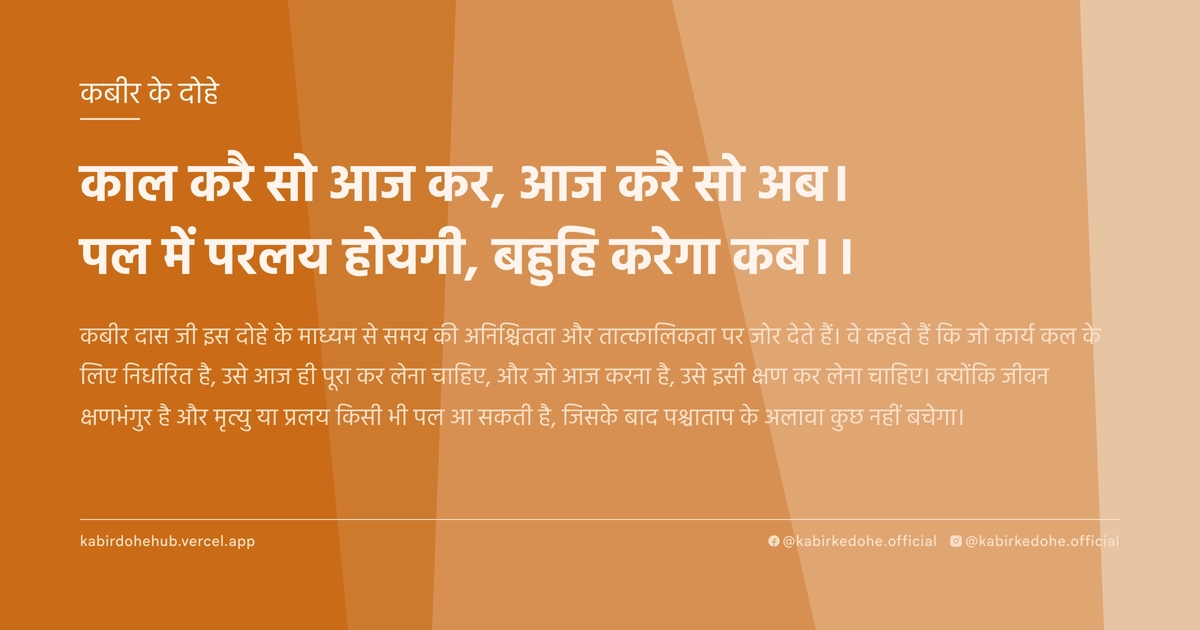
काल करै सो आज कर, आज करै सो अब।
पल में परलय होयगी, बहुहि करेगा कब।।
Kaal karai so aaj kar, aaj karai so ab. Pal mein parlay hoyegi, bahuhi karega kab.
इस पृष्ठ पर इस कबीर दोहे का अर्थ (meaning), हिंदी व्याख्या और अंग्रेज़ी अनुवाद, दार्शनिक विश्लेषण और व्यावहारिक जीवन सीख दी गई है। यह दोहा समय का महत्व (The Value of Time) विषय से जुड़ा है — Kabir doha meaning and explanation in Hindi and English.
अर्थ (Meaning):
कबीर दास जी इस दोहे के माध्यम से समय की अनिश्चितता और तात्कालिकता पर जोर देते हैं। वे कहते हैं कि जो कार्य कल के लिए निर्धारित है, उसे आज ही पूरा कर लेना चाहिए, और जो आज करना है, उसे इसी क्षण कर लेना चाहिए। क्योंकि जीवन क्षणभंगुर है और मृत्यु या प्रलय किसी भी पल आ सकती है, जिसके बाद पश्चाताप के अलावा कुछ नहीं बचेगा।
Kabir emphasizes the uncertainty and urgency of time. He asserts that tasks deferred to tomorrow should be completed today, and those planned for today should be executed this very moment. Since life is ephemeral and the 'pralaya' (dissolution or death) can occur in an instant, delaying spiritual or worldly duties leads to a state where action becomes impossible.
व्याख्या (Interpretation):
शाब्दिक अर्थ समय प्रबंधन का प्रतीत होता है, किंतु गहरा आध्यात्मिक अर्थ 'साधना' की तात्कालिकता से जुड़ा है। यहाँ 'काल' केवल समय नहीं, बल्कि माया का वह जाल है जो मनुष्य को 'कल' के भ्रम में उलझाकर रखता है। यह विलंब वास्तव में अहंकार का एक रूप है, जो यह मानता है कि उसके पास अनंत समय है। निर्गुण भक्ति में, आत्मा का परमात्मा से मिलन किसी बाहरी अनुष्ठान पर नहीं, बल्कि वर्तमान क्षण की जागरूकता पर निर्भर है। जब कबीर 'परलय' की बात करते हैं, तो वे केवल भौतिक मृत्यु नहीं, बल्कि उस चेतना के विलोपन की बात कर रहे हैं जहाँ अवसर समाप्त हो जाते हैं। यह अद्वैत वेदांत के उस सत्य को दर्शाता है कि केवल 'अब' ही वास्तविक है; भूत और भविष्य केवल मानसिक कल्पनाएँ हैं। इस प्रकार, यह दोहा साधक को माया के मोह से जगाकर उसे आत्म-साक्षात्कार के वर्तमान मार्ग पर अग्रसर करता है।
While the literal meaning suggests time management, the deeper spiritual essence concerns the urgency of 'Sadhana' (spiritual practice). Here, 'Kaal' (time) is not merely a clock but the web of Maya that traps the human mind in the illusion of 'tomorrow'. This procrastination is a subtle form of ego, operating under the delusion of permanence. In Nirgun Bhakti, the union of the Atman with the formless Brahman depends entirely on present-moment awareness, not on ritualistic schedules. When Kabir mentions 'Parlay' (dissolution), he refers not just to physical death, but to the closing of the spiritual window of opportunity. This aligns with Advaita Vedanta, where only the 'Now' is real; past and future are mere mental constructs. Thus, the couplet serves as a wake-up call to shatter the ego's complacency and embrace the immediate path to liberation.
दार्शनिक विश्लेषण (Philosophical Analysis):
कबीर का यह दोहा उनके युग के उस सामाजिक और धार्मिक परिवेश की प्रतिक्रिया है जहाँ लोग कर्मकांडों और लंबी धार्मिक यात्राओं को भविष्य के लिए सुरक्षित रखते थे। कबीर ने इस बात का खंडन किया कि मोक्ष किसी विशेष समय या स्थान पर प्राप्त होता है। उन्होंने सिखाया कि ईश्वर किसी मंदिर या मस्जिद में नहीं, बल्कि वर्तमान क्षण की शुद्ध चेतना में विद्यमान है। यह विचार सूफी मत के 'अन-अल-हक' (मैं ही सत्य हूँ) और अद्वैत वेदांत के 'अहं ब्रह्मास्मि' के करीब है, जहाँ साधक को यह समझना होता है कि सत्य तक पहुँचने का मार्ग बाहरी नहीं, बल्कि आंतरिक और तात्कालिक है।
दार्शनिक स्तर पर, कबीर यहाँ 'समय' को एक बाधा के रूप में देखते हैं। माया मनुष्य को यह विश्वास दिलाती है कि वह कल अधिक आध्यात्मिक होगा, कल वह क्षमा करेगा, या कल वह सत्य बोलेगा। यह 'कल' कभी नहीं आता क्योंकि यह अहंकार द्वारा निर्मित एक सुरक्षा कवच है। कबीर इस कवच को नष्ट करने का आह्वान करते हैं। वे तर्क देते हैं कि यदि आप वर्तमान क्षण में जागृत नहीं हैं, तो आप कभी जागृत नहीं होंगे।
यह दोहा कर्मयोग के सिद्धांत को भी पुष्ट करता है। जब कार्य को बिना किसी मानसिक द्वंद्व के 'अब' में किया जाता है, तो कर्ता का अहंकार समाप्त हो जाता है। जब 'मैं' और 'मेरा समय' का भाव मिट जाता है, तब केवल कर्म शेष रहता है, जो कि ईश्वर की सेवा के समान है। यह मानसिक रूपांतरण व्यक्ति को आलस्य से सक्रियता की ओर और भ्रम से स्पष्टता की ओर ले जाता है।
कबीर की यह चेतावनी किसी डराने वाले उपदेश की तरह नहीं, बल्कि एक प्रेमी की पुकार की तरह है जो अपने प्रिय को समय की बर्बादी से बचाना चाहता है। वे जानते हैं कि मृत्यु एक अटल सत्य है, लेकिन उससे भी बड़ा सत्य यह है कि जीवन का मूल्य उसकी लंबाई में नहीं, बल्कि उसकी गहराई और जागरूकता में है।
अंततः, यह विश्लेषण हमें बताता है कि कबीर के लिए 'अब' ही वह एकमात्र द्वार है जिससे गुजरकर मनुष्य सीमित अस्तित्व से असीमित ब्रह्म में विलीन हो सकता है। जो इस द्वार को पहचान लेता है, वह समय के बंधन से मुक्त होकर कालजयी हो जाता है।
This couplet is a reaction to the socio-religious climate of Kabir's era, where people often deferred spiritual growth to a later date or relied on elaborate rituals promised for the future. Kabir rejected the notion that liberation is a destination reached after a long journey or at a specific time. He taught that the Divine resides not in distant temples or mosques, but within the pure consciousness of the present moment. This resonates with the Sufi concept of 'An-al-Haq' and the Advaita Vedanta realization of 'Aham Brahmasmi', where the path to truth is internal and immediate.
Philosophically, Kabir views 'Time' as a primary obstacle. Maya convinces the individual that they will become more spiritual tomorrow, forgive tomorrow, or speak the truth tomorrow. This 'tomorrow' is a mirage created by the ego to maintain a comfort zone of complacency. Kabir calls for the annihilation of this illusion. He argues that if one is not awake in the present moment, they will never be awake.
The couplet also reinforces the principle of Karma Yoga. When an action is performed in the 'Now' without mental conflict or hesitation, the ego of the doer begins to dissolve. When the sense of 'I' and 'my time' vanishes, only the action remains, which becomes a form of service to the Divine. This psychological transformation shifts the practitioner from lethargy to vitality and from confusion to clarity.
Kabir's warning is not a preachy threat but the urgent call of a lover wanting to save the beloved from the waste of a precious life. He acknowledges that death is inevitable, but emphasizes that the value of life lies not in its duration, but in its depth and awareness.
Ultimately, this analysis reveals that for Kabir, the 'Now' is the only portal through which a human can transition from a limited existence to the limitless Brahman. He who recognizes this portal transcends the bondage of time and becomes timeless.
मूल संदेश (Core Message):
- कल का भ्रम ही आध्यात्मिक पतन का मुख्य कारण है।
- वर्तमान क्षण ही एकमात्र वास्तविक द्वार है।
- विलंब अहंकार का सूक्ष्म रूप है, इसे पहचानें।
- साधना को समय के दायरे से बाहर निकालें।
- मृत्यु की याद हमें वर्तमान में जीवित करती है।
- कर्म और ध्यान को एक ही बिंदु पर लाएं।
- The illusion of 'tomorrow' is the primary cause of spiritual decline.
- The present moment is the only authentic portal to truth.
- Procrastination is a subtle mask of the ego; recognize it.
- Remove spiritual practice from the constraints of a schedule.
- The awareness of death awakens us to the present.
- Merge action and meditation into a single point of focus.
व्यावहारिक उदाहरण (Practical Example):
वाराणसी के एक पुराने मोहल्ले में रामदीन नाम का एक वृद्ध बुनकर रहता था। वह अपनी कला में निपुण था, लेकिन उसका मन हमेशा भविष्य की चिंताओं में डूबा रहता था। वह सोचता था कि जब उसके बेटे बड़े हो जाएंगे और वह अधिक धन कमा लेगा, तब वह शांति से ध्यान करेगा और अपने जीवन के अधूरे आध्यात्मिक संकल्पों को पूरा करेगा। वह हर दिन कहता, "अभी तो परिवार की जिम्मेदारी है, कल जब समय मिलेगा तब ईश्वर की खोज करूँगा।"
एक दिन रामदीन की मुलाकात एक घुमक्कड़ फकीर से हुई, जिसने उसे कबीर का यह दोहा सुनाया। फकीर ने रामदीन के करघे की ओर इशारा करते हुए कहा, "देखो रामदीन, तुम धागे तो जोड़ रहे हो, लेकिन जीवन का धागा धीरे-धीरे टूट रहा है। तुम जिस 'कल' की प्रतीक्षा कर रहे हो, वह वास्तव में एक मृगतृष्णा है।"
रामदीन को पहले तो यह बात अजीब लगी, लेकिन उसी रात उसे एक तीव्र ज्वर ने पकड़ लिया। बिस्तर पर पड़े हुए, जब उसने अपनी आँखों के सामने समय को रेत की तरह फिसलते देखा, तो उसे अहसास हुआ कि उसने अपना पूरा जीवन 'तैयारी' में बिता दिया, लेकिन कभी 'जीया' नहीं। उसे याद आया कि कैसे उसने अपने पड़ोसियों से मनमुटाव रखा था यह सोचकर कि वह बाद में सुलह कर लेगा।
उसने महसूस किया कि उसका अहंकार उसे यह विश्वास दिला रहा था कि वह समय का स्वामी है, जबकि वह समय का दास था। इस बोध ने उसके भीतर एक गहरा परिवर्तन किया। जैसे ही उसका स्वास्थ्य थोड़ा सुधरा, उसने अपनी सारी संचित संपत्ति का एक बड़ा हिस्सा गरीबों में बाँट दिया और अपने उन सभी शत्रुओं से क्षमा मांगी जिनसे वह वर्षों से नहीं मिला था।
रामदीन ने अब अपने काम करने के तरीके को बदल दिया। वह अब केवल कपड़े नहीं बुनता था, बल्कि हर धागे के साथ एक मंत्र का जाप करता और वर्तमान क्षण को ही अपनी प्रार्थना बना लिया। उसने यह जान लिया कि करघे पर बैठना और ईश्वर का ध्यान करना अलग-अलग कार्य नहीं हैं, यदि उन्हें 'अब' में किया जाए।
उसने अपने बेटे को सिखाया कि सफलता धन संचय में नहीं, बल्कि इस बात में है कि आप इस क्षण में कितने जागरूक हैं। वह अब भविष्य की चिंता में नहीं जीता था, बल्कि हर सांस को एक उत्सव की तरह लेता था।
गाँव के लोग हैरान थे कि जो रामदीन हमेशा तनाव में रहता था, वह अब इतना शांत और आनंदित कैसे हो गया। रामदीन बस मुस्कुराता और कहता, "मैंने कल को मार दिया है, अब केवल आज बचा है।"
उसकी यह नई जीवनशैली उसके आस-पास के लोगों के लिए एक प्रेरणा बन गई। उसने साबित कर दिया कि आध्यात्मिक जागृति के लिए किसी विशेष समय या स्थान की आवश्यकता नहीं है, बल्कि केवल एक दृढ़ निश्चय की आवश्यकता है कि 'अब' ही सब कुछ है।
In an old neighborhood of Varanasi lived an elderly weaver named Ramdeen. He was masterful in his craft, but his mind was always submerged in future anxieties. He believed that once his sons grew up and he accumulated more wealth, he would peacefully meditate and fulfill the spiritual vows he had deferred. He would often say, "Right now, family responsibilities come first; tomorrow, when I have time, I shall seek the Divine."
A chance encounter with a wandering fakir changed everything. The fakir recited Kabir's couplet and pointed toward Ramdeen's loom, saying, "Look, Ramdeen, you are joining threads, but the thread of your own life is slowly fraying. The 'tomorrow' you await is nothing but a mirage."
Ramdeen initially found this unsettling, but that very night, a severe fever gripped him. Lying in bed, watching time slip away like sand, he realized he had spent his entire life in 'preparation' but had never actually 'lived'. He remembered the grudges he held against neighbors, thinking he would reconcile with them 'later'.
He realized his ego had tricked him into believing he was the master of time, while he was actually its slave. This realization triggered a profound shift. As soon as his health improved, he distributed a large portion of his savings among the poor and sought forgiveness from those he had wronged for years.
Ramdeen transformed his approach to work. He no longer just wove cloth; he began chanting a mantra with every thread, turning the act of weaving into a living prayer. He understood that sitting at the loom and meditating on God were not separate activities if done in the 'Now'.
He taught his sons that success is not in the accumulation of wealth, but in the degree of awareness one possesses in the present moment. He ceased living in future anxiety and began treating every breath as a celebration.
Villagers were amazed that the once stressed Ramdeen had become so serene and joyful. Ramdeen would simply smile and say, "I have killed 'tomorrow'; now, only 'today' remains."
His new way of life became an inspiration to all. He proved that spiritual awakening does not require a special time or place, but only the firm resolve that 'Now' is everything.
अभ्यास मार्गदर्शन (Practice Guidance):
- प्रतिदिन 15 मिनट 'साक्षी भाव' का अभ्यास करें: बिना किसी निर्णय के केवल वर्तमान क्षण की आवाजों और संवेदनाओं को महसूस करें।
- स्व-पूछताछ जर्नल: हर रात लिखें कि आज आपने किन कार्यों को 'कल' पर टाला और वह कौन सा डर या अहंकार था जिसने आपको रोका।
- तात्कालिक कर्म: दिन में कम से कम एक ऐसा कार्य करें जिसे आप लंबे समय से टाल रहे हैं, चाहे वह किसी से माफी मांगना हो या कोई अधूरा काम पूरा करना।
- निदान चेकलिस्ट: यदि आप बार-बार 'जब यह होगा, तब मैं खुश होऊँगा' सोच रहे हैं, तो समझ लें कि आप माया के प्रभाव में हैं और वर्तमान से कटे हुए हैं।
- Practice 'Witness Consciousness' for 15 minutes daily: Observe sounds and sensations of the present moment without judgment.
- Self-Inquiry Journaling: Every night, record the tasks you deferred to 'tomorrow' and identify the specific fear or ego-driven resistance that stopped you.
- Immediate Action: Complete at least one task daily that you have been procrastinating, whether it is apologizing to someone or finishing a long-pending chore.
- Diagnostic Checklist: If you frequently think, "I will be happy once X happens," recognize that you are under the influence of Maya and disconnected from the present.
चिंतन प्रश्न (Reflection Questions):
- वह कौन सा 'कल' है जिसका मैं वर्षों से इंतजार कर रहा हूँ, और वह वास्तव में मुझे किस डर से बचा रहा है?
- यदि मुझे पता चले कि यह मेरा अंतिम दिन है, तो मेरी प्राथमिकताएं कैसे बदलेंगी और मैं अभी क्या करूँगा?
- क्या मेरी डिजिटल पहचान (सोशल मीडिया) मुझे वर्तमान क्षण से दूर ले जाकर एक काल्पनिक भविष्य की छवि बनाने में मदद कर रही है?
- मैं किन नैतिक कर्तव्यों को 'सही समय' के इंतजार में टाल रहा हूँ?
- क्या मेरा 'कल' पर भरोसा करना वास्तव में मेरी आध्यात्मिक आलस्य को छिपाने का एक तरीका है?
- What is the 'tomorrow' I have been waiting for for years, and what fear is it actually shielding me from?
- If I knew today was my final day, how would my priorities shift and what would I do immediately?
- Is my digital identity (social media) distancing me from the present to build a fictional image of a future self?
- Which moral duties am I deferring while waiting for the 'right time'?
- Is my reliance on 'tomorrow' actually a sophisticated way of masking my spiritual lethargy?