
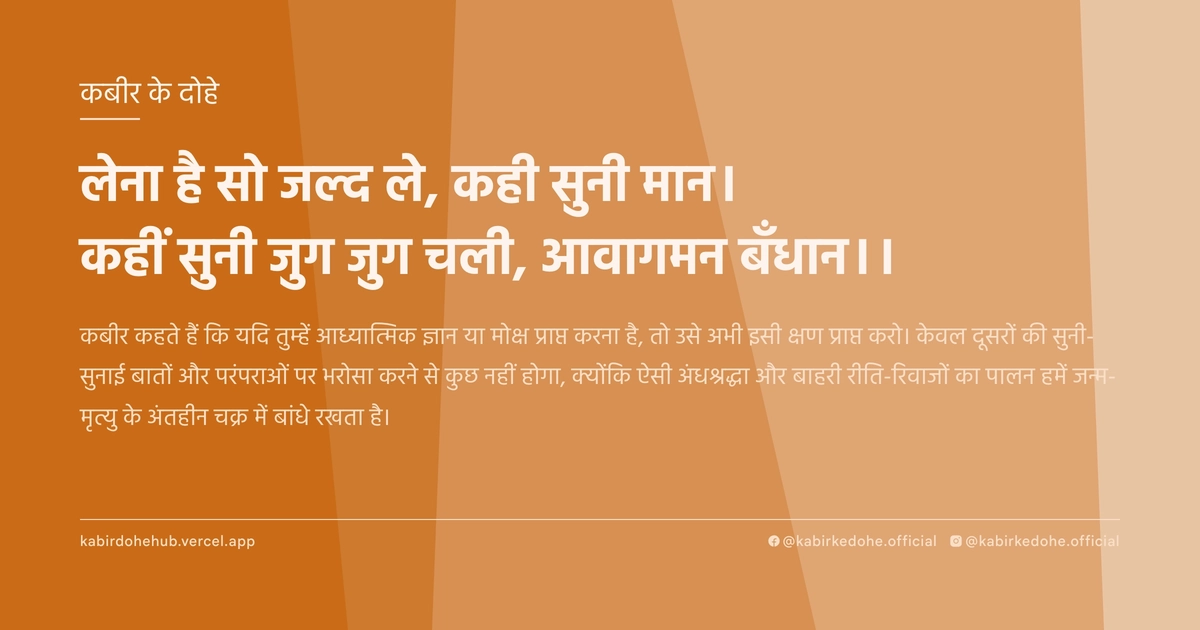
लेना है सो जल्द ले, कही सुनी मान।
कहीं सुनी जुग जुग चली, आवागमन बँधान।।
Lena hai so jald le, kahi suni maan. Kahin suni jug jug chali, aavagaman bandhaan.
इस पृष्ठ पर इस कबीर दोहे का अर्थ (meaning), हिंदी व्याख्या और अंग्रेज़ी अनुवाद, दार्शनिक विश्लेषण और व्यावहारिक जीवन सीख दी गई है। यह दोहा समय का महत्व (The Value of Time) विषय से जुड़ा है — Kabir doha meaning and explanation in Hindi and English.
अर्थ (Meaning):
कबीर कहते हैं कि यदि तुम्हें आध्यात्मिक ज्ञान या मोक्ष प्राप्त करना है, तो उसे अभी इसी क्षण प्राप्त करो। केवल दूसरों की सुनी-सुनाई बातों और परंपराओं पर भरोसा करने से कुछ नहीं होगा, क्योंकि ऐसी अंधश्रद्धा और बाहरी रीति-रिवाजों का पालन हमें जन्म-मृत्यु के अंतहीन चक्र में बांधे रखता है।
Kabir urges that if one seeks spiritual awakening or liberation, it must be pursued with immediate urgency. Relying solely on hearsay, inherited traditions, or second-hand scriptures is futile, as such blind adherence to external rituals only serves to bind the soul to the eternal cycle of birth and death.
व्याख्या (Interpretation):
इस दोहे का शाब्दिक अर्थ है कि सत्य की खोज में विलंब नहीं करना चाहिए। यहाँ 'कही सुनी' का तात्पर्य उन सामाजिक और धार्मिक रूढ़ियों से है जिन्हें हमने बिना प्रश्न किए स्वीकार कर लिया है। आध्यात्मिक स्तर पर, यह माया के उस जाल की ओर संकेत करता है जहाँ मनुष्य दूसरों के अनुभवों को अपना मान बैठता है। निर्गुण भक्ति के अनुसार, ईश्वर बाहर नहीं बल्कि भीतर है, फिर भी हम बाहरी शोर में उलझे रहते। यह विरोधाभास है कि हम मोक्ष की बात तो करते हैं, लेकिन उसे प्राप्त करने के लिए आवश्यक व्यक्तिगत प्रयास के बजाय परंपराओं की शरण लेते हैं। अंततः, यह आत्मा और ब्रह्म के अद्वैत बोध की आवश्यकता पर बल देता है, जो केवल प्रत्यक्ष अनुभव से संभव है, न कि किसी की कही हुई बातों से।
Literally, the verse warns against procrastination in the pursuit of Truth. 'Kahi suni' refers to the societal and religious dogmas accepted without scrutiny. Metaphorically, this points to the veil of Maya, where the seeker mistakes borrowed knowledge for realized wisdom. In the context of Nirgun Bhakti, the Divine is formless and internal, yet the seeker remains trapped in external noise. The central paradox lies in the human tendency to seek liberation through the very rituals that perpetuate bondage. This emphasizes the non-duality of Atman and Brahman, asserting that liberation is an experiential realization rather than a theoretical conclusion derived from scriptures or hearsay.
दार्शनिक विश्लेषण (Philosophical Analysis):
कबीर का यह दोहा उस युग की प्रतिक्रिया है जहाँ धर्म केवल कर्मकांड और पुरोहितवाद तक सीमित हो गया था। वे स्पष्ट रूप से ritualism (कर्मकांड) का खंडन करते हैं, क्योंकि उनका मानना था कि बाहरी आडंबर आत्मा की आंतरिक यात्रा में बाधा उत्पन्न करते हैं। यह दृष्टिकोण अद्वैत वेदांत के करीब है, जहाँ 'अहं ब्रह्मास्मि' का अनुभव केवल स्वयं के साक्षात्कार से होता है, न कि किसी मध्यस्थ के माध्यम से।
सूफीवाद के प्रभाव में, कबीर 'इश्क' या गहन प्रेम और अनुभव को महत्व देते हैं। उनके लिए सत्य वह नहीं है जो किताबों में लिखा है, बल्कि वह है जो जीवन के अनुभव में उतरता है। वे जाति और धर्म के कृत्रिम विभाजनों को नकारते हुए यह समझाते हैं कि सत्य सार्वभौमिक है और इसे प्राप्त करने के लिए किसी विशेष सामाजिक पहचान की आवश्यकता नहीं है।
मनोवैज्ञानिक स्तर पर, यह दोहा 'संज्ञानात्मक जड़ता' (cognitive inertia) पर प्रहार करता है। मनुष्य अक्सर अपनी मान्यताओं को चुनौती देने के बजाय उन्हें दोहराना पसंद करता है क्योंकि यह सुरक्षित लगता है। कबीर इस सुरक्षा के भ्रम को तोड़कर व्यक्ति को उसकी अपनी जिम्मेदारी लेने के लिए प्रेरित करते हैं।
आवागमन का बंधन वास्तव में अज्ञानता (Avidya) का बंधन है। जब तक हम दूसरों के बताए रास्तों पर चलते हैं, हम अपनी मौलिक चेतना को खो देते हैं। मुक्ति तब होती है जब व्यक्ति 'सुनी-सुनाई' बातों का त्याग कर स्वयं का साक्षी बनता है।
अंततः, कबीर यह संदेश देते हैं कि समय की महत्ता आध्यात्मिक यात्रा में सर्वोपरि है। 'जल्द ले' का अर्थ जल्दबाजी नहीं, बल्कि 'वर्तमान क्षण' (Present Moment) की जागरूकता है। जो व्यक्ति वर्तमान में जागृत नहीं है, वह अनंत काल तक भ्रम के चक्र में घूमता रहता है।
This Doha is a sharp critique of the era's prevailing ritualism and priestly hegemony. Kabir rejects the notion that liberation can be achieved through mechanical adherence to tradition, arguing that external formalities act as barriers to the internal journey. This aligns with Advaita Vedanta, where the realization of 'Aham Brahmasmi' (I am Brahman) requires direct experience rather than mediation by a priest or scripture.
Influenced by Sufism, Kabir prioritizes 'Ishq' (divine love) and direct intuitive experience over scholastic learning. For him, Truth is not a set of propositions to be memorized but a reality to be lived. He dismantles caste and religious hierarchies, asserting that the path to the Formless (Nirgun) is open to all, regardless of social identity.
Psychologically, the verse attacks 'cognitive inertia.' Humans tend to repeat inherited beliefs because it provides a false sense of security. Kabir challenges this comfort, urging the individual to take radical responsibility for their own spiritual evolution.
The 'bondage of coming and going' (Aavagaman) is essentially the bondage of Avidya (ignorance). As long as one follows a borrowed map, they remain lost in the illusion of the ego. Liberation occurs only when the seeker ceases to be a parrot of tradition and becomes a witness to their own existence.
Finally, Kabir emphasizes the urgency of the 'Now.' 'Jald le' does not imply haste, but rather the cultivation of mindfulness in the present moment. He suggests that those who defer their awakening to a future date or a specific ritual remain trapped in the cycle of samsara indefinitely.
मूल संदेश (Core Message):
- परंपराओं का अंधानुकरण आध्यात्मिक प्रगति में सबसे बड़ी बाधा है।
- सत्य उधार नहीं लिया जा सकता; इसे स्वयं अनुभव करना पड़ता है।
- वर्तमान क्षण ही एकमात्र द्वार है जहाँ से मुक्ति संभव है।
- बाहरी कर्मकांड केवल अहंकार को संतुष्ट करते हैं, आत्मा को नहीं।
- स्वयं का साक्षात्कार ही वास्तविक धर्म और अंतिम सत्य है।
- Blind adherence to tradition is the greatest obstacle to spiritual progress.
- Truth cannot be borrowed; it must be experienced personally.
- The present moment is the only gateway through which liberation is possible.
- External rituals satisfy the ego, not the soul.
- Self-realization is the only true religion and the ultimate truth.
व्यावहारिक उदाहरण (Practical Example):
वाराणसी के एक पुराने घाट पर रहने वाले रामदीन नाम के एक वृद्ध बुनकर थे। रामदीन ने अपना पूरा जीवन इसी विश्वास में बिताया कि यदि वे हर साल एक विशेष तीर्थयात्रा करेंगे और कठिन व्रत रखेंगे, तो उन्हें मृत्यु के बाद मोक्ष मिल जाएगा। उन्होंने अपनी सारी जमापूंजी और समय इन 'सुनी-सुनाई' परंपराओं में लगा दिया, लेकिन उनके मन की अशांति और क्रोध कभी कम नहीं हुआ।
एक दिन उनकी मुलाकात एक घुमक्कड़ साधु से हुई, जिसने उनसे पूछा, 'रामदीन, तुम मोक्ष को भविष्य की किसी यात्रा में क्यों खोज रहे हो? क्या तुम इस समय अपने भीतर उठने वाले क्रोध और मोह को नहीं देख सकते?'
रामदीन ने उत्तर दिया, 'परंतु पंडित जी ने कहा है कि इन अनुष्ठानों के बिना मुक्ति संभव नहीं है।'
साधु मुस्कुराया और बोला, 'पंडित की बात सुनी-सुनाई है, लेकिन तुम्हारा दुख तुम्हारा अपना है। क्या तुम उस दुख को अभी, इसी क्षण मिटाने का साहस रखते हो, या फिर से एक और जन्म की प्रतीक्षा करोगे?'
यह बात रामदीन के हृदय में गहरे तक उतर गई। उन्हें अहसास हुआ कि वे केवल एक मानसिक आदत का पालन कर रहे थे, न कि वास्तव में सत्य की खोज कर रहे थे। उन्होंने तीर्थयात्राओं का मोह छोड़ा और अपना ध्यान अपने भीतर की जागरूकता पर केंद्रित किया।
उन्होंने देखा कि जब वे दूसरों की मदद करते समय अहंकार नहीं लाते, तो उन्हें वही शांति मिलती है जिसकी तलाश वे तीर्थों में कर रहे थे। उन्होंने पाया कि मोक्ष कोई गंतव्य नहीं, बल्कि वर्तमान में जीने की एक कला है।
रामदीन ने अब केवल परंपराओं का पालन करना बंद कर दिया और अपने कर्मों को ही पूजा बना लिया। उन्होंने अपने गाँव के अन्य बुनकरों को भी सिखाया कि धर्म बाहरी दिखावे में नहीं, बल्कि ईमानदारी और करुणा में है।
उनकी जीवनशैली बदल गई; अब वे क्रोधित होने के बजाय शांत रहकर समस्या का समाधान ढूंढते थे। उनकी आँखों में एक नई चमक थी, क्योंकि उन्होंने 'कही सुनी' बातों के बंधन को तोड़कर स्वयं के अनुभव का मार्ग चुन लिया था।
अंततः, रामदीन ने महसूस किया कि जिस मोक्ष को वे मृत्यु के बाद खोज रहे थे, वह वास्तव में उनके अहंकार के विसर्जन में छिपा था, जो उन्होंने इसी जीवन में प्राप्त कर लिया।
In the ancient ghats of Varanasi lived an elderly weaver named Ramdeen. Ramdeen had spent his entire life believing that if he performed specific annual pilgrimages and rigorous fasts, he would attain salvation after death. He invested all his savings and time into these 'hearsay' traditions, yet his inner turmoil and anger never subsided.
One day, he met a wandering ascetic who asked him, 'Ramdeen, why do you seek liberation in a future journey? Can you not see the anger and attachment rising within you right now?'
Ramdeen replied, 'But the priest said that without these rituals, salvation is impossible.'
The ascetic smiled and said, 'The priest's word is hearsay, but your suffering is your own. Do you have the courage to extinguish that suffering here and now, or will you wait for another lifetime?'
These words struck a chord deep within Ramdeen. He realized he was merely following a mental habit rather than seeking the Truth. He abandoned his obsession with pilgrimages and shifted his focus toward internal awareness.
He discovered that when he helped others without ego, he experienced the very peace he had been searching for in distant shrines. He realized that liberation is not a destination, but the art of living consciously in the present.
Ramdeen stopped blindly following traditions and turned his daily work into a form of worship. He taught other weavers in his village that spirituality lies not in external displays, but in honesty and compassion.
His lifestyle transformed; instead of reacting with anger, he began to resolve conflicts with stillness. There was a new light in his eyes, for he had broken the chains of 'hearsay' and embraced the path of direct experience.
Ultimately, Ramdeen realized that the salvation he sought after death was actually hidden in the dissolution of his ego, which he had achieved in this very life.
अभ्यास मार्गदर्शन (Practice Guidance):
- प्रतिदिन 20 मिनट मौन रहकर यह निरीक्षण करें कि आपके कितने विचार आपके अपने हैं और कितने समाज या दूसरों द्वारा आरोपित हैं।
- एक 'मान्यता डायरी' बनाएँ: उन परंपराओं की सूची लिखें जिनका आप पालन करते हैं और स्वयं से पूछें, 'यदि यह परंपरा न होती, तो क्या मेरा आध्यात्मिक विकास रुक जाता?'
- व्यवहार परिवर्तन: जब भी आप किसी बात को 'सब ऐसा ही कहते हैं' कहकर स्वीकार करें, तो रुकें और उस विचार की तर्कसंगतता और अनुभव की जाँच करें।
- निदान चेकलिस्ट: क्या आप अभी भी मोक्ष को भविष्य की किसी घटना या बाहरी क्रिया से जोड़ रहे हैं? क्या आप सत्य के लिए दूसरों के प्रमाणों पर निर्भर हैं? यदि हाँ, तो आप अभी भी 'कही सुनी' के बंधन में हैं।
- Spend 20 minutes daily in silence, observing how many of your thoughts are genuinely your own and how many are projections of society or others.
- Maintain a 'Belief Journal': List the traditions you follow and ask yourself, 'If this tradition didn't exist, would my spiritual growth be hindered?'
- Behavioral Shift: Whenever you accept something by saying 'everyone says so,' stop and examine the rationality and experiential truth of that thought.
- Diagnostic Checklist: Are you still linking liberation to a future event or an external action? Are you relying on others' testimonials for Truth? If yes, you are still bound by 'hearsay'.
चिंतन प्रश्न (Reflection Questions):
- मेरी कितनी मान्यताएँ वास्तव में मेरी अपनी हैं, और कितनी मैंने केवल इसलिए अपनाई हैं क्योंकि वे मेरे परिवार या संस्कृति का हिस्सा थीं?
- क्या मैं अपनी आध्यात्मिक यात्रा में किसी 'गुरु' या 'किताब' को सत्य मान रहा हूँ, या मैं उन्हें केवल एक मानचित्र की तरह उपयोग कर रहा हूँ?
- मेरे जीवन का वह कौन सा 'सुना-सुनाई' सच है जिसे छोड़ने का साहस मैं आज तक नहीं जुटा पाया?
- क्या मेरी धार्मिक पहचान मेरे आंतरिक विकास में सहायक है या वह केवल एक सामाजिक मुखौटा है?
- यदि आज सारी धार्मिक पुस्तकें और परंपराएँ समाप्त हो जाएँ, तो मेरे पास ईश्वर या सत्य को खोजने का क्या आधार बचेगा?
- How many of my beliefs are truly my own, and how many have I adopted simply because they were part of my family or culture?
- In my spiritual journey, am I treating a 'guru' or a 'book' as the Truth itself, or am I using them merely as a map?
- What is that 'hearsay' truth in my life which I have lacked the courage to abandon until today?
- Is my religious identity aiding my internal growth, or is it merely a social mask?
- If all religious texts and traditions vanished today, what basis would I have left to find God or Truth?