
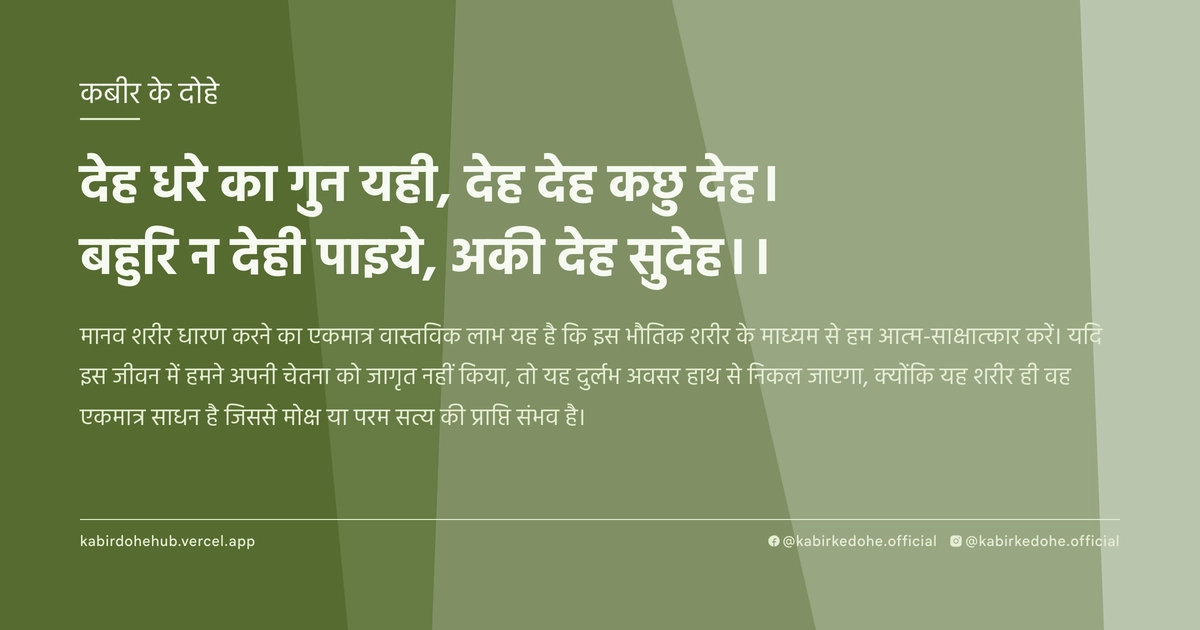
देह धरे का गुन यही, देह देह कछु देह।
बहुरि न देही पाइये, अकी देह सुदेह।।
Deh dhare ka gun yahi, deh deh kachhu deh. Bahuri na dehi paiye, aki deh sudeh.
इस पृष्ठ पर इस कबीर दोहे का अर्थ (meaning), हिंदी व्याख्या और अंग्रेज़ी अनुवाद, दार्शनिक विश्लेषण और व्यावहारिक जीवन सीख दी गई है। यह दोहा आत्मा और शरीर (Soul and Body) विषय से जुड़ा है — Kabir doha meaning and explanation in Hindi and English.
अर्थ (Meaning):
मानव शरीर धारण करने का एकमात्र वास्तविक लाभ यह है कि इस भौतिक शरीर के माध्यम से हम आत्म-साक्षात्कार करें। यदि इस जीवन में हमने अपनी चेतना को जागृत नहीं किया, तो यह दुर्लभ अवसर हाथ से निकल जाएगा, क्योंकि यह शरीर ही वह एकमात्र साधन है जिससे मोक्ष या परम सत्य की प्राप्ति संभव है।
The sole virtue of possessing a human body is to utilize this physical existence to realize the Divine. If one fails to awaken their consciousness during this tenure, the opportunity is lost, for the human form is the only vehicle capable of achieving liberation and understanding the ultimate truth.
व्याख्या (Interpretation):
यह दोहा शरीर की नश्वरता और उसकी उपयोगिता के बीच के द्वंद्व को दर्शाता है। शाब्दिक अर्थ में, कबीर कहते हैं कि शरीर का गुण केवल तभी है जब वह आध्यात्मिक उन्नति का माध्यम बने। रूपक के तौर पर, 'देह' केवल मांस और हड्डी नहीं, बल्कि वह 'पात्र' है जिसमें आत्मा निवास करती है। निर्गुण भक्ति के परिप्रेक्ष्य में, यह शरीर एक पुल है जिसे पार करना आवश्यक है; यदि हम पुल पर ही रुक गए और उसे अपना घर मान लिया, तो हम माया के जाल में फंस जाएंगे। अद्वैत वेदांत के अनुसार, शरीर वह दर्पण है जिसमें हम अपनी वास्तविक पहचान (ब्रह्म) को देख सकते हैं, बशर्ते दर्पण साफ हो। यहाँ 'सुदेह' का अर्थ केवल स्वस्थ शरीर नहीं, बल्कि वह शरीर है जो आध्यात्मिक अनुशासन से परिष्कृत हो चुका है।
This couplet highlights the tension between the transience of the body and its spiritual utility. Literally, Kabir asserts that the body's value lies solely in its role as a catalyst for spiritual evolution. Metaphorically, the 'body' is not merely flesh and bone, but the 'vessel' containing the soul. In the context of Nirgun Bhakti, the body is a bridge to be crossed; to linger on the bridge and mistake it for the destination is to fall prey to Maya (illusion). According to Advaita Vedanta, the body is the mirror in which we perceive our true identity as Brahman, provided the mirror is cleansed of ego. Here, 'Sudeh' refers not to a physically fit body, but to a body refined through spiritual discipline and awareness.
दार्शनिक विश्लेषण (Philosophical Analysis):
कबीर का यह विचार उनके युग के उस सामाजिक परिवेश से उपजा है जहाँ कर्मकांड और बाहरी आडंबरों का बोलबाला था। उन्होंने स्पष्ट किया कि तीर्थयात्रा या कठिन उपवासों से अधिक महत्वपूर्ण शरीर के भीतर की यात्रा है। यह दृष्टिकोण सूफी मत के 'इंसान-ए-कामिल' (पूर्ण मनुष्य) की अवधारणा से मेल खाता है, जहाँ शरीर को ईश्वर के नूर को प्रतिबिंबित करने का माध्यम माना जाता है।
दार्शनिक स्तर पर, कबीर यहाँ 'देह' को एक उपकरण के रूप में प्रस्तुत कर रहे हैं। वे चेतावनी देते हैं कि शरीर के प्रति अत्यधिक मोह (देह-अभिमान) ही अज्ञानता का मूल है। जब मनुष्य स्वयं को केवल शरीर मानता है, तो वह जन्म और मृत्यु के चक्र (संसार) में फंसा रहता है। यह अद्वैत वेदांत के उस सिद्धांत की पुष्टि करता है जहाँ 'अहं ब्रह्मास्मि' का अनुभव करने के लिए पहले इस मिथ्या देह-बोध का विसर्जन आवश्यक है।
कबीर का विरोध उन लोगों से था जो शरीर को केवल भोग का साधन मानते थे या जो इसे पूरी तरह नकार कर वैराग्य का ढोंग करते थे। उनका मार्ग 'मध्यम मार्ग' है—शरीर का उपयोग करो, लेकिन इसमें बंधो मत। यह मनोवैज्ञानिक रूपांतरण की प्रक्रिया है जहाँ व्यक्ति 'मैं शरीर हूँ' से 'मैं वह चेतना हूँ जो शरीर का उपयोग कर रही है' की ओर बढ़ता है।
यहाँ 'सुदेह' की अवधारणा अत्यंत महत्वपूर्ण है। यह शारीरिक सुंदरता नहीं, बल्कि 'साधना' द्वारा प्राप्त वह अवस्था है जहाँ शरीर और मन एक लय में होते हैं। जब अहंकार का विसर्जन होता है, तब शरीर केवल एक माध्यम रह जाता है, और आत्मा अपनी अनंतता को पहचान लेती है।
अंततः, यह दोहा समय की तात्कालिकता (Urgency) पर जोर देता है। कबीर यह नहीं कहते कि मृत्यु के बाद अवसर मिलेगा, बल्कि वे इस वर्तमान क्षण की दुर्लभता को रेखांकित करते हैं। यह बोध व्यक्ति को आलस्य से निकालकर आत्म-अन्वेषण की ओर प्रेरित करता है, जो कि भक्ति आंदोलन का मूल स्वर था।
Kabir's insight emerges from a socio-cultural era dominated by rigid ritualism and external piety. He asserts that the internal journey within the body is far more consequential than pilgrimages or austere fasting. This perspective aligns with the Sufi concept of 'Insan-e-Kamil' (the Perfect Human), where the body is viewed as a mirror reflecting the Divine Light.
Philosophically, Kabir presents the body as a tool. He warns that excessive attachment to the physical form (Deh-Abhiman) is the root of all ignorance. When a human identifies solely as the body, they remain trapped in the cycle of birth and death (Samsara). This validates the Advaita Vedanta principle that the dissolution of the false bodily identity is prerequisite to realizing 'Aham Brahmasmi' (I am Brahman).
Kabir opposed two extremes: those who viewed the body merely as a vehicle for sensory indulgence and those who performed a facade of renunciation by completely negating the physical. His path is the 'Middle Way'—utilize the body, but do not be enslaved by it. This is a process of psychological transformation, moving from 'I am the body' to 'I am the consciousness utilizing the body.'
The concept of 'Sudeh' is pivotal here. It does not refer to physical beauty, but to a state achieved through 'Sadhana' (spiritual practice) where the body and mind operate in harmony. Once the ego is annihilated, the body becomes a mere instrument, allowing the soul to recognize its own infinity.
Ultimately, this couplet emphasizes the urgency of the present moment. Kabir does not promise future opportunities after death; instead, he highlights the rarity of the current human incarnation. This realization jolts the individual out of spiritual lethargy and drives them toward self-inquiry, which was the core resonance of the Bhakti movement.
मूल संदेश (Core Message):
- शरीर एक साधन है, साध्य नहीं।
- देह-अभिमान ही आध्यात्मिक पतन का कारण है।
- मानव जन्म दुर्लभ है, इसे केवल भौतिक सुखों में न गंवाएं।
- चेतना का जागरण ही वास्तविक 'सुदेह' की प्राप्ति है।
- आत्मा की अनंतता को पहचानने के लिए देह की सीमाओं को समझना आवश्यक है।
- The body is a medium, not the destination.
- Identification with the physical form is the root of spiritual decline.
- Human birth is rare; do not squander it on mere material pleasures.
- Awakening of consciousness is the only true attainment of a 'Sudeh'.
- To realize the infinity of the soul, one must first understand the limitations of the body.
व्यावहारिक उदाहरण (Practical Example):
वाराणसी के एक पुराने घाट पर रहने वाले माधव नाम के एक वृद्ध बुनकर थे। माधव जीवन भर केवल कपड़ों की बुनाई में लगे रहे, यह मानते हुए कि उनकी नियति केवल गरीबी और मेहनत है। वे अक्सर देखते थे कि लोग गंगा में डुबकी लगाकर पुण्य कमाने का दावा करते थे, जबकि वे स्वयं अपने भीतर के खालीपन से जूझ रहे थे।
एक दिन माधव की मुलाकात एक घुमक्कड़ संत से हुई, जिन्होंने कबीर का यह दोहा सुनाया। संत ने माधव से कहा, 'तुम्हारी करघे की मशीन तो ठीक है, लेकिन क्या तुमने कभी सोचा है कि इस मशीन को चलाने वाला कौन है?' माधव ने उत्तर दिया, 'मैं ही तो चलाता हूँ।' संत मुस्कुराए और बोले, 'नहीं, तुम वह शरीर हो जो मशीन चला रहा है, लेकिन तुम वह नहीं हो जो इस शरीर को चला रहा है।'
इस एक वाक्य ने माधव के भीतर एक हलचल पैदा कर दी। उन्होंने महसूस किया कि उन्होंने अपना पूरा जीवन केवल 'देह' की जरूरतों को पूरा करने में बिता दिया, लेकिन उस 'चेतना' को कभी नहीं जाना जिसने उन्हें यह जीवन दिया। उन्होंने अपनी बुनाई जारी रखी, लेकिन अब उनका नजरिया बदल गया था।
अब जब वे धागों को जोड़ते, तो वे उसे केवल कपड़ा नहीं, बल्कि जीवन के ताने-बाने के रूप में देखते। उन्होंने अपनी दिनचर्या में मौन का अभ्यास शुरू किया। वे अब केवल पेट भरने के लिए नहीं कमाते थे, बल्कि हर काम को एक प्रार्थना की तरह करने लगे।
उनके व्यवहार में एक गहरा ठहराव आ गया। वे अब दूसरों की आलोचना नहीं करते थे, क्योंकि उन्हें समझ आया कि हर व्यक्ति अपनी अपनी देह की माया में उलझा हुआ है। उनकी आँखों में एक ऐसी शांति थी जो पहले कभी नहीं देखी गई थी।
एक समय ऐसा आया जब माधव ने अपनी सारी जमापूंजी उन गरीब बच्चों की शिक्षा पर लगा दी जो उनके मोहल्ले में रहते थे। उन्होंने महसूस किया कि 'सुदेह' वह है जो दूसरों के काम आए और जिसमें अहंकार का लेश मात्र भी न हो।
उनके पड़ोसी हैरान थे कि एक साधारण बुनकर अचानक इतना शांत और परोपकारी कैसे हो गया। माधव ने बस इतना कहा, 'मैंने केवल यह जान लिया कि यह शरीर एक किराए का घर है, और मुझे अब इस घर के मालिक को पहचानना है।'
अंततः, माधव की मृत्यु जब हुई, तो उनके चेहरे पर एक ऐसी मुस्कान थी जैसे उन्होंने कोई बहुत बड़ा रहस्य पा लिया हो। उन्होंने अपने जीवन के अंतिम वर्षों में देह को साधन बनाया, न कि साध्य।
In the ancient ghats of Varanasi lived an elderly weaver named Madhav. For decades, Madhav spent his days weaving cloth, believing his destiny was merely a cycle of poverty and hard labor. He often watched pilgrims dip into the Ganges, claiming to earn merit, while he himself struggled with an internal void.
One day, Madhav met a wandering saint who recited this specific Doha of Kabir. The saint asked, 'Your loom is functioning well, but have you ever wondered who is operating the machine?' Madhav replied, 'I am the one operating it.' The saint smiled and said, 'No, you are the body operating the machine, but you are not the consciousness that operates the body.'
This single sentence triggered a profound shift within Madhav. He realized he had spent his entire existence catering to the needs of the 'body,' never once acknowledging the 'consciousness' that granted him this life. He continued his weaving, but his perspective had fundamentally shifted.
Now, as he interlaced the threads, he saw not just fabric, but the very tapestry of existence. He began practicing silence in his daily routine. He no longer worked merely to fill his stomach; every action became a form of prayer.
A deep stillness descended upon his behavior. He ceased criticizing others, realizing that every human is entangled in the illusion of their own physical identity. A serenity appeared in his eyes that had never been seen before.
Eventually, Madhav dedicated all his meager savings to the education of impoverished children in his neighborhood. He realized that a 'Sudeh' (pure body) is one that serves others and is devoid of the slightest trace of ego.
His neighbors were astonished that a simple weaver had become so tranquil and altruistic. Madhav simply replied, 'I have only realized that this body is a rented house, and it is time I recognized the Landlord.'
When Madhav finally passed away, there was a smile on his face as if he had unlocked a great secret. In the final years of his life, he had treated the body as a means, not as the end.
अभ्यास मार्गदर्शन (Practice Guidance):
- प्रतिदिन 20 मिनट 'साक्षी भाव' का अभ्यास करें: शांत बैठें और अपने शरीर की संवेदनाओं को ऐसे देखें जैसे आप किसी बाहरी वस्तु को देख रहे हों।
- आत्म-पूछताछ जर्नल: प्रतिदिन लिखें—'आज मैंने कितनी बार स्वयं को केवल अपने शरीर या सामाजिक पहचान से जोड़ा, और कितनी बार मैं अपनी आंतरिक चेतना के प्रति सजग रहा?'
- व्यवहार परिवर्तन: जब भी क्रोध या लोभ उत्पन्न हो, तुरंत सोचें—'क्या यह प्रतिक्रिया मेरी आत्मा की है या केवल इस नश्वर देह के अहंकार की?'
- निदान चेकलिस्ट: यदि आप अभी भी अपनी शारीरिक सुंदरता, बीमारी या उम्र के प्रति अत्यधिक चिंतित हैं, तो आप 'देह-माया' में हैं। यदि आप शरीर को एक उपकरण मानकर सेवा में लगे हैं, तो आप 'सुदेह' की ओर बढ़ रहे हैं।
- Practice 'Witness Consciousness' for 20 minutes daily: Sit in silence and observe your bodily sensations as if you are observing an external object.
- Self-Inquiry Journaling: Daily record—'How many times today did I identify solely with my body or social persona, and how many times was I aware of my internal consciousness?'
- Behavioral Shift: Whenever anger or greed arises, immediately ask—'Is this reaction coming from my soul, or merely from the ego of this perishable body?'
- Diagnostic Checklist: If you are still excessively anxious about physical beauty, illness, or aging, you are trapped in 'Deh-Maya.' If you view the body as a tool for service, you are moving toward 'Sudeh'.
चिंतन प्रश्न (Reflection Questions):
- यदि आज आपका शरीर पूरी तरह बदल जाए, तो आपकी कौन सी पहचान शेष रहेगी?
- आप अपने शरीर की देखभाल स्वास्थ्य के लिए करते हैं या केवल सामाजिक प्रदर्शन (Digital Ego) के लिए?
- क्या आप अपनी बीमारियों या शारीरिक कमियों को अपनी आत्मा की पहचान मान लेते हैं?
- वह कौन सा डर है जो आपको यह मानने से रोकता है कि आप शरीर से परे कुछ और हैं?
- क्या आपकी दिनचर्या में ऐसा कोई क्षण है जहाँ आप पूरी तरह 'देह-विस्मृत' हो जाते हैं?
- If your body were completely changed today, which part of your identity would remain?
- Do you care for your body for the sake of health, or merely for social validation (Digital Ego)?
- Do you mistake your illnesses or physical limitations for the identity of your soul?
- What is the fear that prevents you from believing you are something beyond the body?
- Is there a single moment in your daily routine where you become completely 'body-forgotten'?