
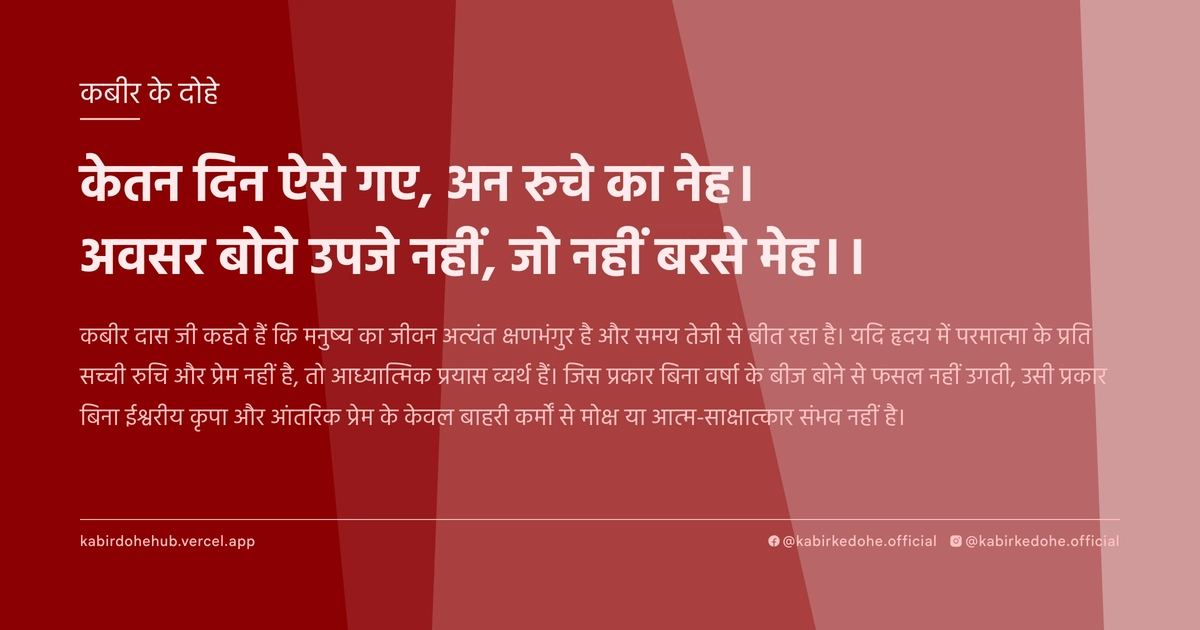
केतन दिन ऐसे गए, अन रुचे का नेह।
अवसर बोवे उपजे नहीं, जो नहीं बरसे मेह।।
Ketan din aise gaye, an ruche ka neh. Avsar bove upje nahi, jo nahi barse meh.
इस पृष्ठ पर इस कबीर दोहे का अर्थ (meaning), हिंदी व्याख्या और अंग्रेज़ी अनुवाद, दार्शनिक विश्लेषण और व्यावहारिक जीवन सीख दी गई है। यह दोहा समय का महत्व (The Value of Time) विषय से जुड़ा है — Kabir doha meaning and explanation in Hindi and English.
अर्थ (Meaning):
कबीर दास जी कहते हैं कि मनुष्य का जीवन अत्यंत क्षणभंगुर है और समय तेजी से बीत रहा है। यदि हृदय में परमात्मा के प्रति सच्ची रुचि और प्रेम नहीं है, तो आध्यात्मिक प्रयास व्यर्थ हैं। जिस प्रकार बिना वर्षा के बीज बोने से फसल नहीं उगती, उसी प्रकार बिना ईश्वरीय कृपा और आंतरिक प्रेम के केवल बाहरी कर्मों से मोक्ष या आत्म-साक्षात्कार संभव नहीं है।
Kabir emphasizes the fleeting nature of human existence, noting how days slip away unnoticed. He asserts that without genuine spiritual longing and love, all efforts remain sterile. Just as seeds sown in dry earth cannot sprout without the descent of rain, spiritual growth and liberation are impossible without the 'rain' of divine grace and heartfelt devotion.
व्याख्या (Interpretation):
इस दोहे का शाब्दिक अर्थ समय की नश्वरता और प्रेम की अनिवार्यता को दर्शाता है। 'मेह' या वर्षा यहाँ ईश्वरीय कृपा और प्रेम का प्रतीक है, जबकि 'बीज बोना' मानवीय प्रयासों और अनुष्ठानों को दर्शाता है। कबीर यहाँ निर्गुण भक्ति के उस सिद्धांत को प्रतिपादित कर रहे हैं जहाँ केवल यांत्रिक पूजा पर्याप्त नहीं है। माया के प्रभाव में मनुष्य बाहरी आडंबरों में उलझा रहता है, परंतु बिना आंतरिक रूपांतरण के वह केवल मरुस्थल में बीज बोने जैसा है। यह अद्वैत वेदांत के उस सत्य की ओर संकेत करता है जहाँ जीव और ब्रह्म का मिलन केवल प्रेम और समर्पण के माध्यम से ही संभव है। यहाँ विरोधाभास यह है कि मनुष्य प्रयास तो करता है, लेकिन उस प्रयास की जड़ें प्रेम में नहीं, बल्कि अहंकार या भय में होती हैं।
Literally, the verse addresses the transience of time and the necessity of love. 'Rain' symbolizes divine grace and spiritual longing, while 'sowing seeds' represents human rituals and efforts. Kabir invokes the principle of Nirgun Bhakti, suggesting that mechanical piety is insufficient. Under the veil of Maya, humans engage in outward displays of faith, but without an internal awakening, such acts are as futile as planting seeds in a drought. This aligns with Advaita Vedanta, where the realization of non-duality between Atman and Brahman occurs only through the alchemy of love. The central paradox lies in the human tendency to strive for liberation through the ego, whereas liberation requires the total dissolution of the ego through the 'rain' of surrender.
दार्शनिक विश्लेषण (Philosophical Analysis):
कबीर का यह दोहा उनके युग के धार्मिक पाखंड और कर्मकांडीय कठोरता पर एक गहरा प्रहार है। उन्होंने देखा कि लोग तीर्थयात्राओं और कठिन उपवासों में समय व्यतीत कर रहे थे, लेकिन उनके भीतर करुणा और प्रेम का अभाव था। कबीर का दर्शन सूफीवाद के 'इश्क' (दिव्य प्रेम) और भारतीय भक्ति परंपरा के समन्वय पर आधारित है। वे तर्क देते हैं कि ईश्वर किसी मंदिर या मस्जिद में नहीं, बल्कि हृदय की सच्ची तड़प में बसता है।
दार्शनिक स्तर पर, यह दोहा 'साधन' और 'साध्य' के बीच के अंतर को स्पष्ट करता है। केवल अनुशासन या नियम (बीज बोना) पर्याप्त नहीं हैं; जब तक हृदय में प्रेम की वर्षा नहीं होती, तब तक आध्यात्मिक चेतना का उदय नहीं होता। यह अद्वैत वेदांत के उस विचार का समर्थन करता है जहाँ ज्ञान (Jnana) और भक्ति (Bhakti) एक दूसरे के पूरक हैं। बिना प्रेम के ज्ञान केवल बौद्धिक अहंकार बन जाता है।
कबीर यहाँ जाति और वर्ण के भेदभाव को नकारते हुए यह संदेश देते हैं कि ईश्वरीय कृपा किसी विशिष्ट वर्ग के लिए आरक्षित नहीं है, बल्कि वह सबके लिए उपलब्ध है, बशर्ते उनके भीतर 'रुचि' या सच्ची प्यास हो। वे मनुष्य को चेतावनी देते हैं कि समय निरंतर क्षय हो रहा है, और यदि इस क्षण में प्रेम को नहीं जगाया गया, तो जीवन व्यर्थ चला जाएगा।
मनोवैज्ञानिक रूप से, यह दोहा 'अहंकार' के विसर्जन की बात करता है। जब हम सोचते हैं कि हम केवल 'प्रयास' करके मोक्ष पा लेंगे, तो हम अपने अहंकार को पुष्ट करते हैं। लेकिन जब हम स्वीकार करते हैं कि हम 'वर्षा' (कृपा) के अधीन हैं, तो हमारा अहंकार टूटता है और हम वास्तव में ग्रहणशील बनते हैं।
अंततः, कबीर का संदेश यह है कि आध्यात्मिकता कोई उपलब्धि नहीं है जिसे प्राप्त किया जाए, बल्कि यह एक समर्पण है। जैसे बारिश पर किसान का नियंत्रण नहीं होता, वैसे ही कृपा पर हमारा नियंत्रण नहीं होता; हम केवल अपने हृदय को खुला रखकर उस वर्षा की प्रतीक्षा कर सकते हैं।
This couplet is a profound critique of the ritualistic rigidity and religious hypocrisy prevalent during Kabir's era. He observed people spending lifetimes in pilgrimages and asceticism while remaining devoid of compassion and genuine love. Kabir's philosophy synthesizes the Sufi concept of 'Ishq' (divine love) with the Indian Bhakti tradition, asserting that the Divine resides not in structures, but in the authentic longing of the heart.
Philosophically, the verse distinguishes between 'means' and 'ends.' Discipline and rules (sowing seeds) are insufficient if the heart remains dry. This mirrors Advaita Vedanta's synthesis of Jnana (knowledge) and Bhakti (devotion); knowledge without love becomes mere intellectual vanity. The 'rain' represents the descent of grace, which is the catalyst for spiritual awakening.
Kabir rejects caste and sectarian divides, suggesting that divine grace is not the monopoly of a privileged few but is accessible to anyone possessing true 'ruchi' or spiritual hunger. He warns against the illusion of time, reminding the seeker that existence is fleeting and the window for transformation is narrow.
Psychologically, the poem addresses the dissolution of the ego. The belief that one can 'earn' liberation through effort is an extension of the ego. True surrender occurs when the seeker realizes they are dependent on a grace beyond their control, shifting the focus from 'doing' to 'being' and 'receiving.'
Ultimately, Kabir posits that spirituality is not an achievement to be unlocked but a surrender to be experienced. Just as a farmer cannot force the rain but can only prepare the soil, the seeker cannot command grace but can only make the heart receptive through love.
मूल संदेश (Core Message):
- समय सीमित है, इसे केवल बाहरी अनुष्ठानों में नष्ट न करें।
- बिना प्रेम के आध्यात्मिक प्रयास मृत बीज के समान हैं।
- ईश्वरीय कृपा तभी बरसती है जब अहंकार का सूखा समाप्त होता है।
- सच्ची भक्ति नियमों का पालन नहीं, बल्कि हृदय का रूपांतरण है।
- आत्मा का मिलन केवल पूर्ण समर्पण और निस्वार्थता से संभव है।
- Time is fleeting; do not waste it on hollow external rituals.
- Spiritual efforts without love are like sowing dead seeds.
- Divine grace descends only when the drought of ego ends.
- True devotion is not the adherence to rules, but the transformation of the heart.
- Union with the Absolute is possible only through total surrender and selflessness.
व्यावहारिक उदाहरण (Practical Example):
वाराणसी के एक पुराने मोहल्ले में रामदीन नाम का एक वृद्ध बुनकर रहता था। वह जीवन भर कबीर के दोहे गाता और स्वयं को एक बड़ा भक्त मानता था। वह रोज़ मंदिर जाता, घंटों माला जपता और शहर के सबसे बड़े धर्मगुरुओं के साथ चर्चा करता। उसकी पहचान एक 'ज्ञानी' की बन चुकी थी, लेकिन उसके व्यवहार में कठोरता थी। वह अपने पड़ोसियों को उनकी छोटी गलतियों पर टोकता और खुद को उनसे श्रेष्ठ समझता।
रामदीन का मानना था कि वह 'बीज बो रहा है'—यानी वह सभी धार्मिक नियमों का पालन कर रहा है। लेकिन उसके जीवन में शांति नहीं थी। वह हमेशा इस बात से परेशान रहता कि उसे अभी तक वह 'दिव्य अनुभव' क्यों नहीं हुआ जिसका वर्णन ग्रंथों में है।
एक दिन, उसके घर के पास एक छोटा बच्चा, जो किसी जाति या धर्म के बंधन से मुक्त था, अपनी फटी हुई कमीज पहने हुए खेल रहा था। वह बच्चा भूख से बेहाल था, लेकिन उसने अपनी रोटी का एक टुकड़ा एक घायल कुत्ते को खिला दिया। उस बच्चे की आँखों में जो निस्वार्थ प्रेम और करुणा थी, उसने रामदीन को झकझोर दिया।
रामदीन ने महसूस किया कि वह सालों से केवल शब्दों और नियमों की खेती कर रहा था, लेकिन उसके हृदय की भूमि सूखी थी। उसने देखा कि उस बच्चे के पास कोई शास्त्र नहीं थे, कोई माला नहीं थी, फिर भी उसके भीतर वह 'प्रेम की वर्षा' हो रही थी जिसे रामदीन किताबों में खोज रहा था।
उस क्षण रामदीन का अहंकार टूट गया। उसने महसूस किया कि उसकी 'रुचि' परमात्मा में नहीं, बल्कि अपनी 'भक्ति की छवि' में थी। उसने अपनी श्रेष्ठता का मुखौटा उतार फेंका और उस बच्चे की सरलता से सीखना शुरू किया।
उसने अब माला जपना बंद नहीं किया, लेकिन अब उसकी माला के हर मनके के साथ एक करुणा का भाव जुड़ा था। वह अब लोगों को सुधारने के बजाय उनकी पीड़ा को समझने लगा।
उसने अपने घर के दरवाजे सभी के लिए खोल दिए और बिना किसी भेदभाव के सबकी मदद करने लगा। उसकी कठोरता अब एक सौम्य मुस्कान में बदल गई थी।
रामदीन ने अनुभव किया कि जब उसने 'मैं' को मिटाया, तब वास्तव में 'वर्षा' शुरू हुई। उसकी आध्यात्मिक प्यास अब शांत हो रही थी क्योंकि उसने कर्मकांड से ऊपर उठकर प्रेम को अपना लिया था।
यह 'कबीर ट्विस्ट' था—जहाँ एक ज्ञानी को एक अबोध बालक ने सिखाया कि ईश्वर नियमों में नहीं, बल्कि निस्वार्थ प्रेम के छोटे से कृत्य में बसता है।
अंततः, रामदीन अब केवल एक बुनकर नहीं था जो कपड़े बुनता था, बल्कि वह एक ऐसा इंसान बन गया था जो प्रेम के धागों से दिलों को जोड़ रहा था।
In an ancient alley of Varanasi lived an elderly weaver named Ramdeen. He spent his life singing Kabir's verses and considered himself a great devotee. He visited temples daily, chanted for hours, and debated with the city's most renowned scholars. He had earned the reputation of a 'learned man,' yet his behavior was rigid. He frequently corrected his neighbors' smallest mistakes, viewing himself as spiritually superior.
Ramdeen believed he was 'sowing seeds'—following every religious injunction to the letter. However, peace eluded him. He was perpetually frustrated that he had not yet attained the 'divine experience' described in the scriptures.
One day, a small child, free from the shackles of caste or creed, was playing near his house in a tattered shirt. The child was starving, yet he shared his only piece of bread with a wounded dog. The selfless love and compassion in the child's eyes struck a chord deep within Ramdeen.
Ramdeen realized he had spent years farming words and rules, but the soil of his heart remained parched. He saw that the child possessed no scriptures and no prayer beads, yet the 'rain of love' was pouring within him—the very thing Ramdeen had been searching for in books.
In that moment, Ramdeen's ego shattered. He realized his 'interest' was not in the Divine, but in the 'image of his own devotion.' He cast off the mask of superiority and began to learn from the child's simplicity.
He did not stop chanting, but now every bead of his rosary was infused with genuine compassion. Instead of trying to 'correct' people, he began to understand their pain.
He opened his doors to everyone, helping without discrimination. His rigidity transformed into a gentle, welcoming smile.
Ramdeen experienced that only when the 'I' vanished did the 'rain' actually begin. His spiritual thirst was finally being quenched because he had risen above ritual to embrace love.
This was the 'Kabir Twist'—where a scholar was taught by an innocent child that God resides not in rules, but in a single, selfless act of love.
Ultimately, Ramdeen was no longer just a weaver of cloth, but a weaver of hearts, binding people together with threads of unconditional love.
अभ्यास मार्गदर्शन (Practice Guidance):
- दैनिक चिंतन: प्रतिदिन 15 मिनट मौन बैठें और विचार करें कि क्या आपके कार्य केवल सामाजिक दिखावे के लिए हैं या उनमें वास्तविक प्रेम निहित है।
- आत्म-पूछताछ जर्नल: लिखें कि दिन भर में ऐसी कौन सी स्थितियाँ थीं जहाँ आपने प्रेम के बजाय 'सही होने' के अहंकार को प्राथमिकता दी।
- व्यवहारिक परिवर्तन: किसी ऐसे व्यक्ति की निस्वार्थ मदद करें जिससे आपका वैचारिक मतभेद हो, बिना यह उम्मीद किए कि वे आपकी सराहना करेंगे।
- निदान चेकलिस्ट: क्या आप ईश्वर को पाने के लिए नियमों का सहारा ले रहे हैं? क्या आपकी भक्ति में करुणा है? क्या आप दूसरों की त्रुटियों पर क्रोधित होते हैं? यदि हाँ, तो आपकी 'भूमि' अभी भी सूखी है।
- Daily Contemplation: Spend 15 minutes in silence, questioning whether your actions are driven by social performance or genuine love.
- Self-Inquiry Journal: Document moments throughout the day where you prioritized the ego's need to be 'right' over the heart's need to love.
- Behavioral Shift: Perform a selfless act of service for someone with whom you have a deep ideological conflict, expecting no recognition.
- Diagnostic Checklist: Are you relying on rules to reach the Divine? Is your devotion devoid of compassion? Do you react with anger to others' flaws? If yes, your 'soil' remains dry.
चिंतन प्रश्न (Reflection Questions):
- क्या मेरी धार्मिक या आध्यात्मिक पहचान वास्तव में मुझे विनम्र बना रही है, या यह मेरे अहंकार को एक नया 'पवित्र' रूप दे रही है?
- यदि आज मेरे जीवन से सभी बाहरी रीति-रिवाज हटा दिए जाएं, तो मेरे और परमात्मा के बीच क्या बचेगा?
- मैं किन लोगों को 'अपात्र' मानता हूँ, और क्या यह धारणा मेरे भीतर की आध्यात्मिक शुष्कता को दर्शाती है?
- क्या मैं प्रेम करना चाहता हूँ, या मैं केवल प्रेम पाने का हकदार बनना चाहता हूँ?
- मेरे जीवन में 'वर्षा' (कृपा) की कमी है, या मैंने अपनी कठोरता से अपनी भूमि को इतना सख्त कर लिया है कि पानी सोखना असंभव है?
- Is my religious or spiritual identity making me truly humble, or is it merely giving my ego a 'sacred' mask?
- If all external rituals were stripped away from my life today, what would remain between me and the Divine?
- Whom do I consider 'unworthy,' and does this judgment reflect the spiritual dryness within me?
- Do I actually desire to love, or do I merely wish to be seen as someone entitled to be loved?
- Is there a lack of 'rain' (grace) in my life, or have I made the soil of my heart so hard through rigidity that it can no longer absorb water?