
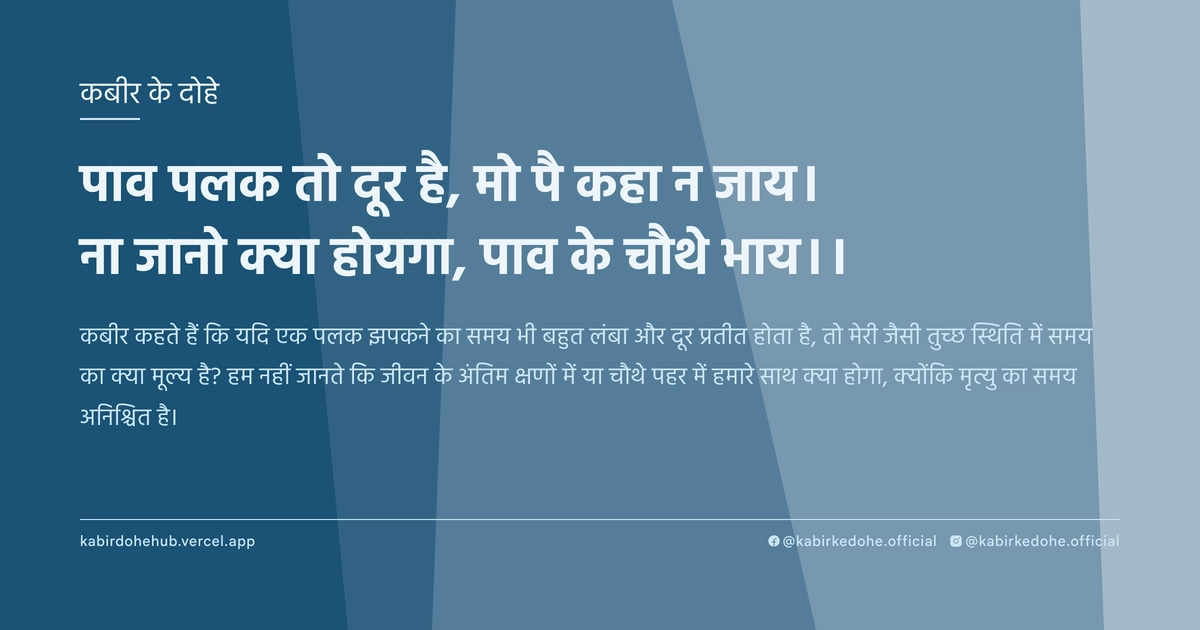
पाव पलक तो दूर है, मो पै कहा न जाय।
ना जानो क्या होयगा, पाव के चौथे भाय।।
Paav palak to door hai, mo pai kaha na jaaye. Na jaano kya hoyega, paav ke chauthe bhay.
इस पृष्ठ पर इस कबीर दोहे का अर्थ (meaning), हिंदी व्याख्या और अंग्रेज़ी अनुवाद, दार्शनिक विश्लेषण और व्यावहारिक जीवन सीख दी गई है। यह दोहा समय का महत्व (The Value of Time) विषय से जुड़ा है — Kabir doha meaning and explanation in Hindi and English.
अर्थ (Meaning):
कबीर कहते हैं कि यदि एक पलक झपकने का समय भी बहुत लंबा और दूर प्रतीत होता है, तो मेरी जैसी तुच्छ स्थिति में समय का क्या मूल्य है? हम नहीं जानते कि जीवन के अंतिम क्षणों में या चौथे पहर में हमारे साथ क्या होगा, क्योंकि मृत्यु का समय अनिश्चित है।
Kabir suggests that if even the blink of an eye feels like a distant eternity, how can a fragile human like me claim control over time? We remain ignorant of what will transpire in the final stages of existence, as the hour of departure is unpredictable and sudden.
व्याख्या (Interpretation):
इस दोहे का शाब्दिक अर्थ समय की क्षणभंगुरता और मृत्यु की अनिश्चितता है। रूपकात्मक रूप से, 'पलक' यहाँ माया के उस पर्दे को दर्शाती है जो सत्य को ढक देता है। निर्गुण भक्ति के संदर्भ में, कबीर चेतावनी देते हैं कि आत्मा और परमात्मा का मिलन केवल तभी संभव है जब अहंकार का विसर्जन हो। अद्वैत वेदांत के अनुसार, हम समय के भ्रम में फंसे हैं, जबकि वास्तविक सत्य 'कालातीत' है। यहाँ 'चौथा भाय' जीवन के अंतिम चरण या प्रलय का संकेत है, जहाँ केवल आत्म-ज्ञान ही काम आता है। यह विरोधाभास है कि हम अनंत काल की योजना बनाते हैं, जबकि हमारा अस्तित्व एक पलक झपकने जितना छोटा है।
Literally, this verse addresses the fragility of time and the unpredictability of death. Metaphorically, the 'blink of an eye' represents the veil of Maya that obscures ultimate reality. In the context of Nirgun Bhakti, Kabir warns that the union of Atman and Brahman is only possible once the ego is dissolved. According to Advaita Vedanta, we are trapped in the illusion of linear time, whereas the Absolute Truth is timeless. The 'fourth stage' signifies the final transition or the dissolution of the physical form, where only spiritual realization serves as a beacon. It highlights the central paradox: humans plan for an eternity they do not possess, while ignoring the fleeting moment they actually inhabit.
दार्शनिक विश्लेषण (Philosophical Analysis):
कबीर का यह दोहा उस कालखंड का प्रतिबिंब है जहाँ कर्मकांड और बाहरी आडंबरों ने आंतरिक खोज को दबा दिया था। उन्होंने मंदिर-मस्जिद के विवादों से ऊपर उठकर 'सहज' मार्ग की बात की। यहाँ वे समय के प्रति मानवीय मोह का खंडन करते हैं, जो कि सूफी मत के 'वक्त' और 'इश्क' के सिद्धांतों से मेल खाता है, जहाँ प्रेमी को हर क्षण अपने प्रिय (ईश्वर) की याद में रहना होता है।
वे जाति और वर्ण व्यवस्था को नकारते हुए यह तर्क देते हैं कि मृत्यु सबको समान बनाती है। जब समय का कोई भरोसा नहीं, तो सामाजिक श्रेष्ठता का अहंकार निरर्थक है। यह विचार अद्वैत वेदांत के उस सिद्धांत को पुष्ट करता है कि शरीर नश्वर है और केवल चेतना ही शाश्वत है।
मनोवैज्ञानिक स्तर पर, कबीर 'मृत्यु-स्मरण' (Memento Mori) का उपयोग कर रहे हैं। यह डराने के लिए नहीं, बल्कि जाग्रत करने के लिए है। जब मनुष्य को अपनी नश्वरता का बोध होता है, तब वह बाहरी दुनिया की दौड़ छोड़कर अंतर्मुखी होता है।
अक्सर लोग इसे केवल एक चेतावनी मानते हैं, लेकिन वास्तव में यह 'वर्तमान क्षण' (The Eternal Now) में जीने का आह्वान है। यदि हम भविष्य की चिंता में डूबे हैं, तो हम उस ईश्वर को खो रहे हैं जो इसी क्षण में मौजूद है।
अंततः, यह दोहा अहंकार के विलोपन की बात करता है। 'मो पै' (मुझ पर) कहकर कबीर स्वयं को शून्य कर देते हैं, जिससे वे सार्वभौमिक सत्य के करीब पहुँच जाते हैं। यह शून्यता ही वह द्वार है जहाँ से असीम की यात्रा शुरू होती है।
This couplet reflects the era where ritualism and external piety had overshadowed internal spiritual inquiry. Kabir transcended the conflicts of temple and mosque to advocate for the 'Sahaj' (natural) path. He dismantles the human attachment to time, aligning with Sufi concepts of 'Waqt' and 'Ishq,' where the seeker must remain in constant remembrance of the Beloved (the Divine).
By rejecting caste and hierarchy, he argues that death is the ultimate equalizer. If time is unpredictable, the arrogance of social superiority becomes an absurdity. This reinforces the Advaita Vedanta principle that while the physical vessel is perishable, the consciousness (Atman) is eternal.
Psychologically, Kabir employs 'death-contemplation' not as a tool of fear, but as a catalyst for awakening. When a human truly realizes their mortality, they cease their outward race and turn inward toward the source.
Common literalist interpretations view this as a mere warning. However, it is actually a call to inhabit 'The Eternal Now.' By obsessing over a distant future, we miss the Divine presence that manifests in the immediate present.
Ultimately, the verse speaks to the annihilation of the ego. By referring to himself in a humble or diminished state ('mo pai'), Kabir achieves a state of spiritual void, which is the only gateway to the Infinite. This emptiness is where the individual ego ends and universal truth begins.
मूल संदेश (Core Message):
- समय का मोह ही सबसे बड़ा आध्यात्मिक अवरोध है।
- भविष्य की तैयारी में वर्तमान को न खोएं।
- मृत्यु की अनिश्चितता ही जीवन को मूल्यवान बनाती है।
- अहंकार को मिटाकर ही शाश्वत सत्य का अनुभव संभव है।
- ईश्वर किसी समय में नहीं, बल्कि हर क्षण में मौजूद है।
- Attachment to time is the greatest spiritual obstacle.
- Do not sacrifice the present on the altar of future preparation.
- The unpredictability of death is what gives life its true value.
- Experience of the Eternal is possible only after the ego dissolves.
- The Divine does not exist in a specific time, but in every single moment.
व्यावहारिक उदाहरण (Practical Example):
वाराणसी के घाटों पर एक वृद्ध विधवा, जानकी, रहती थी। उनका पूरा जीवन केवल इस प्रतीक्षा में बीता कि जब उनके बेटे विदेश से लौटेंगे, तब वे शांति से पूजा-पाठ करेंगी और मोक्ष प्राप्त करेंगी। वे हर दिन अपने पुराने संदूक में रेशमी साड़ियाँ और सोने के गहने सहेजती थीं, यह सोचकर कि भविष्य में वे इनके काम आएंगे।
जानकी का पूरा दिन आने वाले कल की योजना बनाने और बीते हुए कल की यादों में बीत जाता था। वे वर्तमान के हर पल को एक बाधा मानती थीं, जिसे पार करके उन्हें अपने 'सुनहरे भविष्य' तक पहुँचना था।
एक दिन, घाट पर एक फकीर ने उन्हें यह दोहा सुनाया। फकीर ने कहा, 'माँ, तुम उस किनारे की तैयारी कर रही हो जहाँ शायद तुम कभी पहुँचो ही नहीं, जबकि यह किनारा तुम्हारे पैरों के नीचे फिसल रहा है।'
जानकी को पहले तो यह बात कड़वी लगी। उन्होंने सोचा कि फकीर उनके सपनों को तोड़ रहा है। लेकिन उस रात, जब उन्होंने अपनी आँखों को बंद किया, उन्हें महसूस हुआ कि उनकी पूरी उम्र केवल 'इंतजार' की एक लंबी कतार थी।
उन्होंने महसूस किया कि उन्होंने अपने बेटे के आने की खुशी को भविष्य के लिए सुरक्षित रखा था, और इस प्रक्रिया में उन्होंने वर्तमान की शांति को खो दिया। वे यह भूल गई थीं कि सांसें किसी के लौटने का इंतजार नहीं करतीं।
अगले दिन, जानकी ने अपना संदूक खोल दिया। उन्होंने अपनी कीमती साड़ियाँ उन गरीब महिलाओं को दे दीं जो ठंड से कांप रही थीं। उन्होंने गहने बेचकर एक छोटे से पाठशाला के लिए किताबें खरीदीं।
अब वे भविष्य की चिंता नहीं करती थीं। उन्होंने वर्तमान क्षण को ही अपना गंतव्य मान लिया। वे अब केवल पूजा के लिए इंतजार नहीं करती थीं, बल्कि हर मुस्कुराते चेहरे में ईश्वर को देखने लगीं।
जब उनके बेटे अंततः लौटे, तो उन्होंने एक ऐसी माँ को पाया जो अब किसी चीज़ की मोहताज नहीं थी। जानकी अब 'भविष्य' की कैदी नहीं, बल्कि 'वर्तमान' की स्वामिनी थीं।
यह बदलाव उनके जीवन में एक गहरी शांति लेकर आया। उन्होंने जान लिया था कि जीवन का असली आनंद उस 'चौथे पहर' की तैयारी में नहीं, बल्कि इस पल की पूर्णता में है।
जानकी की कहानी हमें सिखाती है कि जब हम समय के मोह को छोड़ देते हैं, तभी हम वास्तव में जीना शुरू करते हैं।
In the ghats of Varanasi lived an elderly widow named Janaki. Her entire life was spent in anticipation—waiting for her sons to return from abroad so she could finally perform rituals in peace and attain salvation. She meticulously preserved silk sarees and gold jewelry in an old trunk, believing they would be essential for her future stability.
Janaki's days were consumed by planning for tomorrow and reminiscing about yesterday. She viewed the present moment as a mere obstacle, a bridge she had to cross to reach her 'golden future.'
One day, a wandering mystic on the ghats recited this Doha to her. The mystic said, 'Mother, you are preparing for a shore you may never reach, while the shore beneath your feet is slipping away.'
At first, Janaki found this bitter. She felt the mystic was destroying her dreams. But that night, as she closed her eyes, she realized her entire existence had been nothing but a long queue of 'waiting.'
She realized she had deferred the joy of her sons' return to a future date, and in doing so, she had sacrificed the peace of the present. She had forgotten that breath does not wait for anyone's arrival.
The next day, Janaki opened her trunk. She gave her precious sarees to poor women shivering in the cold. She sold her jewelry to buy books for a small village school.
She no longer worried about the future. She accepted the present moment as her ultimate destination. She stopped waiting for a specific time to pray and began seeing the Divine in every smiling face she encountered.
When her sons finally returned, they found a mother who was no longer dependent on any external outcome. Janaki was no longer a prisoner of 'tomorrow' but the sovereign of 'now.'
This transformation brought a profound stillness to her life. She understood that the true essence of living is not in preparing for the 'fourth stage' of life, but in the fullness of this very breath.
Janaki's story teaches us that only when we relinquish our obsession with time do we truly begin to live.
अभ्यास मार्गदर्शन (Practice Guidance):
- प्रतिदिन 15 मिनट 'साक्षी भाव' का अभ्यास करें: केवल अपनी सांसों को देखें और यह महसूस करें कि यह क्षण ही एकमात्र सत्य है।
- आत्म-पूछताछ जर्नल: लिखें कि आप किन भविष्य की चिंताओं के कारण वर्तमान की शांति का त्याग कर रहे हैं।
- व्यवहार परिवर्तन: दिन में कम से कम एक कार्य ऐसा करें जिसमें कोई भविष्य का लाभ न हो, केवल वर्तमान की निस्वार्थ सेवा हो।
- निदान चेकलिस्ट: क्या मैं 'जब यह होगा तब मैं खुश होऊँगा' सोचता हूँ? (यदि हाँ, तो आप समय के भ्रम में हैं)। क्या मैं मृत्यु के विचार से डरता हूँ या उसे एक सहज सत्य मानता हूँ?
- Practice 'Witness Consciousness' for 15 minutes daily: Observe your breath and realize that this singular moment is the only existing reality.
- Self-Inquiry Journaling: Document the specific future anxieties that are causing you to sacrifice your present peace.
- Behavioral Shift: Perform at least one act daily that offers no future reward or gain, focusing solely on selfless service in the now.
- Diagnostic Checklist: Do I often think 'I will be happy once X happens'? (If yes, you are trapped in the illusion of time). Do I fear the thought of death, or do I accept it as a natural transition?
चिंतन प्रश्न (Reflection Questions):
- यदि आज आपका अंतिम दिन हो, तो आपकी कौन सी 'भविष्य की योजनाएं' निरर्थक प्रतीत होंगी?
- आपकी डिजिटल पहचान (Social Media) किस तरह आपको एक काल्पनिक भविष्य की दौड़ में लगाए रखती है?
- क्या आपका धर्म केवल मृत्यु के बाद के पुरस्कारों की लालसा है, या यह वर्तमान में जीने की कला है?
- आप अपने जीवन के 'चौथे पहर' के लिए क्या संचित कर रहे हैं—संपत्ति या चेतना?
- वह कौन सा डर है जो आपको इस क्षण में पूरी तरह उपस्थित होने से रोकता है?
- If today were your final day, which of your 'future plans' would appear utterly meaningless?
- How does your digital identity (social media) keep you trapped in a race toward a fictional future?
- Is your spirituality merely a longing for rewards after death, or is it an art of living in the now?
- What are you accumulating for the 'fourth stage' of your life—material wealth or conscious awareness?
- What is the specific fear that prevents you from being fully present in this very moment?