
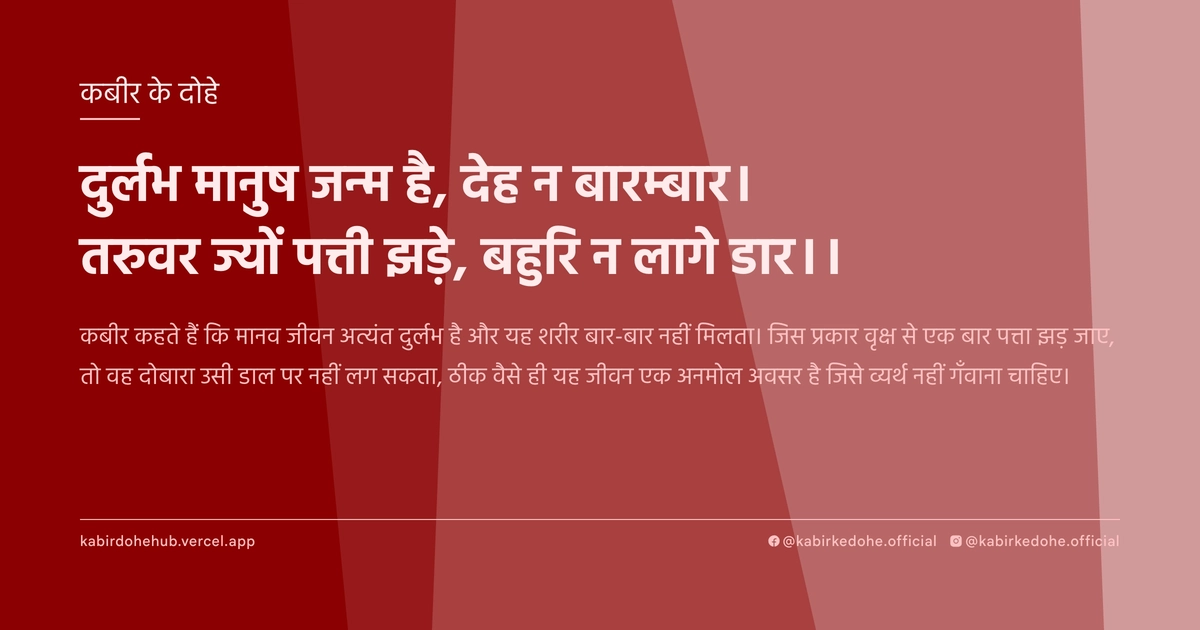
दुर्लभ मानुष जन्म है, देह न बारम्बार।
तरुवर ज्यों पत्ती झड़े, बहुरि न लागे डार।।
Durlabh manush janm hai, deh na barambar. Taruvar jyon patti jhadé, bahuri na laage daar.
इस पृष्ठ पर इस कबीर दोहे का अर्थ (meaning), हिंदी व्याख्या और अंग्रेज़ी अनुवाद, दार्शनिक विश्लेषण और व्यावहारिक जीवन सीख दी गई है। यह दोहा मृतुक्यता (Mortality) विषय से जुड़ा है — Kabir doha meaning and explanation in Hindi and English.
अर्थ (Meaning):
कबीर कहते हैं कि मानव जीवन अत्यंत दुर्लभ है और यह शरीर बार-बार नहीं मिलता। जिस प्रकार वृक्ष से एक बार पत्ता झड़ जाए, तो वह दोबारा उसी डाल पर नहीं लग सकता, ठीक वैसे ही यह जीवन एक अनमोल अवसर है जिसे व्यर्थ नहीं गँवाना चाहिए।
Kabir asserts that human birth is an exceedingly rare occurrence and this physical form is not granted repeatedly. Just as a leaf, once fallen from a tree, can never re-attach itself to the branch, this life is a singular, precious opportunity that must not be squandered.
व्याख्या (Interpretation):
इस दोहे का शाब्दिक अर्थ जीवन की नश्वरता और उसकी दुर्लभता को रेखांकित करता है। रूपक के माध्यम से कबीर समझाते हैं कि जिस तरह प्रकृति में एक बार गिरा पत्ता मृत हो जाता है, वैसे ही मानव शरीर का समय सीमित है। आध्यात्मिक स्तर पर, यह 'निर्गुण भक्ति' की ओर संकेत है, जहाँ शरीर केवल एक माध्यम है। माया का प्रभाव मनुष्य को यह भुला देता है कि वह इस संसार में केवल एक क्षणिक यात्री है। यहाँ 'दुर्लभ' शब्द केवल समय की कमी को नहीं, बल्कि उस चेतना के अवसर को दर्शाता है जो केवल मानव रूप में ही आत्म-साक्षात्कार (Self-realization) कर सकती है। यह अद्वैत वेदांत के उस सिद्धांत से जुड़ा है जहाँ आत्मा का परमात्मा से मिलन ही अंतिम लक्ष्य है, और यह जन्म उस मिलन का एकमात्र द्वार है।
The literal meaning of this couplet underscores the transience and rarity of human existence. Through the metaphor of the falling leaf, Kabir explains that just as a leaf cannot return to the branch once detached, the human physical form is finite. On a spiritual level, this points toward 'Nirgun Bhakti,' where the body is merely a vehicle. The influence of Maya (illusion) makes humans forget that they are but momentary travelers in this cosmic play. The term 'rare' refers not just to the scarcity of time, but to the unique opportunity of human consciousness to achieve self-realization. This aligns with Advaita Vedanta, where the union of Atman (soul) and Brahman (universal consciousness) is the ultimate goal, and this specific birth is the only gateway to that liberation.
दार्शनिक विश्लेषण (Philosophical Analysis):
कबीर का यह दोहा उस समय के सामाजिक और धार्मिक परिवेश में एक क्रांतिकारी आह्वान था, जहाँ लोग कर्मकांडों और बाहरी आडंबरों में उलझे थे। वे स्पष्ट करते हैं कि मोक्ष किसी मंदिर, मस्जिद या तीर्थयात्रा से नहीं, बल्कि इस दुर्लभ मानव जीवन के सही उपयोग से मिलता है। कबीर का दृष्टिकोण 'शून्य' और 'निर्गुण' की ओर है, जहाँ वे ईश्वर को किसी आकार में नहीं, बल्कि आंतरिक अनुभव में खोजते हैं।
ऐतिहासिक रूप से, कबीर ने जाति व्यवस्था और धार्मिक कट्टरता का विरोध किया क्योंकि वे जानते थे कि आत्मा की कोई जाति नहीं होती। उनके लिए, शरीर की दुर्लभता का अर्थ था कि समय सीमित है, इसलिए संकीर्ण पहचानों (जैसे हिंदू या मुस्लिम) को त्यागकर सार्वभौमिक सत्य की खोज करनी चाहिए। यह सूफी मत के 'फना' (अहंकार का विनाश) के सिद्धांत से मिलता-जुलता है, जहाँ व्यक्ति अपनी छोटी पहचान को मिटाकर विराट सत्य में विलीन हो जाता है।
दार्शनिक स्तर पर, कबीर यहाँ समय की रैखिकता और चक्राकार प्रकृति के बीच के द्वंद्व को दिखाते हैं। यद्यपि पुनर्जन्म की बात कही गई है, लेकिन जोर 'दुर्लभता' पर है, जो साधक को तात्कालिकता (urgency) का बोध कराता है। यह आलस्य और आध्यात्मिक प्रमाद (spiritual slumber) के विरुद्ध एक चेतावनी है।
वेदांत के अनुसार, अविद्या (अज्ञान) ही वह पर्दा है जो हमें हमारी वास्तविक प्रकृति से दूर रखता है। कबीर का तर्क है कि यदि हम इस जन्म में उस पर्दे को नहीं हटा पाए, तो हम फिर से उसी अज्ञान के चक्र में फंस जाएंगे। शरीर का गिरना केवल भौतिक मृत्यु नहीं है, बल्कि अवसर का खो जाना है।
अंततः, यह विश्लेषण हमें सिखाता है कि जीवन का मूल्य उसकी लंबाई में नहीं, बल्कि उसकी गहराई और जागरूकता में है। अहंकार का विसर्जन ही वह एकमात्र तरीका है जिससे इस दुर्लभ जन्म को सार्थक बनाया जा सकता है।
This couplet was a revolutionary call within the social and religious milieu of Kabir's era, where people were entangled in ritualism and outward displays of piety. He clarifies that liberation is not achieved through temples, mosques, or pilgrimages, but through the correct utilization of this rare human life. Kabir's perspective is oriented toward 'Shunya' (the void) and 'Nirgun' (the formless), seeking the Divine not in a shape, but in internal experience.
Historically, Kabir opposed the caste system and religious bigotry because he recognized that the soul possesses no caste. For him, the rarity of the body meant that time is limited; therefore, one must discard narrow identities (such as Hindu or Muslim) to seek the universal truth. This resonates with the Sufi concept of 'Fana' (annihilation of the ego), where the individual dissolves their limited identity to merge with the Absolute Truth.
Philosophically, Kabir highlights the tension between the linear and cyclical nature of time. While reincarnation is implied, the emphasis is on 'rarity,' instilling a sense of spiritual urgency in the seeker. It is a stern warning against spiritual slumber and procrastination.
According to Vedanta, Avidya (ignorance) is the veil that separates us from our true nature. Kabir argues that if we fail to lift this veil in this lifetime, we remain trapped in the cycle of ignorance. The 'falling' of the body is not merely physical death, but the loss of a divine opportunity.
Ultimately, this analysis teaches us that the value of life lies not in its duration, but in its depth and awareness. The dissolution of the ego is the only way to make this rare birth meaningful.
मूल संदेश (Core Message):
- समय की सीमितता ही आध्यात्मिक जागृति की सबसे बड़ी प्रेरणा है।
- मानव शरीर केवल एक भौतिक ढांचा नहीं, बल्कि मुक्ति का एक दुर्लभ द्वार है।
- अहंकार और पहचान के झूठे पर्दे को हटाना ही जीवन की सार्थकता है।
- बाहरी कर्मकांडों की तुलना में आंतरिक रूपांतरण कहीं अधिक मूल्यवान है।
- सत्य की खोज में विलंब करना स्वयं के अस्तित्व को नष्ट करने के समान है।
- The finitude of time is the greatest catalyst for spiritual awakening.
- The human body is not merely a physical frame, but a rare gateway to liberation.
- The true meaning of life lies in removing the false veils of ego and identity.
- Internal transformation is infinitely more valuable than external ritualism.
- Delaying the search for Truth is equivalent to erasing one's own existence.
व्यावहारिक उदाहरण (Practical Example):
वाराणसी के एक पुराने मोहल्ले में माधव नाम का एक वृद्ध बुनकर रहता था। माधव का पूरा जीवन केवल कपड़े बुनने और परिवार पालने में बीत गया। वह हमेशा कहता था, "अभी तो बहुत समय है, बुढ़ापे में ईश्वर को याद करूँगा।"
उसकी दिनचर्या केवल काम, नींद और सांसारिक झगड़ों में सिमटी थी। वह अक्सर अपने पड़ोसियों से इस बात पर लड़ता था कि किसका धर्म श्रेष्ठ है या किसकी जाति ऊंची है।
एक दिन माधव ने एक छोटे बच्चे को देखा जो एक सूखे पेड़ से गिरते हुए पत्तों को बड़े ध्यान से देख रहा था। बच्चा उदास था क्योंकि वह एक सुंदर पीले पत्ते को वापस डाल पर लगाने की कोशिश कर रहा था, लेकिन वह बार-बार गिर जाता था।
माधव ने हंसते हुए कहा, "पगले, जो गिर गया वह अब कभी नहीं जुड़ेगा।"
बच्चे ने मासूमियत से पूछा, "क्या हमारा जीवन भी इस पत्ते जैसा है? क्या हम भी एक बार गिरकर दोबारा नहीं जुड़ सकते?"
यह सरल प्रश्न माधव के हृदय में बिजली की तरह कौंध गया। उसे अचानक महसूस हुआ कि वह भी उसी पत्ते की तरह है जो समय की हवाओं में बिखर रहा है, और उसने अपना पूरा जीवन केवल बाहरी तर्कों और अहंकार में व्यर्थ कर दिया।
उसे एहसास हुआ कि उसने 'मानुष जन्म' तो पाया, लेकिन उसका उपयोग 'मनुष्य' बनने में नहीं, बल्कि केवल एक 'जीव' बनकर जीने में किया।
उस दिन के बाद माधव ने लड़ना छोड़ दिया। उसने अपनी बुनाई को ही ध्यान बना लिया। वह अब कपड़े नहीं, बल्कि प्रेम और करुणा बुनने लगा।
उसने अपनी सारी जमापूंजी उन लोगों की मदद में लगा दी जिन्हें समाज ने ठुकरा दिया था। उसने महसूस किया कि असली मोक्ष किसी तीर्थ में नहीं, बल्कि दूसरों के दुख को अपने दुख में बदलने में है।
माधव की मृत्यु जब हुई, तो उसके चेहरे पर एक ऐसी शांति थी जो उसने पिछले सत्तर वर्षों में कभी महसूस नहीं की थी। उसने अंततः उस 'दुर्लभ' अवसर को पहचान लिया था।
In an old neighborhood of Varanasi lived an elderly weaver named Madhav. Madhav's entire life had passed in the singular pursuit of weaving cloth and sustaining his family. He always claimed, "There is plenty of time; I will remember God in my old age."
His routine was confined to work, sleep, and worldly disputes. He often argued with neighbors about whose religion was superior or whose caste was higher.
One day, Madhav observed a small child watching leaves fall from a withered tree. The child was sad, trying desperately to re-attach a beautiful yellow leaf back to the branch, but it kept falling.
Madhav laughed and said, "You fool, once it falls, it can never be attached again."
The child asked innocently, "Is our life also like this leaf? Once we fall, can we not be attached again?"
This simple question struck Madhav's heart like a bolt of lightning. He suddenly realized that he too was like that leaf, scattering in the winds of time, having wasted his entire existence on external arguments and ego.
He realized that while he had attained 'human birth,' he had not used it to become a 'human' in the spiritual sense, but had lived merely as a biological entity.
After that day, Madhav stopped fighting. He turned his weaving into a meditation. He no longer wove mere cloth, but began weaving love and compassion.
He spent his savings helping those whom society had rejected. He realized that true liberation was not in a pilgrimage, but in transforming the suffering of others into his own.
When Madhav finally passed away, there was a serenity on his face that he had never felt in the previous seventy years. He had finally recognized the 'rare' opportunity.
अभ्यास मार्गदर्शन (Practice Guidance):
- प्रतिदिन 20 मिनट मौन रहकर इस विचार पर मनन करें: "यदि यह मेरा अंतिम जन्म है, तो क्या मैं अपनी वर्तमान पहचान और अहंकार के साथ विदा होना चाहता हूँ?"
- एक 'चेतना डायरी' लिखें जिसमें आप उन क्षणों को दर्ज करें जब आपने अपनी ईगो (अहंकार) को सत्य के ऊपर रखा, और फिर विश्लेषण करें कि वह अहंकार किस डर से उपजा था।
- व्यवहार परिवर्तन: किसी ऐसे व्यक्ति की निस्वार्थ सेवा करें जिससे आपका वैचारिक मतभेद हो, ताकि आप यह अनुभव कर सकें कि आत्मा का स्तर पर हम सब एक ही हैं।
- नैदानिक चेकलिस्ट (Diagnostic Checklist): क्या मैं समय को अनंत मानकर आध्यात्मिक अभ्यास टाल रहा हूँ? क्या मेरी पहचान अभी भी केवल नाम, पद और जाति तक सीमित है? क्या मैं जीवन की क्षणभंगुरता को केवल डर के रूप में देखता हूँ या एक प्रेरणा के रूप में?
- Spend 20 minutes daily in silence contemplating: "If this is my final birth, do I wish to depart with my current identity and ego?"
- Maintain a 'Consciousness Journal' recording moments where you placed your ego above the truth, then analyze the fear that birthed that ego.
- Behavioral Change: Perform selfless service for someone with whom you have a deep ideological conflict, to experience the unity of souls beyond labels.
- Diagnostic Checklist: Am I postponing spiritual practice by assuming time is infinite? Is my identity still limited to name, rank, and caste? Do I view the transience of life as a source of fear or as a catalyst for growth?
चिंतन प्रश्न (Reflection Questions):
- यदि आज रात मेरा यह भौतिक शरीर समाप्त हो जाए, तो मेरे पीछे कौन सी 'पहचान' बचेगी—वह जो मैंने समाज के लिए बनाई, या वह जो वास्तव में मैं हूँ?
- मैं अपने समय का कितना हिस्सा 'दिखावे' की दुनिया में बिताता हूँ और कितना 'होने' (Being) की अवस्था में?
- मेरे भीतर का वह कौन सा डर है जो मुझे यह मानने से रोकता है कि मैं इस शरीर से परे कुछ और हूँ?
- क्या मेरी धार्मिक या सामाजिक मान्यताएँ मुझे सत्य के करीब ले जा रही हैं, या वे केवल मेरे अहंकार को सुरक्षा प्रदान कर रही हैं?
- यदि जीवन एक गिरते हुए पत्ते की तरह क्षणभंगुर है, तो मैं किन बातों को पकड़कर बैठा हूँ जो वास्तव में व्यर्थ हैं?
- If my physical body ceased to exist tonight, what 'identity' would remain—the one I constructed for society, or the one I truly am?
- How much of my time is spent in the world of 'appearance' versus the state of 'Being'?
- What is the fear within me that prevents me from accepting that I am something beyond this body?
- Are my religious or social beliefs bringing me closer to the Truth, or are they merely providing security for my ego?
- If life is as transient as a falling leaf, what am I clinging to that is fundamentally worthless?