
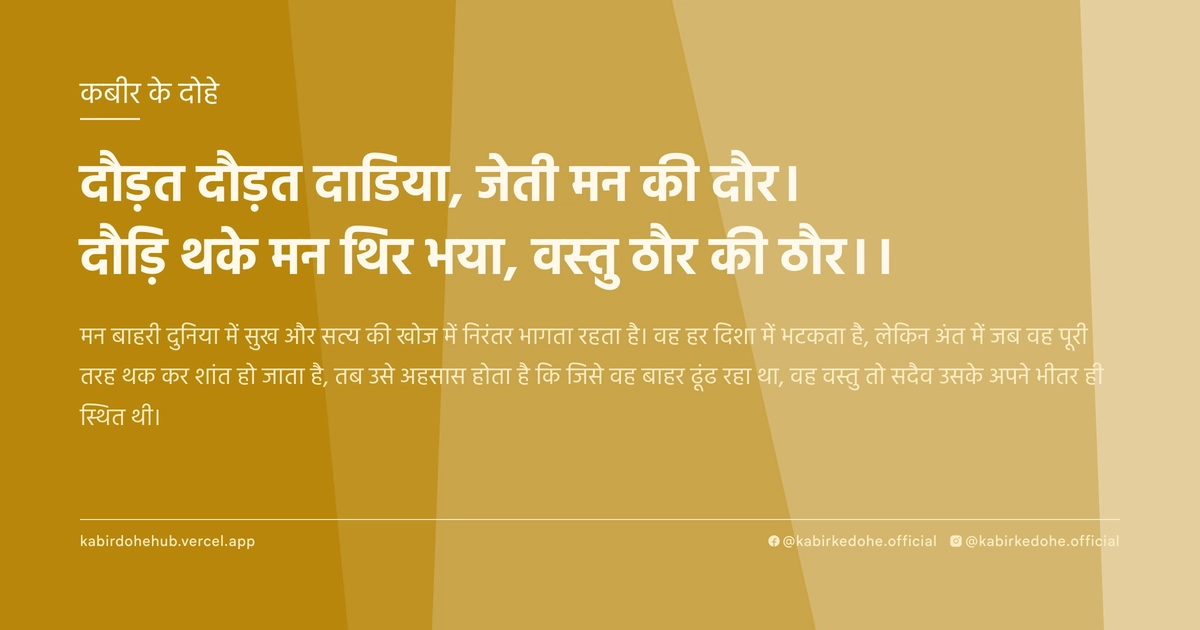
दौड़त दौड़त दाडिया, जेती मन की दौर।
दौड़ि थके मन थिर भया, वस्तु ठौर की ठौर।।
Daudat daudat dadiya, jeti man ki daur. Daudi thake man thir bhaya, vastu thaur ki thaur.
इस पृष्ठ पर इस कबीर दोहे का अर्थ (meaning), हिंदी व्याख्या और अंग्रेज़ी अनुवाद, दार्शनिक विश्लेषण और व्यावहारिक जीवन सीख दी गई है। यह दोहा मन नियंत्रण (Mind Control) विषय से जुड़ा है — Kabir doha meaning and explanation in Hindi and English.
अर्थ (Meaning):
मन बाहरी दुनिया में सुख और सत्य की खोज में निरंतर भागता रहता है। वह हर दिशा में भटकता है, लेकिन अंत में जब वह पूरी तरह थक कर शांत हो जाता है, तब उसे अहसास होता है कि जिसे वह बाहर ढूंढ रहा था, वह वस्तु तो सदैव उसके अपने भीतर ही स्थित थी।
The mind races incessantly, chasing peace and truth across the external world. It exhausts itself in a relentless pursuit of distant horizons, only to discover, upon reaching a state of total stillness, that the sought-after treasure was always present within its own center.
व्याख्या (Interpretation):
इस दोहे का शाब्दिक अर्थ है कि मन की दौड़ तब समाप्त होती है जब वह थक जाता है। आध्यात्मिक स्तर पर, यह 'माया' के प्रभाव को दर्शाता है जहाँ जीव सत्य को बाहरी कर्मकांडों, तीर्थों या भौतिक उपलब्धियों में खोजता है। यह दौड़ वास्तव में अहंकार की यात्रा है। जब मन की यह चंचलता शांत होती है, तब 'अद्वैत' की स्थिति उत्पन्न होती है—जहाँ खोजने वाला और खोजा जाने वाला एक हो जाते हैं। 'वस्तु ठौर की ठौर' का अर्थ है कि आत्मा और परमात्मा का मिलन कहीं बाहर नहीं, बल्कि चेतना के केंद्र में होता है। यह विरोधाभास है कि सत्य को पाने के लिए कहीं जाना नहीं पड़ता, बल्कि केवल ठहरना पड़ता है।
Literally, the verse describes the mind's exhaustion leading to stillness. Metaphorically, it critiques the illusion of 'Maya,' where the seeker pursues the Divine through external rituals, pilgrimages, or material acquisitions. This 'race' is the movement of the ego, projecting the source of happiness onto the external world. When the mind finally exhausts its restlessness, it enters the state of 'Advaita' (non-duality), realizing that the seeker and the sought are one. 'Vastu thaur ki thaur' signifies that the Absolute Truth is ever-present in the center of one's own consciousness. The central paradox is that the destination is actually the starting point; truth is not attained by traveling, but by ceasing all movement.
दार्शनिक विश्लेषण (Philosophical Analysis):
कबीर का यह दोहा निर्गुण भक्ति की पराकाष्ठा है, जहाँ ईश्वर को किसी मूर्ति या मंदिर में नहीं, बल्कि 'शून्य' या 'अनहद नाद' के रूप में भीतर अनुभव किया जाता है। कबीर के समय में धर्म बाहरी आडंबरों और जातिगत श्रेष्ठता में जकड़ा हुआ था। वे इस मानसिक दौड़ को उस सामाजिक और धार्मिक पाखंड का प्रतिबिंब मानते थे जहाँ लोग मोक्ष के लिए बाहरी नियमों का पालन करते थे।
दार्शनिक रूप से, यह अद्वैत वेदांत के उस सिद्धांत से मेल खाता है कि 'ब्रह्म' सर्वव्यापी है और केवल अज्ञानता (अविद्या) के कारण हम उसे अलग महसूस करते हैं। जब मन की वृत्तियाँ शांत होती हैं, तो वह दर्पण की तरह बन जाता है जिसमें सत्य स्पष्ट दिखाई देता है।
सूफीवाद के 'फना' (अहंकार का विनाश) के सिद्धांत के साथ इसका गहरा संबंध है। जब तक 'मैं' (अहंकार) दौड़ रहा है, तब तक सत्य ओझल रहता है। जैसे ही 'मैं' थक कर गिरता है, केवल 'वह' शेष रह जाता है।
यह मनोवैज्ञानिक रूपांतरण की प्रक्रिया है। आधुनिक मनोविज्ञान जिसे 'monkey mind' कहता है, कबीर उसे 'मन की दौड़' कहते हैं। यह दौड़ इच्छाओं का एक अंतहीन चक्र है जो व्यक्ति को वर्तमान क्षण से दूर ले जाता है।
अंततः, कबीर यह स्पष्ट करते हैं कि आध्यात्मिक प्रगति 'प्राप्ति' (acquisition) के बारे में नहीं, बल्कि 'विस्मरण' (forgetting) के बारे में है—उन सभी झूठे रास्तों को भूल जाना जो हमें स्वयं से दूर ले गए।
This couplet represents the pinnacle of Nirgun Bhakti, where the Divine is not sought in idols or temples, but experienced as the 'Void' or the 'Unstruck Sound' within. During Kabir's era, religion was shackled by external pomposity and caste hierarchies. He viewed this mental racing as a reflection of the social and religious hypocrisy where people followed rigid external rules to attain salvation.
Philosophically, this aligns with Advaita Vedanta's premise that 'Brahman' is omnipresent, and we perceive separation only due to ignorance (Avidya). When the fluctuations of the mind cease, it becomes like a polished mirror, reflecting the Truth without distortion.
There is a profound connection here to the Sufi concept of 'Fana' (annihilation of the ego). As long as the 'I' is racing, the Truth remains obscured. Only when the 'I' collapses in exhaustion does the Absolute remain.
This is a process of psychological transformation. What modern psychology calls the 'monkey mind,' Kabir describes as the 'race of the mind.' This race is an endless cycle of desires that alienates the individual from the present moment.
Ultimately, Kabir clarifies that spiritual progress is not about 'acquisition' but about 'unlearning'—forgetting all the false paths that led us away from our own center.
मूल संदेश (Core Message):
- बाहरी खोज अक्सर आंतरिक पलायन का एक मुखौटा होती है।
- शांति प्राप्त करने का एकमात्र तरीका खोज की प्रक्रिया को त्यागना है।
- अहंकार की थकान ही आध्यात्मिक जागृति का द्वार बनती है।
- सत्य कहीं पहुँचने में नहीं, बल्कि अपनी मौलिक स्थिति में लौटने में है।
- स्थिरता ही वह दर्पण है जिसमें परमात्मा का चेहरा दिखता है।
- External searching is often a mask for internal escapism.
- The only way to attain peace is to surrender the process of seeking.
- The exhaustion of the ego becomes the gateway to spiritual awakening.
- Truth is not in arriving somewhere, but in returning to one's original state.
- Stillness is the mirror in which the face of the Divine is revealed.
व्यावहारिक उदाहरण (Practical Example):
वाराणसी के घाटों पर रहने वाली एक वृद्ध विधवा, जानकी, का जीवन इसी द्वंद्व का उदाहरण था। दशकों तक उन्होंने अपनी शांति की खोज के लिए कठिन व्रत रखे, गंगा में घंटों स्नान किया और शहर के हर मंदिर के चक्कर लगाए। उन्हें विश्वास था कि मोक्ष किसी विशेष अनुष्ठान या किसी महान गुरु के आशीर्वाद से मिलेगा।
उनका पूरा जीवन एक 'दौड़' था। वे सुबह चार बजे उठतीं, मंत्रों का जाप करतीं और इस उम्मीद में घंटों प्रार्थना करतीं कि एक दिन उन्हें वह 'दिव्य प्रकाश' दिखेगा जो उनके दुखों को मिटा देगा। लेकिन जैसे-जैसे उम्र बढ़ी, उनका शरीर कमजोर होता गया और उनकी उम्मीदें निराशा में बदलने लगीं।
एक दिन, अत्यधिक शारीरिक थकान और बीमारी के कारण, वे किसी मंदिर जाने में असमर्थ रहीं। वे अपने छोटे से कमरे में चुपचाप लेट गईं। पहली बार, उन्होंने प्रार्थना करना बंद कर दिया। उन्होंने किसी देवता से कुछ नहीं माँगा, न ही किसी मोक्ष की कामना की।
जैसे ही उन्होंने बाहरी खोज का प्रयास छोड़ा, एक गहरा सन्नाटा छा गया। उस सन्नाटे में, उन्हें महसूस हुआ कि जिस शांति के लिए वे वर्षों से घाटों और मंदिरों की धूल फाँक रही थीं, वह शांति उनके अपने हृदय की धड़कन में बसी थी।
उन्हें अहसास हुआ कि उनकी 'दौड़' ही वास्तव में बाधा थी। जब तक वे भाग रही थीं, वे स्वयं से दूर जा रही थीं। जैसे ही वे 'थिर' (स्थिर) हुईं, सत्य उनके सामने प्रकट हो गया।
अब जानकी मंदिर नहीं जाती थीं, लेकिन उनकी आँखों में एक ऐसी चमक थी जो किसी भी तीर्थयात्री में नहीं थी। वे अब दूसरों को उपदेश नहीं देती थीं, बल्कि केवल मुस्कुराकर देखती थीं।
उनका व्यवहार बदल गया; वे अब छोटी-छोटी बातों पर क्रोध नहीं करती थीं क्योंकि उन्हें पता था कि बाहरी दुनिया का शोर केवल एक भ्रम है।
उन्होंने सीखा कि ईश्वर कोई गंतव्य नहीं है जहाँ पहुँचा जाए, बल्कि एक उपस्थिति है जिसे केवल ठहरकर महसूस किया जा सकता है।
Janaki, an elderly widow living on the ghats of Varanasi, embodied this struggle. For decades, she sought peace through rigorous fasts, hours of immersion in the Ganges, and visiting every temple in the city. She believed salvation would come through a specific ritual or the blessing of a great guru.
Her entire life was a 'race.' She woke at 4 AM, chanted mantras, and prayed for hours, hoping for a 'divine light' to erase her sorrows. However, as she aged, her body weakened, and her hopes turned into disappointment.
One day, due to extreme physical exhaustion and illness, she became unable to visit any temple. She lay silently in her small room. For the first time, she stopped praying. She asked for nothing from any deity, nor did she crave salvation.
As she ceased the effort of external searching, a profound silence descended. In that stillness, she realized that the peace she had chased through the dust of ghats and temples for years was residing within her own heartbeat.
She understood that her 'race' was the actual obstacle. As long as she was running, she was moving away from herself. The moment she became 'thir' (still), the Truth revealed itself.
Janaki no longer visited the temples, yet her eyes held a radiance unseen in any pilgrim. She stopped preaching to others and instead looked at them with a knowing smile.
Her behavior transformed; she no longer reacted with anger to trivial matters, knowing that the noise of the external world was merely an illusion.
She learned that God is not a destination to be reached, but a presence to be felt by simply standing still.
अभ्यास मार्गदर्शन (Practice Guidance):
- प्रतिदिन 20 मिनट 'साक्षी भाव' का अभ्यास करें: अपने विचारों को रोकने की कोशिश न करें, बस उन्हें एक दर्शक की तरह देखें जब तक कि वे स्वयं थक कर शांत न हो जाएं।
- स्व-पूछताछ जर्नल: प्रतिदिन लिखें—'आज मैं किस चीज़ के पीछे भाग रहा था? क्या वह वस्तु वास्तव में बाहर थी या मेरी आंतरिक कमी का प्रतिबिंब थी?'
- मौन व्रत: सप्ताह में एक बार 3 घंटे का पूर्ण मौन धारण करें, जिसमें न केवल बोलना, बल्कि डिजिटल उपकरणों का उपयोग भी वर्जित हो।
- डायग्नोस्टिक चेकलिस्ट: यदि आप निरंतर बेचैनी, तुलना की भावना, या 'कुछ छूट जाने' (FOMO) का अनुभव कर रहे हैं, तो समझ लें कि आप अभी भी 'दौड़' में हैं और स्थिरता की आवश्यकता है।
- Practice 'Witness Consciousness' for 20 minutes daily: Do not try to stop your thoughts; simply observe them as a spectator until they exhaust themselves and fall silent.
- Self-Inquiry Journaling: Write daily—'What was I chasing today? Was that object truly external, or was it a reflection of an internal void?'
- Vow of Silence: Once a week, observe 3 hours of absolute silence, prohibiting not only speech but also the use of digital devices.
- Diagnostic Checklist: If you experience constant restlessness, a habit of comparison, or a fear of missing out (FOMO), recognize that you are still in the 'race' and require stillness.
चिंतन प्रश्न (Reflection Questions):
- आपकी वर्तमान 'दौड़' क्या है—करियर, सामाजिक प्रतिष्ठा, या किसी की स्वीकृति? यह दौड़ आपको किस डर से प्रेरित कर रही है?
- यदि आज आपकी सारी बाहरी उपलब्धियाँ छीन ली जाएँ, तो आपके भीतर क्या बचेगा? क्या वह 'बचा हुआ' हिस्सा ही आपकी वास्तविक पहचान है?
- आप अपनी डिजिटल पहचान (सोशल मीडिया) को संवारने में कितनी ऊर्जा लगाते हैं? क्या यह आपकी आंतरिक रिक्तता को भरने का एक प्रयास है?
- क्या आप वास्तव में शांति चाहते हैं, या आप केवल उस उत्तेजना को पसंद करते हैं जो 'शांति की खोज' के नाम पर मिलती है?
- वह कौन सा विचार या इच्छा है जो आपको कभी स्थिर नहीं होने देती? उस विचार के पीछे का मूल भय क्या है?
- What is your current 'race'—career, social status, or validation? What fear is driving this pursuit?
- If all your external achievements were stripped away today, what would remain within you? Is that 'remainder' your true identity?
- How much energy do you invest in sculpting your digital persona? Is this an attempt to fill an internal void?
- Do you truly desire peace, or do you simply enjoy the excitement that comes with the 'search for peace'?
- Which specific thought or desire prevents you from ever being still? What is the fundamental fear underlying that thought?