
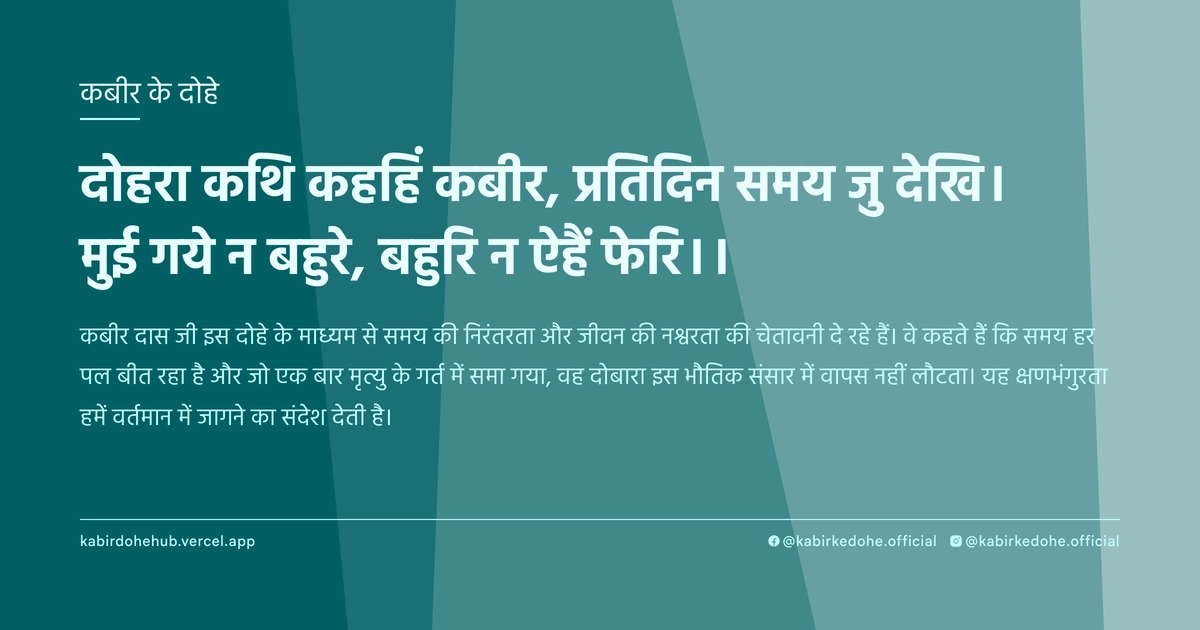
दोहरा कथि कहहिं कबीर, प्रतिदिन समय जु देखि।
मुई गये न बहुरे, बहुरि न ऐहैं फेरि।।
Dohra kathi kahahin Kabir, pratidin samay ju dekh. Mui gaye na bahure, bahuri na aihain pher.
इस पृष्ठ पर इस कबीर दोहे का अर्थ (meaning), हिंदी व्याख्या और अंग्रेज़ी अनुवाद, दार्शनिक विश्लेषण और व्यावहारिक जीवन सीख दी गई है। यह दोहा मृतुक्यता (Mortality) विषय से जुड़ा है — Kabir doha meaning and explanation in Hindi and English.
अर्थ (Meaning):
कबीर दास जी इस दोहे के माध्यम से समय की निरंतरता और जीवन की नश्वरता की चेतावनी दे रहे हैं। वे कहते हैं कि समय हर पल बीत रहा है और जो एक बार मृत्यु के गर्त में समा गया, वह दोबारा इस भौतिक संसार में वापस नहीं लौटता। यह क्षणभंगुरता हमें वर्तमान में जागने का संदेश देती है।
Kabir warns us of the relentless flow of time and the absolute finality of death. He asserts that time passes every single day, and once a soul departs from this physical realm, there is no returning to this specific existence. It is a call to awaken to the urgency of spiritual realization before the window of opportunity closes forever.
व्याख्या (Interpretation):
शाब्दिक रूप से, यह दोहा मृत्यु की अपरिवर्तनीयता को दर्शाता है। गहरे स्तर पर, यह 'माया' के उस भ्रम को तोड़ता है जहाँ मनुष्य स्वयं को अमर समझकर समय व्यर्थ करता है। कबीर यहाँ 'निर्गुण भक्ति' के उस मार्ग की ओर संकेत कर रहे हैं जहाँ साधक को यह बोध होना चाहिए कि शरीर नश्वर है, केवल आत्मा (ब्रह्म) शाश्वत है। यह विरोधाभास है कि हम अनंत काल की बात करते हैं, जबकि हमारा वर्तमान क्षण रेत की तरह फिसल रहा है। जब तक अहंकार जीवित है, हम समय को अपना दास समझते हैं, जबकि वास्तव में हम समय के अधीन हैं। इस बोध के माध्यम से ही जीव अद्वैत वेदांत की उस स्थिति में पहुँच सकता है जहाँ वह समय और स्थान की सीमाओं से मुक्त हो जाता है।
Literally, the couplet highlights the irreversibility of death. Metaphorically, it shatters the illusion of 'Maya' where humans mistakenly perceive themselves as immortal, squandering their precious time. Kabir points toward the path of 'Nirgun Bhakti,' urging the seeker to realize that while the body is perishable, the Atman (Universal Soul) is eternal. There is a profound paradox here: we speak of eternity while our present moment slips away like sand. As long as the ego persists, we believe we command time, whereas we are merely its subjects. Only through this realization can one reach the state of Advaita Vedanta, transcending the limitations of time and space to merge with the formless Brahman.
दार्शनिक विश्लेषण (Philosophical Analysis):
कबीर का यह विचार उनके युग के उस सामाजिक परिवेश से उपजा है जहाँ लोग कर्मकांडों और बाहरी आडंबरों में इतने लीन थे कि वे जीवन के वास्तविक उद्देश्य को भूल गए थे। वे मंदिर-मस्जिद की दीवारों से परे, आंतरिक रूपांतरण की बात करते हैं। यहाँ कबीर का दर्शन सूफीवाद के 'फना' (अहंकार का विनाश) और अद्वैत वेदांत के 'माया' विलोपन से मिलता है। वे तर्क देते हैं कि यदि मृत्यु निश्चित है, तो जाति, धर्म और सामाजिक प्रतिष्ठा के झूठे अहंकार का कोई मूल्य नहीं है।
दार्शनिक रूप से, कबीर यहाँ 'क्षणवाद' की बात नहीं कर रहे, बल्कि 'जागरूकता' की बात कर रहे हैं। वे चेतावनी देते हैं कि आध्यात्मिक यात्रा को कल पर टालना सबसे बड़ा भ्रम है। यह दृष्टिकोण हमें सिखाता है कि मुक्ति किसी भविष्य की घटना नहीं है, बल्कि वर्तमान क्षण में अहंकार के विसर्जन का परिणाम है।
कबीर की अस्वीकृति केवल कर्मकांडों की नहीं, बल्कि उस मानसिक जड़ता की है जो मनुष्य को यह विश्वास दिलाती है कि उसके पास 'अभी और समय है'। यह मनोवैज्ञानिक प्रहार व्यक्ति को उसकी नींद से जगाने के लिए है, ताकि वह बाहरी शोर को छोड़कर अपने भीतर के मौन को खोज सके।
सूफी संतों की तरह, कबीर भी प्रेम और विरह के माध्यम से ईश्वर की प्राप्ति की बात करते हैं, लेकिन यहाँ विरह 'समय के बीतने' का विरह है। जब मनुष्य को यह अहसास होता है कि वह समय की धारा में बह रहा है, तब उसकी तड़प वास्तविक होती है और वह सच्चे अर्थों में परमात्मा की ओर मुड़ता है।
अंततः, यह दोहा हमें सिखाता है कि जीवन की सार्थकता उसकी लंबाई में नहीं, बल्कि उसकी गहराई और सत्य के साथ उसके जुड़ाव में है। जो व्यक्ति समय की इस गति को पहचान लेता है, वह भय से मुक्त होकर सहज सहजता में जीता है, क्योंकि वह जान चुका है कि केवल सत्य ही स्थायी है।
Kabir's insight emerges from a socio-cultural era where people were so immersed in ritualism and outward displays of piety that they forgot the actual purpose of existence. He speaks of internal transformation beyond the walls of temples and mosques. Here, Kabir's philosophy converges with the Sufi concept of 'Fana' (annihilation of the ego) and the Advaita Vedanta principle of dissolving 'Maya.' He argues that if death is certain, then the false pride of caste, religion, and social status holds no value.
Philosophically, Kabir is not advocating for mere nihilism or momentary existence, but for 'acute awareness.' He warns that postponing the spiritual journey to 'tomorrow' is the greatest delusion. This perspective teaches us that liberation is not a future event but the result of dissolving the ego in the present moment.
Kabir's rejection is not merely of rituals, but of the mental inertia that convinces a human that they have 'plenty of time.' This is a psychological strike intended to wake the individual from their slumber, urging them to leave the external noise and seek the silence within.
Similar to Sufi mystics, Kabir speaks of attaining the Divine through love and longing, but here the longing is for the 'passing of time.' When a human realizes they are drifting in the current of time, their yearning becomes authentic, and they truly turn toward the Divine.
Ultimately, this couplet teaches us that the meaning of life lies not in its duration, but in its depth and its alignment with Truth. One who recognizes this temporal flow lives in a state of effortless grace, free from fear, knowing that only the Truth is permanent.
मूल संदेश (Core Message):
- समय की गति अपरिवर्तनीय है, इसे पहचानें।
- कल का इंतज़ार करना आध्यात्मिक आत्महत्या है।
- मृत्यु का बोध ही वास्तविक जीवन की शुरुआत है।
- अहंकार को समय की धारा में विसर्जित करें।
- वर्तमान क्षण ही एकमात्र सत्य और द्वार है।
- कर्मकांडों से ऊपर उठकर आत्म-साक्षात्कार करें।
- The flow of time is irreversible; recognize it.
- Waiting for tomorrow is a form of spiritual suicide.
- The awareness of death is the beginning of true life.
- Dissolve the ego into the current of time.
- The present moment is the only truth and the only gateway.
- Rise above rituals to achieve self-realization.
व्यावहारिक उदाहरण (Practical Example):
वाराणसी के एक पुराने घाट पर रहने वाले रामदीन नाम के एक वृद्ध नाविक थे। उनका पूरा जीवन केवल नाव चलाने और पर्यटकों को गंगा की लहरें दिखाने में बीत गया। रामदीन का मानना था कि उनके पास अभी बहुत समय है; वे सोचते थे कि जब वे और बूढ़े हो जाएंगे, तब वे शांति से बैठकर ईश्वर का ध्यान करेंगे और अपने जीवन के पापों का प्रायश्चित करेंगे। वे हर दिन घाट पर होने वाली आरती देखते, लेकिन उसमें शामिल नहीं होते, यह सोचकर कि 'अभी तो बहुत समय है'।
एक दिन, रामदीन ने देखा कि उनके एक पुराने साथी, जो उनसे केवल दो साल बड़े थे, का अचानक निधन हो गया। उस साथी की मृत्यु इतनी आकस्मिक थी कि उसे अपनी अधूरी इच्छाओं को पूरा करने का समय तक नहीं मिला। रामदीन ने देखा कि कैसे वह व्यक्ति, जो कल तक उनके साथ हँस रहा था, अब केवल एक याद बनकर रह गया था।
इस घटना ने रामदीन के भीतर एक गहरा आघात किया। उन्हें कबीर का वह दोहा याद आया कि समय निरंतर बीत रहा है और गया हुआ समय कभी वापस नहीं आता। उन्हें अहसास हुआ कि वे जिस 'कल' का इंतज़ार कर रहे थे, वह वास्तव में एक छलावा था।
रामदीन ने उसी क्षण अपनी जीवनशैली बदल दी। उन्होंने नाव चलाना बंद नहीं किया, लेकिन अब वे हर सवारी के साथ एक छोटा सा आध्यात्मिक संवाद करने लगे। उन्होंने अपने अहंकार को त्याग दिया कि वे केवल एक नाविक हैं; उन्होंने खुद को समय के एक यात्री के रूप में देखना शुरू किया।
उन्होंने अपने घर के एक कोने को ध्यान के लिए समर्पित किया। अब वे सुबह की पहली किरण के साथ मौन में बैठते और स्वयं से पूछते, 'यदि आज मेरा अंतिम दिन हो, तो क्या मैं संतुष्ट हूँ?'
उनकी व्यवहारिक परिवर्तन यह था कि उन्होंने उन लोगों की मदद करना शुरू किया जिन्हें वे पहले अनदेखा करते थे। उन्होंने घाट पर आने वाले लाचार वृद्धों को मुफ्त में पार उतारा, यह सोचकर कि सेवा ही समय का सबसे श्रेष्ठ उपयोग है।
रामदीन के चेहरे पर अब एक अजीब सी शांति थी। वे अब समय के बीतने से डरते नहीं थे, बल्कि हर बीतते पल का स्वागत करते थे। उन्होंने सीखा कि मृत्यु का भय केवल तभी तक रहता है जब तक हम जीवन को व्यर्थ गँवाते हैं।
जब रामदीन ने अंततः अपनी अंतिम सांस ली, तो वे डरे हुए नहीं थे। वे मुस्कुरा रहे थे क्योंकि उन्होंने समय के साथ युद्ध करना छोड़ दिया था और समय के प्रवाह में स्वयं को विलीन कर दिया था। यह 'कबीर ट्विस्ट' था—मृत्यु के बोध ने उन्हें वास्तव में जीना सिखाया।
On the ancient ghats of Varanasi lived an elderly boatman named Ramdeen. His entire life had been spent simply rowing boats and showing the waves of the Ganges to tourists. Ramdeen believed he still had plenty of time; he thought that once he became even older, he would sit in peace, meditate on God, and atone for the sins of his life. He watched the daily Aarti on the ghats but never participated, thinking, 'There is still much time.'
One day, Ramdeen witnessed the sudden passing of an old companion, only two years his senior. The death was so abrupt that the man had no time to fulfill his lingering desires. Ramdeen saw how a person who was laughing with him just yesterday had now become nothing more than a memory.
This event struck a deep chord within Ramdeen. He recalled Kabir's couplet about how time flows relentlessly and once gone, it never returns. He realized that the 'tomorrow' he had been waiting for was, in fact, a mirage.
Ramdeen changed his lifestyle that very moment. He did not stop rowing his boat, but he began engaging in small spiritual dialogues with every passenger. He shed the ego of being 'just a boatman' and started seeing himself as a traveler through time.
He dedicated a corner of his home to meditation. Now, with the first ray of dawn, he would sit in silence and ask himself, 'If today were my last day, would I be content?'
His behavioral shift manifested in helping those he had previously ignored. He began ferrying helpless elderly pilgrims for free, believing that selfless service was the highest use of time.
There was now a strange peace on Ramdeen's face. He no longer feared the passing of time; instead, he welcomed every fleeting moment. He learned that the fear of death persists only as long as we waste our lives.
When Ramdeen finally breathed his last, he was not afraid. He was smiling because he had stopped fighting time and had instead merged himself into its flow. This was the 'Kabir Twist'—the awareness of death taught him how to truly live.
अभ्यास मार्गदर्शन (Practice Guidance):
- दैनिक चिंतन: हर सुबह उठकर 5 मिनट इस विचार पर ध्यान दें कि यह दिन आपके जीवन का एक अनमोल हिस्सा है जो दोबारा नहीं आएगा।
- आत्म-पूछताछ जर्नल: प्रतिदिन एक ऐसी गतिविधि लिखें जिसे आपने 'कल' पर टाला, और विश्लेषण करें कि वह टालमटोल आपके अहंकार या आलस्य का परिणाम थी।
- व्यवहारिक परिवर्तन: किसी ऐसे व्यक्ति को क्षमा करें या किसी की मदद करें जिसे आप लंबे समय से टाल रहे थे, यह मानकर कि समय सीमित है।
- डायग्नोस्टिक चेकलिस्ट: क्या आप अक्सर 'जब मैं रिटायर हो जाऊंगा तब...' या 'अगले साल मैं...' जैसे वाक्यों का प्रयोग करते हैं? यदि हाँ, तो आप समय के भ्रम (माया) में जी रहे हैं।
- Daily Contemplation: Spend 5 minutes every morning reflecting on the fact that this day is a precious fragment of your life that will never return.
- Self-Inquiry Journal: Record one activity each day that you postponed to 'tomorrow' and analyze whether that procrastination was a result of ego or lethargy.
- Behavioral Shift: Forgive someone or help a person you have been avoiding for a long time, accepting that time is finite.
- Diagnostic Checklist: Do you frequently use phrases like 'When I retire, then I will...' or 'Next year I will...'? If yes, you are living within the illusion of time (Maya).
चिंतन प्रश्न (Reflection Questions):
- यदि आपको पता चले कि आपके पास केवल एक सप्ताह शेष है, तो आपकी वर्तमान प्राथमिकताएं कितनी बदल जाएंगी?
- आपकी 'डिजिटल पहचान' (सोशल मीडिया) आपको यह विश्वास दिलाने में कैसे मदद करती है कि आप अमर हैं या समय असीमित है?
- वह कौन सा आंतरिक डर है जो आपको वर्तमान क्षण में पूरी तरह जीने से रोकता है?
- क्या आप वास्तव में समय का उपयोग कर रहे हैं, या समय आपका उपयोग करके आपको नष्ट कर रहा है?
- आपकी कौन सी आदतें इस भ्रम को पुष्ट करती हैं कि 'अभी बहुत समय बाकी है'?
- मृत्यु के विचार से आप डरते हैं या यह आपको अधिक जागरूक बनाता है?
- If you knew you had only one week left, how drastically would your current priorities shift?
- How does your 'digital identity' (social media) reinforce the illusion that you are immortal or that time is limitless?
- What is the internal fear that prevents you from living fully in the present moment?
- Are you truly utilizing time, or is time utilizing you to wear you down?
- Which of your habits reinforce the delusion that 'there is still plenty of time'?
- Does the thought of death frighten you, or does it make you more conscious?