
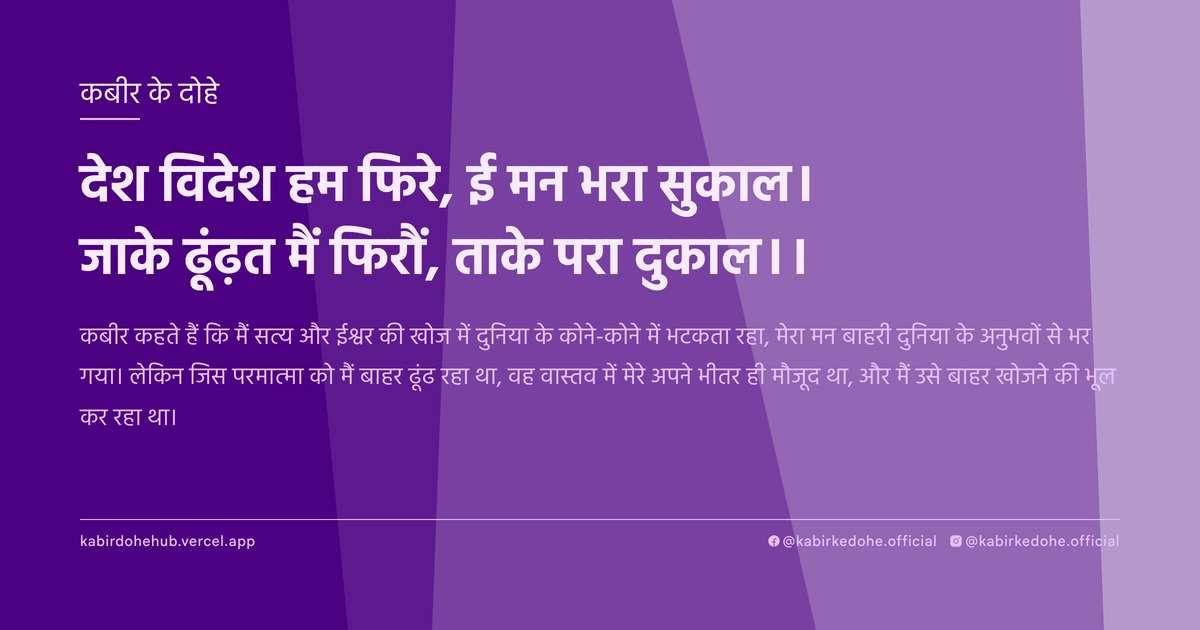
देश विदेश हम फिरे, ई मन भरा सुकाल।
जाके ढूंढ़त मैं फिरौं, ताके परा दुकाल।।
Desh videsh hum phire, ee man bhara sukaal. Jaake dhundhat main phiraun, taake para dukaal.
इस पृष्ठ पर इस कबीर दोहे का अर्थ (meaning), हिंदी व्याख्या और अंग्रेज़ी अनुवाद, दार्शनिक विश्लेषण और व्यावहारिक जीवन सीख दी गई है। यह दोहा अंतर ज्योति (The Inner Light) विषय से जुड़ा है — Kabir doha meaning and explanation in Hindi and English.
अर्थ (Meaning):
कबीर कहते हैं कि मैं सत्य और ईश्वर की खोज में दुनिया के कोने-कोने में भटकता रहा, मेरा मन बाहरी दुनिया के अनुभवों से भर गया। लेकिन जिस परमात्मा को मैं बाहर ढूंढ रहा था, वह वास्तव में मेरे अपने भीतर ही मौजूद था, और मैं उसे बाहर खोजने की भूल कर रहा था।
Kabir reflects on his exhaustive journey across lands and foreign shores, his mind saturated with the experiences of the external world. He realizes that the Divine entity he spent his life searching for in distant places was actually residing within his own heart all along, rendering his external search futile.
व्याख्या (Interpretation):
यह दोहा बाहरी खोज और आंतरिक वास्तविकता के विरोधाभास को दर्शाता है। शाब्दिक अर्थ में, यह एक यात्री की व्यथा है, लेकिन आध्यात्मिक स्तर पर यह 'माया' के प्रभाव का वर्णन है। कबीर यहाँ 'निर्गुण भक्ति' की बात कर रहे हैं, जहाँ ईश्वर किसी मंदिर, मस्जिद या भौगोलिक स्थान में नहीं, बल्कि आत्मा (Atman) में स्थित है। जब तक साधक अपनी पहचान को शरीर और मन से जोड़कर रखता है, वह 'द्वैत' (duality) में फंसा रहता है। जैसे ही वह यह समझता है कि वह स्वयं ब्रह्म का अंश है, खोज समाप्त हो जाती है और केवल अनुभव शेष रहता है। यह अद्वैत वेदांत के उस सत्य को पुष्ट करता है कि 'अहं ब्रह्मास्मि'—मैं ही वह अनंत सत्य हूँ।
This couplet illustrates the paradox between external searching and internal realization. Literally, it describes a traveler's fatigue, but metaphorically, it depicts the veil of 'Maya' (illusion). Kabir emphasizes 'Nirgun Bhakti' (devotion to the formless), asserting that the Divine is not confined to temples, mosques, or geography, but resides within the Atman. As long as the seeker identifies with the physical body and ego, they remain trapped in duality. The moment they realize they are an extension of the Absolute, the search ends and only experience remains. This reinforces the Advaita Vedanta truth of 'Aham Brahmasmi'—I am the Absolute Truth, highlighting the irony of seeking the seeker.
दार्शनिक विश्लेषण (Philosophical Analysis):
कबीर का यह दोहा उस युग की प्रतिक्रिया है जहाँ धर्म केवल कर्मकांडों, तीर्थयात्राओं और बाहरी प्रतीकों तक सीमित था। उन्होंने पुरोहितवाद और कट्टरपंथ का विरोध करते हुए यह स्थापित किया कि ईश्वर तक पहुँचने का मार्ग 'बाहर' नहीं बल्कि 'भीतर' है। यह दृष्टिकोण सूफीवाद के 'इन्सान-ए-कामिल' (पूर्ण मानव) और अद्वैत वेदांत के गैर-द्वैतवाद का संगम है, जहाँ आत्मा और परमात्मा के बीच का अंतर केवल अज्ञानता के कारण प्रतीत होता है।
ऐतिहासिक रूप से, कबीर ने जाति व्यवस्था और धार्मिक भेदभाव को चुनौती दी क्योंकि यदि ईश्वर सबके भीतर है, तो कोई भी व्यक्ति जन्म या वर्ण के आधार पर छोटा या बड़ा नहीं हो सकता। यह सामाजिक क्रांति का एक आध्यात्मिक आधार था। उन्होंने सिखाया कि बाहरी यात्राएँ केवल मन को भ्रमित करती हैं, जबकि आंतरिक यात्रा अहंकार का विनाश करती है।
मनोवैज्ञानिक स्तर पर, 'देश विदेश' का भ्रमण हमारे मन की उन इच्छाओं का प्रतीक है जो हमें निरंतर बाहरी उत्तेजनाओं और भौतिक उपलब्धियों की ओर धकेलती हैं। हम सोचते हैं कि कोई नया शहर, नया रिश्ता या नई उपलब्धि हमें पूर्ण कर देगी। कबीर इस पैटर्न को तोड़ते हैं और बताते हैं कि पूर्णता एक 'अवस्था' है, 'स्थान' नहीं।
यहाँ 'सुकाल' और 'दुकाल' शब्दों का प्रयोग समय और स्थिति की विडंबना को दर्शाता है। जब हम बाहर खोजते हैं, तो हम समय बर्बाद करते हैं, जबकि सत्य हमारे पास होने के बावजूद हम उसके लिए तरसते हैं। यह एक आध्यात्मिक विडंबना है जहाँ प्यासा व्यक्ति कुएँ के ऊपर खड़ा होकर पानी की तलाश में पूरी दुनिया घूमता है।
अंततः, यह विश्लेषण हमें यह समझने पर मजबूर करता है कि 'अहंकार' ही वह पर्दा है जो हमें हमारे वास्तविक स्वरूप से अलग करता है। जब 'मैं' (ego) मिट जाता है, तब केवल 'वह' (Divine) बचता है। यह शून्य की अवस्था है जहाँ खोजकर्ता और खोजा जाने वाला एक ही हो जाते हैं।
Kabir's couplet is a direct reaction to an era where religion was reduced to rituals, pilgrimages, and external symbols. By opposing priestly hegemony and dogmatism, he established that the path to the Divine is internal, not external. This perspective is a synthesis of Sufi 'Insan-e-Kamil' (the Perfect Human) and the non-duality of Advaita Vedanta, where the perceived gap between the soul and the Absolute is merely a product of ignorance.
Historically, Kabir challenged the caste system and religious bigotry. If the Divine resides within every being, no individual can be superior or inferior based on birth or varna. This provided a spiritual foundation for social revolution. He taught that external journeys only distract the mind, whereas the internal journey annihilates the ego.
Psychologically, 'traveling the world' symbolizes the human tendency to seek fulfillment in external stimuli and material achievements. We believe a new city, a new relationship, or a new status will complete us. Kabir disrupts this pattern, asserting that wholeness is a state of being, not a destination.
The use of 'Sukaal' and 'Dukaal' highlights the irony of spiritual timing. While searching externally, we waste our existence, longing for a Truth that is already present. It is the spiritual tragedy of a thirsty man standing atop a well, wandering the globe in search of water.
Ultimately, this analysis reveals that the 'Ego' is the only veil separating us from our true nature. When the 'I' dissolves, only the 'Divine' remains. This is the state of Shunya (void), where the seeker and the sought merge into one singular reality.
मूल संदेश (Core Message):
- बाहरी खोज अक्सर आंतरिक पलायन का एक मुखौटा होती है।
- सत्य किसी भूगोल में नहीं, बल्कि चेतना की गहराई में है।
- अहंकार वह पर्दा है जो हमें स्वयं से अलग करता है।
- खोज को समाप्त करना ही वास्तविक प्राप्ति है।
- जब 'मैं' मिटता है, तब अनंत का अनुभव होता है।
- External searching is often a mask for internal avoidance.
- Truth resides not in geography, but in the depths of consciousness.
- The ego is the veil that separates us from our true essence.
- Ending the search is the ultimate attainment.
- When the 'I' dissolves, the Infinite is experienced.
व्यावहारिक उदाहरण (Practical Example):
वाराणसी के घाटों पर रहने वाली एक वृद्ध विधवा, जानकी, का जीवन केवल पूजा-पाठ और तीर्थों की कहानियों के इर्द-गिर्द घूमता था। वह मानती थी कि मोक्ष केवल कठिन तपस्या और दूरदराज के पवित्र स्थानों की यात्रा से मिलता है। उसने अपनी जीवन भर की जमा पूँजी काशी, गया और बद्रीनाथ की यात्राओं में खर्च कर दी, इस उम्मीद में कि उसे एक दिन 'दिव्य प्रकाश' का अनुभव होगा।
हर यात्रा के बाद वह वापस आती, लेकिन उसका मन और अधिक अशांत हो जाता। उसे लगता कि शायद उसने सही मंत्र नहीं पढ़ा या उसकी श्रद्धा में कमी थी। वह जितना अधिक बाहर खोजती, उसके भीतर का खालीपन उतना ही बढ़ता जाता। वह अक्सर मंदिर के पुजारियों से पूछती कि वह ईश्वर को 'देख' क्यों नहीं पा रही है।
एक दिन, वह एक साधारण से बुनकर के पास बैठी, जो शांति से अपना काम कर रहा था। उस बुनकर ने जानकी की व्याकुलता देखी और बस इतना कहा, 'माँ, आप उस दर्पण को ढूंढ रही हैं जिसे आपने अपने माथे पर लगाया हुआ है।' जानकी को पहले तो यह बात समझ नहीं आई, लेकिन उसने अपनी आँखें बंद कीं और पहली बार बाहर के शोर को छोड़कर अपनी सांसों पर ध्यान दिया।
उसने महसूस किया कि जिस शांति की तलाश में वह हजारों मील चली थी, वह शांति उसके भीतर की खामोशी में छिपी थी। उसे एहसास हुआ कि उसकी तीर्थयात्राएं केवल शरीर का विस्थापन थीं, आत्मा का नहीं। वह समझ गई कि मंदिर की मूर्तियों में नहीं, बल्कि अपनी करुणा और प्रेम में ही ईश्वर का वास है।
उस दिन के बाद, जानकी ने यात्राएं करना बंद कर दिया। उसने अपना समय उन अनाथ बच्चों की सेवा में लगाना शुरू किया जो घाटों पर भटकते थे। उसने पाया कि जब वह दूसरों के दुख दूर करती है, तो उसे वही 'दिव्य प्रकाश' अनुभव होता है जिसे वह हिमालय की गुफाओं में खोज रही थी।
उसका व्यवहार पूरी तरह बदल गया। अब वह धार्मिक कट्टरता के बजाय सहज प्रेम में विश्वास करने लगी। उसकी आँखों में एक ऐसी चमक थी जो पहले कभी नहीं थी—एक ऐसी तृप्ति जो बाहरी दुनिया की किसी भी वस्तु से नहीं मिल सकती थी।
वह अब दूसरों को भी यही समझाती कि ईश्वर कोई व्यक्ति या स्थान नहीं है, बल्कि एक अहसास है जो केवल तब जागता है जब हम अपनी बाहरी पहचान को त्याग देते हैं।
यह 'कबीर ट्विस्ट' था: खोज का अंत तब हुआ जब खोजकर्ता ने स्वयं को ही खोज लिया। जानकी अब एक तीर्थयात्री नहीं, बल्कि एक जागृत आत्मा बन चुकी थी।
Janaki, an elderly widow living on the ghats of Varanasi, spent her life immersed in rituals and stories of pilgrimages. She believed that liberation (Moksha) could only be attained through rigorous penance and visiting distant holy sites. She spent her life savings on trips to Kashi, Gaya, and Badrinath, hoping to one day experience a 'divine light.'
After every journey, she returned, but her mind grew more restless. She felt she perhaps hadn't recited the mantras correctly or lacked sufficient faith. The more she searched externally, the deeper her internal void became. She often asked the temple priests why she could not 'see' God.
One day, she sat beside a simple weaver who was calmly working on his loom. Observing Janaki's distress, the weaver simply said, 'Mother, you are searching for the mirror that you have already placed upon your own forehead.' Janaki didn't understand at first, but she closed her eyes and, for the first time, ignored the external noise to focus on her own breath.
She realized that the peace she had traveled thousands of miles to find was hidden within her own silence. She understood that her pilgrimages were merely displacements of the body, not the soul. She recognized that the Divine resides not in temple idols, but in her own capacity for compassion and love.
After that day, Janaki stopped traveling. She began spending her time serving orphaned children who wandered the ghats. She discovered that when she alleviated the suffering of others, she experienced the same 'divine light' she had sought in the caves of the Himalayas.
Her behavior transformed completely. She moved from religious rigidity to a state of effortless love. There was a glow in her eyes that had never been there before—a satisfaction that no external object could provide.
She now taught others that God is not a person or a place, but a realization that awakens only when we relinquish our external identities.
This was the 'Kabir Twist': the search ended when the seeker discovered that they were the very thing they were seeking. Janaki was no longer a pilgrim; she had become an awakened soul.
अभ्यास मार्गदर्शन (Practice Guidance):
- प्रतिदिन 20 मिनट 'साक्षी भाव' का अभ्यास करें: अपने विचारों को बिना किसी निर्णय के केवल देखें, जैसे आप किसी और के विचार देख रहे हों।
- स्व-अन्वेषण जर्नल: प्रतिदिन एक ऐसी घटना लिखें जहाँ आपने बाहरी प्रशंसा या मान्यता की तलाश की, और फिर विश्लेषण करें कि उस समय आपके भीतर क्या कमी महसूस हो रही थी।
- मौन व्रत: सप्ताह में एक बार कम से कम 3 घंटे का पूर्ण मौन रखें, जिसमें न केवल बोलना बंद हो, बल्कि डिजिटल उपकरणों का उपयोग भी न हो।
- निदान चेकलिस्ट: क्या मैं अपनी खुशी के लिए बाहरी परिस्थितियों पर निर्भर हूँ? क्या मैं दूसरों में वह गुण ढूंढ रहा हूँ जो मुझे अपने भीतर विकसित करना चाहिए? यदि हाँ, तो आप अभी भी 'बाहर' खोज रहे हैं।
- Practice 'Witness Consciousness' for 20 minutes daily: Observe your thoughts without judgment, as if you are watching someone else's mental process.
- Self-Inquiry Journaling: Daily record an instance where you sought external validation or praise, and analyze what internal void you were trying to fill at that moment.
- Vow of Silence: Once a week, maintain complete silence for at least 3 hours, abstaining not only from speaking but also from using digital devices.
- Diagnostic Checklist: Am I dependent on external circumstances for my happiness? Am I seeking qualities in others that I should cultivate within myself? If yes, you are still searching 'outside'.
चिंतन प्रश्न (Reflection Questions):
- मैं अपनी पहचान बनाने के लिए किन बाहरी मुखौटों का उपयोग कर रहा हूँ?
- यदि मेरी सभी सामाजिक उपलब्धियाँ और पद छीन लिए जाएँ, तो मेरे भीतर क्या बचेगा?
- क्या मेरी आध्यात्मिक यात्रा वास्तव में सत्य की खोज है, या केवल अपनी बेचैनी से भागने का एक तरीका?
- मैं किन लोगों या वस्तुओं में अपनी पूर्णता ढूंढ रहा हूँ, और यह मेरी आंतरिक कमी को कैसे दर्शाता है?
- क्या मैं उस शांति से डरता हूँ जो पूर्ण मौन और अकेलेपन में मिलती है?
- What external masks am I using to construct my identity?
- If all my social achievements and titles were stripped away, what would remain within me?
- Is my spiritual journey truly a quest for Truth, or merely a way to escape my own restlessness?
- In which people or objects am I seeking my completeness, and how does this reflect my internal void?
- Am I afraid of the silence that comes with absolute solitude?