
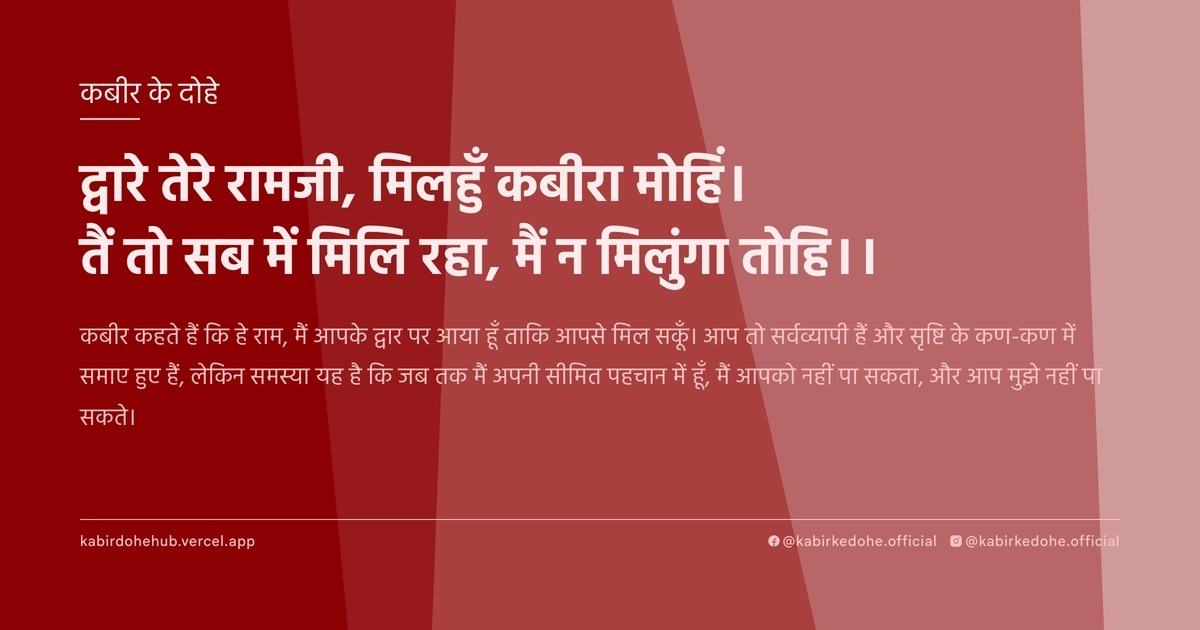
द्वारे तेरे रामजी, मिलहुँ कबीरा मोहिं।
तैं तो सब में मिलि रहा, मैं न मिलुंगा तोहि।।
Dware tere Ramji, milhun Kabira mohin. Tain to sab me mili raha, main na milunga tohi.
इस पृष्ठ पर इस कबीर दोहे का अर्थ (meaning), हिंदी व्याख्या और अंग्रेज़ी अनुवाद, दार्शनिक विश्लेषण और व्यावहारिक जीवन सीख दी गई है। यह दोहा निर्गुण ब्रह्म (Nirguna Brahman) विषय से जुड़ा है — Kabir doha meaning and explanation in Hindi and English.
अर्थ (Meaning):
कबीर कहते हैं कि हे राम, मैं आपके द्वार पर आया हूँ ताकि आपसे मिल सकूँ। आप तो सर्वव्यापी हैं और सृष्टि के कण-कण में समाए हुए हैं, लेकिन समस्या यह है कि जब तक मैं अपनी सीमित पहचान में हूँ, मैं आपको नहीं पा सकता, और आप मुझे नहीं पा सकते।
Kabir addresses the Divine, stating that he has arrived at the threshold of the Eternal. He acknowledges that while the Divine is omnipresent, permeating every atom of existence, the seeker remains elusive because the ego creates a barrier that prevents the union of the individual soul with the Universal Consciousness.
व्याख्या (Interpretation):
यह दोहा द्वैत से अद्वैत की यात्रा का वर्णन करता है। 'द्वारे' का अर्थ भौतिक द्वार नहीं, बल्कि चेतना की वह सीमा है जहाँ जीव और ईश्वर का मिलन होता है। कबीर यहाँ एक सुंदर विरोधाभास प्रस्तुत करते हैं: राम सब जगह हैं, फिर भी कबीर उन्हें 'ढूँढ' रहे हैं। यह दर्शाता है कि सत्य उपलब्ध तो है, लेकिन हमारी 'मैं' (अहंकार) उसे देखने नहीं देती। जब तक 'मैं' जीवित है, तब तक 'तुम' (परमात्मा) अलग महसूस होते हैं। निर्गुण भक्ति के अनुसार, जब साधक अपनी व्यक्तिगत पहचान को मिटा देता है, तब उसे बोध होता है कि वह स्वयं ही वह राम है जिसे वह बाहर खोज रहा था। यह आत्मा और ब्रह्म की अभिन्नता का संकेत है।
This couplet describes the transition from duality to non-duality. The 'door' is not a physical entrance but the threshold of consciousness where the individual soul meets the Eternal. Kabir presents a profound paradox: Ram is omnipresent, yet Kabir seeks Him. This implies that while Truth is readily available, the 'I' (ego) obscures the vision. As long as the sense of separate identity persists, the Divine remains an external entity. In the tradition of Nirgun Bhakti, the seeker realizes that the search is a mirror; by annihilating the ego, the seeker discovers that they are the very Divine they were pursuing. It is a direct pointer toward Atman-Brahman non-duality, where the seeker and the sought merge into one.
दार्शनिक विश्लेषण (Philosophical Analysis):
कबीर का यह दृष्टिकोण उनके युग के कर्मकांडी और रूढ़िवादी धर्म के विरुद्ध एक सशक्त प्रहार था। उस समय धर्म केवल मंदिरों, मस्जिदों और बाहरी अनुष्ठानों तक सीमित था। कबीर ने 'राम' को किसी विशेष मूर्ति या व्यक्ति के रूप में नहीं, बल्कि एक सार्वभौमिक ऊर्जा (Sufi 'Nur' या Vedantic 'Brahman') के रूप में परिभाषित किया। उन्होंने तर्क दिया कि यदि ईश्वर सर्वव्यापी है, तो उसे किसी विशेष स्थान पर खोजना व्यर्थ है।
अद्वैत वेदांत के साथ इसका गहरा संबंध है, जहाँ 'अहं ब्रह्मास्मि' (मैं ही ब्रह्म हूँ) का सिद्धांत केंद्र में है। कबीर यहाँ उस मनोवैज्ञानिक बाधा की बात कर रहे हैं जिसे 'माया' कहा जाता है। माया वह पर्दा है जो हमें यह विश्वास दिलाता है कि हम अलग-अलग इकाइयाँ हैं। जब कबीर कहते हैं 'मैं न मिलुंगा तोहि', तो वे उस सूक्ष्म अहंकार की बात कर रहे हैं जो स्वयं को ईश्वर से अलग मानकर अपनी विशिष्टता बनाए रखना चाहता है।
सूफी मत के 'फना' (अहंकार का विनाश) की अवधारणा यहाँ स्पष्ट दिखती है। सूफीवाद में माना जाता है कि जब तक प्रेमी (साधक) अपने अस्तित्व को मिटा नहीं देता, वह प्रिय (ईश्वर) में विलीन नहीं हो सकता। कबीर का यह दोहा इसी विलीनीकरण की तड़प और उसकी अनिवार्यता को दर्शाता है।
सामाजिक स्तर पर, यह संदेश जाति और वर्ग के भेदभाव को समाप्त करता है। यदि राम सब में हैं, तो कोई भी व्यक्ति नीच या उच्च नहीं हो सकता। यह विचार उस समय के समाज के लिए क्रांतिकारी था, क्योंकि यह सीधे तौर पर ब्राह्मणवादी श्रेष्ठता और बाहरी दिखावे को चुनौती दे रहा था।
अंततः, यह दोहा मनोवैज्ञानिक रूपांतरण की बात करता है। यह हमें सिखाता है कि आध्यात्मिक यात्रा बाहर की ओर नहीं, बल्कि भीतर की ओर है। बाहरी तीर्थयात्राएँ केवल मन को भ्रमित करती हैं; वास्तविक तीर्थ वह क्षण है जब 'मैं' का विसर्जन होता है और केवल 'वह' शेष रह जाता है।
Kabir's perspective serves as a potent critique of the ritualistic and orthodox religion of his era. At a time when spirituality was confined to temples, mosques, and external ceremonies, Kabir redefined 'Ram' not as a deity in a statue or a historical figure, but as a universal energy—akin to the Sufi 'Nur' or the Vedantic 'Brahman'. He argued that if the Divine is omnipresent, searching for Him in a specific location is a futile exercise.
This aligns deeply with Advaita Vedanta, specifically the principle of 'Aham Brahmasmi' (I am Brahman). Kabir addresses the psychological barrier known as 'Maya' (illusion). Maya is the veil that convinces the soul of its separate existence. When Kabir says, 'I shall not be found by You,' he refers to the subtle ego that clings to its distinct identity, preventing the realization of oneness.
The Sufi concept of 'Fana' (annihilation of the self) is evident here. In Sufism, the lover must perish in the Beloved to truly find the Beloved. Kabir’s couplet captures this longing and the necessity of self-extinction. The paradox is that the Divine is always present, but the 'I' is the only obstacle to that presence.
Socially, this teaching dismantles caste and class hierarchies. If the Divine permeates every being, no individual can be inherently superior or inferior. This was a revolutionary stance in a society stratified by birth, challenging the foundations of ritual purity and social exclusion.
Ultimately, this is a lesson in psychological transformation. It shifts the spiritual trajectory from the external to the internal. External pilgrimages are mere distractions; the true pilgrimage is the moment the 'I' dissolves, leaving only the Absolute. It is the movement from the fragmented self to the integrated Whole.
मूल संदेश (Core Message):
- बाहरी खोज एक भ्रम है; सत्य भीतर स्थित है।
- अहंकार वह पर्दा है जो ईश्वर को ओझल करता है।
- जब 'मैं' मिटता है, तभी 'वह' प्रकट होता है।
- सर्वव्यापी ईश्वर को पाने का एकमात्र मार्ग स्वयं को खोना है।
- भक्ति कर्मकांड में नहीं, बल्कि अहंकार के विसर्जन में है।
- External searching is an illusion; Truth resides within.
- The ego is the veil that obscures the Divine presence.
- Only when the 'I' vanishes does the 'Absolute' appear.
- The only way to find the Omnipresent is to lose the self.
- Devotion lies not in rituals, but in the dissolution of ego.
व्यावहारिक उदाहरण (Practical Example):
एक समय की बात है, वाराणसी के घाटों पर माधव नाम का एक वृद्ध नाविक रहता था। माधव का जीवन केवल नाव चलाने और यात्रियों को पार लगाने में बीत रहा था। वह बहुत धार्मिक था और हर दिन घंटों मंदिर में प्रार्थना करता था, यह उम्मीद करते हुए कि एक दिन भगवान उसे दर्शन देंगे और उसके दुखों का अंत करेंगे। वह अक्सर शिकायत करता कि भगवान उसे अनदेखा कर रहे हैं।
एक दिन, उसकी नाव में एक फकीर सवार हुआ। फकीर ने देखा कि माधव प्रार्थना तो कर रहा है, लेकिन उसके मन में क्रोध और अहंकार भरा है कि वह 'कितना बड़ा भक्त' है। फकीर ने माधव से पूछा, 'तुम किसे खोज रहे हो?' माधव ने गर्व से कहा, 'मैं उस राम को खोज रहा हूँ जो इस संसार का स्वामी है, लेकिन वह मुझे नहीं मिलता।'
फकीर मुस्कुराया और उसने माधव से कहा, 'तुम राम को अपने द्वार पर बुला रहे हो, लेकिन तुम्हारे भीतर का 'मैं' इतना बड़ा है कि राम के लिए वहाँ कोई जगह ही नहीं बची है। तुम राम को बाहर खोज रहे हो, जबकि वह तुम्हारी नाव के हर तख्ते में, तुम्हारी हर सांस में और तुम्हारे सामने बैठे इस फकीर में भी है।'
माधव को पहले तो यह बात समझ नहीं आई। लेकिन फकीर ने उसे एक चुनौती दी: 'अगले सात दिनों तक, तुम जो भी सेवा करोगे, यह सोचकर करना कि तुम स्वयं राम की सेवा कर रहे हो, और अपनी 'भक्त' होने की पहचान को पूरी तरह भूल जाओ।'
शुरुआत में माधव के लिए यह कठिन था। जब कोई यात्री उसे गाली देता, तो उसका अहंकार जागता। लेकिन वह तुरंत याद करता कि वह व्यक्ति भी राम का ही रूप है। धीरे-धीरे, उसका क्रोध शांत होने लगा। उसने देखा कि जब वह अपनी 'श्रेष्ठता' का भाव छोड़ देता है, तो उसे हर चेहरे में एक असीम शांति दिखने लगती है।
एक दिन, एक अत्यंत बीमार और असहाय वृद्ध व्यक्ति उसकी नाव पर आया। माधव ने उसे बिना किसी स्वार्थ के, अपनी पूरी शक्ति लगाकर पार लगाया और उसकी देखभाल की। उस क्षण, माधव को महसूस हुआ कि वह व्यक्ति नहीं, बल्कि स्वयं राम ही थे।
उसे अचानक बोध हुआ कि वह अब तक राम को एक 'पुरस्कार' की तरह खोज रहा था, जबकि राम तो उसकी सेवा और करुणा में पहले से ही मौजूद थे। उसका 'मैं' मिट चुका था और अब केवल प्रेम शेष था।
माधव अब मंदिर में घंटों बैठने के बजाय, हर इंसान की सेवा में राम को देखने लगा। उसकी नाव अब केवल नदी पार नहीं कराती थी, बल्कि लोगों को उनके भीतर के राम से मिलाने का माध्यम बन गई थी।
Once, on the ghats of Varanasi, lived an elderly boatman named Madhav. His life revolved around rowing passengers across the river. Madhav was deeply religious, spending hours in prayer at the temple, hoping that one day God would grant him a vision and end his suffering. He often complained that the Divine was ignoring him.
One day, a wandering dervish boarded his boat. The dervish noticed that while Madhav prayed, his heart was filled with a subtle pride about being a 'great devotee.' The dervish asked, 'Who is it you seek?' Madhav replied with pride, 'I seek Ram, the Lord of the Universe, but He remains elusive.'
The dervish smiled and said, 'You call Ram to your door, but the 'I' within you is so vast that there is no room left for Him. You search for Ram outside, while He resides in every plank of your boat, in every breath you take, and even in me, sitting before you.'
Madhav was initially confused. The dervish gave him a challenge: 'For the next seven days, whatever service you perform, do it believing that you are serving Ram Himself, and completely forget your identity as a 'devotee.''
At first, this was difficult. When a passenger insulted him, his ego flared up. But he would immediately remind himself that the passenger was also a manifestation of Ram. Gradually, his anger subsided. He realized that when he let go of his sense of 'superiority,' he began to see a profound peace in every face.
One day, a frail, sick elderly man boarded his boat. Madhav helped him across with utmost care and selfless devotion. In that moment, Madhav felt that it wasn't just a man he was helping, but the Divine Himself.
He suddenly realized that he had been seeking Ram as a 'reward' or a destination, whereas Ram was already present in his acts of service and compassion. His 'I' had dissolved, and only love remained.
Madhav stopped spending hours in the temple and instead began seeing Ram in every human being. His boat no longer just crossed the river; it became a vessel for others to discover the Divine within themselves.
अभ्यास मार्गदर्शन (Practice Guidance):
- प्रतिदिन 20 मिनट मौन अभ्यास करें, जहाँ आप केवल अपनी सांसों को देखें और यह विचार करें कि यह सांस पूरी सृष्टि की साझा सांस है।
- एक 'अहंकार डायरी' लिखें: दिन भर में जब भी आपको लगे कि आप दूसरों से श्रेष्ठ हैं या आप 'सही' हैं, उसे लिखें और फिर विश्लेषण करें कि वह 'मैं' कहाँ से आया।
- सेवा का अभ्यास: दिन में कम से कम एक ऐसा कार्य करें जिसमें आपको कोई श्रेय (credit) न मिले और आप अपनी पहचान पूरी तरह गुप्त रखें।
- निदान चेकलिस्ट: क्या मैं अभी भी दूसरों को 'बदलने' की कोशिश कर रहा हूँ? क्या मैं अपनी धार्मिकता पर गर्व करता हूँ? क्या मैं ईश्वर को केवल मंदिर/मस्जिद में पाता हूँ? यदि हाँ, तो 'मैं' अभी भी बाधा है।
- Practice 20 minutes of daily silence, observing your breath and contemplating that this breath is a shared rhythm of the entire universe.
- Maintain an 'Ego Journal': Record moments during the day when you felt superior to others or clung to being 'right,' and analyze the origin of that 'I'.
- Anonymous Service: Perform at least one act of kindness daily where you receive no credit and keep your identity completely hidden.
- Diagnostic Checklist: Am I still trying to 'change' others? Do I take pride in my spirituality? Do I find the Divine only in sacred spaces? If yes, the 'I' is still the barrier.
चिंतन प्रश्न (Reflection Questions):
- मेरी वह कौन सी 'धार्मिक या नैतिक पहचान' है जिसे मैं छोड़ने से सबसे ज्यादा डरता हूँ?
- यदि मेरा नाम, पद और उपलब्धियां छीन ली जाएं, तो मेरे भीतर क्या बचेगा?
- क्या मैं वास्तव में ईश्वर को चाहता हूँ, या मैं केवल ईश्वर द्वारा अपनी इच्छाओं की पूर्ति चाहता हूँ?
- मेरे जीवन का वह कौन सा क्षेत्र है जहाँ मेरा 'अहंकार' सबसे अधिक सक्रिय है—मेरा परिवार, मेरा कार्यक्षेत्र, या मेरा डिजिटल व्यक्तित्व?
- क्या मैं दूसरों की कमियों में वास्तव में उन्हें देख रहा हूँ, या केवल अपनी धारणाओं का प्रतिबिंब?
- What is the 'religious or moral identity' I am most afraid to let go of?
- If my name, title, and achievements were stripped away, what would remain within me?
- Do I truly desire the Divine, or do I only desire the Divine to fulfill my personal wishes?
- In which area of my life is my 'ego' most active—my family, my profession, or my digital persona?
- When I see flaws in others, am I seeing them truly, or am I seeing a reflection of my own projections?