
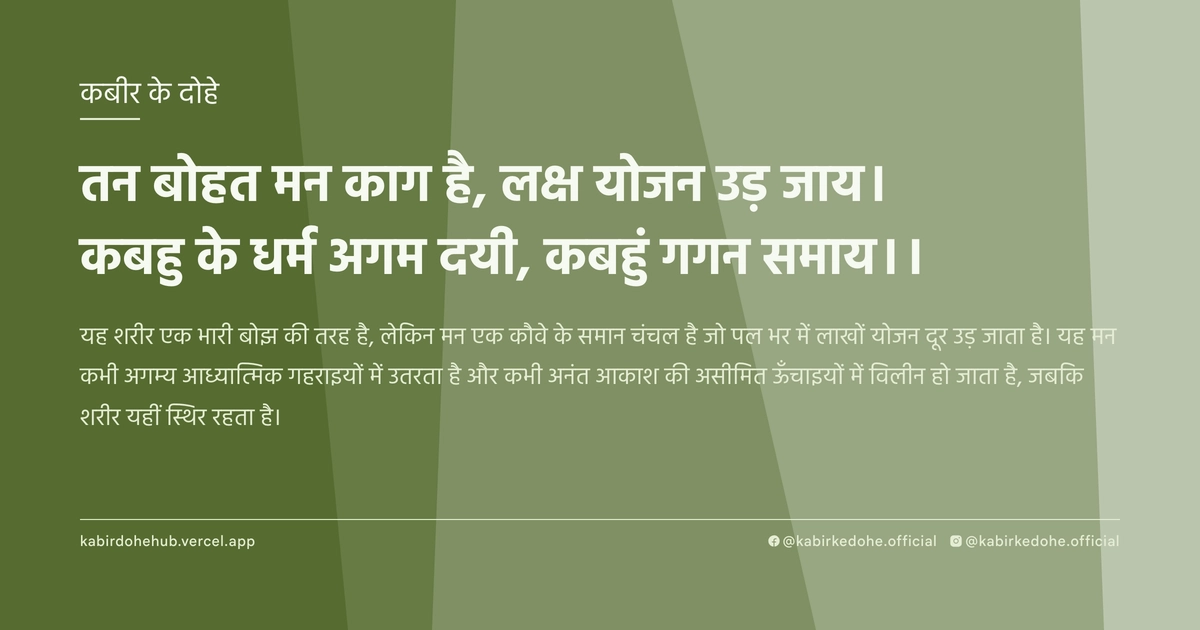
तन बोहत मन काग है, लक्ष योजन उड़ जाय।
कबहु के धर्म अगम दयी, कबहुं गगन समाय।।
Tan bohat man kaag hai, laksh yojan ud jaaye. Kabhu ke dharm agam dayi, kabhun gagan samaye.
इस पृष्ठ पर इस कबीर दोहे का अर्थ (meaning), हिंदी व्याख्या और अंग्रेज़ी अनुवाद, दार्शनिक विश्लेषण और व्यावहारिक जीवन सीख दी गई है। यह दोहा आत्मा और शरीर (Soul and Body) विषय से जुड़ा है — Kabir doha meaning and explanation in Hindi and English.
अर्थ (Meaning):
यह शरीर एक भारी बोझ की तरह है, लेकिन मन एक कौवे के समान चंचल है जो पल भर में लाखों योजन दूर उड़ जाता है। यह मन कभी अगम्य आध्यात्मिक गहराइयों में उतरता है और कभी अनंत आकाश की असीमित ऊँचाइयों में विलीन हो जाता है, जबकि शरीर यहीं स्थिर रहता है।
The physical body is a heavy burden, yet the mind is like a crow that can fly millions of leagues in an instant. This consciousness oscillates wildly, diving into the unfathomable depths of spiritual longing one moment and expanding into the infinite expanse of the cosmic sky the next, while the physical frame remains anchored.
व्याख्या (Interpretation):
कबीर यहाँ शरीर और मन के द्वंद्व को दर्शाते हैं। 'तन बोझत' भौतिकता और मोह के भारीपन का प्रतीक है, जबकि 'काग' (कौवा) मन की चंचलता और उसकी असीमित यात्रा क्षमता को दर्शाता है। यह दोहा निरगुण भक्ति के उस सिद्धांत को उजागर करता है जहाँ आत्मा शरीर की सीमाओं से परे है। जब मन माया के प्रभाव में होता है, तो वह सांसारिक इच्छाओं के पीछे भागता है, लेकिन जब वह जागृत होता है, तो वह 'अगम' (अप्राप्य) सत्य और 'गगन' (शून्य/परमात्मा) में समा जाता है। यह अद्वैत वेदांत के उस सत्य की ओर संकेत है जहाँ व्यक्ति यह अनुभव करता है कि वह केवल यह सीमित शरीर नहीं, बल्कि वह अनंत चेतना है जो समय और स्थान की सीमाओं को लांघ सकती है।
Kabir illustrates the profound duality between the physical vessel and the wandering consciousness. The 'burdened body' symbolizes the inertia of materiality and attachment, while the 'crow' represents the restless nature of the mind and its capacity for transcendental travel. This verse highlights the Nirgun Bhakti principle where the soul transcends physical constraints. When dominated by Maya, the mind chases fleeting desires; however, when awakened, it plunges into the 'Agam' (the unfathomable divine) and merges with the 'Gagan' (the cosmic void or Brahman). It points toward the Advaita Vedanta truth that the individual is not the limited flesh, but the infinite consciousness capable of traversing the boundaries of time and space.
दार्शनिक विश्लेषण (Philosophical Analysis):
कबीर का यह दोहा मध्यकालीन भारत के उस सामाजिक-धार्मिक परिवेश में रचा गया था जहाँ बाहरी कर्मकांडों और शारीरिक शुद्धता पर अत्यधिक बल दिया जाता था। कबीर ने इस भौतिकतावाद को चुनौती देते हुए आंतरिक यात्रा पर जोर दिया। वे बताते हैं कि धर्म केवल मंदिर या मस्जिद जाने में नहीं, बल्कि मन की उस अवस्था में है जहाँ वह अहंकार को छोड़कर शून्य में विलीन हो जाए।
दार्शनिक स्तर पर, यह सूफी मत के 'फना' (अहंकार का विनाश) और वेदांत के 'अहं ब्रह्मास्मि' के करीब है। मन की तुलना कौवे से करना यह दर्शाता है कि मन स्वभाव से ही अस्थिर है, लेकिन इसी अस्थिरता में उसकी मुक्ति का बीज छिपा है। यदि मन बाहरी दुनिया से हटकर भीतर की ओर मुड़ जाए, तो वही 'काग' परमात्मा के अनंत आकाश में समा सकता है।
कबीर यहाँ जाति और वर्ग के भेदों को निरर्थक बताते हैं क्योंकि आत्मा का कोई रंग या जाति नहीं होती। शरीर का बोझ सभी के लिए समान है, चाहे वह राजा हो या रंक। वास्तविक भेद केवल उस मन का है जो या तो वासनाओं में फँसा है या फिर मोक्ष की खोज में है।
मनोवैज्ञानिक रूप से, यह दोहा मानव की मानसिक व्याकुलता और उसकी आध्यात्मिक क्षमता के बीच के तनाव को दर्शाता है। हम अक्सर अपने शरीर की सीमाओं को ही अपनी सीमा मान लेते हैं, जबकि हमारी चेतना असीम है। कबीर हमें इस भ्रम (माया) से बाहर निकलने का आह्वान करते हैं।
अंततः, यह विश्लेषण हमें सिखाता है कि आध्यात्मिक प्रगति का मार्ग बाहरी तीर्थयात्रा नहीं, बल्कि मन का रूपांतरण है। जब मन 'अगम' (अथाह) सत्य को पहचान लेता है, तो वह शरीर के बोझ से मुक्त होकर उस सार्वभौमिक चेतना का हिस्सा बन जाता है जहाँ द्वैत समाप्त हो जाता है।
This couplet was composed during a medieval Indian era dominated by rigid ritualism and an obsession with physical purity. Kabir challenged this externalism by emphasizing the internal odyssey. He asserts that true spirituality does not reside in the act of visiting temples or mosques, but in the state of mind where the ego dissolves into the void.
Philosophically, this aligns with the Sufi concept of 'Fana' (annihilation of the self) and the Vedantic realization of 'Aham Brahmasmi' (I am Brahman). Comparing the mind to a crow signifies its inherent restlessness; yet, within this very volatility lies the seed of liberation. If the mind pivots from the external world toward the interior, the same 'crow' can merge into the infinite sky of the Divine.
Kabir renders caste and class distinctions irrelevant, as the soul possesses no color or lineage. The 'burden of the body' is a universal equalizer, affecting the king and the pauper alike. The only true distinction lies in the state of the mind—whether it is enslaved by cravings or liberated by the quest for Truth.
Psychologically, the verse depicts the tension between human mental agitation and spiritual potential. We often mistake the limitations of our physical vessel for the limitations of our being, whereas our consciousness is boundless. Kabir calls us to awaken from this illusion (Maya).
Ultimately, this analysis teaches that spiritual evolution is not achieved through external pilgrimages but through the transmutation of the mind. Once the mind recognizes the 'Agam' (unfathomable) truth, it sheds the weight of the physical ego and integrates into the universal consciousness where duality ceases to exist.
मूल संदेश (Core Message):
- शरीर एक सीमित वस्त्र है, चेतना एक अनंत आकाश है।
- मानसिक चंचलता को आध्यात्मिक उड़ान में बदलें।
- भौतिक सीमाओं को अपनी पहचान न बनने दें।
- अहंकार का बोझ छोड़कर शून्य में विलीन होना ही मुक्ति है।
- सत्य न तो शरीर में है, न बाहरी दुनिया में, वह भीतर के विस्तार में है।
- The body is a limited garment; consciousness is an infinite sky.
- Transform mental restlessness into a spiritual ascent.
- Do not let physical limitations define your identity.
- Liberation is shedding the weight of ego to merge with the Void.
- Truth resides neither in the body nor the world, but in the internal expanse.
व्यावहारिक उदाहरण (Practical Example):
वाराणसी के एक पुराने घाट पर रहने वाली एक वृद्ध विधवा, जानकी, का जीवन केवल अपनी छोटी सी कुटिया और गंगा की आरती तक सीमित था। समाज की नजरों में वह एक बोझिल, कमजोर और उपेक्षित स्त्री थी। उसका शरीर उम्र के साथ झुक गया था और वह मुश्किल से चल पाती थी।
जानकी का दिन प्रार्थनाओं और दूसरों की सेवा में बीतता था, लेकिन उसके भीतर एक गहरा असंतोष था। वह अक्सर सोचती कि क्या उसका जीवन केवल इस सीमित दायरे में सिमट कर रह जाएगा? वह खुद को समाज की बेड़ियों और शरीर की जर्जरता में कैद महसूस करती थी।
एक दिन, वह एक साधु को कबीर के इस दोहे का पाठ करते हुए सुनती है। साधु समझाते हैं कि शरीर तो एक पिंजरा है, लेकिन मन वह पक्षी है जो कहीं भी उड़ सकता है। जानकी को पहली बार अहसास हुआ कि उसकी शारीरिक अक्षमता उसकी आत्मा की उड़ान को नहीं रोक सकती।
उसने अपनी आँखें बंद कीं और कल्पना की कि वह अपने शरीर के बोझ को नीचे छोड़ रही है। उसने महसूस किया कि उसका मन एक छोटे से कौवे की तरह है, जो अब घाट की गलियों से ऊपर उठकर अनंत नीले आकाश में उड़ रहा है।
धीरे-धीरे, जानकी ने अपनी बाहरी परिस्थितियों के प्रति अपनी प्रतिक्रिया बदल दी। जहाँ वह पहले अपनी लाचारी पर रोती थी, अब वह अपने भीतर के उस असीम विस्तार में शांति खोजने लगी।
उसने देखा कि जब वह गहरे ध्यान में उतरती, तो उसे न तो अपनी बीमारी का अहसास होता और न ही समाज के तिरस्कार का। वह 'अगम' सत्य के उस अनुभव में पहुँच गई जहाँ वह स्वयं को ब्रह्मांड का हिस्सा महसूस करने लगी।
गाँव के लोग हैरान थे कि जो स्त्री पहले उदास रहती थी, अब उसके चेहरे पर एक अलौकिक चमक और शांति थी। उसने अपनी भौतिक सीमाओं को स्वीकार किया, लेकिन अपनी चेतना को उनसे अलग कर लिया।
एक दिन, जब उसकी मृत्यु का समय आया, तो उसके चेहरे पर कोई डर नहीं था। उसने मुस्कुराते हुए कहा, 'मेरा शरीर तो यहीं रहेगा, लेकिन मेरा मन अब उस अनंत गगन में समाने जा रहा है।'
जानकी का जीवन इस बात का प्रमाण बना कि भौतिक बंधन चाहे कितने भी भारी क्यों न हों, एक जागृत मन हमेशा मुक्त रह सकता है।
उसकी यह यात्रा एक शारीरिक मृत्यु नहीं, बल्कि एक आध्यात्मिक प्रस्थान था, जिसने उसके आसपास के लोगों को भी यह सोचने पर मजबूर कर दिया कि असली स्वतंत्रता कहाँ है।
In the ancient ghats of Varanasi lived an elderly widow named Janaki, whose life was confined to a tiny hut and the daily Ganga Aarti. In the eyes of society, she was a burdened, frail, and neglected woman. Her body had bowed with age, and she could barely walk.
Janaki's days passed in prayer and service, yet a deep dissatisfaction lingered within. She often wondered if her existence was destined to remain within this narrow perimeter. She felt imprisoned by societal shackles and the decay of her own flesh.
One day, she overheard a wandering monk reciting this specific Doha of Kabir. The monk explained that the body is merely a cage, but the mind is a bird capable of flying anywhere. For the first time, Janaki realized that her physical infirmity could not obstruct the flight of her soul.
She closed her eyes and visualized herself shedding the weight of her physical frame. She felt her mind, like a small crow, rising above the narrow alleys of the ghats and soaring into the infinite blue sky.
Gradually, Janaki changed her response to her external circumstances. Where she once wept over her helplessness, she began to seek peace within that vast internal expanse.
She discovered that in deep meditation, she felt neither the pain of her illness nor the sting of societal neglect. She reached that experience of 'Agam' truth where she felt herself as an integral part of the universe.
The villagers were astonished that the woman who was once perpetually sorrowful now carried a divine glow and profound serenity on her face. She accepted her physical limitations but detached her consciousness from them.
When the time of her passing arrived, there was no fear in her eyes. She smiled and whispered, 'My body will remain here, but my mind is now merging into that infinite sky.'
Janaki's life became a testament to the fact that no matter how heavy the physical burdens, an awakened mind can always remain free.
Her journey was not a physical death, but a spiritual departure, forcing those around her to question where true liberation actually lies.
अभ्यास मार्गदर्शन (Practice Guidance):
- प्रतिदिन 20 मिनट 'साक्षी भाव' का अभ्यास करें: अपने शरीर को एक बाहरी वस्तु की तरह देखें और महसूस करें कि आपकी चेतना इससे अलग और विस्तृत है।
- स्व-अन्वेषण जर्नल: लिखें कि दिन भर में किन क्षणों में आपका मन 'बोझ' (तनाव/चिंता) महसूस कर रहा था और किन क्षणों में वह 'गगन' (स्वतंत्रता/आनंद) का अनुभव कर पाया।
- व्यवहारिक परिवर्तन: जब भी आप शारीरिक थकान या मानसिक दबाव महसूस करें, एक गहरी सांस लें और कल्पना करें कि आप अपने शरीर से ऊपर उठकर पूरे दृश्य को एक तटस्थ दर्शक की तरह देख रहे हैं।
- डायग्नोस्टिक चेकलिस्ट: क्या आप अपनी पहचान केवल अपने नाम, पद या शरीर से जोड़ते हैं? क्या आप छोटी समस्याओं को जीवन का अंतिम सत्य मान लेते हैं? यदि हाँ, तो आप अभी भी 'तन के बोझ' में फंसे हैं।
- Practice 'Witness Consciousness' for 20 minutes daily: Observe your body as an external object and realize that your consciousness is distinct and far more expansive.
- Self-Inquiry Journaling: Record moments throughout the day when your mind felt like a 'burden' (stress/anxiety) versus moments it experienced the 'sky' (freedom/bliss).
- Behavioral Shift: Whenever you feel physical exhaustion or mental pressure, take a deep breath and visualize yourself rising above your body, observing the entire scene as a neutral spectator.
- Diagnostic Checklist: Do you identify yourself solely by your name, title, or physical form? Do you treat minor setbacks as absolute truths of existence? If yes, you are still trapped in the 'burden of the body'.
चिंतन प्रश्न (Reflection Questions):
- यदि आज आपका शरीर पूरी तरह समाप्त हो जाए, तो आपके व्यक्तित्व का वह कौन सा हिस्सा बचेगा जिसे आप 'मैं' कहते हैं?
- आपकी कौन सी सामाजिक पहचान (जाति, पेशा, पद) आपके लिए सबसे बड़ा 'बोझ' बन गई है?
- क्या आपका मन वास्तव में स्वतंत्र है, या यह केवल एक विचार से दूसरे विचार के पिंजरे में उड़ रहा है?
- आपकी डिजिटल पहचान (सोशल मीडिया) आपके वास्तविक आंतरिक विस्तार को बढ़ा रही है या उसे और सीमित कर रही है?
- वह कौन सा डर है जो आपको अपने भीतर के 'अनंत गगन' में उतरने से रोकता है?
- If your body were to vanish today, what part of your personality would remain that you call 'I'?
- Which social identity (caste, profession, status) has become the heaviest 'burden' for you to carry?
- Is your mind truly free, or is it merely flying from one cage of thought to another?
- Does your digital identity (social media) expand your internal vastness or further restrict it?
- What is the specific fear that prevents you from diving into the 'infinite sky' within?