
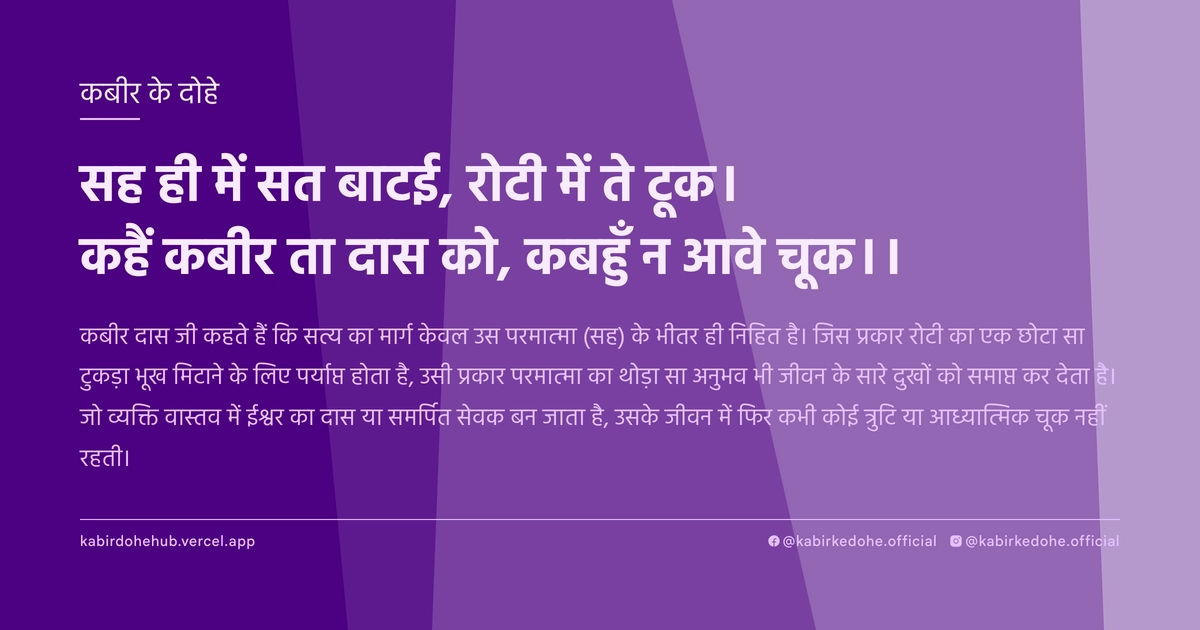
सह ही में सत बाटई, रोटी में ते टूक।
कहैं कबीर ता दास को, कबहुँ न आवे चूक।।
Sah hi mein sat baatai, roti mein te took. Kahein Kabir ta daas ko, kabhu na aave chook.
इस पृष्ठ पर इस कबीर दोहे का अर्थ (meaning), हिंदी व्याख्या और अंग्रेज़ी अनुवाद, दार्शनिक विश्लेषण और व्यावहारिक जीवन सीख दी गई है। यह दोहा सहज योग (Sahaja Yoga) विषय से जुड़ा है — Kabir doha meaning and explanation in Hindi and English.
अर्थ (Meaning):
कबीर दास जी कहते हैं कि सत्य का मार्ग केवल उस परमात्मा (सह) के भीतर ही निहित है। जिस प्रकार रोटी का एक छोटा सा टुकड़ा भूख मिटाने के लिए पर्याप्त होता है, उसी प्रकार परमात्मा का थोड़ा सा अनुभव भी जीवन के सारे दुखों को समाप्त कर देता है। जो व्यक्ति वास्तव में ईश्वर का दास या समर्पित सेवक बन जाता है, उसके जीवन में फिर कभी कोई त्रुटि या आध्यात्मिक चूक नहीं रहती।
Kabir asserts that the path of Truth resides solely within the Divine (Sah). Just as a small morsel of bread suffices to satiate hunger, a mere glimpse of the Divine Truth is enough to dissolve all worldly suffering. He suggests that for the one who has truly become a servant of the Truth, there is no longer any room for spiritual error or deviation from the path of righteousness.
व्याख्या (Interpretation):
इस दोहे का शाब्दिक अर्थ है कि सत्य परमात्मा में है और रोटी के टुकड़े की तरह वह अनिवार्य है। रूपकात्मक रूप से, 'रोटी का टुकड़ा' उस न्यूनतम आध्यात्मिक बोध का प्रतीक है जो अस्तित्व की भूख को शांत करता है। यहाँ 'सह' निर्गुण ब्रह्म को दर्शाता है, जो किसी बाहरी मंदिर या मस्जिद में नहीं, बल्कि अंतरात्मा में स्थित है। यह अद्वैत वेदांत के उस सिद्धांत को पुष्ट करता है जहाँ जीव और ब्रह्म एक ही हैं। माया का पर्दा केवल तब हटता है जब हम बाहरी कर्मकांडों को छोड़कर आंतरिक समर्पण को अपनाते हैं। कबीर यहाँ विरोधाभास पैदा करते हैं कि पूर्णता पाने के लिए केवल एक 'टुकड़े' या एक क्षण के सच्चे बोध की आवश्यकता है। अंततः, यह दासत्व अहंकार के विसर्जन की प्रक्रिया है, जहाँ 'मैं' समाप्त होता है और केवल 'वह' शेष रहता है।
Literally, the verse states that Truth is found in the Divine and is as essential as a piece of bread. Metaphorically, the 'morsel of bread' symbolizes the minimal yet potent spiritual awakening required to satiate the existential hunger of the soul. 'Sah' refers to the Nirgun Brahman—the formless Absolute—which resides not in external shrines but within the core of one's being. This aligns with Advaita Vedanta, emphasizing the non-duality of the Atman and Brahman. The veil of Maya is lifted only when ritualistic piety is replaced by internal surrender. Kabir presents a paradox: that total liberation can be triggered by a single, authentic moment of realization. Ultimately, the 'servitude' mentioned is the process of ego-annihilation, where the individual 'I' dissolves into the universal 'Thou'.
दार्शनिक विश्लेषण (Philosophical Analysis):
कबीर का यह दोहा उनके युग के धार्मिक पाखंड और कर्मकांडीय जटिलताओं पर एक गहरा प्रहार है। 15वीं शताब्दी में, धर्म अक्सर बाहरी दिखावे, जातिगत श्रेष्ठता और कठिन अनुष्ठानों में सिमट गया था। कबीर ने इस व्यवस्था को चुनौती देते हुए 'सह' (परमात्मा) को अत्यंत सरल और सुलभ बताया। उनका दर्शन सूफीवाद के 'फना' (अहंकार का विनाश) और वेदांत के 'ज्ञान' का एक अनूठा संगम है। वे तर्क देते हैं कि यदि सत्य इतना सरल है कि वह रोटी के एक टुकड़े की तरह उपलब्ध है, तो फिर लंबी तीर्थयात्राओं और जटिल मंत्रों की आवश्यकता क्यों है?
दार्शनिक स्तर पर, यह दोहा 'साधन' और 'साध्य' के बीच के अंतर को मिटाता है। कबीर के अनुसार, भक्ति कोई बाहरी क्रिया नहीं बल्कि एक आंतरिक स्थिति है। जब व्यक्ति स्वयं को परमात्मा का 'दास' मानता है, तो वह वास्तव में अपनी व्यक्तिगत इच्छाओं और अहंकार का त्याग कर रहा होता है। यह 'दासत्व' गुलामी नहीं, बल्कि पूर्ण समर्पण है, जो मनुष्य को मानसिक द्वंद्वों से मुक्त करता है।
यहाँ 'चूक' शब्द अत्यंत महत्वपूर्ण है। आध्यात्मिक मार्ग पर चूक तब होती है जब बुद्धि और हृदय के बीच संघर्ष होता है। कबीर का मानना है कि जब चेतना पूरी तरह से परमात्मा में लीन हो जाती है, तो विवेक स्वतः जागृत हो जाता है और व्यक्ति कर्मफल के बंधन से मुक्त होकर सहज रूप से सही मार्ग पर चलने लगता है।
यह शिक्षण हमें सिखाता है कि सत्य की खोज बाहर नहीं, बल्कि भीतर है। जिस प्रकार भूख लगने पर रोटी की तलाश की जाती है, उसी प्रकार आत्मा की तड़प ही सत्य की प्राप्ति का एकमात्र मार्ग है। यह मार्ग किसी विशेष जाति या धर्म के लिए नहीं, बल्कि हर उस व्यक्ति के लिए खुला है जो अपने अहंकार को छोड़ने के लिए तैयार है।
अंततः, कबीर यह स्पष्ट करते हैं कि आध्यात्मिक पूर्णता किसी बाहरी उपलब्धि का परिणाम नहीं है, बल्कि यह एक आंतरिक सरलता की वापसी है। जब हम जटिलताओं को छोड़कर सहजता को अपनाते हैं, तभी हम उस 'सत बाट' (सत्य मार्ग) पर अग्रसर होते हैं जहाँ कोई त्रुटि संभव नहीं है।
This couplet is a profound critique of the ritualistic complexities and religious hypocrisy prevalent during Kabir's era. In the 15th century, spirituality had largely devolved into external displays, caste hierarchies, and arduous rituals. Kabir challenged this by presenting 'Sah' (the Divine) as something profoundly simple and accessible. His philosophy is a unique synthesis of the Sufi concept of 'Fana' (annihilation of the self) and the Vedantic pursuit of 'Jnana' (knowledge).
Philosophically, Kabir collapses the distinction between the 'means' and the 'end'. He argues that if Truth is as fundamental and available as a piece of bread, then the necessity for elaborate pilgrimages and complex mantras vanishes. Devotion, in his view, is not an external act but an internal state of being. By identifying as a 'servant' of the Divine, the seeker is not embracing slavery, but rather practicing the total surrender of the individual ego.
The term 'chook' (error/lapse) is pivotal here. In the spiritual journey, an error occurs when there is a conflict between the intellect and the heart. Kabir posits that once consciousness is fully merged with the Divine, intuitive wisdom (Viveka) awakens naturally. The individual then acts in alignment with the cosmic law, free from the bondage of karmic anxiety.
This teaching emphasizes that the quest for Truth is an inward journey. Just as one seeks bread when hungry, the soul's longing is the only true vehicle for realization. This path is universal, transcending caste and creed, open to anyone willing to relinquish the illusion of a separate identity.
Ultimately, Kabir clarifies that spiritual perfection is not an external achievement but a return to primordial simplicity. By shedding the layers of intellectual and social complexity, one enters the 'Sat Baat' (True Path), where the possibility of error is erased by the presence of Divine Grace.
मूल संदेश (Core Message):
- सत्य बाहरी खोज नहीं, आंतरिक पहचान है।
- अहंकार का विसर्जन ही वास्तविक प्राप्ति है।
- सरलता ही सबसे कठिन और उच्चतम साधना है।
- समर्पण जब पूर्ण होता है, तब त्रुटियाँ समाप्त होती हैं।
- परमात्मा रोटी की तरह अनिवार्य और सुलभ है।
- Truth is not an external quest, but an internal recognition.
- The dissolution of the ego is the only true attainment.
- Simplicity is the most rigorous and highest spiritual practice.
- When surrender is absolute, all errors vanish.
- The Divine is as essential and accessible as a morsel of bread.
व्यावहारिक उदाहरण (Practical Example):
वाराणसी के एक पुराने घाट पर माधव नाम का एक वृद्ध बुनकर रहता था। माधव अपनी पूरी जिंदगी रेशमी धागों से सुंदर वस्त्र बुनने में बिता चुका था, लेकिन उसका मन हमेशा इस बात से परेशान रहता था कि वह अपने जीवन में 'पूर्ण' क्यों नहीं है। वह घंटों मंदिरों में बैठता, कठिन व्रत करता और शास्त्रों के कठिन शब्दों को समझने की कोशिश करता, फिर भी उसके भीतर एक खालीपन था।
एक दिन उसकी मुलाकात एक फकीर से हुई जो घाट की सीढ़ियों पर बैठा केवल एक सूखी रोटी खा रहा था। फकीर के चेहरे पर एक ऐसी शांति थी जो माधव ने बड़े-बड़े विद्वानों के चेहरे पर भी नहीं देखी थी। माधव ने उत्सुकता में पूछा, "बाबा, मैं वर्षों से तपस्या कर रहा हूँ, फिर भी शांति नहीं मिली। आपने ऐसा क्या पाया?"
फकीर ने अपनी रोटी का एक छोटा सा टुकड़ा माधव की ओर बढ़ाया और मुस्कुराते हुए कहा, "बेटा, तूने पूरी दुनिया के नक्शे रट लिए, लेकिन उस घर का रास्ता भूल गया जो तेरे भीतर है। तू सत्य को पहाड़ों और ग्रंथों में ढूँढ रहा है, जबकि वह इस रोटी के एक टुकड़े की तरह सरल और तेरे पास है। बस अपने 'मैं' को इस रोटी की तरह तोड़कर दूसरों में बाँट दे।"
माधव को पहले तो यह बात समझ नहीं आई, लेकिन उसने प्रयोग करने का निर्णय लिया। उसने तय किया कि वह अब केवल अपनी मुक्ति के लिए प्रार्थना नहीं करेगा, बल्कि अपने काम को ही प्रार्थना बना लेगा। उसने अपने बुनकर के पेशे को एक सेवा के रूप में देखना शुरू किया।
जब वह कपड़ा बुनता, तो वह यह नहीं सोचता कि उसे कितने पैसे मिलेंगे या लोग उसकी तारीफ करेंगे। वह हर धागे को परमात्मा का एक अंश मानकर बुनने लगा। उसने अपने अहंकार को—कि वह एक 'महान कलाकार' है—पूरी तरह त्याग दिया और स्वयं को उस परम शक्ति का एक छोटा सा यंत्र या 'दास' समझने लगा।
धीरे-धीरे माधव के जीवन में बदलाव आने लगा। जो क्रोध और चिड़चिड़ापन उसे पहले सताता था, वह गायब हो गया। अब वह केवल अपने लिए नहीं बुनता था, बल्कि समय-समय पर गरीब बच्चों को मुफ्त में कपड़े देने लगा। उसने महसूस किया कि जब उसने अपनी श्रेष्ठता का अहंकार छोड़ा, तो उसका मन वास्तव में शांत हो गया।
एक दिन, जब वह एक अत्यंत जटिल डिजाइन बना रहा था, उसे अचानक महसूस हुआ कि वह और उसका काम अलग नहीं हैं। वह 'बुनने वाला' नहीं रहा, बल्कि केवल 'बुनाई' रह गई। उसे वह 'सत बाट' मिल गया जिसकी तलाश वह मंदिरों में कर रहा था।
माधव ने समझा कि सत्य किसी कठिन साधना में नहीं, बल्कि इस सरलता में है कि हम स्वयं को शून्य कर लें। अब उसके जीवन में कोई 'चूक' नहीं थी, क्योंकि उसकी हर सांस अब उस परमात्मा के प्रति समर्पण थी। वह अब एक सफल बुनकर नहीं, बल्कि एक मुक्त आत्मा था।
In the ancient ghats of Varanasi lived an elderly weaver named Madhav. Madhav had spent his entire life weaving exquisite silk fabrics, yet his mind was perpetually plagued by a sense of incompleteness. He spent hours in temples, observed rigorous fasts, and struggled to decipher complex scriptures, yet an existential void remained within him.
One day, he encountered a wandering dervish sitting on the stone steps, eating a simple, dry piece of bread. The dervish possessed a serenity that Madhav had never witnessed even in the most learned scholars. Driven by curiosity, Madhav asked, "Baba, I have practiced austerity for years, yet peace eludes me. What have you found?"
The dervish offered a small morsel of his bread to Madhav and smiled, saying, "Son, you have memorized the maps of the entire world, but you have forgotten the path to the home that resides within you. You seek Truth in mountains and texts, while it is as simple as this piece of bread and is already beside you. Just break your 'I' like this bread and distribute it among others."
Initially, Madhav found this paradoxical, but he decided to experiment. He resolved that he would no longer pray solely for his own liberation; instead, he would turn his work into a prayer. He began to view his weaving not as a profession, but as a service.
Whenever he wove, he stopped thinking about the profit or the praise he would receive. He began to treat every thread as a fragment of the Divine. He completely relinquished the ego of being a 'master artist' and started seeing himself as a mere instrument or 'servant' of the Supreme Power.
Gradually, a transformation occurred. The anger and irritability that once haunted him vanished. He stopped weaving only for himself and began gifting clothes to underprivileged children. He realized that when he let go of his claim to superiority, his mind finally attained stillness.
One day, while working on an incredibly complex pattern, he suddenly felt that there was no distinction between the weaver and the weaving. The 'weaver' disappeared, and only the 'act of weaving' remained. He had found the 'Sat Baat' (True Path) that he had been searching for in temples.
Madhav understood that Truth does not lie in arduous rituals, but in the simplicity of becoming zero. Now, there were no 'lapses' in his life, for every breath had become an act of surrender to the Divine. He was no longer just a successful weaver, but a liberated soul.
अभ्यास मार्गदर्शन (Practice Guidance):
- दैनिक ध्यान: प्रतिदिन 20 मिनट मौन बैठें और यह विचार करें कि आपका अस्तित्व केवल एक माध्यम है, कर्ता नहीं। 'मैं' के विचार को एक सूखे पत्ते की तरह गिरते हुए देखें।
- आत्म-पूछताछ जर्नल: प्रतिदिन एक ऐसी घटना लिखें जहाँ आपके अहंकार ने आपको सत्य से दूर किया। लिखें कि यदि आप उस समय 'दास भाव' (समर्पण) में होते, तो आपकी प्रतिक्रिया क्या होती।
- व्यवहारिक परिवर्तन: दिन में कम से कम एक ऐसा कार्य करें जिसमें आपको कोई श्रेय (credit) न मिले और जिसे आप पूरी तरह गुप्त रखें। यह 'अहंकार के विसर्जन' का अभ्यास है।
- डायग्नोस्टिक चेकलिस्ट: स्वयं से पूछें—क्या मैं अभी भी सही और गलत के बीच मानसिक संघर्ष कर रहा हूँ? क्या मैं अपनी उपलब्धियों पर गर्व महसूस करता हूँ? यदि हाँ, तो आप अभी भी 'चूक' की स्थिति में हैं। यदि आप सहज और शांत हैं, तो आप मार्ग पर हैं।
- Daily Meditation: Sit in silence for 20 minutes and contemplate that your existence is merely a medium, not the doer. Visualize the thought of 'I' falling away like a dry leaf.
- Self-Inquiry Journal: Record one daily incident where your ego distanced you from the truth. Write how your reaction would have differed if you had acted from a state of 'servitude' (total surrender).
- Behavioral Shift: Perform at least one act of kindness daily that brings you no credit and keep it entirely secret. This is a practical exercise in the 'annihilation of ego'.
- Diagnostic Checklist: Ask yourself—Am I still struggling mentally between right and wrong? Do I feel a sense of pride in my achievements? If yes, you are still in a state of 'lapse'. If you feel effortless and calm, you are on the path.
चिंतन प्रश्न (Reflection Questions):
- मेरी वह कौन सी 'धार्मिक या नैतिक' पहचान है जिसे मैं दुनिया के सामने बनाए रखने के लिए संघर्ष करता हूँ?
- यदि मेरा सारा पद, प्रतिष्ठा और ज्ञान छीन लिया जाए, तो क्या मेरे भीतर कुछ बचेगा जिसे मैं 'सत्य' कह सकूँ?
- मैं किन सूक्ष्म तरीकों से अपनी मदद को भी एक 'अहंकार' के रूप में प्रदर्शित करता हूँ?
- क्या मेरी भक्ति वास्तव में समर्पण है, या यह केवल ईश्वर से कुछ पाने का एक परिष्कृत सौदा है?
- मेरे जीवन का वह कौन सा क्षेत्र है जहाँ मैं अभी भी 'कर्ता' बनने की जिद कर रहा हूँ?
- What is the 'religious or moral' identity that I struggle to maintain in the eyes of the world?
- If all my status, reputation, and knowledge were stripped away, would anything remain within me that I could call 'Truth'?
- In what subtle ways do I turn my acts of kindness into a display of ego?
- Is my devotion truly a surrender, or is it merely a sophisticated transaction to gain something from the Divine?
- In which area of my life am I still stubbornly insisting on being the 'doer'?