
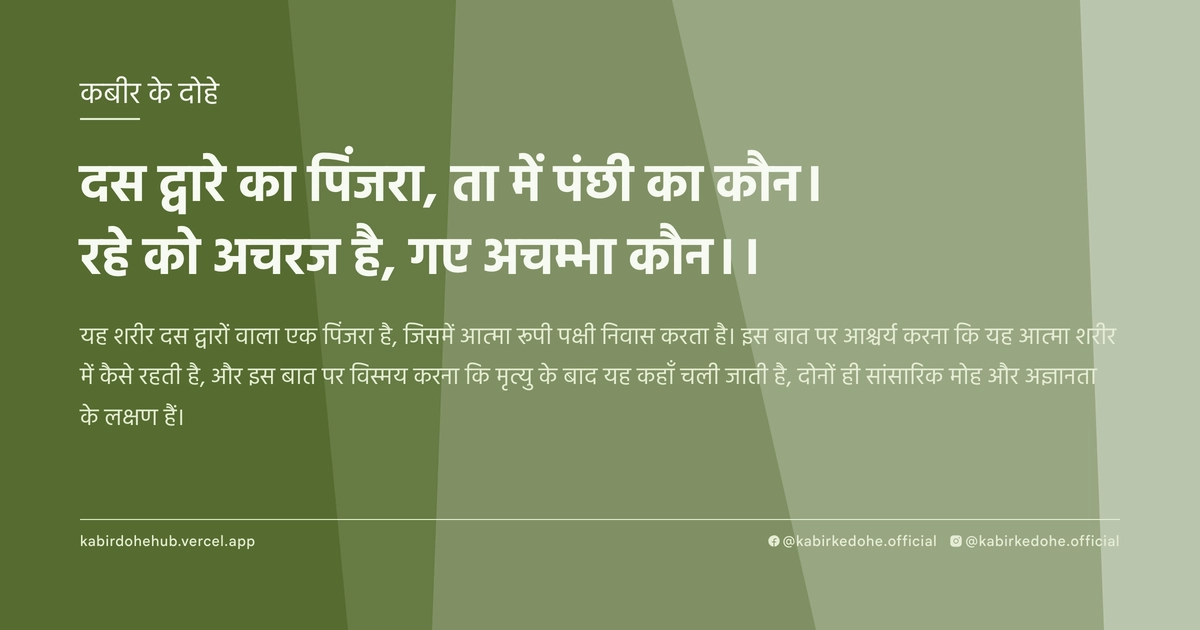
दस द्वारे का पिंजरा, ता में पंछी का कौन।
रहे को अचरज है, गए अचम्भा कौन।।
Das dware ka pinjra, ta mein panchhi ka kaun. Rahe ko achraj hai, gaye achambha kaun.
इस पृष्ठ पर इस कबीर दोहे का अर्थ (meaning), हिंदी व्याख्या और अंग्रेज़ी अनुवाद, दार्शनिक विश्लेषण और व्यावहारिक जीवन सीख दी गई है। यह दोहा आत्मा और शरीर (Soul and Body) विषय से जुड़ा है — Kabir doha meaning and explanation in Hindi and English.
अर्थ (Meaning):
यह शरीर दस द्वारों वाला एक पिंजरा है, जिसमें आत्मा रूपी पक्षी निवास करता है। इस बात पर आश्चर्य करना कि यह आत्मा शरीर में कैसे रहती है, और इस बात पर विस्मय करना कि मृत्यु के बाद यह कहाँ चली जाती है, दोनों ही सांसारिक मोह और अज्ञानता के लक्षण हैं।
The human body is described as a cage with ten gates, within which resides the bird-like soul. Kabir suggests that marveling at how the soul remains within the body or feeling bewildered by its departure at death are both reflections of spiritual ignorance and worldly attachment.
व्याख्या (Interpretation):
कबीर यहाँ शरीर की तुलना एक पिंजरे से करते हैं, जहाँ 'दस द्वार' इंद्रियों और शारीरिक छिद्रों का प्रतीक हैं। आत्मा, जो अनंत और निराकार है, इस सीमित भौतिक ढांचे में कैद है। यह द्वंद्व 'माया' का परिणाम है, जहाँ शुद्ध चेतना स्वयं को शरीर मान लेती है। निर्गुण भक्ति के अनुसार, आत्मा और परमात्मा एक ही हैं; शरीर केवल एक अस्थायी आवरण है। जब पक्षी (आत्मा) पिंजरे (शरीर) को छोड़ता है, तो वह अपने वास्तविक स्वरूप, ब्रह्म में विलीन हो जाता है। यह विरोधाभास है कि हम उस बंधन पर शोक मनाते हैं जो वास्तव में हमारी मुक्ति का मार्ग है।
Kabir employs the metaphor of a cage with 'ten gates' to represent the physical body and its sensory openings. The bird symbolizes the Atman, an eternal spark of the Divine, currently imprisoned by the illusion of Maya. In the context of Nirgun Bhakti, the soul's identification with the flesh is the primary error of human existence. The paradox lies in the human tendency to grieve the 'departure' of the bird, failing to realize that the exit from the cage is the return to the formless Brahman. This non-duality suggests that the separation is illusory; the bird was never truly the cage, and its flight is not a loss but a liberation into the infinite.
दार्शनिक विश्लेषण (Philosophical Analysis):
यह दोहा कबीर के उस क्रांतिकारी दृष्टिकोण को दर्शाता है जहाँ वे शरीर की नश्वरता और आत्मा की अमरता के बीच के अंतर को स्पष्ट करते हैं। उनके समय में, कर्मकांड और शारीरिक शुद्धता पर अत्यधिक बल दिया जाता था, जिसे कबीर ने पूरी तरह नकारा। वे तर्क देते हैं कि यदि हम केवल बाहरी शरीर की पूजा या शुद्धि करते हैं, तो हम उस 'पक्षी' को भूल जाते हैं जो वास्तव में महत्वपूर्ण है।
अद्वैत वेदांत के परिप्रेक्ष्य में, यह 'अविद्या' या अज्ञान का वर्णन है। जब तक जीव स्वयं को इस शरीर (पिंजरे) के साथ जोड़कर देखता है, वह जन्म और मृत्यु के चक्र में फंसा रहता है। कबीर का दर्शन यहाँ सूफीवाद के 'फना' (अहंकार का विनाश) के करीब आता है, जहाँ व्यक्ति अपनी सीमित पहचान को मिटाकर सार्वभौमिक सत्य में समा जाता है।
कबीर का प्रहार उन लोगों पर है जो मृत्यु को एक त्रासदी मानते हैं। उनके लिए, मृत्यु केवल एक द्वार है। वे समझाते हैं कि जिस प्रकार एक पक्षी पिंजरे से मुक्त होकर आकाश में उड़ता है, उसी प्रकार आत्मा भौतिक बंधनों से मुक्त होकर अपने मूल स्रोत में लौटती है। यह विचार मृत्यु के भय को समाप्त कर जीवन को एक साक्षी भाव से जीने की प्रेरणा देता है।
यह विश्लेषण यह भी स्पष्ट करता है कि 'दस द्वार' केवल शारीरिक नहीं, बल्कि मानसिक द्वार भी हैं—काम, क्रोध, लोभ, मोह, मद, मत्सर, ईर्ष्या, अहंकार, भय और घृणा। जब तक ये द्वार खुले हैं, आत्मा बाहरी दुनिया के शोर में खोई रहती है। मुक्ति तब होती है जब ध्यान इन बाहरी द्वारों से हटकर आंतरिक केंद्र की ओर मुड़ता है।
अंततः, कबीर यह संदेश देते हैं कि शरीर का अस्तित्व एक क्षणिक घटना है। जो लोग शरीर के प्रति आसक्त हैं, वे मृत्यु पर विलाप करते हैं, लेकिन जो आत्म-साक्षात्कार कर चुके हैं, उनके लिए यह केवल एक वस्त्र बदलने जैसा है। यह बोध व्यक्ति को जाति, धर्म और सामाजिक प्रतिष्ठा के कृत्रिम बंधनों से मुक्त करता है, क्योंकि अंततः सभी 'पक्षी' एक ही अनंत आकाश का हिस्सा हैं।
This Doha encapsulates Kabir's radical perspective on the transience of the physical form versus the eternity of the soul. During his era, spiritual life was often reduced to external rituals and caste-based purity. Kabir dismantles this by asserting that the 'cage' (the body) is irrelevant compared to the 'bird' (the soul). He argues that focusing on the vessel rather than the essence is a fundamental spiritual error.
From the lens of Advaita Vedanta, this is a discourse on 'Avidya' or primordial ignorance. The soul's suffering stems from the false identification with the limited physical body. Kabir's thought aligns with the Sufi concept of 'Fana'—the annihilation of the ego-self to realize the Divine Presence. The 'ten gates' are not merely anatomical but represent the sensory distractions and psychological attachments that keep the soul tethered to the material plane.
Kabir challenges the conventional perception of death as a tragedy. To him, death is the ultimate liberation, the moment the bird finally escapes the bars of the cage. By shifting the focus from the loss of the body to the liberation of the spirit, he removes the fear of mortality, encouraging a life lived in 'Sakshi Bhav' or witness consciousness.
Furthermore, the poem critiques the obsession with social identity. Caste, creed, and status are merely decorations on the cage; they hold no value for the bird. By emphasizing the universal nature of the soul, Kabir promotes a spiritual egalitarianism that transcends the rigid hierarchies of his time, suggesting that the same divine spark resides in every human regardless of their social standing.
Ultimately, the philosophical core is the realization of non-duality. The wonder at the soul's presence or absence is a symptom of a dualistic mind. Once the seeker realizes that the bird, the cage, and the sky are all manifestations of the one Formless Reality (Nirgun Brahman), the 'wonder' vanishes, replaced by a profound, silent peace.
मूल संदेश (Core Message):
- शरीर एक अस्थायी निवास है, इसे अपनी अंतिम पहचान न मानें।
- मृत्यु अंत नहीं, बल्कि आत्मा की वास्तविक स्वतंत्रता का द्वार है।
- बाहरी दिखावे और कर्मकांडों से ऊपर उठकर आंतरिक सत्य को खोजें।
- अहंकार का विसर्जन ही उस 'पक्षी' की असली उड़ान है।
- आत्मा और परमात्मा के बीच का अलगाव केवल एक भ्रम है।
- The body is a temporary dwelling; do not mistake it for your ultimate identity.
- Death is not an end, but the gateway to the soul's true liberation.
- Rise above external appearances and rituals to discover the inner truth.
- The dissolution of the ego is the only way for the 'bird' to truly fly.
- The perceived separation between the soul and the Divine is a mere illusion.
व्यावहारिक उदाहरण (Practical Example):
वाराणसी के एक पुराने घाट पर रहने वाले माधव नाम के एक वृद्ध बुनकर थे। माधव अपनी पूरी जिंदगी रेशमी धागों से सुंदर वस्त्र बुनने में बिता चुके थे, लेकिन उनका मन हमेशा इस बात से परेशान रहता था कि वे अपनी संपत्ति और अपनी पहचान को अपने बाद कैसे सुरक्षित रखेंगे। वे अपने बेटों और पोतों के बीच इस बात को लेकर चिंतित रहते थे कि उनकी 'विरासत' क्या होगी।
एक दिन, माधव ने एक फकीर को देखा जो नदी के किनारे बैठा मुस्कुरा रहा था। माधव ने उनसे पूछा, 'आप इतने शांत कैसे हैं? क्या आपको अपनी मृत्यु या अपने भविष्य की चिंता नहीं है?' फकीर ने मुस्कुराते हुए माधव के हाथ में मौजूद रेशमी कपड़े की ओर इशारा किया और कहा, 'माधव, तुम इस कपड़े को बहुत कीमती मानते हो, लेकिन क्या तुम यह भूल गए कि कपड़ा केवल धागों का एक समूह है? जब कपड़ा फट जाएगा, तो धागे कहाँ जाएंगे? क्या वे नष्ट हो जाएंगे या वापस अपनी मूल अवस्था में लौट जाएंगे?'
माधव को पहले तो यह बात समझ नहीं आई, लेकिन फिर उन्हें कबीर का वह दोहा याद आया—'दस द्वारे का पिंजरा'। उन्हें अचानक अहसास हुआ कि वे जिस 'विरासत' और 'पहचान' को बचाने की कोशिश कर रहे थे, वह केवल उस 'पिंजरे' की सजावट थी। उनका अहंकार, उनका नाम, उनका घर—सब कुछ केवल उस पिंजरे की सलाखें थीं जिन्होंने उन्हें असली आजादी से दूर रखा था।
उस क्षण माधव के भीतर एक गहरा परिवर्तन आया। उन्होंने महसूस किया कि वे बुनकर नहीं हैं, बल्कि वह चेतना हैं जो बुनने की प्रक्रिया को देख रही है। उन्होंने अपनी संपत्ति के प्रति मोह छोड़ दिया और अपने परिवार के साथ शांति से रहना शुरू किया। अब वे मृत्यु से डरते नहीं थे, बल्कि उसे एक पुराने, फटे हुए कपड़े को बदलने जैसा मानते थे।
उनके व्यवहार में एक अद्भुत हल्कापन आ गया। जो माधव पहले छोटी-छोटी बातों पर क्रोधित होते थे, अब वे हर किसी के प्रति करुणा से भर गए थे। उन्होंने समझा कि यदि हर इंसान एक पिंजरे में कैद पक्षी है, तो नफरत करने का कोई मतलब नहीं है।
उन्होंने अपने जीवन के अंतिम वर्ष दूसरों की सेवा में बिताए, बिना किसी फल की इच्छा के। जब उनके अंतिम समय की बात आई, तो उनके चेहरे पर कोई डर नहीं था। उनके बेटों ने देखा कि उनके पिता विलाप करने के बजाय एक गहरी शांति में थे।
माधव ने अपने पोतों से कहा, 'बेटा, इस पिंजरे को सजाने में समय मत गंवाओ, बल्कि उस पक्षी को पहचानो जो तुम्हारे भीतर गा रहा है।' यह उनकी अंतिम शिक्षा थी।
माधव की कहानी हमें सिखाती है कि जब हम शरीर और पहचान के मोह से मुक्त होते हैं, तभी हम वास्तव में जीना शुरू करते हैं। उनकी मुक्ति किसी बाहरी अनुष्ठान से नहीं, बल्कि एक साधारण सत्य के बोध से हुई थी।
In the ancient alleys of Varanasi lived an elderly weaver named Madhav. Madhav had spent his entire life weaving exquisite silk fabrics, but his mind was perpetually clouded by anxiety over his legacy. He was obsessed with how his wealth and identity would be preserved after his passing, often arguing with his sons about the 'inheritance' he was leaving behind.
One afternoon, Madhav encountered a wandering dervish sitting by the Ganges, radiating an inexplicable peace. Curious, Madhav asked, 'How can you be so serene? Do you not fear death or the loss of your existence?' The dervish pointed to the silk cloth in Madhav's hand and asked, 'Madhav, you value this cloth highly, but do you forget that it is merely a collection of threads? When the cloth eventually tears and decays, where do the threads go? Do they vanish, or do they simply return to their original state?'
Madhav was initially puzzled, but the words triggered a memory of Kabir's verse regarding the 'cage of ten gates.' A sudden realization struck him: the legacy, the wealth, and the social identity he was so desperate to protect were nothing more than decorations on the cage. His ego, his name, and his house were the very bars that had kept him imprisoned and distant from true freedom.
In that moment of clarity, a profound transformation occurred. Madhav realized he was not the weaver, but the consciousness witnessing the act of weaving. He let go of his attachment to material possessions and began to live with his family in a state of genuine contentment.
An extraordinary lightness entered his demeanor. The man who once flared up in anger over minor mistakes now looked upon everyone with deep compassion. He understood that if every human being is but a bird trapped in a cage, then hatred and judgment are entirely meaningless.
He spent the remaining years of his life in selfless service, devoid of any desire for reward. When his final hour approached, there was no trace of fear on his face. His sons observed that their father was not mourning his end but was immersed in a deep, luminous silence.
Madhav whispered to his grandsons, 'My children, do not spend your lives decorating the cage; instead, recognize the bird that sings within you.' This became his final and most enduring lesson.
Madhav's story illustrates that true living begins only when we detach from the illusion of the physical identity. His liberation did not come from complex rituals, but from the simple, piercing realization of the soul's nature.
अभ्यास मार्गदर्शन (Practice Guidance):
- प्रतिदिन 20 मिनट 'साक्षी भाव' का अभ्यास करें: शांत बैठें और अपने शरीर की संवेदनाओं को ऐसे देखें जैसे आप किसी बाहरी वस्तु को देख रहे हों।
- आत्म-पूछताछ जर्नल: हर रात लिखें कि आज किन क्षणों में आपने स्वयं को अपने 'सामाजिक मुखौटे' (पिंजरे) से जोड़कर देखा और कहाँ आप अपनी वास्तविक चेतना का अनुभव कर पाए।
- व्यवहारिक परिवर्तन: जब भी क्रोध या ईर्ष्या महसूस हो, स्वयं से पूछें, 'क्या यह भावना इस पिंजरे की है या उस पक्षी की?'
- निदान चेकलिस्ट: यदि आप अभी भी अपनी शारीरिक सुंदरता, पद या संपत्ति के खोने के विचार से अत्यधिक भयभीत हैं, तो समझें कि आप अभी भी पिंजरे की सलाखों से चिपके हुए हैं।
- Practice 'Witness Consciousness' for 20 minutes daily: Sit in silence and observe your bodily sensations as if you are watching an external object, detaching the 'I' from the 'body'.
- Self-Inquiry Journaling: Each night, record instances where you identified with your 'social mask' (the cage) versus moments where you felt your pure, unconditioned consciousness.
- Behavioral Shift: Whenever you feel anger or jealousy, ask yourself: 'Is this emotion belonging to the cage (the ego) or to the bird (the soul)?'
- Diagnostic Checklist: If the thought of losing your physical beauty, social status, or material wealth still triggers intense panic, recognize that you are still clinging to the bars of the cage.
चिंतन प्रश्न (Reflection Questions):
- यदि आज आपकी सारी सामाजिक पहचान (नाम, पद, रिश्ता) छीन ली जाए, तो आपके भीतर क्या बचेगा?
- आप अपने जीवन का कितना समय 'पिंजरे' को सजाने में बिता रहे हैं और कितना 'पक्षी' को समझने में?
- क्या आपका डर वास्तव में मृत्यु का है, या उस पहचान के खोने का जिसे आपने जीवन भर संजोया है?
- आपकी कौन सी ऐसी आदतें हैं जो आपको इस भौतिक शरीर के साथ इतना मजबूती से बांधे रखती हैं कि आप अपनी दिव्यता भूल जाते हैं?
- क्या आप वास्तव में स्वतंत्र हैं, या आप केवल एक बड़े और अधिक आरामदायक पिंजरे की तलाश में हैं?
- If all your social identities—name, title, relationships—were stripped away today, what would remain of you?
- How much of your life is spent decorating the 'cage' versus understanding the 'bird' within?
- Is your fear truly about death, or is it about the loss of the identity you have spent a lifetime constructing?
- Which of your habits bind you so tightly to this physical form that you forget your own divinity?
- Are you truly free, or are you simply searching for a larger, more comfortable cage?