
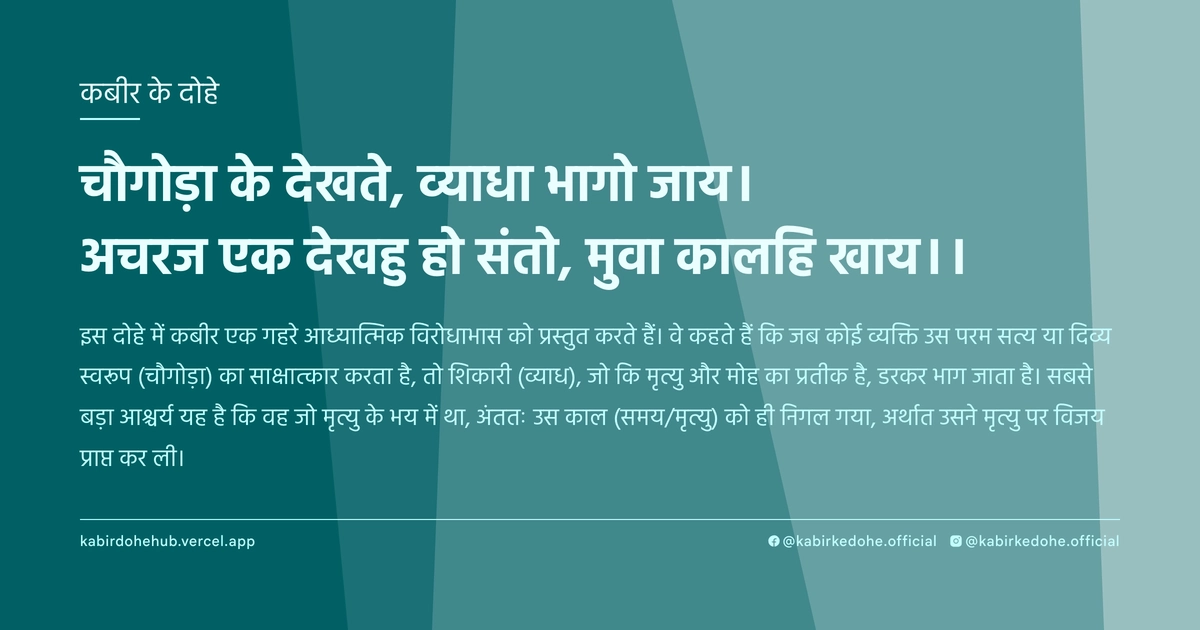
चौगोड़ा के देखते, व्याधा भागो जाय।
अचरज एक देखहु हो संतो, मुवा कालहि खाय।।
Chaugoda ke dekhte, vyadha bhago jaaye. Achraj ek dekhahu ho santo, muva kaalhi khaaye.
इस पृष्ठ पर इस कबीर दोहे का अर्थ (meaning), हिंदी व्याख्या और अंग्रेज़ी अनुवाद, दार्शनिक विश्लेषण और व्यावहारिक जीवन सीख दी गई है। यह दोहा मृतुक्यता (Mortality) विषय से जुड़ा है — Kabir doha meaning and explanation in Hindi and English.
अर्थ (Meaning):
इस दोहे में कबीर एक गहरे आध्यात्मिक विरोधाभास को प्रस्तुत करते हैं। वे कहते हैं कि जब कोई व्यक्ति उस परम सत्य या दिव्य स्वरूप (चौगोड़ा) का साक्षात्कार करता है, तो शिकारी (व्याध), जो कि मृत्यु और मोह का प्रतीक है, डरकर भाग जाता है। सबसे बड़ा आश्चर्य यह है कि वह जो मृत्यु के भय में था, अंततः उस काल (समय/मृत्यु) को ही निगल गया, अर्थात उसने मृत्यु पर विजय प्राप्त कर ली।
In this couplet, Kabir presents a profound spiritual paradox. He suggests that when one beholds the Divine Form or the Ultimate Truth (Chaugoda), the hunter (Vyadha)—symbolizing death, attachment, and the ego—flees in terror. The ultimate wonder, addressed to the seekers, is that the one who was once prey to time has now consumed Time itself, effectively achieving victory over death and the cycle of rebirth.
व्याख्या (Interpretation):
यहाँ 'चौगोड़ा' उस विराट स्वरूप या पूर्णता का प्रतीक है जो माया के परदों के पीछे छिपा है। 'व्याध' या शिकारी केवल एक बाहरी व्यक्ति नहीं, बल्कि वह मानसिक वासना और अज्ञान है जो हमारी आत्मा को बांधे रखता है। जब साधक को आत्म-साक्षात्कार होता है, तो वह पहचान लेता है कि वह शरीर नहीं बल्कि अविनाशी आत्मा है। यह बोध ही वह शक्ति है जिससे मृत्यु का भय समाप्त हो जाता है। यह निरगुण भक्ति का सार है जहाँ ईश्वर किसी मूर्ति में नहीं, बल्कि स्वयं के भीतर की शून्यता और पूर्णता में पाया जाता है। अद्वैत वेदांत के अनुसार, जब ज्ञाता और ज्ञेय का भेद मिट जाता है, तब काल (समय) का प्रभाव समाप्त हो जाता है। यह विरोधाभास कि 'मृत व्यक्ति ने काल को खा लिया', वास्तव में अहंकार की मृत्यु और चेतना के अनंत विस्तार का संकेत है।
Here, 'Chaugoda' symbolizes the Vast Form or the Totality hidden behind the veils of Maya. The 'Vyadha' or hunter is not merely a physical entity but represents the mental cravings and ignorance that imprison the soul. When the seeker attains self-realization, they recognize that they are not the perishable body but the imperishable Atman. This realization is the catalyst that dissolves the fear of death. This is the essence of Nirgun Bhakti, where the Divine is found not in idols, but in the void and fullness within. According to Advaita Vedanta, when the distinction between the knower and the known vanishes, the influence of Kaal (Time) ceases. The paradox of the 'dead consuming Time' signifies the death of the ego and the subsequent expansion of consciousness into the eternal present.
दार्शनिक विश्लेषण (Philosophical Analysis):
कबीर का यह दोहा उस युग की प्रतिक्रिया है जहाँ धर्म केवल कर्मकांडों और बाहरी आडंबरों तक सीमित था। कबीर ने स्पष्ट किया कि मोक्ष किसी तीर्थ यात्रा या कठिन व्रत से नहीं, बल्कि आंतरिक रूपांतरण से मिलता है। यहाँ 'व्याध' का भागना इस बात का प्रतीक है कि जब सत्य का प्रकाश आता है, तो भ्रम और भय स्वतः समाप्त हो जाते हैं। यह सूफी मत के 'फना' (अहंकार का विनाश) के विचार से मेल खाता है, जहाँ व्यक्ति अपनी छोटी पहचान को मिटाकर परमात्मा में विलीन हो जाता है।
दार्शनिक स्तर पर, यह अद्वैत वेदांत के उस सिद्धांत को पुष्ट करता है कि ब्रह्म ही एकमात्र सत्य है और जगत मिथ्या है। जब साधक इस सत्य को जान लेता है, तो वह जन्म और मृत्यु के चक्र (संसार) से मुक्त हो जाता है। कबीर यहाँ यह समझा रहे हैं कि मृत्यु वास्तव में एक भ्रम है; केवल वह मरता है जो खुद को शरीर मानता है। जो स्वयं को अनंत चेतना मानता है, उसके लिए मृत्यु केवल एक वस्त्र बदलने जैसी प्रक्रिया है।
सामाजिक संदर्भ में, कबीर ने जाति और वर्ण के भेदभाव को नकारते हुए यह संदेश दिया कि आध्यात्मिक जागृति किसी विशेष वर्ग का विशेषाधिकार नहीं है। एक साधारण बुनकर भी उस 'चौगोड़े' का दर्शन कर सकता है यदि उसका हृदय शुद्ध हो। यह विचार उस समय के कट्टरपंथी धार्मिक ढांचे पर एक गहरा प्रहार था, जो मोक्ष को केवल शास्त्रों के ज्ञान तक सीमित रखते थे।
मनोवैज्ञानिक रूप से, यह दोहा भय के प्रबंधन की बात करता है। मनुष्य का सबसे बड़ा भय मृत्यु का भय है। कबीर सुझाव देते हैं कि इस भय का समाधान मृत्यु से भागना नहीं, बल्कि मृत्यु के स्रोत—अहंकार—को पहचानना और उसे मिटाना है। जब 'मैं' मिटता है, तो मारने वाला और मरने वाला दोनों एक हो जाते हैं।
अंततः, 'काल को खाना' एक रूपक है उस अवस्था के लिए जहाँ समय की सीमाएं समाप्त हो जाती हैं। हम वर्तमान क्षण में जीते हैं, लेकिन हमारी चिंताएं भविष्य और अतीत में होती हैं। जो व्यक्ति पूर्णतः वर्तमान में स्थित हो जाता है, वह समय के बंधन से मुक्त हो जाता है। यही वह 'अचरज' है जिसे कबीर संतों को देखने के लिए आमंत्रित कर रहे हैं।
Kabir's couplet is a reaction to an era where religion was confined to rituals and external displays. He clarifies that liberation is not achieved through pilgrimages or rigorous fasting, but through internal transformation. The fleeing of the 'Vyadha' symbolizes that when the light of Truth emerges, delusions and fears vanish spontaneously. This aligns with the Sufi concept of 'Fana' (annihilation of the ego), where the individual dissolves their limited identity into the Divine.
On a philosophical level, this reinforces the Advaita Vedanta principle that Brahman is the only reality and the world is an illusion (Maya). Once the seeker realizes this, they are liberated from the cycle of birth and death (Samsara). Kabir explains that death is essentially an illusion; only that which identifies as the body dies. One who identifies as infinite consciousness perceives death as merely changing a garment.
In a social context, Kabir rejected caste and class distinctions, asserting that spiritual awakening is not the privilege of a specific elite. Even a simple weaver can behold the 'Chaugoda' if their heart is pure. This was a profound critique of the orthodox religious structures of his time, which limited salvation to those with scriptural knowledge.
Psychologically, the verse addresses the management of fear. The greatest human fear is the fear of death. Kabir suggests that the solution is not to flee from death, but to recognize and annihilate its source—the ego. When the 'I' is erased, the killer and the killed become one.
Ultimately, 'consuming Time' is a metaphor for the state where the boundaries of time collapse. Humans live in the present but are plagued by the past and future. One who is fully anchored in the Now transcends the constraints of time. This is the 'wonder' that Kabir invites the saints to witness.
मूल संदेश (Core Message):
- भय अज्ञान की उपज है, सत्य का नहीं।
- अहंकार की मृत्यु ही वास्तविक जीवन की शुरुआत है।
- हम शरीर नहीं, बल्कि अनंत चेतना के अंश हैं।
- जब 'मैं' मिटता है, तब काल का बंधन टूटता है।
- परम सत्य का साक्षात्कार ही मृत्यु पर विजय है।
- Fear is a product of ignorance, not of Truth.
- The death of the ego is the beginning of true life.
- We are not the body, but fragments of infinite consciousness.
- When the 'I' vanishes, the shackles of Time break.
- Realization of the Ultimate Truth is the victory over death.
व्यावहारिक उदाहरण (Practical Example):
एक समय की बात है, वाराणसी के घाटों पर रहने वाला एक वृद्ध नाविक था, जिसका नाम माधव था। माधव का पूरा जीवन केवल नाव चलाने और लोगों को नदी पार कराने में बीता। वह स्वभाव से बहुत डरा हुआ रहता था, क्योंकि उसे लगता था कि उसकी मृत्यु किसी भी क्षण हो सकती है और वह अपने पीछे अपनी छोटी सी झोपड़ी और परिवार को असुरक्षित छोड़ जाएगा।
माधव हर दिन गंगा आरती देखता, लेकिन उसका मन कभी शांत नहीं हुआ। वह अक्सर सोचता कि क्या ईश्वर वास्तव में है या यह सब केवल एक कहानी है। वह मृत्यु के भय से इतना ग्रस्त था कि वह रात को ठीक से सो नहीं पाता था। उसके लिए 'काल' एक क्रूर शिकारी की तरह था जो हर पल उसके करीब आ रहा था।
एक दिन, माधव की मुलाकात एक घुमक्कड़ फकीर से हुई। फकीर ने माधव की आंखों में वह गहरा डर देख लिया। फकीर ने उससे कहा, 'माधव, तुम उस शिकारी से डर रहे हो जो वास्तव में तुम्हारा अपना ही प्रतिबिंब है। तुम जिसे मृत्यु कह रहे हो, वह केवल एक पर्दा है। जिस दिन तुम उस पर्दे के पीछे के विराट स्वरूप को देख लोगे, शिकारी खुद डरकर भाग जाएगा।'
माधव ने पूछा, 'मैं उस स्वरूप को कैसे देखूँ?' फकीर ने मुस्कुराकर कहा, 'अपनी नाव को किनारे लगाओ और अपनी सांसों की गहराई में उतरकर देखो। यह शरीर तुम्हारी नाव है, लेकिन तुम वह नदी हो जो कभी समाप्त नहीं होती।'
माधव ने अगले कुछ महीनों तक फकीर के मार्गदर्शन में मौन साधना शुरू की। उसने धीरे-धीरे यह महसूस किया कि उसका डर उसकी अपनी पहचान (नाविक होने की पहचान) से जुड़ा था। जब उसने अपनी छोटी पहचान को छोड़ दिया, तो उसे महसूस हुआ कि वह केवल एक शरीर नहीं, बल्कि उस अनंत चेतना का हिस्सा है जो पूरे ब्रह्मांड में व्याप्त है।
एक दिन, जब माधव बहुत बीमार पड़ा और उसे लगा कि अब उसका अंत समय आ गया है, तो वह डरा नहीं। इसके बजाय, उसने एक गहरी शांति महसूस की। उसे ऐसा लगा जैसे वह 'चौगोड़ा' या वह विराट सत्य उसके सामने खड़ा है। उस क्षण, मृत्यु का भय (व्याध) पूरी तरह गायब हो गया।
माधव ने महसूस किया कि जिसे वह अब तक अपना अंत समझ रहा था, वह वास्तव में एक नई शुरुआत थी। उसने अपनी चेतना के स्तर पर मृत्यु को 'खा लिया', यानी उसने मृत्यु के डर को अपनी शक्ति में बदल लिया।
जब वह अंतिम सांस ले रहा था, उसके चेहरे पर एक अद्भुत मुस्कान थी। उसके परिवार ने देखा कि वह डरा हुआ नहीं था, बल्कि वह बहुत खुश था। उसने अपनी अंतिम बातों में कहा, 'शिकारी भाग गया, अब केवल प्रकाश बचा है।'
माधव की यह कहानी हमें सिखाती है कि जब हम अपनी सीमित पहचान को त्यागकर सार्वभौमिक सत्य से जुड़ते हैं, तो जीवन का सबसे बड़ा भय भी एक उत्सव बन जाता है।
उसका रूपांतरण केवल बाहरी नहीं था, बल्कि वह पूरी तरह से आंतरिक था। उसने यह जान लिया कि काल केवल शरीर को नष्ट करता है, आत्मा को नहीं।
Once, on the ghats of Varanasi, lived an elderly boatman named Madhav. Madhav had spent his entire life rowing boats and ferrying people across the river. He lived in a state of constant anxiety, fearing that death could strike at any moment, leaving his small hut and family insecure.
Madhav watched the Ganga Aarti every day, but his mind never found peace. He often wondered if God truly existed or if it was all just a story. He was so consumed by the fear of death that he could barely sleep at night. To him, 'Kaal' (Time/Death) was like a cruel hunter closing in on him.
One day, Madhav met a wandering fakir. The fakir saw the deep-seated fear in Madhav's eyes. He told him, 'Madhav, you are afraid of a hunter who is actually your own reflection. What you call death is merely a veil. The day you behold the Vast Form behind that veil, the hunter will flee in terror.'
Madhav asked, 'How do I see that Form?' The fakir smiled and replied, 'Tether your boat to the shore and dive into the depths of your own breath. This body is your boat, but you are the river that never ends.'
Under the fakir's guidance, Madhav began a practice of silent meditation. He gradually realized that his fear was tied to his limited identity as a 'boatman.' As he let go of this small ego, he felt that he was not just a body, but a part of the infinite consciousness pervading the universe.
One day, when Madhav fell gravely ill and felt his end was near, he did not panic. Instead, he felt a profound peace. It was as if the 'Chaugoda' or the Ultimate Truth stood before him. In that moment, the fear of death (the Vyadha) vanished completely.
Madhav realized that what he had perceived as the end was actually a new beginning. He 'consumed' death at the level of consciousness, transforming his fear into power.
As he took his final breath, a strange, serene smile played on his lips. His family noticed that he wasn't afraid; he was joyful. In his final words, he whispered, 'The hunter has fled; only light remains.'
Madhav's story teaches us that when we transcend our limited identity and align with the universal truth, the greatest fear of life becomes a celebration.
His transformation was not external but entirely internal. He understood that Time destroys only the body, never the Soul.
अभ्यास मार्गदर्शन (Practice Guidance):
- प्रतिदिन 20 मिनट 'साक्षी भाव' का अभ्यास करें: अपने विचारों और शरीर की संवेदनाओं को बिना किसी निर्णय के केवल एक दर्शक की तरह देखें।
- आत्म-पूछताछ जर्नल: प्रतिदिन लिखें कि 'आज मेरा कौन सा डर मुझे सीमित कर रहा था?' और फिर विश्लेषण करें कि वह डर किस 'झूठी पहचान' (अहंकार) से जुड़ा है।
- मृत्यु-चिंतन (Maranasati): दिन में एक बार यह विचार करें कि यह शरीर नश्वर है, लेकिन मेरे भीतर की चेतना अविनाशी है। इसे भय के रूप में नहीं, बल्कि मुक्ति के रूप में देखें।
- डायग्नोस्टिक चेकलिस्ट: यदि आप छोटी बातों पर अत्यधिक क्रोधित होते हैं या भविष्य की चिंता में डूबे रहते हैं, तो इसका अर्थ है कि 'व्याध' (अज्ञान) अभी भी सक्रिय है। यदि आप विपरीत परिस्थितियों में भी तटस्थ रह पाते हैं, तो आप 'चौगोड़े' के करीब हैं।
- Practice 'Witness Consciousness' for 20 minutes daily: Observe your thoughts and bodily sensations as a detached observer without judgment.
- Self-Inquiry Journaling: Write daily: 'Which fear limited me today?' then analyze which 'false identity' (ego) that fear is attached to.
- Contemplation on Impermanence (Maranasati): Once a day, reflect that while the body is perishable, the consciousness within is imperishable. View this not as a fear, but as liberation.
- Diagnostic Checklist: If you react with extreme anger to trivial matters or are consumed by future anxieties, the 'Vyadha' (ignorance) is still active. If you remain equanimous in adversity, you are approaching the 'Chaugoda'.
चिंतन प्रश्न (Reflection Questions):
- वह कौन सी सामाजिक या पेशेवर पहचान है जिसे मैं अपनी असली पहचान मानता हूँ, और यदि वह छिन जाए तो मैं कौन रहूँगा?
- क्या मेरा डिजिटल व्यक्तित्व (सोशल मीडिया इमेज) मेरे वास्तविक आंतरिक स्वरूप को छिपाने का एक तरीका है?
- मैं किन चीजों को खोने से सबसे ज्यादा डरता हूँ, और क्या वह डर वास्तव में मेरी आत्मा का है या केवल मेरी वासनाओं का?
- क्या मैं वास्तव में वर्तमान क्षण में जीता हूँ, या मैं केवल यादों और उम्मीदों के बीच एक भ्रम में जी रहा हूँ?
- मेरे जीवन का वह कौन सा हिस्सा है जहाँ मैं अभी भी 'शिकारी' (डर/अहंकार) के नियंत्रण में हूँ?
- Which social or professional identity do I mistake for my true self, and who would I be if that were stripped away?
- Is my digital persona a mechanism to hide my authentic internal self?
- What am I most afraid of losing, and is that fear truly of the soul or merely of my attachments?
- Do I truly live in the present moment, or am I existing in a delusion between memories and expectations?
- Which part of my life is still under the control of the 'hunter' (fear/ego)?