
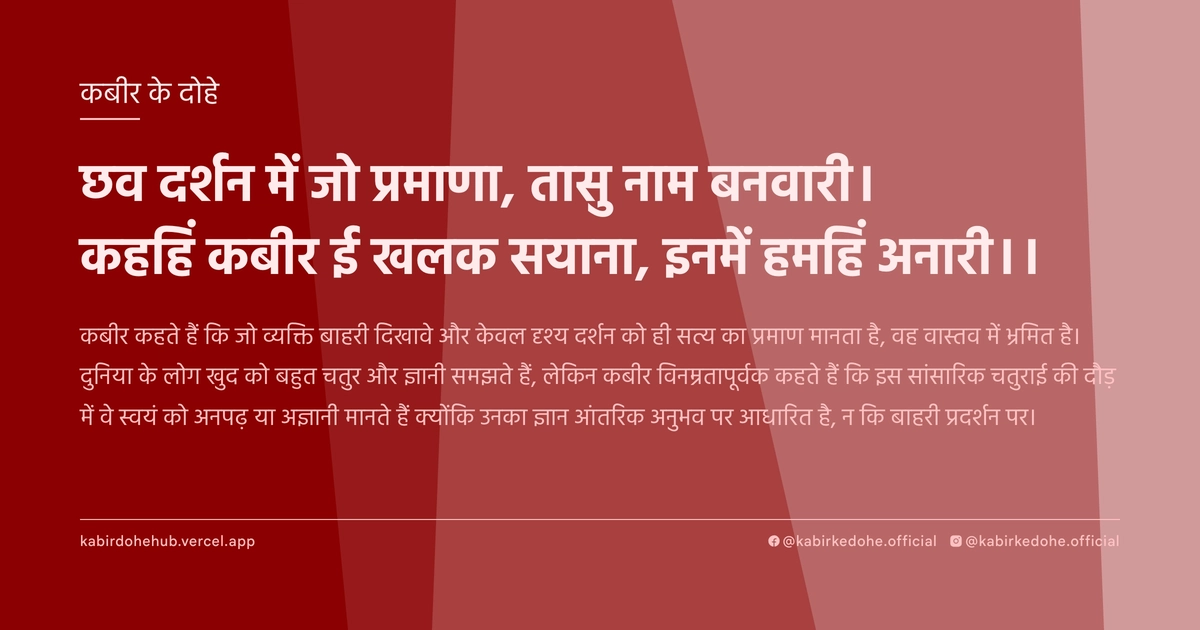
छव दर्शन में जो प्रमाणा, तासु नाम बनवारी।
कहहिं कबीर ई खलक सयाना, इनमें हमहिं अनारी।।
Chhav darshan mein jo pramana, tasu naam banwari. Kahahin kabir ee khalak sayana, inme hamhin anari.
इस पृष्ठ पर इस कबीर दोहे का अर्थ (meaning), हिंदी व्याख्या और अंग्रेज़ी अनुवाद, दार्शनिक विश्लेषण और व्यावहारिक जीवन सीख दी गई है। यह दोहा विनम्रता (Humility) विषय से जुड़ा है — Kabir doha meaning and explanation in Hindi and English.
अर्थ (Meaning):
कबीर कहते हैं कि जो व्यक्ति बाहरी दिखावे और केवल दृश्य दर्शन को ही सत्य का प्रमाण मानता है, वह वास्तव में भ्रमित है। दुनिया के लोग खुद को बहुत चतुर और ज्ञानी समझते हैं, लेकिन कबीर विनम्रतापूर्वक कहते हैं कि इस सांसारिक चतुराई की दौड़ में वे स्वयं को अनपढ़ या अज्ञानी मानते हैं क्योंकि उनका ज्ञान आंतरिक अनुभव पर आधारित है, न कि बाहरी प्रदर्शन पर।
Kabir asserts that those who rely solely on outward appearances and visual rituals as proof of spiritual realization are mistaken. While the world prides itself on intellectual cleverness and social sophistication, Kabir humbly claims to be the 'ignorant one' among these 'wise' people, because his wisdom is rooted in internal experience rather than external validation.
व्याख्या (Interpretation):
यह दोहा दृश्य जगत की माया और वास्तविक सत्य के बीच के अंतर को स्पष्ट करता है। 'छव दर्शन' का अर्थ है वह बाहरी चमक-धमक या धार्मिक अनुष्ठान जिन्हें लोग ईश्वर की प्राप्ति का प्रमाण मानते हैं। कबीर यहाँ एक गहरे विरोधाभास का उपयोग कर रहे हैं: दुनिया जिसे 'सयाना' (चतुर) कहती है, वह वास्तव में माया के जाल में फँसा हुआ है। 'अनारी' शब्द यहाँ अज्ञानता का नहीं, बल्कि उस सहजता और सरलता का प्रतीक है जो अहंकार के विसर्जन के बाद आती है। यह निर्गुण भक्ति का सार है, जहाँ ईश्वर किसी मूर्ति या बाहरी रूप में नहीं, बल्कि चेतना के भीतर स्थित है। जब साधक यह स्वीकार कर लेता है कि वह बाहरी दुनिया की चतुराई में 'अनारी' है, तभी वह उस परम सत्य के लिए योग्य बनता है जो शब्दों और दृश्यों से परे है। यह अद्वैत वेदांत के उस सिद्धांत को दर्शाता है जहाँ व्यक्ति अपनी सीमित पहचान (ego) को मिटाकर पूर्णता में विलीन हो जाता है।
This couplet elucidates the chasm between the illusory visual world and the ultimate Truth. 'Chhav darshan' refers to the external splendor or religious rituals that people mistake for spiritual evidence. Kabir employs a profound paradox: those the world deems 'sayana' (clever) are actually entangled in the web of Maya. The term 'anari' (ignorant/unskilled) here does not signify a lack of intelligence, but rather the purity and simplicity that emerge after the dissolution of the ego. This is the essence of Nirgun Bhakti, where the Divine is not found in idols or external forms, but within the depths of consciousness. Only when a seeker accepts their 'ignorance' regarding worldly sophistication do they become eligible for the Truth that transcends words and images. It mirrors the Advaita Vedanta principle where the individual identity is shed to realize non-duality with the Absolute.
दार्शनिक विश्लेषण (Philosophical Analysis):
कबीर का यह दोहा उनके युग के उस सामाजिक और धार्मिक परिवेश पर प्रहार है जहाँ धर्म केवल कर्मकांडों और बाहरी प्रतीकों तक सीमित हो गया था। उन्होंने देखा कि लोग तीर्थयात्राओं, विशेष वस्त्रों और तिलक के माध्यम से अपनी आध्यात्मिक श्रेष्ठता सिद्ध करने का प्रयास करते थे। कबीर इसे 'छव दर्शन' कहते हैं—एक ऐसा प्रमाण जो केवल आँखों को संतुष्ट करता है, आत्मा को नहीं। उनका दर्शन सूफीवाद के 'फना' (अहंकार का विनाश) और वेदांत के 'माया' सिद्धांत का एक अनूठा संगम है।
वे तर्क देते हैं कि बौद्धिक चतुराई (intellectual cleverness) अक्सर सत्य के मार्ग में सबसे बड़ी बाधा होती है। जब कोई व्यक्ति खुद को 'ज्ञानी' मानता है, तो वह नए अनुभवों के लिए द्वार बंद कर लेता है। कबीर की 'अनारी' होने की घोषणा वास्तव में एक आध्यात्मिक रणनीति है। यह अहंकार का पूर्ण समर्पण है, जिससे वह शून्य बन जाते हैं ताकि ईश्वर उन्हें पूरी तरह भर सके।
यह विचार जाति व्यवस्था और पदानुक्रमित ज्ञान के विरुद्ध एक विद्रोह है। कबीर यह स्थापित करते हैं कि सत्य किसी विशेष शास्त्र, कुल या बाहरी योग्यता का मोहताज नहीं है। वह केवल उस हृदय में उतरता है जो सरल है और जिसने अपनी चतुराई का त्याग कर दिया है। यहाँ 'बनवारी' शब्द का प्रयोग ईश्वर के उस रूप के लिए है जो चंचल और सर्वव्यापी है, जिसे केवल आंतरिक दृष्टि से देखा जा सकता है।
मनोवैज्ञानिक स्तर पर, यह दोहा 'कॉग्निटिव डिसोनेंस' को संबोधित करता है। समाज हमें सिखाता है कि सफल होने के लिए चतुर होना आवश्यक है, लेकिन कबीर कहते हैं कि आध्यात्मिक मुक्ति के लिए 'मूर्ख' (सरल) होना आवश्यक है। यह विरोधाभास साधक को उसकी सामाजिक पहचान और उसकी वास्तविक आत्मा के बीच के संघर्ष को समझने पर मजबूर करता है।
अंततः, कबीर यह संदेश देते हैं कि सत्य का प्रमाण बाहरी दुनिया के मानदंडों में नहीं, बल्कि आंतरिक शांति और आत्म-साक्षात्कार में है। जो दुनिया की नजर में असफल या अनपढ़ है, वह वास्तव में उस गुप्त ज्ञान का स्वामी हो सकता है जिसे बड़े-बड़े विद्वान अपनी किताबी चतुराई के कारण कभी नहीं पा सके।
This couplet is a sharp critique of the socio-religious climate of Kabir's era, where spirituality had devolved into mere ritualism and external symbolism. He observed people attempting to validate their spiritual superiority through pilgrimages, specific attire, and sectarian marks. Kabir labels this 'Chhav darshan'—evidence that satisfies the eyes but leaves the soul hungry. His philosophy is a unique synthesis of the Sufi concept of 'Fana' (annihilation of the self) and the Vedantic notion of 'Maya'.
He argues that intellectual cleverness is often the greatest obstacle on the path to Truth. When an individual perceives themselves as 'wise,' they close the doors to genuine experiential realization. Kabir's claim of being 'anari' is not a confession of stupidity, but a strategic spiritual surrender. By becoming 'nothing,' he creates the vacuum necessary for the Divine to fill him completely.
This perspective is a rebellion against the caste system and the hierarchy of knowledge. Kabir establishes that Truth is not the monopoly of any specific scripture, lineage, or external qualification. It descends only into a heart that is simple and has relinquished its craving for intellectual dominance. The use of 'Banwari' refers to the Divine as the playful, omnipresent essence that can only be perceived through the inner eye.
Psychologically, the verse addresses the tension between social conditioning and spiritual authenticity. Society mandates cleverness for survival and success, but Kabir posits that 'simplicity' (or being perceived as a fool) is the prerequisite for liberation. This paradox forces the seeker to confront the conflict between their public persona and their authentic self.
Ultimately, Kabir suggests that the proof of Truth lies not in the metrics of the external world, but in inner stillness and self-realization. One who is deemed unsuccessful or unlettered by societal standards may actually possess the secret knowledge that scholars miss due to their rigid adherence to textual intellect.
मूल संदेश (Core Message):
- बाहरी दिखावा सत्य का प्रमाण नहीं होता।
- बौद्धिक अहंकार आध्यात्मिक प्रगति का सबसे बड़ा अवरोध है।
- सरलता और विनम्रता ही वास्तविक ज्ञान के द्वार हैं।
- सत्य शब्दों में नहीं, बल्कि मौन अनुभव में बसता है।
- खुद को शून्य करना ही पूर्णता को प्राप्त करने का एकमात्र मार्ग है।
- External appearances are never proof of spiritual Truth.
- Intellectual ego is the greatest barrier to spiritual evolution.
- Simplicity and humility are the only gateways to real wisdom.
- Truth resides not in words, but in silent experience.
- Emptying the self is the only way to achieve wholeness.
व्यावहारिक उदाहरण (Practical Example):
एक समय की बात है, वाराणसी के एक पुराने मोहल्ले में माधव नाम का एक वृद्ध बुनकर रहता था। माधव बहुत ही साधारण व्यक्ति था, वह न तो संस्कृत जानता था और न ही कठिन पूजा-पाठ करता था। उसके मोहल्ले में एक बहुत बड़े पंडित जी रहते थे, जिन्होंने कई शास्त्र पढ़े थे और जिनका पूरा दिन अनुष्ठानों और बाहरी दिखावे में बीतता था। पंडित जी अक्सर माधव का मजाक उड़ाते थे कि वह कितना 'अनपढ़' और 'अज्ञानी' है क्योंकि वह केवल चुपचाप अपना काम करता और कभी किसी धार्मिक चर्चा में भाग नहीं लेता था।
माधव हमेशा मुस्कुराकर कहता, 'पंडित जी, आप बहुत विद्वान हैं, मैं तो बस एक अनारी हूँ।' पंडित जी को लगता था कि माधव वास्तव में मूर्ख है। एक दिन शहर में एक महान संत आए। उनके पास आने वाले लोग अपनी विद्वत्ता का प्रदर्शन कर रहे थे। पंडित जी ने भी अपने कठिन श्लोकों और शास्त्रों के ज्ञान से संत को प्रभावित करने की कोशिश की। उन्होंने लंबी-चौड़ी बातें कीं और यह साबित करने का प्रयास किया कि वे कितने ज्ञानी हैं।
संत ने उनकी बातें सुनीं और शांति से कहा, 'आपका ज्ञान शब्दों में है, लेकिन क्या वह आपके व्यवहार में है?' पंडित जी निरुत्तर हो गए। तभी माधव वहां पहुंचा। उसने कोई बात नहीं की, बस संत के चरणों में सिर झुकाया और अपनी सरल मुस्कान के साथ खड़ा रहा। संत ने माधव की आंखों में देखा और अचानक चिल्लाकर कहा, 'मिल गया! असली ज्ञानी तो यह अनपढ़ बुनकर है!'
पंडित जी हैरान रह गए। उन्होंने पूछा, 'महाराज, यह तो एक अनपढ़ है, इसमें क्या ज्ञान है?' संत ने उत्तर दिया, 'पंडित जी, आपकी चतुराई ने आपके चारों ओर एक दीवार खड़ी कर दी है। आप सत्य को खोज रहे हैं, लेकिन आपका अहंकार आपको सत्य देखने नहीं दे रहा। माधव ने अपनी चतुराई को बहुत पहले मार दिया था। वह खुद को अनारी मानकर शून्य हो गया, और इसीलिए वह उस परमात्मा से जुड़ पाया जिसे आप केवल किताबों में ढूंढ रहे हैं।'
उस दिन पंडित जी को समझ आया कि जिसे वे 'अनपढ़' समझ रहे थे, वह वास्तव में आंतरिक शांति का शिखर था। माधव की सरलता ही उसका सबसे बड़ा प्रमाण थी। पंडित जी का अहंकार टूट गया। उन्होंने महसूस किया कि उनकी सारी किताबी चतुराई केवल एक 'छव दर्शन' (बाहरी दिखावा) थी।
माधव ने धीरे से कहा, 'पंडित जी, जब हम खुद को सबसे बड़ा समझने लगते हैं, तब हम सीखना बंद कर देते हैं। जिस दिन मैंने मान लिया कि मैं कुछ नहीं हूँ, उसी दिन मुझे सब कुछ मिल गया।'
पंडित जी ने उस दिन से अपनी बाहरी श्रेष्ठता का त्याग कर दिया। उन्होंने सीखा कि वास्तविक ज्ञान वह नहीं है जो दूसरों को प्रभावित करे, बल्कि वह है जो मनुष्य को विनम्र बनाए।
माधव की उस 'अनारी' होने की कला ने पंडित जी के जीवन को बदल दिया। अब वे शास्त्रों को केवल पढ़ने के लिए नहीं, बल्कि जीने के लिए उपयोग करने लगे।
Once in an ancient lane of Varanasi lived an elderly weaver named Madhav. Madhav was a simple man; he knew no Sanskrit and performed no complex rituals. In the same neighborhood lived a renowned priest who had mastered numerous scriptures and spent his days in elaborate rituals and outward displays of piety. The priest often mocked Madhav, calling him 'unlettered' and 'ignorant' because Madhav simply worked in silence and never participated in theological debates.
Madhav would always smile and reply, 'Pandit ji, you are the learned one; I am but an amateur, an anari.' The priest believed Madhav was truly foolish. One day, a great saint visited the city. People flocked to him, each trying to showcase their intellectual prowess. The priest also attempted to impress the saint with his recitation of complex shlokas and his vast scriptural knowledge, speaking at length to prove his wisdom.
The saint listened calmly and then asked, 'Your knowledge is in your words, but is it in your conduct?' The priest was speechless. Just then, Madhav arrived. He said nothing; he simply bowed at the saint's feet and stood there with a serene, simple smile. The saint looked into Madhav's eyes and suddenly exclaimed, 'Found him! The true knower is this unlettered weaver!'
The priest was shocked. 'Maharaj, how can this be? He is uneducated, what knowledge could he possibly have?' The saint replied, 'Pandit ji, your cleverness has built a wall around you. You seek the Truth, but your ego prevents you from seeing it. Madhav killed his cleverness long ago. By accepting himself as an 'anari,' he became a void, and thus he could merge with the Divine you seek only in books.'
That day, the priest realized that the man he considered 'ignorant' had actually reached the pinnacle of inner peace. Madhav's simplicity was his greatest credential. The priest's ego shattered, and he understood that his scriptural mastery was merely 'Chhav darshan'—an external facade.
Madhav softly said, 'Pandit ji, when we believe we are the greatest, we stop learning. The day I accepted I was nothing, I gained everything.'
The priest renounced his pursuit of external superiority. He learned that true knowledge is not that which impresses others, but that which renders a human being humble.
Madhav's 'art of being an amateur' transformed the priest's life. He began to use scriptures not for prestige, but as a guide for living.
अभ्यास मार्गदर्शन (Practice Guidance):
- दैनिक अभ्यास: प्रतिदिन 15 मिनट मौन बैठें और अपने भीतर उठने वाले 'ज्ञानी' होने के विचार को पहचानें। जब भी आपको लगे कि आप किसी से श्रेष्ठ हैं, मन ही मन कहें—'मैं अनारी हूँ'।
- आत्म-पूछताछ जर्नल: लिखें कि जीवन के किन क्षेत्रों में आप अपनी 'छवि' (image) को बचाने के लिए संघर्ष कर रहे हैं। क्या आपकी पहचान आपके ज्ञान से है या आपके अस्तित्व से?
- व्यवहार परिवर्तन: किसी ऐसे व्यक्ति की बात ध्यान से सुनें जिसे समाज 'अज्ञानी' मानता है। उसमें छिपे हुए सहज सत्य को खोजने का प्रयास करें।
- डायग्नोस्टिक चेकलिस्ट: क्या आप दूसरों को सुधारने की तीव्र इच्छा रखते हैं? क्या आप अपनी उपलब्धियों का उल्लेख बातचीत में बार-बार करते हैं? यदि हाँ, तो आप 'सयाना' होने के जाल में हैं।
- Daily Practice: Sit in silence for 15 minutes daily. Observe the rising thought of being 'knowledgeable' or 'superior.' Whenever this arises, mentally whisper—'I am an anari (a simpleton).'
- Self-Inquiry Journal: Document the areas of your life where you are struggling to maintain a certain 'image.' Ask yourself: Is my identity derived from my knowledge or my existence?
- Behavioral Shift: Actively listen to someone whom society deems 'ignorant.' Try to discover the innate, simple truth hidden in their perspective.
- Diagnostic Checklist: Do you feel an intense urge to correct others? Do you frequently mention your achievements in conversation? If yes, you are trapped in the illusion of being 'sayana' (clever).
चिंतन प्रश्न (Reflection Questions):
- मेरी वह कौन सी 'डिजिटल पहचान' है जिसे मैं सत्य से अधिक महत्वपूर्ण मानता हूँ?
- क्या मैं वास्तव में सत्य की खोज कर रहा हूँ, या केवल यह सिद्ध करना चाहता हूँ कि मैं सही हूँ?
- मेरे जीवन का वह कौन सा हिस्सा है जहाँ मेरी 'चतुराई' मेरे रिश्तों को नष्ट कर रही है?
- यदि मेरी सारी डिग्रियाँ और पद छीन लिए जाएँ, तो मेरे भीतर क्या बचेगा?
- क्या मैं अपनी कमजोरियों को स्वीकार करने का साहस रखता हूँ, या मैं उन्हें 'ज्ञान' के पीछे छिपाता हूँ?
- Which part of my 'digital identity' do I value more than my authentic truth?
- Am I truly seeking the Truth, or am I merely seeking validation that I am right?
- In which area of my life is my 'cleverness' actively destroying my relationships?
- If all my degrees and titles were stripped away, what would remain of me?
- Do I have the courage to accept my vulnerabilities, or do I hide them behind a mask of knowledge?