
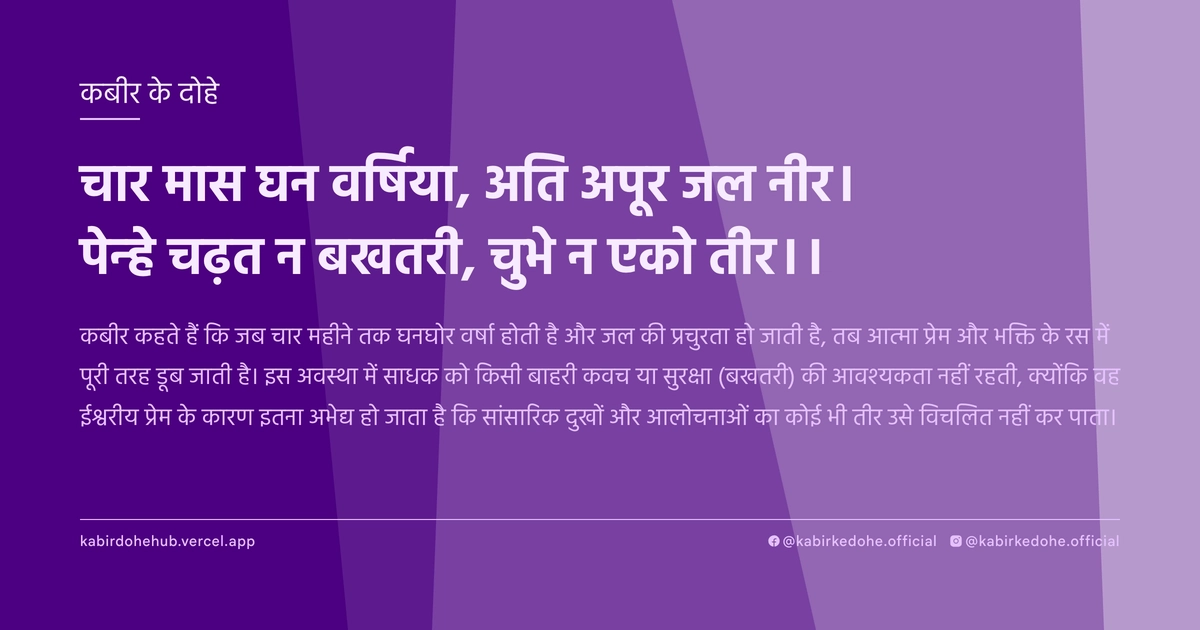
चार मास घन वर्षिया, अति अपूर जल नीर।
पेन्हे चढ़त न बखतरी, चुभे न एको तीर।।
Chaar maas ghan varshiya, ati apoor jal neer. Penhe chadhat na bakhtari, chubhe na eko teer.
इस पृष्ठ पर इस कबीर दोहे का अर्थ (meaning), हिंदी व्याख्या और अंग्रेज़ी अनुवाद, दार्शनिक विश्लेषण और व्यावहारिक जीवन सीख दी गई है। यह दोहा भक्ति (Bhakti) विषय से जुड़ा है — Kabir doha meaning and explanation in Hindi and English.
अर्थ (Meaning):
कबीर कहते हैं कि जब चार महीने तक घनघोर वर्षा होती है और जल की प्रचुरता हो जाती है, तब आत्मा प्रेम और भक्ति के रस में पूरी तरह डूब जाती है। इस अवस्था में साधक को किसी बाहरी कवच या सुरक्षा (बखतरी) की आवश्यकता नहीं रहती, क्योंकि वह ईश्वरीय प्रेम के कारण इतना अभेद्य हो जाता है कि सांसारिक दुखों और आलोचनाओं का कोई भी तीर उसे विचलित नहीं कर पाता।
Kabir describes a state where for four months, the clouds of divine grace pour down incessantly, flooding the soul with the waters of spiritual love. In this state of total immersion, the seeker no longer needs an external armor of ego or defense; they become so spiritually fortified by love that no arrow of worldly suffering, criticism, or desire can pierce their inner peace.
व्याख्या (Interpretation):
यहाँ 'चार मास' का अर्थ केवल समय नहीं, बल्कि साधना की एक गहन अवधि या पूर्णता का प्रतीक है। 'घन' और 'नीर' उस असीम कृपा और प्रेम का रूपक हैं जो साधक के अहंकार को धो डालते हैं। जब व्यक्ति निर्गुण भक्ति में लीन होता है, तो वह द्वैत से मुक्त होकर अद्वैत की स्थिति में पहुँच जाता है, जहाँ 'मैं' और 'तू' का भेद मिट जाता है। 'बखतरी' या कवच यहाँ अहंकार और सामाजिक पहचान का प्रतीक है, जिसे हम दुनिया से बचने के लिए पहनते हैं। लेकिन जब आत्मा ब्रह्म के साथ एकाकार होती है, तो वह स्वाभाविक रूप से अभेद्य हो जाती है। यह विरोधाभास है कि जब हम अपनी रक्षा के सारे साधन (अहंकार) त्याग देते हैं, तभी हम वास्तव में सुरक्षित होते हैं। यह स्थिति माया के प्रभाव को समाप्त कर देती है, जिससे संसार के कष्ट केवल लहरों की तरह लगते हैं जो गहराई को नहीं छू पातीं।
The 'four months' here do not merely denote a calendar period but symbolize a complete cycle of spiritual saturation or the peak of an initiatory experience. The 'clouds' and 'water' are metaphors for the torrential downpour of Divine Grace (Kripa) and Love (Prem) that washes away the calcified layers of the ego. In the path of Nirgun Bhakti, the seeker moves toward the formless absolute, dissolving the illusion of separation (Maya) and realizing the non-duality of Atman and Brahman. The 'bakhtari' or armor represents the psychological defenses, social masks, and the egoic identity we construct to protect ourselves from the world. Kabir presents a profound paradox: true invulnerability is achieved not by strengthening the armor, but by dissolving the self that needs protecting. When the soul is drenched in the nectar of the Infinite, it becomes a void—and an arrow cannot pierce a void. This is the state of Jivanmukti, where the world's arrows of grief and pleasure pass through the practitioner without leaving a scratch.
दार्शनिक विश्लेषण (Philosophical Analysis):
यह दोहा कबीर की उस क्रांतिकारी दृष्टि को दर्शाता है जहाँ वे बाहरी कर्मकांडों और सुरक्षात्मक ढोंगों को नकारते हैं। उनके समय में, लोग धर्म और जाति के नाम पर अपनी पहचान का 'कवच' पहनकर दूसरों से श्रेष्ठ महसूस करते थे। कबीर इसे एक भ्रम मानते हैं। वे बताते हैं कि वास्तविक सुरक्षा किसी बाहरी समूह या धार्मिक पहचान में नहीं, बल्कि आंतरिक रूपांतरण में है।
अद्वैत वेदांत के परिप्रेक्ष्य में, यह 'नीर' वह ज्ञान है जो अज्ञान की अग्नि को शांत करता है। जब साधक यह जान लेता है कि वह स्वयं ब्रह्म है, तो भय का कोई आधार नहीं बचता। भय वहीं होता है जहाँ 'दूसरा' होता है; जहाँ केवल एक ही तत्व है, वहाँ तीर चलाने वाला और तीर लगने वाला दोनों एक ही हो जाते हैं।
सूफी मत के 'फना' (अहंकार का विनाश) के सिद्धांत से यह गहराई से जुड़ा है। सूफीवाद में, जब प्रेमी अपने महबूब (ईश्वर) में पूरी तरह विलीन हो जाता है, तो उसकी अपनी स्वतंत्र सत्ता समाप्त हो जाती है। यह 'विलीनीकरण' ही वह कवच है जो उसे दुनिया की तकलीफों से मुक्त करता है।
मनोवैज्ञानिक स्तर पर, यह दोहा 'अटैचमेंट' (आसक्ति) के अंत की बात करता है। हम दुखी इसलिए होते हैं क्योंकि हम अपनी पहचान से चिपके रहते हैं। जब हम इस पहचान को 'प्रेम की वर्षा' में बहा देते हैं, तो हम मानसिक रूप से इतने लचीले और शांत हो जाते हैं कि बाहरी परिस्थितियाँ हमें प्रभावित नहीं करतीं।
कबीर यहाँ यह स्पष्ट कर रहे हैं कि भक्ति कोई शुष्क अनुशासन नहीं है, बल्कि एक भावनात्मक और आध्यात्मिक विसर्जन है। यह ritualism (कर्मकांड) के विरुद्ध एक सशक्त प्रहार है, क्योंकि कवच पहनना (दिखावा करना) आसान है, लेकिन स्वयं को प्रेम की वर्षा में भिगोना (समर्पण करना) कठिन है।
This Doha reflects Kabir's revolutionary stance against external rituals and the superficial protections of social identity. During his era, people wore the 'armor' of caste, creed, and religious orthodoxy to establish a sense of superiority and security. Kabir dismisses this as a futile exercise in illusion, asserting that true sanctuary is found only through internal transmutation.
From the lens of Advaita Vedanta, the 'water' symbolizes the torrential flow of Jnana (knowledge) that extinguishes the fire of Avidya (ignorance). When the seeker realizes the fundamental identity of the Atman with Brahman, the very foundation of fear collapses. Fear exists only where there is a perceived 'other'; in the state of absolute non-duality, the archer, the arrow, and the target merge into one single consciousness.
This aligns profoundly with the Sufi concept of 'Fana' (annihilation of the self). In Sufism, when the lover is completely consumed by the Beloved, the individual ego ceases to exist. This state of annihilation is the ultimate shield. If there is no 'I' to be wounded, no arrow of worldly sorrow can find a mark. The void becomes the strongest fortress.
Psychologically, Kabir is addressing the cessation of attachment. Human suffering is rooted in the desperate clinging to a curated self-image. By allowing the 'rain of love' to wash away this image, the practitioner achieves a state of equanimity (Samatva). The external world continues to fluctuate, but the internal core remains undisturbed, mirroring the depth of an ocean that is unaffected by the storms on its surface.
Ultimately, Kabir emphasizes that Bhakti is not a dry, disciplined adherence to rules, but an emotional and spiritual immersion. He critiques ritualism by contrasting the 'wearing of armor' (the act of performing religious identity) with the 'experience of rain' (the act of surrender). The former is an act of the ego; the latter is the death of the ego.
मूल संदेश (Core Message):
- अहंकार का कवच हमें सुरक्षा नहीं, बल्कि अलगाव देता है।
- प्रेम का पूर्ण विसर्जन ही वास्तविक अभेद्यता है।
- जब 'मैं' मिट जाता है, तो चोट लगने वाला कोई नहीं बचता।
- बाहरी ढोंगों को छोड़कर आंतरिक गहराई में उतरें।
- शांति वह शक्ति है जिसे कोई भी हथियार नहीं तोड़ सकता।
- The armor of ego provides not security, but isolation.
- Total immersion in love is the only true invulnerability.
- When the 'I' vanishes, there is no one left to be wounded.
- Abandon external pretenses to dive into internal depths.
- Peace is a power that no weapon can ever shatter.
व्यावहारिक उदाहरण (Practical Example):
वाराणसी के एक पुराने घाट पर रहने वाले माधव नाम के एक वृद्ध बुनकर थे। माधव जीवन भर अपनी कला में निपुण रहे, लेकिन उनका स्वभाव बहुत क्रोधी था। वे अपनी सामाजिक प्रतिष्ठा और अपनी 'शुद्धता' के कवच को लेकर बहुत संजीदा थे। यदि कोई उनकी जाति का या उनके काम का अनादर करता, तो वे घंटों तक क्रोध में जलते रहते। उनके लिए उनका अहंकार ही उनकी 'बखतरी' थी, जिसे पहनकर वे दुनिया का सामना करते थे।
एक दिन उनकी मुलाकात एक फकीर से हुई, जिसने उन्हें केवल एक बात कही—'माधव, तूने रेशम के धागों से कपड़ा तो बुना, लेकिन अपने मन के धागों को प्रेम में नहीं रंगा। तू कवच पहनकर लड़ रहा है, जबकि जीत तो सरेंडर (समर्पण) में है।'
माधव ने इस बात पर विचार किया और धीरे-धीरे ध्यान और निस्वार्थ सेवा का मार्ग अपनाया। उन्होंने अपने भीतर के क्रोध को ईश्वरीय प्रेम की वर्षा में बहाना शुरू किया। उन्होंने महसूस किया कि जब वे खुद को 'बड़ा बुनकर' या 'उच्च कुल का' मानना छोड़ देते हैं, तो लोगों की बातें उन्हें चुभना बंद हो जाती हैं।
एक समय ऐसा आया जब शहर के कुछ प्रभावशाली लोगों ने उनकी छोटी सी दुकान को हटाने के लिए उन पर दबाव डाला और उन्हें बहुत भला-बुरा कहा। पहले का माधव चिल्लाता और लड़ता, लेकिन अब वह शांत था।
उसके भीतर प्रेम की वह 'वर्षा' हो चुकी थी जिसने उसके अहंकार की कठोर परत को पिघला दिया था। वह मुस्कुराकर उनकी बातें सुनता रहा। उसकी शांति देखकर सामने वाले का क्रोध धीरे-धीरे शांत होने लगा।
उन्हें लगा कि माधव के पास कोई ऐसा गुप्त कवच है जो उन्हें अभेद्य बना रहा है, जबकि वास्तव में माधव ने कवच उतार फेंका था।
उसने पाया कि जब उसने अपनी पहचान का मोह छोड़ दिया, तो दुनिया का कोई भी शब्द उसे चोट नहीं पहुँचा सका।
उसकी आँखों में अब क्रोध नहीं, बल्कि एक असीम करुणा थी।
माधव अब केवल कपड़े नहीं बुनता था, बल्कि वह प्रेम के धागों से लोगों के दिलों को जोड़ रहा था।
यह 'कबीर ट्विस्ट' था—सुरक्षा कवच को त्यागने के बाद ही वह वास्तव में सुरक्षित हो गया।
In the ancient alleys of Varanasi lived an elderly weaver named Madhav. Madhav was a master of his craft, but his heart was heavy with anger and pride. He was deeply attached to his social standing and the 'purity' of his lineage. For him, this identity was his 'bakhtari' (armor), which he wore proudly to shield himself from the perceived insignificance of others. Any slight to his status would leave him simmering in rage for days.
One afternoon, he encountered a wandering Sufi mystic who looked at him and said, 'Madhav, you have woven exquisite silk with your hands, but you have failed to dye the threads of your soul in the color of love. You are fighting the world with armor, not realizing that the only true victory lies in surrender.'
These words haunted Madhav. He began a journey of self-inquiry and selfless service, attempting to wash away his rigid ego in the 'rain' of divine love. He started practicing the art of seeing the Divine in everyone, regardless of their caste or status. He realized that his anger was merely a reaction to the fear of losing his imagined importance.
Months later, a group of influential landlords attempted to seize the small piece of land where his loom stood. They insulted him, mocked his poverty, and threatened him with power. The old Madhav would have screamed, fought, and been consumed by bitterness.
But the new Madhav remained profoundly still. The 'rain' of love had dissolved the hard shell of his ego. He listened to their insults with a gentle smile, feeling no sting, no wound, and no urge to defend himself.
The landlords were baffled. They felt as if Madhav was wearing an invisible, impenetrable shield that deflected every verbal arrow they fired. They didn't realize that he had simply discarded the armor altogether.
By letting go of the need to be 'someone' in the eyes of the world, he became untouchable by the world's malice.
His silence was more powerful than any argument, and his peace more intimidating than any weapon.
Eventually, the landlords themselves felt a strange sense of shame in the presence of such undisturbed grace and backed away from their demands.
Madhav had discovered the Kabir Twist: by abandoning the armor of the ego, he had attained a state of invulnerability that no armor could ever provide.
अभ्यास मार्गदर्शन (Practice Guidance):
- प्रतिदिन 20 मिनट 'शून्य ध्यान' का अभ्यास करें, जहाँ आप कल्पना करें कि ईश्वरीय प्रेम की वर्षा आपके अहंकार की परतों को धो रही है।
- एक 'अहंकार डायरी' बनाएँ। जब भी आपको किसी की बात बुरी लगे, लिखें कि आपके भीतर का कौन सा 'कवच' (पहचान) चोटिल हुआ है।
- सचेत व्यवहार परिवर्तन: दिन में कम से कम एक बार ऐसी स्थिति में जाएँ जहाँ आप अपनी बात मनवाने के बजाय सामने वाले की बात को शांति से स्वीकार करें।
- डायग्नोस्टिक चेकलिस्ट: क्या मैं अभी भी अपनी सामाजिक स्थिति या उपलब्धियों के आधार पर अपनी सुरक्षा महसूस करता हूँ? क्या दूसरों की आलोचना मुझे विचलित करती है? यदि हाँ, तो कवच अभी भी मौजूद है।
- Practice 20 minutes of 'Sunya Meditation' daily, visualizing a torrential rain of divine love washing away the calcified layers of your ego.
- Maintain an 'Ego Journal'. Whenever you feel offended or hurt, record which specific 'armor' (identity/label) was struck by the arrow of criticism.
- Conscious Behavioral Shift: Once a day, intentionally choose not to defend your image or opinion in a conflict, practicing the art of spiritual surrender.
- Diagnostic Checklist: Do I still derive my sense of security from social status or achievements? Does external criticism disturb my inner equilibrium? If yes, the armor is still present.
चिंतन प्रश्न (Reflection Questions):
- वह कौन सी सामाजिक या पेशेवर पहचान है जिसे मैं अपना 'कवच' मानता हूँ और जिसके खोने के डर से मैं जीता हूँ?
- क्या मेरी विनम्रता वास्तव में समर्पण है, या यह केवल दूसरों को प्रभावित करने का एक परिष्कृत कवच है?
- जब कोई मेरी छवि को खंडित करता है, तो मुझे दुख क्यों होता है? वह 'छवि' वास्तव में कौन है?
- क्या मैं प्रेम की वर्षा में भीगने के लिए तैयार हूँ, या मैं अपनी शुष्कता और कठोरता में अधिक सुरक्षित महसूस करता हूँ?
- मेरे जीवन का वह कौन सा क्षेत्र है जहाँ मैं अभी भी 'तीरों' से बचने के लिए संघर्ष कर रहा हूँ, बजाय इसके कि मैं स्वयं शून्य हो जाऊँ?
- What social or professional identity do I treat as my 'armor,' and what fear drives my need to protect it?
- Is my humility a genuine surrender, or is it merely a sophisticated armor designed to elicit admiration?
- Why do I feel pain when my public image is tarnished? Who is the 'I' that is actually being hurt?
- Am I truly willing to be drenched in the rain of love, or do I feel safer in my dryness and rigidity?
- In which area of my life am I still struggling to dodge 'arrows,' rather than becoming the void through which they pass?