
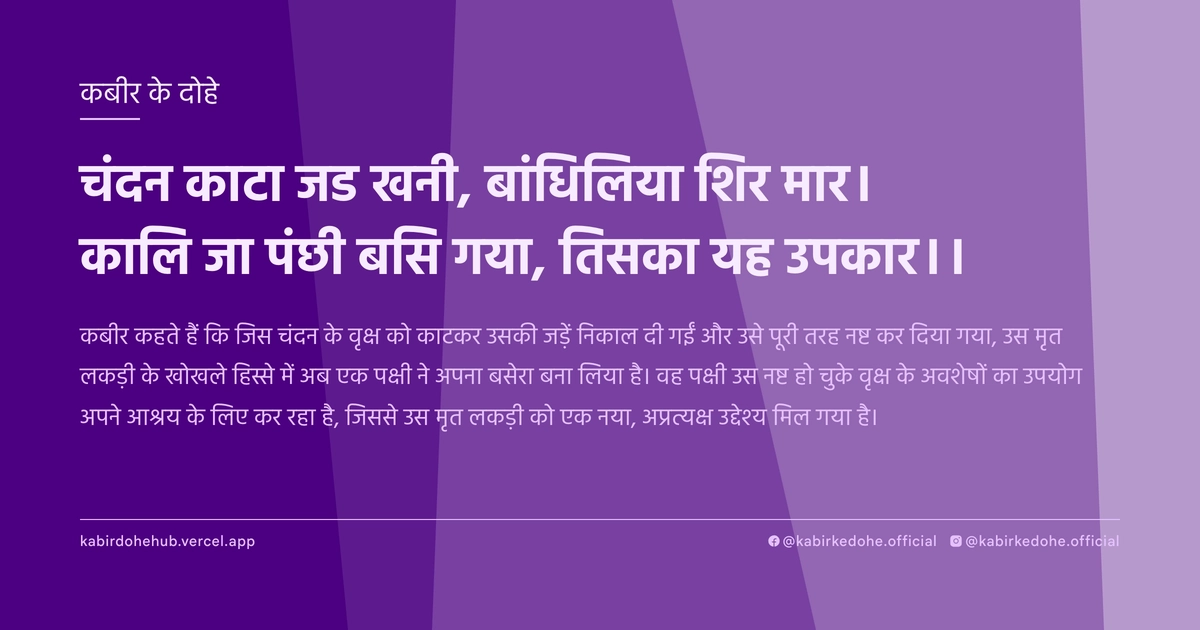
चंदन काटा जड खनी, बांधिलिया शिर मार।
कालि जा पंछी बसि गया, तिसका यह उपकार।।
Chandan kaata jad khani, baandhiliya shir maar. Kaali ja panchhi basi gaya, tiska yeh upkaar.
इस पृष्ठ पर इस कबीर दोहे का अर्थ (meaning), हिंदी व्याख्या और अंग्रेज़ी अनुवाद, दार्शनिक विश्लेषण और व्यावहारिक जीवन सीख दी गई है। यह दोहा मुक्ति (Liberation) विषय से जुड़ा है — Kabir doha meaning and explanation in Hindi and English.
अर्थ (Meaning):
कबीर कहते हैं कि जिस चंदन के वृक्ष को काटकर उसकी जड़ें निकाल दी गईं और उसे पूरी तरह नष्ट कर दिया गया, उस मृत लकड़ी के खोखले हिस्से में अब एक पक्षी ने अपना बसेरा बना लिया है। वह पक्षी उस नष्ट हो चुके वृक्ष के अवशेषों का उपयोग अपने आश्रय के लिए कर रहा है, जिससे उस मृत लकड़ी को एक नया, अप्रत्यक्ष उद्देश्य मिल गया है।
Kabir describes a sandalwood tree that has been felled, its roots ripped from the earth, and its life extinguished. However, a bird has now come to dwell within the hollow of this dead wood. The bird utilizes the remains of the destroyed tree for its shelter, thereby granting a renewed, indirect purpose to the lifeless sandalwood.
व्याख्या (Interpretation):
यह दोहा भौतिक विनाश और आध्यात्मिक पुनर्जन्म के बीच के विरोधाभास को दर्शाता है। 'चंदन' यहाँ शुद्ध चेतना या आत्मा का प्रतीक है, जिसे 'माया' और सांसारिक मोह-माया के प्रहारों ने काट दिया है। 'जड़ खनी' का अर्थ है अहंकार का पूर्ण विनाश। जब मनुष्य का अहंकार पूरी तरह नष्ट हो जाता है, तब वह एक खाली पात्र (खोखला वृक्ष) बन जाता है। यही वह अवस्था है जहाँ 'पंछी' यानी परमात्मा या ईश्वरीय ऊर्जा निवास करती है। यह निर्गुण भक्ति का सार है: जब तक 'मैं' (अहंकार) जीवित है, तब तक ईश्वर नहीं आ सकते; जब 'मैं' मर जाता है, तब परमात्मा का वास होता है। यह अद्वैत वेदांत के उस सिद्धांत को पुष्ट करता है जहाँ आत्मा और ब्रह्म का मिलन केवल तब संभव है जब व्यक्तिगत पहचान का विलोपन हो जाए।
This couplet illustrates the paradox between physical destruction and spiritual rebirth. The 'Sandalwood' symbolizes pure consciousness or the soul, which has been felled by the strikes of 'Maya' and worldly attachments. 'Jad khani' refers to the total eradication of the ego. When a human's ego is completely annihilated, they become an empty vessel (the hollow tree). This is the precise state where the 'Bird'—representing the Divine or Universal Energy—finds a dwelling. This is the essence of Nirgun Bhakti: as long as the 'I' (ego) exists, the Divine cannot enter; only when the 'I' dies does God reside. It reinforces the Advaita Vedanta principle that the union of Atman and Brahman is possible only through the dissolution of the individual identity.
दार्शनिक विश्लेषण (Philosophical Analysis):
कबीर का यह दृष्टिकोण उनके युग के कर्मकांडीय आडंबरों पर एक गहरा प्रहार है। उस समय धर्म का अर्थ केवल बाहरी अनुष्ठानों और तीर्थयात्राओं तक सीमित था, जबकि कबीर 'आंतरिक शून्यता' की बात करते हैं। वे तर्क देते हैं कि ईश्वर को पाने के लिए किसी मंदिर या मस्जिद की आवश्यकता नहीं है, बल्कि स्वयं के भीतर के 'अहंकार रूपी वृक्ष' को काटना आवश्यक है।
दार्शनिक स्तर पर, यह सूफीवाद के 'फना' (Fana) के सिद्धांत से मेल खाता है, जहाँ साधक अपनी व्यक्तिगत इच्छाओं और अस्तित्व को ईश्वर की इच्छा में विलीन कर देता है। जब व्यक्ति स्वयं को शून्य कर लेता है, तो वह ब्रह्मांडीय चेतना के लिए एक माध्यम बन जाता है। यहाँ 'चंदन' की सुगंध अभी भी शेष है, जो यह दर्शाती है कि आत्मा का मूल स्वभाव पवित्र है, चाहे शरीर या अहंकार कितना भी खंडित क्यों न हो।
अद्वैत वेदांत के अनुसार, हम वास्तव में ब्रह्म हैं, लेकिन अविद्या (अज्ञान) के कारण हम खुद को शरीर और मन समझते हैं। कबीर इस अविद्या को 'काटने' की बात कर रहे हैं। यह प्रक्रिया दर्दनाक हो सकती है—जैसे जड़ को उखाड़ना—लेकिन यह एकमात्र मार्ग है जिससे सत्य का अनुभव किया जा सकता है।
कबीर यहाँ यह भी समझाते हैं कि जिसे दुनिया 'विनाश' समझती है (वृक्ष का कटना), वह वास्तव में 'मुक्ति' की शुरुआत है। जब हम अपनी सामाजिक पहचान, पद और प्रतिष्ठा के मोह को त्याग देते हैं, तब हम वास्तव में उपयोगी होते हैं, क्योंकि हम दूसरों के लिए आश्रय और प्रेम का स्रोत बन जाते हैं।
अंततः, यह दोहा हमें सिखाता है कि आध्यात्मिक उपलब्धि का अर्थ कुछ 'प्राप्त' करना नहीं, बल्कि सब कुछ 'खो' देना है। जब हम पूरी तरह रिक्त हो जाते हैं, तब हम पूर्ण हो जाते हैं। यह शून्यता ही वह स्थान है जहाँ परमात्मा का संगीत गूँजता है।
Kabir's perspective is a profound critique of the ritualistic pomposity of his era. At that time, religion was confined to external rituals and pilgrimages, whereas Kabir spoke of 'internal emptiness.' He argues that reaching the Divine requires no temple or mosque, but rather the 'felling of the ego-tree' within oneself.
Philosophically, this aligns with the Sufi concept of 'Fana' (annihilation), where the seeker dissolves their personal desires and existence into the will of God. When an individual renders themselves void, they become a medium for cosmic consciousness. The fragrance of the 'Sandalwood' still lingers, signifying that the soul's fundamental nature is pure, regardless of how fragmented the body or ego may be.
According to Advaita Vedanta, we are essentially Brahman, but due to Avidya (ignorance), we mistake ourselves for the body and mind. Kabir speaks of 'cutting' this ignorance. This process can be painful—like ripping out roots—but it is the only path to experiencing the Truth.
Kabir further explains that what the world perceives as 'destruction' (the felling of the tree) is actually the beginning of 'liberation.' When we relinquish the attachment to social identity, status, and prestige, we truly become useful, serving as a sanctuary of love and shelter for others.
Ultimately, this couplet teaches us that spiritual achievement is not about 'acquiring' something, but about 'losing' everything. When we become completely empty, we become full. This void is the only space where the music of the Divine can resonate.
मूल संदेश (Core Message):
- अहंकार का विनाश ही वास्तविक आध्यात्मिक उदय है।
- जब 'मैं' मिटता है, तभी 'वह' (परमात्मा) प्रकट होता है।
- बाहरी नष्टि अक्सर आंतरिक मुक्ति का द्वार होती है।
- शून्यता कोई अभाव नहीं, बल्कि पूर्णता की पूर्व शर्त है।
- सच्ची सेवा वहीं संभव है जहाँ सेवा करने वाला मिट चुका हो।
- The annihilation of ego is the only true spiritual awakening.
- Only when the 'I' vanishes does the 'Divine' manifest.
- External destruction is often the gateway to internal liberation.
- Emptiness is not a lack, but a prerequisite for wholeness.
- True service is possible only when the server has ceased to exist.
व्यावहारिक उदाहरण (Practical Example):
वाराणसी के घाटों पर रहने वाले एक वृद्ध विधवा, जानकी, की कहानी है। जानकी ने अपना पूरा जीवन कठोर नियमों, सामाजिक दबावों और अपने परिवार की उम्मीदों को पूरा करने में बिता दिया था। वह मानती थी कि उसकी पहचान केवल उसकी तपस्या और उसके दुखों से है। वह एक 'पवित्र' छवि बनाए रखने के लिए संघर्ष करती रही, जिससे उसका मन अहंकार और कड़वाहट से भर गया।
एक दिन, एक भीषण बाढ़ आई जिसने उसकी छोटी सी झोपड़ी और उसकी सारी जमा-पूंजी बहा ले गई। वह सड़क पर आ गई, उसके पास न रहने को घर था और न ही वह सामाजिक सम्मान जिसे उसने सालों से संजोया था। वह पूरी तरह टूट चुकी थी, जैसे कोई कटा हुआ चंदन का पेड़ हो जिसकी जड़ें उखड़ गई हों।
शुरुआत में वह विलाप करती रही, लेकिन धीरे-धीरे उसे महसूस हुआ कि जब उसके पास खोने के लिए कुछ नहीं बचा, तो उसके मन का वह भारी बोझ भी उतर गया जिसने उसे सालों से जकड़ा हुआ था। उसकी 'पहचान' का अहंकार नष्ट हो गया था।
अब वह घाट पर चुपचाप बैठती और आने-जाने वाले दुखी लोगों की बातें सुनती। वह उन्हें कोई उपदेश नहीं देती थी, बस उनकी पीड़ा में उनके साथ बैठती थी।
शहर के लोग, जो पहले उसकी 'पवित्रता' से डरते थे, अब उसके पास सुकून पाने आते थे। वह एक ऐसा आश्रय बन गई थी जहाँ हर कोई अपना दर्द साझा कर सकता था।
उसकी आंतरिक शून्यता ने उसे दूसरों के लिए एक खुला द्वार बना दिया था। वह अब केवल एक विधवा नहीं थी, बल्कि करुणा का एक जीवित स्रोत थी।
उसने महसूस किया कि जब तक वह अपनी 'मर्यादा' और 'अहंकार' के वृक्ष को पकड़े हुए थी, वह दूसरों के लिए अनुपयोगी थी।
लेकिन जब वह 'नष्ट' हो गई, तब वह वास्तव में सबके काम आने लगी। यही कबीर का वह 'उपकार' था, जहाँ विनाश ही वास्तव में सृजन का मार्ग बन गया।
This is the story of Janaki, an elderly widow living on the ghats of Varanasi. Janaki had spent her entire life adhering to rigid rules, social pressures, and the expectations of her family. She believed her identity was defined solely by her austerity and her suffering. She struggled to maintain an image of 'purity,' which filled her mind with ego and bitterness.
One day, a devastating flood swept away her small hut and all her meager savings. She was left on the street, with neither a home to live in nor the social respect she had cherished for years. She was completely broken, like a felled sandalwood tree whose roots had been ripped out.
Initially, she wailed in grief, but gradually she realized that when she had nothing left to lose, the heavy burden of identity that had gripped her for years also vanished. The ego of her 'status' was annihilated.
She began to sit quietly on the ghats, listening to the stories of the grieving people who passed by. She gave no sermons; she simply sat with them in their pain.
People from the city, who once feared her 'purity,' now came to her for peace. She became a sanctuary where anyone could share their sorrow.
Her internal emptiness had turned her into an open door for others. She was no longer just a widow, but a living source of compassion.
She realized that as long as she clung to the tree of her 'dignity' and 'ego,' she was useless to others.
But when she was 'destroyed,' she truly became useful to everyone. This was Kabir's 'upkaar' (benefit), where destruction became the path to true creation.
अभ्यास मार्गदर्शन (Practice Guidance):
- दैनिक आत्म-निरीक्षण: प्रतिदिन 20 मिनट मौन बैठें और विचार करें कि आपकी कौन सी 'पहचान' (जैसे पद, धर्म, या छवि) आपको दूसरों से अलग करती है। उस पहचान को मानसिक रूप से 'काटने' का अभ्यास करें।
- शून्यता का लेखन: एक डायरी लिखें जिसमें आप उन चीजों की सूची बनाएं जिन्हें आप 'अपना' कहते हैं। फिर उनके सामने लिखें कि यदि ये सब छीन लिए जाएं, तो आपके भीतर क्या बचेगा।
- सेवा का अभ्यास: किसी ऐसे व्यक्ति की मदद करें जिससे आपका कोई संबंध न हो और बदले में किसी पहचान या प्रशंसा की इच्छा न रखें। यह 'अहंकार विहीन' सेवा होनी चाहिए।
- डायग्नोस्टिक चेकलिस्ट: क्या आप किसी की आलोचना करते समय श्रेष्ठ महसूस करते हैं? क्या आप अपनी उपलब्धियों का श्रेय स्वयं लेते हैं? यदि हाँ, तो आपका 'अहंकार वृक्ष' अभी भी खड़ा है। यदि आप दूसरों के दुख में बिना किसी निर्णय के लीन हो पाते हैं, तो आप शून्यता की ओर बढ़ रहे हैं।
- Daily Self-Inquiry: Sit in silence for 20 minutes daily and contemplate which 'identities' (such as status, religion, or image) separate you from others. Practice mentally 'felling' those identities.
- Writing the Void: Keep a journal listing everything you call 'mine.' Then, write beside each item what would remain within you if all these were taken away.
- Practice of Selfless Service: Help someone with whom you have no connection, without desiring any recognition or praise. This must be 'ego-less' service.
- Diagnostic Checklist: Do you feel superior while criticizing someone? Do you take sole credit for your achievements? If yes, your 'ego-tree' is still standing. If you can immerse yourself in others' pain without judgment, you are moving toward the void.
चिंतन प्रश्न (Reflection Questions):
- यदि आपकी सामाजिक प्रतिष्ठा और डिजिटल पहचान (Social Media Image) आज पूरी तरह मिट जाए, तो आप स्वयं को कैसे परिभाषित करेंगे?
- क्या आप वास्तव में दूसरों की मदद करते हैं, या आप उस 'मदद करने वाले' की छवि से प्रेम करते हैं?
- आपके जीवन का वह कौन सा 'पवित्र' विश्वास है जो वास्तव में आपके विकास में बाधा बन रहा है?
- क्या आप अपनी विफलताओं को 'विनाश' मानते हैं या 'शून्यता' की ओर एक कदम?
- आपकी आत्मा की वह कौन सी सुगंध है जो आपके अहंकार के गिरने के बाद भी शेष रहेगी?
- If your social prestige and digital identity were completely erased today, how would you define yourself?
- Do you truly help others, or are you in love with the image of being 'the helper'?
- Which 'sacred' belief in your life is actually acting as an obstacle to your growth?
- Do you perceive your failures as 'destruction' or as a step toward 'emptiness'?
- What is that fragrance of your soul that will remain even after your ego has fallen?