
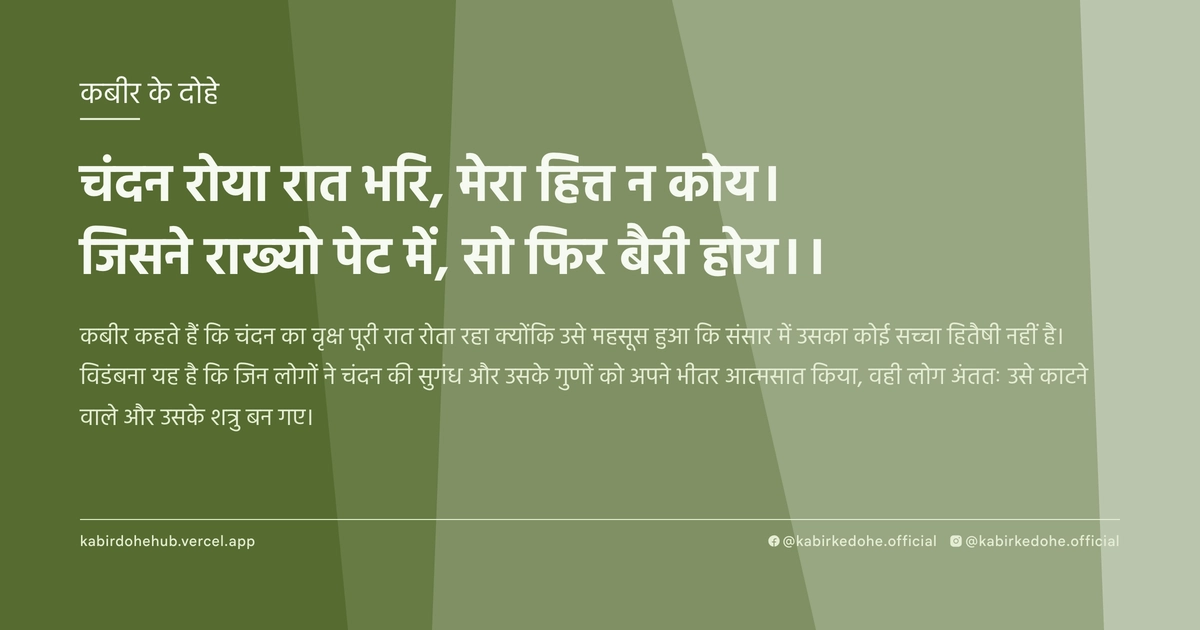
चंदन रोया रात भरि, मेरा हित्त न कोय।
जिसने राख्यो पेट में, सो फिर बैरी होय।।
Chandan roya raat bhari, mera hitt na koy. Jisne raakhyo pet me, so phir bairi hoye.
इस पृष्ठ पर इस कबीर दोहे का अर्थ (meaning), हिंदी व्याख्या और अंग्रेज़ी अनुवाद, दार्शनिक विश्लेषण और व्यावहारिक जीवन सीख दी गई है। यह दोहा आत्मा और शरीर (Soul and Body) विषय से जुड़ा है — Kabir doha meaning and explanation in Hindi and English.
अर्थ (Meaning):
कबीर कहते हैं कि चंदन का वृक्ष पूरी रात रोता रहा क्योंकि उसे महसूस हुआ कि संसार में उसका कोई सच्चा हितैषी नहीं है। विडंबना यह है कि जिन लोगों ने चंदन की सुगंध और उसके गुणों को अपने भीतर आत्मसात किया, वही लोग अंततः उसे काटने वाले और उसके शत्रु बन गए।
Kabir observes that the sandalwood tree wept throughout the night, realizing it had no true well-wishers. The profound irony lies in the fact that those who cherished its fragrance and absorbed its essence into their very being were the same ones who eventually became its enemies by cutting it down.
व्याख्या (Interpretation):
यह दोहा प्रतीकात्मक रूप से उस आध्यात्मिक विडंबना को दर्शाता है जहाँ व्यक्ति की अच्छाई ही उसके विनाश का कारण बनती है। चंदन यहाँ 'साधक' या 'परमात्मा' का प्रतीक है, जिसकी निस्वार्थ सेवा और सुगंध सबको आकर्षित करती है। 'पेट में रखना' केवल भौतिक उपभोग नहीं, बल्कि उस गुण के प्रति आसक्ति को दर्शाता है। यह निरगुण भक्ति के उस पहलू को उजागर करता है जहाँ माया संसार केवल बाहरी आकर्षणों को देखता है, आंतरिक सत्य को नहीं। जब अहंकार (Maya) हावी होता है, तो वह उस स्रोत को ही नष्ट कर देता है जिससे वह पोषण पा रहा था। यह आत्मा और ब्रह्म के द्वैत की त्रासदी है, जहाँ अज्ञानी व्यक्ति उस ईश्वर को ही खोजता है जिसे वह अपने भीतर नष्ट कर चुका है।
This couplet symbolically portrays the spiritual irony where a being's own virtue becomes the catalyst for its destruction. Sandalwood represents the 'Seeker' or the 'Divine', whose selfless service and fragrance attract all. 'Keeping it in the stomach' refers not just to physical consumption, but to an attachment to the quality without understanding the source. It highlights a facet of Nirgun Bhakti where the world of Maya perceives only external attractions, ignoring the internal truth. When the ego dominates, it destroys the very source from which it derives nourishment. This is the tragedy of the duality between Atman and Brahman, where the ignorant search for a God they have already annihilated within themselves.
दार्शनिक विश्लेषण (Philosophical Analysis):
कबीर का यह दोहा मध्यकालीन भारत के सामाजिक और धार्मिक पाखंड पर एक तीखा प्रहार है। वे यहाँ उस विडंबना को रेखांकित करते हैं जहाँ समाज उन लोगों का शोषण करता है जो सबसे अधिक उदार होते हैं। दार्शनिक स्तर पर, यह अद्वैत वेदांत के उस सिद्धांत से जुड़ा है जहाँ जीव अपनी अज्ञानता के कारण अपने ही वास्तविक स्वरूप (ब्रह्म) को पहचान नहीं पाता और उसे बाहरी दुनिया के लाभ के लिए नष्ट कर देता है।
सूफी मत के संदर्भ में, यह 'इश्क-ए-हकीकी' (ईश्वरीय प्रेम) और 'इश्क-ए-मजाजी' (सांसारिक प्रेम) के बीच के संघर्ष को दर्शाता है। लोग चंदन की सुगंध (मायावी सुख) से प्रेम करते हैं, लेकिन उस सुगंध के स्रोत (परमात्मा) की रक्षा नहीं करते। यह अहंकार के उस सूक्ष्म जाल को दर्शाता है जहाँ व्यक्ति जिसे पूजता है, अंततः उसी का उपभोग कर उसे समाप्त कर देता है।
कबीर कर्मकांडों और बाहरी दिखावे का विरोध करते हैं। वे समझाते हैं कि यदि आपका धर्म केवल लाभ उठाने तक सीमित है, तो वह धर्म नहीं, बल्कि स्वार्थ है। यहाँ 'बैरी' (शत्रु) वह है जो कृतज्ञता को भूल चुका है। यह मनोवैज्ञानिक परिवर्तन की मांग करता है जहाँ व्यक्ति 'उपभोक्ता' से 'संरक्षक' बने।
यह दोहा यह भी संकेत देता है कि आध्यात्मिक मार्ग पर चलने वाले साधक को अक्सर अकेलेपन और विश्वासघात का सामना करना पड़ता है। जब कोई व्यक्ति समाज को बिना शर्त प्रेम देता है, तो समाज अक्सर उस प्रेम को कमजोरी समझकर उसका लाभ उठाता है। यह 'शून्य' की स्थिति है जहाँ साधक को यह समझ आता है कि बाहरी दुनिया में कोई स्थायी सहारा नहीं है।
अंततः, कबीर हमें चेतावनी देते हैं कि हम अपनी चेतना को केवल बाहरी सुगंधों तक सीमित न रखें। यदि हम केवल फल की इच्छा रखते हैं और वृक्ष की जड़ों की उपेक्षा करते हैं, तो हम आध्यात्मिक रूप से अंधे हैं। यह दोहा हमें आत्म-साक्षात्कार की ओर ले जाता है, जहाँ हम यह पहचान सकें कि हमारा असली शत्रु बाहर नहीं, बल्कि हमारे भीतर का वह लालच है जो हमें अपने ही स्रोत से अलग करता है।
Kabir's couplet is a sharp critique of the social and religious hypocrisy of medieval India. He underscores the irony where society exploits those who are most generous. Philosophically, this aligns with Advaita Vedanta, where the individual, blinded by ignorance (Avidya), fails to recognize their true nature (Brahman) and destroys it for the sake of worldly gains.
In the context of Sufism, this reflects the conflict between 'Ishq-e-Haqiqi' (Divine Love) and 'Ishq-e-Majazi' (Worldly Love). People love the fragrance of sandalwood (illusory pleasure) but fail to protect the source of that fragrance (the Divine). This illustrates the subtle trap of the ego, where a person loves a quality but destroys the entity possessing it.
Kabir rejects ritualism and superficial piety. He explains that if one's faith is limited to extraction and benefit, it is not spirituality but selfishness. The 'enemy' here is the one who has forgotten gratitude. This calls for a psychological transformation from being a 'consumer' to becoming a 'protector'.
The verse also suggests that those on the spiritual path often encounter profound loneliness and betrayal. When a seeker offers unconditional love to society, the world often perceives that love as weakness and exploits it. This is the state of 'Shunya' (void), where the seeker realizes there is no permanent external support.
Ultimately, Kabir warns us not to limit our consciousness to external fragrances. If we desire only the fruit while neglecting the roots of the tree, we are spiritually blind. This couplet leads us toward self-realization, urging us to recognize that our true enemy is not outside, but the greed within that separates us from our own source.
मूल संदेश (Core Message):
- बाहरी प्रशंसा एक भ्रम है जो अहंकार को पोषित करती है।
- सच्ची उदारता वह है जिसमें प्रतिफल की कोई इच्छा न हो।
- दुनिया गुणों का उपभोग करती है, लेकिन गुणवान का सम्मान कम ही करती है।
- अपनी शांति का आधार दूसरों की प्रतिक्रियाओं को न बनने दें।
- जब आप स्वयं में पूर्ण होते हैं, तो बाहरी शत्रुता अर्थहीन हो जाती है।
- आत्मा की सुगंध बाहरी परिस्थितियों से स्वतंत्र और शाश्वत है।
- External praise is an illusion that feeds the ego.
- True generosity is that which harbors no desire for reward.
- The world consumes virtues but rarely honors the virtuous.
- Do not let the reactions of others be the foundation of your peace.
- When you are complete within yourself, external enmity becomes meaningless.
- The fragrance of the soul is eternal and independent of external circumstances.
व्यावहारिक उदाहरण (Practical Example):
राजस्थान के एक छोटे से गाँव में रामू नाम का एक वृद्ध कुम्हार रहता था। वह अपनी मिट्टी की कलाकृतियों में इतनी ईमानदारी और प्रेम डालता था कि उसके बर्तन न केवल सुंदर थे, बल्कि उनमें एक अजीब सी शांति थी। गाँव के लोग उसकी कला की प्रशंसा करते थे और उसके बर्तनों को अपनी शान मानते थे।
रामू ने अपनी पूरी उम्र गाँव वालों की मदद करने में बिता दी। उसने कई गरीब परिवारों को मुफ्त में बर्तन दिए और अपनी कला का ज्ञान बिना किसी शुल्क के युवाओं को सिखाया। वह एक चंदन के वृक्ष की तरह था, जिसकी उदारता की सुगंध पूरे क्षेत्र में फैली हुई थी।
समय बदला और गाँव में एक बड़ा शहर विकसित होने लगा। कुछ नए व्यापारियों ने देखा कि रामू की कला की मांग शहर में बहुत अधिक है। उन्होंने रामू को लालच दिया कि वे उसके काम को बड़े स्तर पर ले जाएंगे, लेकिन बदले में उन्होंने उसकी कार्यप्रणाली को पूरी तरह बदल दिया।
उन्होंने रामू से कहा कि वह अब कला के लिए नहीं, बल्कि केवल मुनाफे के लिए काम करे। उन्होंने उसे मशीनों का उपयोग करने के लिए मजबूर किया और उसकी उस मौलिकता को छीन लिया जिसने उसे विशेष बनाया था। रामू ने विरोध किया, तो उन लोगों ने उसे उसके ही घर और चाक से बेदखल कर दिया।
जिन लोगों ने रामू की कला का गुणगान किया था, वही अब उसके खिलाफ खड़े थे क्योंकि वह उनके व्यावसायिक लाभ के रास्ते में आ रहा था। रामू ने महसूस किया कि लोग उसकी 'सुगंध' (कला) से प्यार करते थे, लेकिन उस 'वृक्ष' (कलाकार) की परवाह किसी को नहीं थी।
एक रात, अपनी टूटी हुई झोपड़ी में बैठे रामू को कबीर का यह दोहा याद आया। उसे समझ आया कि उसकी पीड़ा का कारण यह नहीं था कि लोग बुरे थे, बल्कि यह कि उसने अपनी पहचान दूसरों की प्रशंसा में खोज ली थी।
इस 'कबीर ट्विस्ट' ने रामू को पूरी तरह बदल दिया। उसने अब दूसरों के लिए नहीं, बल्कि अपनी आत्मा की संतुष्टि के लिए मिट्टी को छूना शुरू किया। उसने अपनी कला को बाजार से हटाकर एक साधना बना लिया।
अब वह बर्तन नहीं बनाता था, बल्कि मिट्टी के माध्यम से ध्यान करता था। जब उसने बाहरी अपेक्षाओं को त्याग दिया, तो उसकी कला में एक ऐसी दिव्यता आई कि लोग फिर से उसके पास आए, लेकिन इस बार वे लाभ के लिए नहीं, बल्कि शांति की खोज में आए।
रामू ने सीखा कि जब आप स्वयं को स्रोत के रूप में पहचान लेते हैं, तो बाहरी दुनिया का 'बैरी' होना आपको विचलित नहीं करता। उसने अपनी आंतरिक शांति को बाहरी प्रशंसा से ऊपर रखा और वास्तव में मुक्त हो गया।
उसकी कहानी यह सिखाती है कि निस्वार्थता का मार्ग कठिन है, लेकिन जब आप अपनी खुशी को दूसरों की स्वीकृति से अलग कर लेते हैं, तब आप वास्तव में चंदन की तरह सुगंधित होते हैं, चाहे दुनिया आपको काटे या बचाए।
In a small village in Rajasthan lived an elderly potter named Ramu. He poured such honesty and love into his clay creations that his pots were not only beautiful but radiated a strange sense of peace. The villagers praised his art and considered his pottery a symbol of prestige.
Ramu spent his entire life helping the villagers. He gave pottery for free to poor families and taught his craft to the youth without charging a fee. He was like a sandalwood tree, whose generosity spread fragrance throughout the region.
Times changed, and a large town began to develop near the village. Some new merchants noticed that Ramu's art was in high demand in the city. They lured Ramu with promises of scaling his work, but in return, they completely altered his process.
They told Ramu to work for profit rather than art. They forced him to use machines and stripped away the originality that made him special. When Ramu resisted, those same people evicted him from his home and his potter's wheel.
Those who had once praised Ramu's art now stood against him because he was an obstacle to their commercial gain. Ramu realized that people loved his 'fragrance' (the art), but no one cared for the 'tree' (the artist).
One night, sitting in his broken hut, Ramu remembered this doha of Kabir. He understood that the cause of his pain was not that people were evil, but that he had sought his identity in the praise of others.
This 'Kabir Twist' transformed Ramu. He stopped creating for others and began touching the clay for the satisfaction of his own soul. He moved his art away from the market and turned it into a spiritual practice.
He no longer made pots; he meditated through the clay. Once he abandoned external expectations, a divinity entered his work that drew people back—not for profit, but in search of peace.
Ramu learned that when you recognize yourself as the source, the 'enmity' of the external world cannot disturb you. He placed his inner peace above external validation and became truly free.
His story teaches that the path of selflessness is difficult, but when you detach your happiness from the approval of others, you become fragrant like sandalwood, regardless of whether the world cuts you down or preserves you.
अभ्यास मार्गदर्शन (Practice Guidance):
- प्रतिदिन 20 मिनट मौन साधना करें, जहाँ आप अपनी आंतरिक अच्छाई को बाहरी प्रशंसा की आवश्यकता के बिना महसूस करें।
- एक जर्नल लिखें जिसमें उन क्षणों को दर्ज करें जब आपने दूसरों की मदद की और बदले में आपको उपेक्षा या विरोध मिला; विश्लेषण करें कि क्या आपकी खुशी उस मदद देने में थी या प्रतिक्रिया पाने में।
- व्यवहार परिवर्तन: किसी ऐसे व्यक्ति की निस्वार्थ मदद करें जिससे आपको पता हो कि वह कभी आपका आभार व्यक्त नहीं करेगा।
- डायग्नोस्टिक चेकलिस्ट: क्या मैं तब दुखी होता हूँ जब मेरी अच्छाई को पहचाना नहीं जाता? क्या मैं दूसरों की मदद इसलिए करता हूँ ताकि मैं 'अच्छा' दिखूँ? यदि हाँ, तो मैं अभी भी माया के प्रभाव में हूँ।
- Practice 20 minutes of daily silent meditation, focusing on feeling your inner goodness without the need for external validation.
- Maintain a journal recording moments where you helped others but received neglect or opposition; analyze whether your joy was in the act of giving or in the expectation of a reaction.
- Behavioral Change: Perform a selfless act of service for someone you know will never express gratitude to you.
- Diagnostic Checklist: Do I feel distressed when my kindness goes unnoticed? Do I help others primarily to be perceived as 'good'? If yes, I am still under the influence of Maya.
चिंतन प्रश्न (Reflection Questions):
- क्या मेरी 'अच्छाई' वास्तव में निस्वार्थ है, या यह मेरी सामाजिक छवि को बनाए रखने का एक उपकरण है?
- मैं उन लोगों के प्रति कैसा व्यवहार करता हूँ जिनसे मुझे भविष्य में कोई लाभ मिलने की संभावना नहीं है?
- जब मेरे प्रियजन मेरी उम्मीदों के विपरीत व्यवहार करते हैं, तो क्या मेरा प्रेम घृणा में बदल जाता है?
- क्या मैं अपनी आंतरिक शांति के लिए दूसरों की स्वीकृति पर निर्भर हूँ?
- मेरे जीवन में 'चंदन' कौन है जिसे मैंने अपनी जरूरतों के लिए इस्तेमाल किया और फिर अनदेखा कर दिया?
- यदि दुनिया मेरी सारी उपलब्धियों को भुला दे, तो क्या मेरे पास अभी भी कुछ ऐसा है जिसे मैं प्रेम कर सकूँ?
- Is my 'goodness' truly selfless, or is it a tool to maintain my social image?
- How do I treat those from whom I have no possibility of receiving any future benefit?
- When my loved ones behave contrary to my expectations, does my love transform into hatred?
- Am I dependent on the approval of others for my internal peace?
- Who is the 'Sandalwood' in my life whom I used for my needs and then ignored?
- If the world forgot all my achievements, would I still have something within me that I could love?