
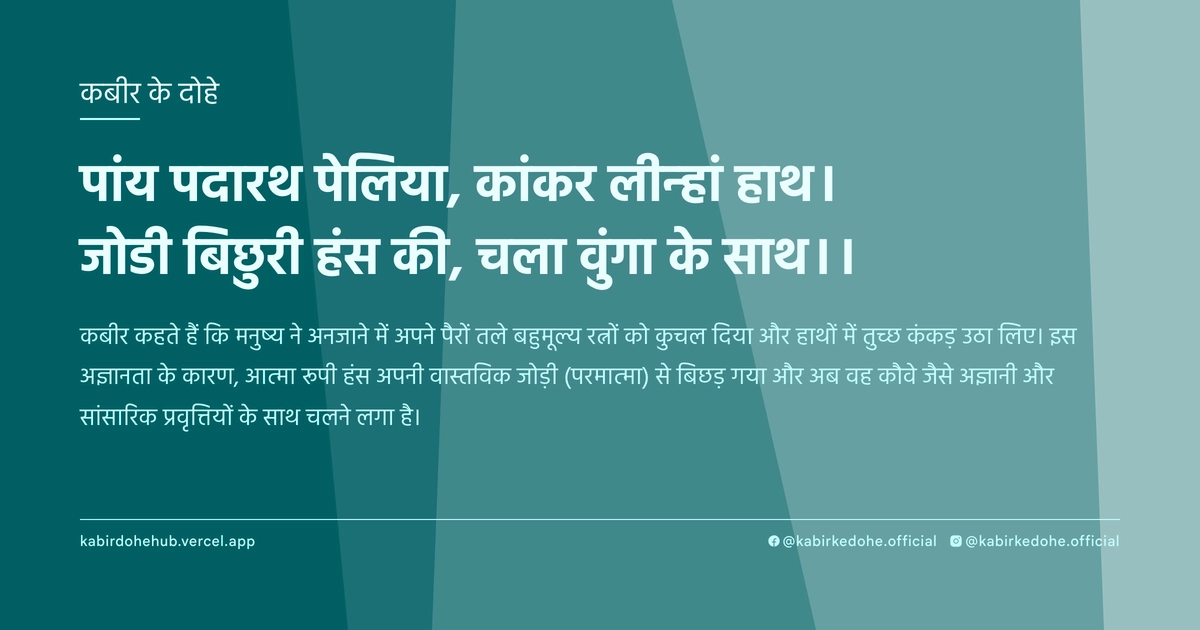
पांय पदारथ पेलिया, कांकर लीन्हां हाथ।
जोडी बिछुरी हंस की, चला वुंगा के साथ।।
Paay padarath peliya, kaankar linhan haath. Jodi bichhuri hans ki, chala vunga ke saath.
इस पृष्ठ पर इस कबीर दोहे का अर्थ (meaning), हिंदी व्याख्या और अंग्रेज़ी अनुवाद, दार्शनिक विश्लेषण और व्यावहारिक जीवन सीख दी गई है। यह दोहा माया (Maya) विषय से जुड़ा है — Kabir doha meaning and explanation in Hindi and English.
अर्थ (Meaning):
कबीर कहते हैं कि मनुष्य ने अनजाने में अपने पैरों तले बहुमूल्य रत्नों को कुचल दिया और हाथों में तुच्छ कंकड़ उठा लिए। इस अज्ञानता के कारण, आत्मा रूपी हंस अपनी वास्तविक जोड़ी (परमात्मा) से बिछड़ गया और अब वह कौवे जैसे अज्ञानी और सांसारिक प्रवृत्तियों के साथ चलने लगा है।
Kabir observes that humanity has inadvertently trampled upon priceless spiritual gems beneath their feet while clutching worthless pebbles in their hands. Due to this profound ignorance, the soul—symbolized as a swan—has become separated from its divine counterpart, now drifting aimlessly in the company of crows, representing worldly attachments and ignorance.
व्याख्या (Interpretation):
इस दोहे में 'पदारथ' (रत्न) आंतरिक दिव्यता और आत्म-साक्षात्कार का प्रतीक है, जबकि 'कांकर' (कंकड़) माया और सांसारिक मोह-माया को दर्शाते हैं। कबीर एक गहरे विरोधाभास को उजागर करते हैं: सत्य हमारे भीतर ही मौजूद है, फिर भी हम उसे बाहर खोजते हैं। 'हंस' शुद्ध चेतना का प्रतीक है, जो अपनी मूल प्रकृति को भूलकर 'वुंगा' (कौवे) यानी अहंकार और वासनाओं के साथ घुल-मिल गया है। यह स्थिति अद्वैत वेदांत के 'माया' सिद्धांत को स्पष्ट करती है, जहाँ जीव अपनी वास्तविक पहचान (ब्रह्म) को भूलकर मिथ्या जगत को सत्य मान लेता है। यहाँ बिछड़ना भौतिक नहीं, बल्कि आध्यात्मिक विस्मृति है।
In this couplet, 'padarth' (gems) symbolize inner divinity and self-realization, while 'kaankar' (pebbles) represent Maya and worldly attachments. Kabir highlights a profound paradox: Truth resides within, yet we seek it externally. The 'hans' (swan) symbolizes pure consciousness, which, having forgotten its origin, now associates with the 'vunga' (crow), representing ego and desire. This state elucidates the Advaita Vedanta concept of Maya, where the individual soul forgets its identity as Brahman and mistakes the illusory world for reality. The separation described is not physical, but a spiritual amnesia.
दार्शनिक विश्लेषण (Philosophical Analysis):
कबीर का यह दर्शन निर्गुण भक्ति और सूफीवाद का एक अनूठा संगम है। वे उस समय के धार्मिक पाखंड और कर्मकांडों पर प्रहार करते हैं जहाँ लोग बाहरी तीर्थयात्राओं और पूजा-पाठ (कंकड़) में लगे थे, जबकि ईश्वर का वास उनके अपने हृदय (रत्न) में था। यह विश्लेषण दर्शाता है कि कैसे मनुष्य अपनी चेतना को बाहरी शोर में खो देता है।
अद्वैत वेदांत के परिप्रेक्ष्य में, यह दोहा 'अविद्या' (अज्ञान) की व्याख्या करता है। जब तक साधक यह नहीं समझता कि वह स्वयं वह अनंत सत्य है, वह संसार के तुच्छ सुखों के पीछे भागता रहेगा। कबीर यहाँ चेतावनी देते हैं कि गलत संगति (कौवे का साथ) आत्मा की मौलिक पवित्रता को दूषित कर देती है।
सूफी मत के 'इश्क-ए-हकीकी' (ईश्वरीय प्रेम) के संदर्भ में, यह आत्मा की अपने मूल स्रोत से विरह की पीड़ा है। आत्मा एक प्रवासी है जो घर तो भूल गई है, लेकिन उसकी तड़प उसे वापस बुलाती है। यहाँ 'हंस' का बिछड़ना वास्तव में एक जागृति का आह्वान है।
मनोवैज्ञानिक स्तर पर, यह दोहा हमारी 'मूल्य प्रणालियों' के विस्थापन को दर्शाता है। हम अक्सर तात्कालिक संतुष्टि (Instant Gratification) को दीर्घकालिक शांति (Eternal Peace) से ऊपर रखते हैं। यह अहंकार का वह खेल है जहाँ हम स्वयं को छोटा महसूस करते हैं और बाहरी उपलब्धियों को अपनी पहचान बना लेते हैं।
अंततः, कबीर का संदेश यह है कि मुक्ति किसी बाहरी वस्तु की प्राप्ति में नहीं, बल्कि उस 'रत्न' को पहचानने में है जिसे हमने अनजाने में पैरों तले कुचल दिया है। यह पूर्ण आत्म-समर्पण और अहंकार के विसर्जन की प्रक्रिया है, जिससे आत्मा पुनः अपने मूल स्वरूप में विलीन हो जाती है।
Kabir's philosophy here is a unique synthesis of Nirgun Bhakti and Sufism. He strikes at the religious hypocrisy and ritualism of his era, where people were obsessed with external pilgrimages and ceremonies (pebbles), while the Divine resided within their own hearts (gems). This analysis reveals how humans lose their consciousness amidst external noise.
From the perspective of Advaita Vedanta, this doha explains 'Avidya' (ignorance). Until the seeker realizes that they are the infinite Truth themselves, they will continue to chase the trivial pleasures of the world. Kabir warns that wrong association (the company of crows) contaminates the original purity of the soul.
In the context of the Sufi concept of 'Ishq-e-Haqiqi' (Divine Love), this is the agony of the soul's separation from its source. The soul is a wanderer who has forgotten home, yet the longing pulls it back. The separation of the 'swan' is actually a call for awakening.
Psychologically, this doha reflects the displacement of our 'value systems.' We often prioritize instant gratification over eternal peace. This is the game of the ego, where we perceive ourselves as limited and mistake external achievements for our true identity.
Ultimately, Kabir's message is that liberation does not lie in acquiring something external, but in recognizing the 'gem' we have inadvertently trampled. It is a process of total surrender and the dissolution of the ego, allowing the soul to merge back into its original form.
मूल संदेश (Core Message):
- बाहरी खोज अक्सर आंतरिक सत्य से ध्यान भटकाती है।
- अहंकार वह पर्दा है जो हमें हमारी दिव्यता देखने नहीं देता।
- सच्ची संपत्ति आत्म-साक्षात्कार है, न कि सांसारिक संचय।
- गलत संगति आत्मा की मौलिक चमक को धुंधला कर देती है।
- शांति का मार्ग बाहर जाने में नहीं, बल्कि भीतर लौटने में है।
- External quests often distract us from the internal truth.
- Ego is the veil that prevents us from seeing our own divinity.
- True wealth is self-realization, not worldly accumulation.
- Wrong association dims the original radiance of the soul.
- The path to peace is not in going out, but in returning within.
व्यावहारिक उदाहरण (Practical Example):
वाराणसी के एक पुराने घाट पर रहने वाले माधव नाम के एक वृद्ध बुनकर की कहानी है। माधव अपनी पूरी जिंदगी रेशमी कपड़ों में बारीक धागों की बुनाई करता रहा, लेकिन उसका मन हमेशा अशांत रहता था। वह शहर के बड़े पंडितों के पास जाता, महंगे अनुष्ठान करता और मोक्ष के लिए बाहरी ग्रंथों के रहस्यों को खोजने की कोशिश करता। वह मानता था कि शांति किसी विशेष मंत्र या किसी दूरस्थ तीर्थ में मिलेगी।
माधव का जीवन उन 'कंकड़ों' को इकट्ठा करने जैसा था—बाहरी मान्यताएं, सामाजिक प्रतिष्ठा और जटिल अनुष्ठान। वह अपने भीतर की सहज शांति और करुणा को पूरी तरह अनदेखा कर चुका था। वह अपने परिवार से चिड़चिड़ा रहता और हर छोटी बात पर क्रोधित होता, यह सोचते हुए कि वह एक 'धार्मिक' व्यक्ति है क्योंकि वह रोज घंटों पूजा करता है।
एक दिन, घाट पर एक फकीर आया जिसने माधव को देखते ही कहा, "तू रेशम के धागों में उलझा है, जबकि असली धागा तो तेरे भीतर है जो तुझे परमात्मा से जोड़ता है। तूने दुनिया भर के पत्थर जमा कर लिए, पर अपने पैरों के नीचे दबे हीरे को नहीं देखा।"
माधव को पहले तो यह बात समझ नहीं आई। लेकिन उस रात, जब वह चुपचाप बैठा था, उसे महसूस हुआ कि उसकी सारी पूजा और अनुष्ठान केवल उसके अहंकार को संतुष्ट कर रहे थे। उसने महसूस किया कि जिस शांति को वह काशी के मंदिरों में खोज रहा था, वह वास्तव में उसके भीतर की सरलता और निस्वार्थ प्रेम में थी।
उसने महसूस किया कि उसने अपने जीवन के सबसे कीमती क्षणों को क्रोध और बाहरी दिखावे में गँवा दिया। यह उसके लिए 'हंस का कौवों के साथ चलना' था—यानी एक आध्यात्मिक आत्मा का सांसारिक अहंकार के साथ तालमेल बिठाना।
अगले दिन से माधव ने अपना व्यवहार बदल दिया। उसने अनुष्ठानों को कम किया और सेवा को प्राथमिकता दी। उसने अपने पड़ोस के गरीब बच्चों को मुफ्त में बुनाई सिखानी शुरू की। उसने पाया कि जब वह दूसरों के दुखों को दूर करता है, तो उसे वह शांति मिलती है जो हज़ारों मंत्रों से नहीं मिली थी।
उसका क्रोध शांत हो गया और उसके चेहरे पर एक दिव्य चमक आ गई। अब वह केवल कपड़े नहीं बुन रहा था, बल्कि वह प्रेम और करुणा के धागों से जीवन को बुन रहा था।
माधव ने जान लिया था कि 'पदारथ' (रत्न) कहीं बाहर नहीं, बल्कि उसके अपने हृदय की शुद्धता में था। उसने कंकड़ों को छोड़ दिया और अंततः अपने आंतरिक संगीत को सुन पाया।
There is a story of an elderly weaver named Madhav, living on an old ghat in Varanasi. Madhav spent his entire life weaving intricate threads into silk fabrics, yet his mind remained perpetually restless. He would visit the city's great pundits, perform expensive rituals, and try to uncover the secrets of salvation in external texts. He believed peace could be found in a specific mantra or a distant pilgrimage.
Madhav's life was like collecting 'pebbles'—external validations, social prestige, and complex rituals. He had completely ignored the innate peace and compassion within himself. He was irritable with his family and prone to anger over trivial matters, all while believing he was a 'religious' man because he spent hours in prayer daily.
One day, a wandering dervish arrived at the ghat and, upon seeing Madhav, said, "You are entangled in silk threads, while the real thread is within you, connecting you to the Divine. You have collected stones from all over the world, but you failed to see the diamond crushed beneath your own feet."
At first, Madhav did not understand. But that night, as he sat in silence, he realized that all his prayers and rituals were merely feeding his ego. He felt that the peace he sought in the temples of Kashi actually resided in his own simplicity and selfless love.
He realized he had wasted the most precious moments of his life on anger and external show. This was his 'swan walking with crows'—a spiritual soul aligning itself with worldly ego.
From the next day, Madhav changed his behavior. He reduced the rituals and prioritized service. He began teaching weaving for free to the poor children in his neighborhood. He discovered that when he alleviated the suffering of others, he found a peace that thousands of mantras could not provide.
His anger subsided, and a divine glow appeared on his face. He was no longer just weaving cloth; he was weaving life with threads of love and compassion.
Madhav had realized that the 'padarth' (gem) was not anywhere outside, but in the purity of his own heart. He let go of the pebbles and finally heard his internal music.
अभ्यास मार्गदर्शन (Practice Guidance):
- प्रतिदिन 20 मिनट मौन अभ्यास करें, जहाँ आप बाहरी दुनिया की आवाज़ों को छोड़कर केवल अपनी आंतरिक श्वास और उपस्थिति पर ध्यान केंद्रित करें।
- एक 'अहंकार डायरी' बनाएँ: दिन भर में उन क्षणों को लिखें जब आपने बाहरी प्रशंसा (कंकड़) को आंतरिक शांति (रत्न) से ऊपर रखा।
- स्व-पूछताछ (Self-Inquiry) का अभ्यास करें: जब भी आप किसी बाहरी वस्तु या व्यक्ति से अपनी खुशी जोड़ें, तो पूछें, "क्या यह वास्तव में मेरी आत्मा की आवश्यकता है या केवल एक सामाजिक मुखौटा?"
- निदान चेकलिस्ट: क्या आप दूसरों की आलोचना से विचलित होते हैं? क्या आप अपनी पहचान अपनी उपलब्धियों से जोड़ते हैं? यदि हाँ, तो आप अभी भी 'कंकड़ों' को पकड़े हुए हैं।
- Practice 20 minutes of daily silence, shifting focus from external noises to your internal breath and presence.
- Maintain an 'Ego Diary': Record moments during the day when you prioritized external validation (pebbles) over internal peace (gems).
- Practice Self-Inquiry: Whenever you link your happiness to an external object or person, ask, "Is this truly a need of my soul, or just a social mask?"
- Diagnostic Checklist: Do you get disturbed by others' criticism? Do you tie your identity to your achievements? If yes, you are still clutching the 'pebbles'.
चिंतन प्रश्न (Reflection Questions):
- मेरे जीवन के वे कौन से 'कंकड़' हैं जिन्हें मैं सबसे अधिक मजबूती से पकड़े हुए हूँ?
- क्या मेरी सार्वजनिक छवि (Public Image) मेरे वास्तविक आंतरिक स्वरूप को दबा रही है?
- मैं किन लोगों या आदतों के साथ 'कौवे' की तरह चल रहा हूँ, जो मेरी आध्यात्मिक प्रगति को रोक रहे हैं?
- यदि मेरी सारी उपलब्धियाँ और पद छीन लिए जाएँ, तो मेरे पास क्या बचेगा?
- क्या मैं वास्तव में सत्य की खोज कर रहा हूँ, या केवल अपनी मान्यताओं की पुष्टि?
- What are the 'pebbles' in my life that I am clutching most tightly?
- Is my public image suppressing my true internal nature?
- With which people or habits am I walking like a 'crow', hindering my spiritual progress?
- If all my achievements and titles were stripped away, what would remain of me?
- Am I truly seeking the truth, or merely seeking confirmation of my existing beliefs?