
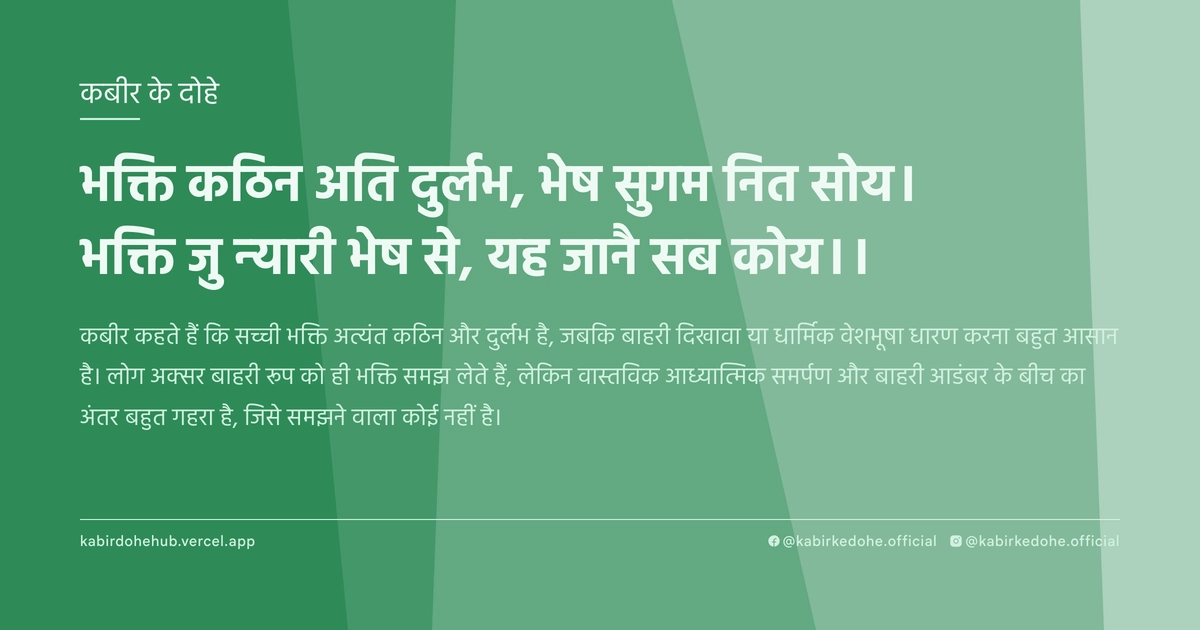
भक्ति कठिन अति दुर्लभ, भेष सुगम नित सोय।
भक्ति जु न्यारी भेष से, यह जानै सब कोय।।
Bhakti kathin ati durlabh, bhesh sugam nit soy. Bhakti ju nyaari bhesh se, yeh jaanai sab koy.
इस पृष्ठ पर इस कबीर दोहे का अर्थ (meaning), हिंदी व्याख्या और अंग्रेज़ी अनुवाद, दार्शनिक विश्लेषण और व्यावहारिक जीवन सीख दी गई है। यह दोहा भक्ति (Bhakti) विषय से जुड़ा है — Kabir doha meaning and explanation in Hindi and English.
अर्थ (Meaning):
कबीर कहते हैं कि सच्ची भक्ति अत्यंत कठिन और दुर्लभ है, जबकि बाहरी दिखावा या धार्मिक वेशभूषा धारण करना बहुत आसान है। लोग अक्सर बाहरी रूप को ही भक्ति समझ लेते हैं, लेकिन वास्तविक आध्यात्मिक समर्पण और बाहरी आडंबर के बीच का अंतर बहुत गहरा है, जिसे समझने वाला कोई नहीं है।
Kabir asserts that true devotion is exceedingly difficult and rare to attain, whereas adopting a religious outward appearance or costume is effortless. People often mistake the external facade for spiritual progress, yet there is a profound distinction between genuine internal surrender and mere ritualistic display.
व्याख्या (Interpretation):
इस दोहे का शाब्दिक अर्थ है कि बाहरी पहनावा आसान है पर आंतरिक भक्ति कठिन। रूपक के स्तर पर, 'भेष' माया के उस आवरण को दर्शाता है जिसे मनुष्य अपनी सामाजिक और धार्मिक पहचान बनाने के लिए ओढ़ता है। यह निर्गुण भक्ति का सिद्धांत है जहाँ ईश्वर किसी विशेष वस्त्र या कर्मकांड में नहीं, बल्कि शुद्ध चेतना में बसता है। यहाँ 'कठिन' शब्द अहंकार के विसर्जन की प्रक्रिया को इंगित करता है, जो आत्मा और परमात्मा के अद्वैत बोध की पहली शर्त है। यह विरोधाभास है कि जो सबसे सरल दिखता है (भेष), वह वास्तव में सत्य से सबसे दूर ले जाता है।
Literally, the verse contrasts the ease of wearing a religious garb with the hardship of actual devotion. Metaphorically, 'bhesh' represents the veil of Maya—the social and religious identities humans construct to signal piety. This aligns with Nirgun Bhakti, where the Divine resides not in specific rituals or attire, but in pure, formless consciousness. The term 'kathin' (difficult) refers to the agonizing process of ego-annihilation, the prerequisite for realizing the non-duality of Atman and Brahman. It presents the central paradox: the path that appears most accessible (outward ritual) is often the greatest obstacle to inner truth.
दार्शनिक विश्लेषण (Philosophical Analysis):
कबीर का यह दोहा उनके युग के धार्मिक पाखंड और कर्मकांडवाद पर एक तीखा प्रहार है। उन्होंने देखा कि कैसे लोग केवल गेरुआ वस्त्र पहनकर या माला फेरकर स्वयं को संत घोषित कर देते थे, जबकि उनके भीतर क्रोध, लोभ और अहंकार यथावत थे। यह विश्लेषण अद्वैत वेदांत के उस सत्य से मेल खाता है जहाँ 'अहं ब्रह्मास्मि' का अनुभव केवल बाहरी क्रियाओं से नहीं, बल्कि गहन आत्म-साक्षात्कार से होता है।
सूफी मत के 'फना' (अहंकार का विनाश) के सिद्धांत की तरह, कबीर यहाँ यह समझा रहे हैं कि जब तक 'मैं' (अहंकार) जीवित है, तब तक भक्ति केवल एक प्रदर्शन है। वे तर्क देते हैं कि धर्म कोई पोशाक नहीं है जिसे बदला जा सके, बल्कि यह एक आंतरिक रूपांतरण है। ritualism या कर्मकांड केवल मन को संतुष्ट करते हैं, लेकिन आत्मा को मुक्त नहीं करते।
ऐतिहासिक रूप से, कबीर ने जाति और धर्म के कृत्रिम विभाजनों को चुनौती दी। उनके लिए, भक्ति का अर्थ था सत्य के प्रति पूर्ण समर्पण, चाहे वह किसी भी सामाजिक पृष्ठभूमि से हो। वे चेतावनी देते हैं कि बाहरी प्रतीकों पर निर्भरता वास्तव में आध्यात्मिक आलस्य है, क्योंकि यह व्यक्ति को यह भ्रम देता है कि उसने लक्ष्य प्राप्त कर लिया है, जबकि वह अभी शुरुआती दहलीज पर भी नहीं पहुँचा है।
मनोवैज्ञानिक स्तर पर, 'भेष' एक रक्षा तंत्र (defense mechanism) है। व्यक्ति अपनी आंतरिक रिक्तता और असुरक्षाओं को छिपाने के लिए धार्मिक पहचान का सहारा लेता है। जब कोई कहता है 'मैं एक भक्त हूँ', तो वह वास्तव में अपनी पहचान को एक विशेष श्रेणी में सीमित कर रहा होता है, जो कि अद्वैत के व्यापक विस्तार के विपरीत है।
अंततः, कबीर यह स्पष्ट करते हैं कि वास्तविक भक्ति वह है जो अदृश्य है। वह मौन है, वह निस्वार्थ है और वह किसी प्रशंसा की अभिलाषी नहीं है। जब भक्ति 'भेष' से अलग हो जाती है, तभी वह वास्तव में 'न्यारी' या अद्वितीय बनती है। यह वह बिंदु है जहाँ साधक अपनी पहचान खोकर उस अनंत में विलीन हो जाता है जिसे शब्दों या वस्त्रों में नहीं बांधा जा सकता।
This couplet is a piercing critique of the religious hypocrisy and ritualism prevalent during Kabir's era. He observed how individuals claimed sainthood simply by donning saffron robes or chanting beads, while their internal landscapes remained cluttered with anger, greed, and ego. This analysis mirrors the core of Advaita Vedanta, where the realization of 'Aham Brahmasmi' (I am Brahman) is achieved not through external acts, but through profound self-realization.
Parallel to the Sufi concept of 'Fana' (the annihilation of the self), Kabir explains that as long as the 'I' (the ego) persists, devotion is merely a performance. He argues that spirituality is not a costume to be changed, but an internal transmutation. Ritualism serves only to soothe the mind; it does not liberate the soul from the cycle of birth and death.
Historically, Kabir challenged the artificial divisions of caste and creed. For him, Bhakti meant absolute surrender to Truth, regardless of social standing. He warns that reliance on external symbols is a form of spiritual laziness, creating a delusion of achievement while the seeker has not even reached the threshold of the path.
Psychologically, 'bhesh' acts as a defense mechanism. Individuals use religious identity to mask internal voids and insecurities. When one claims, 'I am a devotee,' they are effectively limiting their identity to a category, which contradicts the expansive, non-dual nature of the Absolute.
Ultimately, Kabir clarifies that genuine devotion is invisible. It is silent, selfless, and seeks no validation. When devotion detaches itself from the 'facade,' it becomes 'nyari'—unique and transcendental. This is the point where the seeker ceases to exist as a separate entity and merges into the Infinite, which cannot be contained by clothes or customs.
मूल संदेश (Core Message):
- बाहरी दिखावा आध्यात्मिक प्रगति का प्रमाण नहीं है।
- सच्ची भक्ति अहंकार के पूर्ण विसर्जन की मांग करती है।
- धर्म वस्त्रों में नहीं, बल्कि आचरण की शुद्धता में है।
- माया हमें प्रतीकों में उलझाती है, जबकि सत्य प्रतीकों से परे है।
- करुणा और निस्वार्थता ही वास्तविक ईश्वर-साक्षात्कार हैं।
- External display is not evidence of spiritual progress.
- True devotion demands the total dissolution of the ego.
- Religion lies not in garments, but in the purity of conduct.
- Maya entangles us in symbols, while Truth exists beyond them.
- Compassion and selflessness are the only true realizations of God.
व्यावहारिक उदाहरण (Practical Example):
वाराणसी के एक पुराने घाट पर माधव नाम का एक वृद्ध व्यक्ति रहता था। वह शहर का सबसे प्रसिद्ध 'भक्त' माना जाता था। वह हमेशा शुद्ध सफेद वस्त्र पहनता, माथे पर बड़ा चंदन का तिलक लगाता और दिन भर जोर-जोर से मंत्रोच्चार करता ताकि हर आने-जाने वाले को उसकी भक्ति का पता चले। लोग उसे प्रणाम करते और उसकी आध्यात्मिक ऊंचाई की प्रशंसा करते, जिससे माधव का अहंकार और अधिक बढ़ गया।
उसी घाट के कोने में एक बूढ़ा नाविक रहता था, जिसका नाम शिव था। शिव के पास न तो कोई विशेष वस्त्र थे, न ही वह कभी मंत्र पढ़ता था। वह दिन भर कड़ी धूप में नाव चलाता और अपनी कमाई का आधा हिस्सा चुपचाप भूखों को खिला देता। वह कभी किसी को नहीं बताता था कि वह क्या कर रहा है, और न ही वह कभी मंदिर के मुख्य पुजारी के साथ बैठता था।
एक दिन, माधव ने शिव को देखा और उसका उपहास किया। उसने कहा, 'तुम जैसे गंदे कपड़े पहनने वाले और बिना किसी नियम के रहने वाले व्यक्ति को ईश्वर के बारे में क्या पता? देखो मेरी पवित्रता और मेरा अनुशासन!' शिव ने केवल मुस्कुराकर अपनी नाव की ओर इशारा किया और चुप रहा।
उसी शाम, घाट पर एक भीषण दुर्घटना हुई। एक छोटा बच्चा नदी की लहरों में बह गया। माधव, जो अपनी सफेद पोशाक और तिलक की पवित्रता बनाए रखने में व्यस्त था, डर गया कि उसके कपड़े गंदे हो जाएंगे और उसकी 'छवि' खराब होगी। वह किनारे पर खड़ा होकर केवल जोर-जोर से प्रार्थना करने लगा, यह उम्मीद करते हुए कि लोग उसकी भक्ति देखेंगे।
दूसरी ओर, शिव ने एक पल भी नहीं सोचा। उसने अपनी फटी हुई धोती की परवाह किए बिना ठंडे और गंदे पानी में छलांग लगा दी। उसने अपनी पूरी ताकत लगाकर बच्चे को डूबने से बचाया, लेकिन इस प्रक्रिया में वह खुद कीचड़ और मलबे में पूरी तरह सन गया।
जब शिव बच्चे को लेकर बाहर आया, तो वह किसी संत जैसा नहीं दिख रहा था, बल्कि एक साधारण, गंदा मजदूर लग रहा था। लेकिन उस बच्चे की माँ की आँखों में जो कृतज्ञता थी और उस क्षण में शिव के हृदय में जो निस्वार्थ प्रेम था, वह किसी भी मंत्र से अधिक शक्तिशाली था।
माधव यह सब देख रहा था। उसे अचानक महसूस हुआ कि उसकी सफेद पोशाक वास्तव में एक दीवार थी जिसने उसे मानवता से अलग कर दिया था। उसका 'भेष' उसे भक्ति का भ्रम दे रहा था, जबकि शिव की 'अशुद्धता' में वास्तविक भक्ति छिपी थी।
उस दिन माधव का अहंकार टूट गया। उसने महसूस किया कि उसने अब तक केवल 'भेष' की पूजा की थी, भक्ति की नहीं। उसने अपना तिलक पोंछा और पहली बार शिव के पैरों को छुआ, यह समझते हुए कि ईश्वर वस्त्रों में नहीं, बल्कि करुणा के कार्यों में बसता है।
On an ancient ghat in Varanasi lived an elderly man named Madhav. He was regarded as the city's most renowned 'devotee.' He always wore pristine white robes, applied a large sandalwood tilak on his forehead, and chanted mantras loudly throughout the day so that every passerby would acknowledge his piety. People bowed to him, and their praise only inflated Madhav's ego further.
In a secluded corner of the same ghat lived an old boatman named Shiv. Shiv possessed no special attire, nor did he ever chant mantras. He spent his days rowing in the scorching sun and silently gave away half of his meager earnings to the hungry. He never announced his charity, nor did he ever seek a seat beside the head priest of the temple.
One day, Madhav noticed Shiv and mocked him. He said, 'What does a man in filthy clothes, living without any discipline, know of God? Look at my purity and my rigor!' Shiv merely smiled, pointed toward his boat, and remained silent.
That evening, a terrible accident occurred on the ghat. A small child was swept away by the river's current. Madhav, preoccupied with maintaining the purity of his white robes and tilak, hesitated, fearing his clothes would be soiled and his 'image' tarnished. He stood on the bank, chanting loudly, hoping people would witness his devotion.
Conversely, Shiv did not hesitate for a second. Without a thought for his torn dhoti, he plunged into the cold, murky water. With all his strength, he rescued the child from drowning, though in the process, he became completely covered in mud and debris.
When Shiv emerged with the child, he did not look like a saint; he looked like a common, dirty laborer. But the gratitude in the mother's eyes and the selfless love in Shiv's heart at that moment were more powerful than any mantra.
Madhav witnessed this. He suddenly realized that his white robes were actually a wall that had separated him from humanity. His 'facade' had given him the illusion of devotion, while actual devotion was hidden within Shiv's 'impurity.'
That day, Madhav's ego shattered. He realized he had been worshipping the 'costume' rather than the 'connection.' He wiped away his tilak and, for the first time, touched Shiv's feet, understanding that God dwells not in garments, but in acts of compassion.
अभ्यास मार्गदर्शन (Practice Guidance):
- दैनिक आत्म-निरीक्षण: प्रतिदिन 15 मिनट मौन बैठें और विचार करें कि आपके कौन से कार्य 'दिखावे' के लिए हैं और कौन से 'सत्य' के लिए।
- अनाम सेवा: सप्ताह में एक बार ऐसा कार्य करें जिससे किसी की मदद हो, लेकिन यह सुनिश्चित करें कि किसी को भी पता न चले कि वह आपने किया है।
- पहचान का विसर्जन: अपनी सामाजिक, व्यावसायिक या धार्मिक पहचान को हटाकर स्वयं से पूछें—'जब ये सब छिन जाएगा, तब मैं वास्तव में कौन हूँ?'
- निदान चेकलिस्ट: यदि आप किसी की प्रशंसा न मिलने पर क्रोधित या उदास महसूस करते हैं, तो समझ लें कि आप 'भक्ति' नहीं, बल्कि 'भेष' में जी रहे हैं।
- Daily Self-Inquiry: Sit in silence for 15 minutes daily and analyze which of your actions are performed for 'show' and which are rooted in 'truth.'
- Anonymous Service: Once a week, perform an act of kindness ensuring that absolutely no one knows you were the benefactor.
- Dissolution of Identity: Strip away your social, professional, and religious labels and ask yourself—'When all these are gone, who am I truly?'
- Diagnostic Checklist: If you feel anger or sadness when you are not praised for your virtues, recognize that you are living in the 'facade' rather than in 'devotion.'
चिंतन प्रश्न (Reflection Questions):
- क्या मेरी धार्मिक या नैतिक पहचान मेरे वास्तविक स्वभाव को छिपाने का एक मुखौटा है?
- यदि समाज से मेरी सारी उपाधियाँ और पहचान छीन ली जाएँ, तो क्या मेरे भीतर कुछ शेष बचेगा?
- मैं अपनी 'पवित्रता' को बनाए रखने के लिए कितनी बार दूसरों की पीड़ा की अनदेखी करता हूँ?
- क्या मैं ईश्वर को खोज रहा हूँ, या मैं केवल एक 'भक्त' के रूप में पहचाना जाना चाहता हूँ?
- मेरे जीवन का कौन सा हिस्सा केवल दूसरों को प्रभावित करने के लिए बनाया गया है?
- Is my religious or moral identity merely a mask to hide my true nature?
- If all my titles and identities were stripped away by society, would anything remain within me?
- How often do I ignore the suffering of others to maintain my own 'purity'?
- Am I searching for the Divine, or do I simply wish to be recognized as a 'devotee'?
- Which part of my life is constructed solely to impress others?