
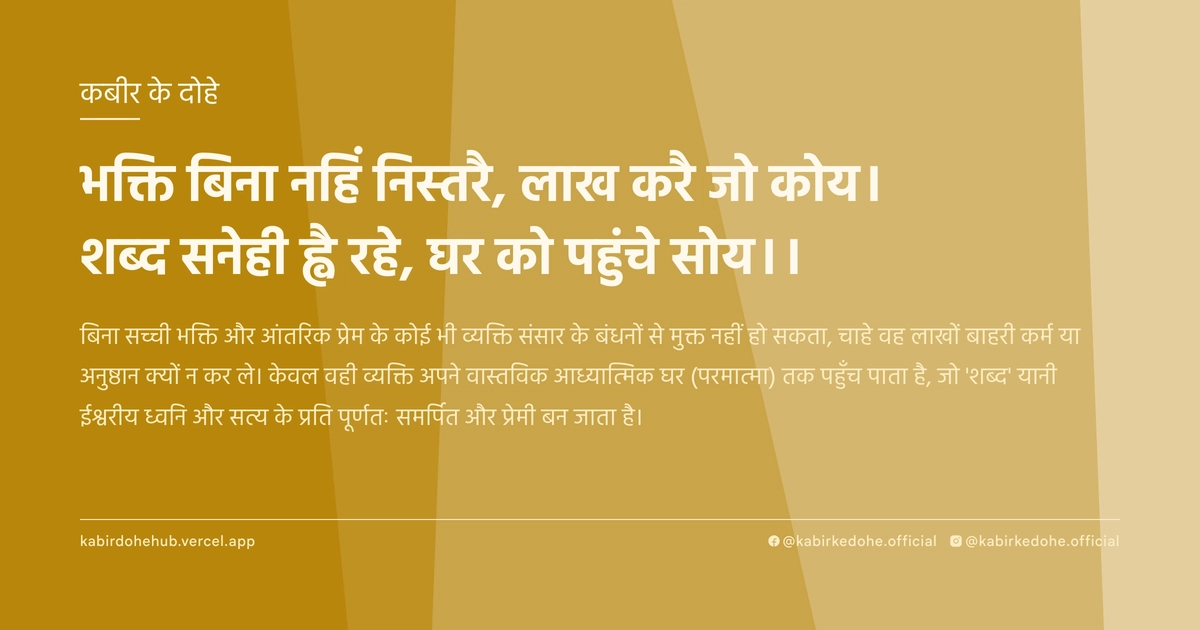
भक्ति बिना नहिं निस्तरै, लाख करै जो कोय।
शब्द सनेही ह्वै रहे, घर को पहुंचे सोय।।
Bhakti bina nahin nistare, laakh kare jo koy. Shabd sanehi hvai rahe, ghar ko pahunche soy.
इस पृष्ठ पर इस कबीर दोहे का अर्थ (meaning), हिंदी व्याख्या और अंग्रेज़ी अनुवाद, दार्शनिक विश्लेषण और व्यावहारिक जीवन सीख दी गई है। यह दोहा भक्ति (Bhakti) विषय से जुड़ा है — Kabir doha meaning and explanation in Hindi and English.
अर्थ (Meaning):
बिना सच्ची भक्ति और आंतरिक प्रेम के कोई भी व्यक्ति संसार के बंधनों से मुक्त नहीं हो सकता, चाहे वह लाखों बाहरी कर्म या अनुष्ठान क्यों न कर ले। केवल वही व्यक्ति अपने वास्तविक आध्यात्मिक घर (परमात्मा) तक पहुँच पाता है, जो 'शब्द' यानी ईश्वरीय ध्वनि और सत्य के प्रति पूर्णतः समर्पित और प्रेमी बन जाता है।
No one can achieve true liberation or transcend the cycle of existence without genuine devotion, regardless of how many millions of external rituals or charitable acts they perform. Only those who cultivate a deep, loving intimacy with the 'Shabd'—the primordial divine sound and eternal truth—can eventually return to their true spiritual home, the Source of all being.
व्याख्या (Interpretation):
कबीर यहाँ 'निस्तरण' या मुक्ति की बात कर रहे हैं, जो केवल यांत्रिक पूजा से संभव नहीं है। 'लाख करै' का अर्थ है कि बाहरी आडंबर, जैसे तीर्थयात्रा या कठोर तपस्या, तब तक व्यर्थ हैं जब तक हृदय में प्रेम न हो। 'शब्द' यहाँ केवल ध्वनि नहीं, बल्कि वह निराकार ब्रह्म है जो हर जीव में गूँज रहा है। यह निर्गुण भक्ति का सार है जहाँ भक्त और भगवान के बीच का द्वैत समाप्त हो जाता है। जब साधक शब्द-सनेही बनता है, तो वह माया के भ्रम को पार कर जाता है। अंततः, 'घर' का अर्थ भौतिक निवास नहीं, बल्कि आत्मा का परमात्मा में विलीनीकरण है। यह अद्वैत वेदांत की उस स्थिति को दर्शाता है जहाँ 'मैं' और 'तू' का भेद मिट जाता है।
Kabir speaks of 'nistarai' or liberation, asserting that it is unattainable through mechanical piety. 'Laakh karai' implies that external rituals, such as pilgrimages or rigorous asceticism, remain futile unless fueled by heart-centered love. The 'Shabd' here is not merely a spoken word, but the primordial vibration of the Formless Brahman resonating within every living entity. This is the essence of Nirgun Bhakti, where the duality between the devotee and the Divine dissolves. By becoming a 'lover of the Word,' the seeker pierces through the veil of Maya (illusion). Ultimately, 'home' does not refer to a physical dwelling, but to the merging of the Atman (individual soul) back into the Brahman (Universal Consciousness). It mirrors the Advaita Vedanta realization where the illusion of separation vanishes entirely.
दार्शनिक विश्लेषण (Philosophical Analysis):
कबीर का यह दोहा उस युग की प्रतिक्रिया है जहाँ धर्म केवल कर्मकांडों और जातिगत श्रेष्ठता में सिमट गया था। उन्होंने स्पष्ट किया कि मोक्ष किसी विशेष जाति, धर्म या बाहरी क्रिया का परिणाम नहीं है, बल्कि यह आंतरिक रूपांतरण की प्रक्रिया है। यह विचार सूफी मत के 'इश्क-ए-हकीकी' (ईश्वरीय प्रेम) से गहराई से मेल खाता है, जहाँ प्रेमी अपने अस्तित्व को मिटाकर केवल प्रिय (ईश्वर) में लीन हो जाता है।
अद्वैत वेदांत के परिप्रेक्ष्य में, कबीर यह समझा रहे हैं कि जब तक अहंकार (Ego) मौजूद है, तब तक 'लाख' कर्म भी बंधन ही बढ़ाते हैं। वास्तविक मुक्ति तब होती है जब व्यक्ति यह पहचान ले कि वह स्वयं वही 'शब्द' है जिसकी वह खोज कर रहा है। यहाँ भक्ति का अर्थ किसी मूर्ति की पूजा नहीं, बल्कि उस निराकार सत्य के प्रति पूर्ण समर्पण है जो सर्वव्यापी है।
कबीर ने ritualism (अनुष्ठानवाद) का खंडन करते हुए यह तर्क दिया कि ईश्वर मंदिर या मस्जिद में नहीं, बल्कि हृदय की पवित्रता और सत्य के प्रति प्रेम में बसता है। यह मनोवैज्ञानिक परिवर्तन की मांग करता है—बाहरी प्रदर्शन से आंतरिक मौन की ओर प्रस्थान।
इस दर्शन में 'शब्द' वह सेतु है जो सीमित मनुष्य को असीमित परमात्मा से जोड़ता है। यह नाद-योग की परंपरा का हिस्सा है, जहाँ ध्वनि के माध्यम से चेतना का विस्तार होता है। जब साधक शब्द के साथ एकाकार होता है, तो उसकी व्यक्तिगत पहचान मिट जाती है और वह सार्वभौमिक चेतना का हिस्सा बन जाता है।
अंततः, यह दोहा हमें सिखाता है कि ज्ञान (Jnana) और कर्म (Karma) तब तक अधूरे हैं जब तक उनमें भक्ति (Bhakti) का रस न मिले। बिना प्रेम के ज्ञान केवल अहंकार बढ़ाता है, और बिना प्रेम के कर्म केवल थकान देते हैं। केवल प्रेम ही वह कुंजी है जो मोक्ष के द्वार खोलती है।
This couplet is a profound reaction to an era where religion had devolved into mere ritualism and caste-based superiority. Kabir asserts that liberation is not the byproduct of a specific caste, creed, or external act, but a process of internal alchemy. This aligns deeply with the Sufi concept of 'Ishq-e-Haqiqi' (Divine Love), where the lover annihilates their own existence to merge entirely with the Beloved.
From the lens of Advaita Vedanta, Kabir explains that as long as the ego persists, even 'millions' of good deeds only strengthen the bonds of karma. True liberation occurs only when the seeker realizes that they are the very 'Shabd' (Word/Truth) they have been searching for. Devotion here is not the worship of an idol, but a total surrender to the Formless Truth that permeates every atom of existence.
By rejecting ritualism, Kabir argues that the Divine resides not in temples or mosques, but in the purity of the heart and the love for Truth. This demands a psychological shift—a migration from external performance to internal silence.
In this philosophy, the 'Shabd' serves as the bridge connecting the limited human experience to the unlimited Divine. It draws from the tradition of Nada Yoga, where sound is used as a vehicle for the expansion of consciousness. When the seeker becomes one with the Word, the individual identity dissolves into the universal consciousness.
Ultimately, this doha teaches that knowledge (Jnana) and action (Karma) are incomplete without the essence of devotion (Bhakti). Knowledge without love only inflates the ego, and action without love leads only to exhaustion. Love is the only key that unlocks the gates of liberation.
मूल संदेश (Core Message):
- बाहरी कर्मकांड केवल शरीर को थकाते हैं, आत्मा को नहीं जगाते।
- प्रेम ही वह एकमात्र सेतु है जो मनुष्य को परमात्मा से जोड़ता है।
- सत्य शब्दों में नहीं, बल्कि उस प्रेम में है जो शब्दों के पार है।
- अहंकार का विसर्जन ही वास्तविक 'घर' की वापसी है।
- निराकार ब्रह्म की प्राप्ति केवल हृदय की सरलता से संभव है।
- External rituals exhaust the body but fail to awaken the soul.
- Love is the only bridge that connects the human to the Divine.
- Truth lies not in the words, but in the love that transcends them.
- The dissolution of the ego is the only true return to the 'Home'.
- Realization of the Formless is possible only through the simplicity of heart.
व्यावहारिक उदाहरण (Practical Example):
वाराणसी के घाटों पर रहने वाले एक वृद्ध विधवा, जानकी, का जीवन केवल कठोर नियमों और सामाजिक मर्यादाओं के इर्द-गिर्द घूमता था। वह प्रतिदिन घंटों मंत्र जाप करती, गंगा स्नान करती और कड़े उपवास रखती। समाज उसे एक 'आदर्श सती' मानता था, लेकिन उसके भीतर एक गहरी रिक्तता और दूसरों के प्रति निर्णय लेने की प्रवृत्ति थी। वह मानती थी कि उसकी ये 'लाख' क्रियाएं उसे मोक्ष दिलाएंगी।
एक दिन उसकी मुलाकात एक घुमंतू साधु से हुई जो बिना किसी माला या तिलक के केवल मौन रहकर मुस्कुरा रहा था। जानकी ने उससे पूछा, 'मैं इतने वर्षों से तपस्या कर रही हूँ, फिर भी शांति क्यों नहीं मिली?' साधु ने धीरे से कहा, 'तुम शब्दों को पढ़ रही हो, लेकिन शब्द के प्रेम को नहीं जानतीं। तुम नियमों की पूजा कर रही हो, उस जीव के नहीं जो उन नियमों का रचयिता है।'
यह बात जानकी के हृदय पर चोट कर गई। उसने महसूस किया कि उसकी भक्ति केवल एक सामाजिक मुखौटा थी, एक डर कि कहीं वह 'पाप' न कर ले। उसने धीरे-धीरे बाहरी दिखावे को कम किया और अपना ध्यान इस बात पर लगाया कि वह हर इंसान में उसी एक ईश्वरीय अंश को देखे।
उसने अपने घर के पास रहने वाले एक अछूत परिवार के बच्चों को पढ़ाना शुरू किया, जिन्हें समाज ने बहिष्कृत कर दिया था। पहले वह यह काम 'पुण्य' कमाने के लिए कर रही थी, लेकिन धीरे-धीरे वह उन बच्चों की मासूमियत और उनके संघर्षों से प्रेम करने लगी।
एक शाम, जब वह एक बच्चे को पढ़ा रही थी, उसे अचानक महसूस हुआ कि वह जो शांति गंगा के ठंडे पानी में खोज रही थी, वह इस निस्वार्थ प्रेम और सेवा में मिल रही है। वह 'शब्द' अब उसके लिए मंत्र नहीं, बल्कि करुणा बन गया था।
उसका अहंकार, जो उसे 'पवित्र' होने का भ्रम देता था, अब पूरी तरह टूट चुका था। उसने पाया कि जब उसने दूसरों के दुख को अपना माना, तो उसका अपना दुख गायब हो गया।
उसकी आँखों में अब निर्णय नहीं, बल्कि केवल प्रेम था। वह अब केवल नियमों का पालन नहीं कर रही थी, बल्कि वह स्वयं प्रेम बन गई थी।
जानकी अब 'घर' पहुँच चुकी थी। वह भौतिक रूप से अभी भी उसी घाट पर थी, लेकिन आंतरिक रूप से वह उस अनंत शांति में विलीन हो चुकी थी जहाँ कोई भेद नहीं था।
Janaki, an elderly widow living on the ghats of Varanasi, lived a life strictly governed by rigid rules and social expectations. She spent hours daily chanting mantras, bathing in the Ganges, and observing severe fasts. Society viewed her as a 'paragon of virtue,' yet inside, she harbored a profound emptiness and a tendency to judge others. She believed these 'millions' of rituals would guarantee her salvation.
One day, she encountered a wandering monk who wore no beads or tilak, simply sitting in a smile of deep silence. Janaki asked him, 'I have practiced such austerity for years, yet why have I not found peace?' The monk replied softly, 'You are reading the words, but you do not know the love of the Word. You worship the rules, not the Living Truth that created them.'
These words struck a chord in Janaki's heart. She realized her devotion was merely a social mask, driven by the fear of committing 'sin.' Slowly, she reduced her external displays of piety and shifted her focus toward seeing the same divine spark in every human being.
She began teaching the children of an 'untouchable' family living nearby, whom society had shunned. Initially, she did this to earn 'merit,' but gradually, she began to genuinely love the children's innocence and their struggles.
One evening, while teaching a child, she suddenly felt that the peace she had sought in the cold waters of the Ganges was manifesting in this selfless love and service. The 'Shabd' was no longer a mantra to be recited, but compassion to be lived.
Her ego, which had fed her the illusion of being 'pure,' completely shattered. She discovered that when she embraced the suffering of others as her own, her own suffering vanished.
There was no longer judgment in her eyes, only love. She was no longer merely following rules; she had become love itself.
Janaki had finally reached 'home.' Physically, she was still on the same ghat, but internally, she had merged into that infinite peace where no distinctions remained.
अभ्यास मार्गदर्शन (Practice Guidance):
- प्रतिदिन 20 मिनट 'अजपा जाप' या आंतरिक ध्वनि (Anahata Nada) पर ध्यान केंद्रित करें, जहाँ आप बाहरी शब्दों के बजाय हृदय की धड़कन और श्वास की लय को सुनें।
- स्व-अन्वेषण जर्नल: प्रतिदिन एक ऐसी घटना लिखें जहाँ आपने किसी की मदद 'पुण्य' कमाने के लिए की, और फिर विश्लेषण करें कि यदि इसमें 'प्रेम' होता तो आपका व्यवहार कैसे अलग होता।
- व्यवहार परिवर्तन: दिन में कम से कम एक बार किसी ऐसे व्यक्ति के प्रति करुणा दिखाएं जिससे आप वैचारिक रूप से असहमत हैं, यह याद दिलाते हुए कि आप दोनों एक ही 'शब्द' के अंश हैं।
- निदान चेकलिस्ट: क्या मैं अपनी आध्यात्मिक उपलब्धियों पर गर्व महसूस करता हूँ? क्या मैं दूसरों के कर्मकांडों को छोटा समझता हूँ? यदि हाँ, तो यह संकेत है कि मैं अभी भी 'लाख' (अहंकार) में हूँ, 'शब्द' में नहीं।
- Practice 20 minutes of 'Ajapa Jap' or focus on the internal sound (Anahata Nada), listening to the rhythm of your breath and heartbeat rather than external mantras.
- Self-Inquiry Journaling: Record one daily instance where you helped someone to earn 'merit,' then analyze how your behavior would differ if the action were driven purely by love.
- Behavioral Shift: Once a day, consciously show compassion to someone with whom you fundamentally disagree, reminding yourself that you are both manifestations of the same 'Shabd'.
- Diagnostic Checklist: Do I feel pride in my spiritual achievements? Do I look down upon the rituals of others? If yes, this is a sign that I am still trapped in 'Laakh' (ego) rather than the 'Shabd'.
चिंतन प्रश्न (Reflection Questions):
- क्या मेरी धार्मिक पहचान मेरे भीतर के प्रेम को बढ़ा रही है या मेरे अहंकार को पोषण दे रही है?
- यदि मुझसे मेरे सभी पद, उपाधियाँ और धार्मिक पहचान छीन ली जाएँ, तो मेरे पास क्या बचेगा?
- मैं किन लोगों को 'अपवित्र' मानता हूँ, और यह धारणा मेरे अपने भीतर के किस अंधेरे को दर्शाती है?
- क्या मैं ईश्वर को पाने के लिए प्रयास कर रहा हूँ, या मैं केवल अपनी इच्छाओं की पूर्ति के लिए प्रार्थना कर रहा हूँ?
- मेरे जीवन का वह कौन सा हिस्सा है जहाँ मैं 'दिखावे' की भक्ति कर रहा हूँ जबकि भीतर शून्य है?
- Is my religious identity expanding the love within me, or is it merely nourishing my ego?
- If all my titles, positions, and religious labels were stripped away, what would remain of me?
- Whom do I perceive as 'impure,' and what does this perception reveal about the shadows within myself?
- Am I striving to realize the Divine, or am I merely praying for the fulfillment of my personal desires?
- In which area of my life am I performing 'performative' devotion while remaining empty inside?