
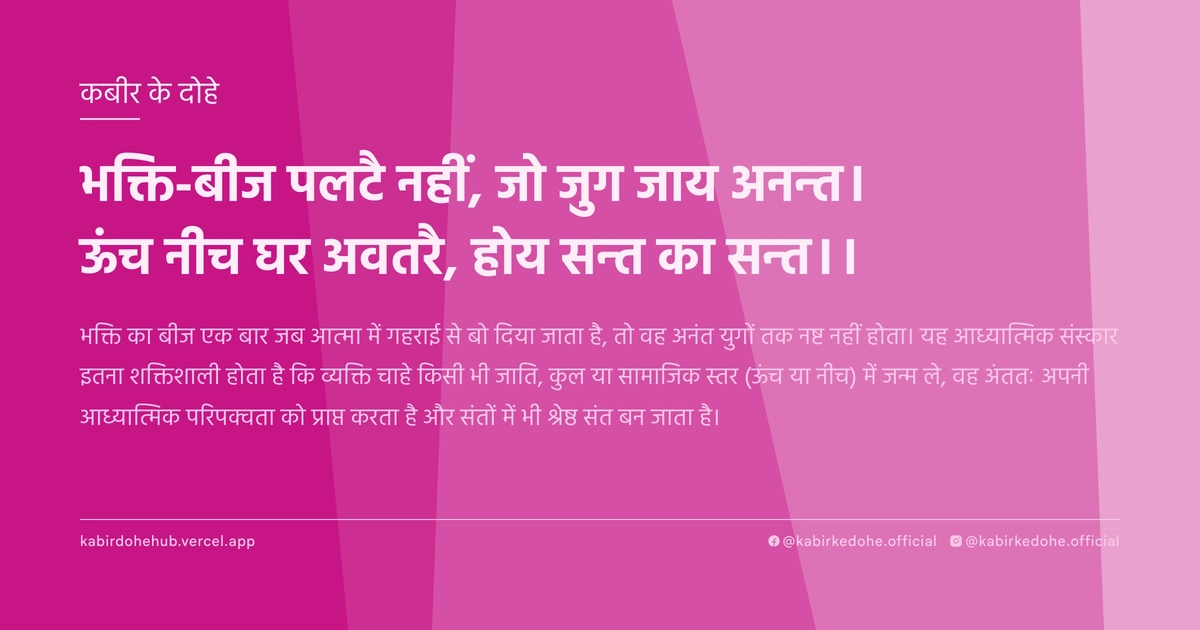
भक्ति-बीज पलटै नहीं, जो जुग जाय अनन्त।
ऊंच नीच घर अवतरै, होय सन्त का सन्त।।
Bhakti-beej palte nahin, jo jug jaaye anant. Oonch neech ghar avtarai, hoye sant ka sant.
इस पृष्ठ पर इस कबीर दोहे का अर्थ (meaning), हिंदी व्याख्या और अंग्रेज़ी अनुवाद, दार्शनिक विश्लेषण और व्यावहारिक जीवन सीख दी गई है। यह दोहा भक्ति (Bhakti) विषय से जुड़ा है — Kabir doha meaning and explanation in Hindi and English.
अर्थ (Meaning):
भक्ति का बीज एक बार जब आत्मा में गहराई से बो दिया जाता है, तो वह अनंत युगों तक नष्ट नहीं होता। यह आध्यात्मिक संस्कार इतना शक्तिशाली होता है कि व्यक्ति चाहे किसी भी जाति, कुल या सामाजिक स्तर (ऊंच या नीच) में जन्म ले, वह अंततः अपनी आध्यात्मिक परिपक्वता को प्राप्त करता है और संतों में भी श्रेष्ठ संत बन जाता है।
The seed of devotion, once deeply sown within the soul, remains indestructible across infinite cycles of time and rebirth. This spiritual imprint is so potent that regardless of the social strata or caste—be it high or low—into which a soul is born, they are destined to realize their divinity and emerge as a saint among saints.
व्याख्या (Interpretation):
यहाँ 'भक्ति-बीज' केवल पूजा-पाठ नहीं, बल्कि उस आत्म-बोध की चिंगारी है जो एक बार प्रज्वलित होने पर कभी नहीं बुझती। कबीर यह स्पष्ट करते हैं कि आध्यात्मिक प्रगति सामाजिक स्थिति से स्वतंत्र है। यह दोहा निरगुण भक्ति के उस सिद्धांत को पुष्ट करता है जहाँ ईश्वर किसी विशेष कुल का नहीं, बल्कि शुद्ध चेतना का है। माया व्यक्ति को विभिन्न जन्मों और पहचानों में उलझा सकती है, लेकिन आत्मा का मूल स्वभाव (अद्वैत) अपरिवर्तित रहता है। जब यह बीज अंकुरित होता है, तो यह व्यक्ति के अहंकार को नष्ट कर उसे ब्रह्म के साथ एकाकार कर देता है। यह एक विरोधाभास है कि भौतिक रूप से 'नीच' माना जाने वाला व्यक्ति आध्यात्मिक रूप से सर्वोच्च हो सकता है।
The 'seed of devotion' here refers not to ritualistic worship, but to the spark of self-realization that, once ignited, becomes eternal. Kabir asserts that spiritual evolution is entirely independent of social standing. This aligns with Nirgun Bhakti, where the Divine is not the property of a specific caste but is pure, formless consciousness. While Maya may entangle the soul in various births and identities, the essential nature of the Atman (non-duality) remains unchanged. When this seed sprouts, it annihilates the ego, merging the individual with the Brahman. It presents the profound paradox that one deemed 'lowly' by societal standards can be the most spiritually exalted.
दार्शनिक विश्लेषण (Philosophical Analysis):
कबीर का यह दोहा उस युग की सामाजिक कठोरता पर प्रहार है जहाँ मोक्ष को केवल उच्च वर्णों का विशेषाधिकार माना जाता था। वे यहाँ 'संस्कार' के सिद्धांत को प्रस्तुत करते हैं, जो यह बताता है कि आध्यात्मिक योग्यता जन्म से नहीं, बल्कि पिछले जन्मों के अभ्यास और आंतरिक खोज से आती है। यह विचार अद्वैत वेदांत के करीब है, जहाँ आत्मा की एकता पर बल दिया गया है और शरीर या जाति को केवल एक बाहरी आवरण माना गया है।
सूफी मत के 'इश्क-ए-इलाही' की तरह, कबीर यहाँ प्रेम और भक्ति को सर्वोच्च मानते हैं, जो सभी बाधाओं को पार कर जाता है। उनके लिए भक्ति कोई बाहरी क्रिया नहीं, बल्कि एक आंतरिक रूपांतरण है। वे कर्मकांडों का विरोध करते हुए यह समझाते हैं कि मंदिर या मस्जिद जाने से अधिक महत्वपूर्ण है उस 'बीज' को अपने भीतर पहचानना।
मनोवैज्ञानिक स्तर पर, यह दोहा व्यक्ति को उसकी वर्तमान परिस्थितियों से ऊपर उठने की प्रेरणा देता है। यह सिखाता है कि हमारी वर्तमान पहचान (नाम, पद, जाति) हमारी अंतिम नियति नहीं है। अहंकार का विसर्जन ही वह प्रक्रिया है जिससे 'भक्ति-बीज' फल देता है।
ऐतिहासिक रूप से, कबीर ने एक ऐसे समाज का निर्माण करना चाहा जहाँ मनुष्य की पहचान उसके गुणों से हो, न कि उसके जन्म से। उन्होंने यह स्थापित किया कि ईश्वर की कृपा और आत्म-ज्ञान किसी भी घर में अवतरित हो सकते हैं, चाहे वह महल हो या झोपड़ी।
अंततः, यह विश्लेषण हमें इस निष्कर्ष पर ले जाता है कि आध्यात्मिक यात्रा एक व्यक्तिगत यात्रा है। जब साधक यह समझ लेता है कि वह स्वयं ही वह सत्य है जिसे वह खोज रहा है, तब वह 'संतों का संत' बन जाता है, अर्थात वह पूर्णता को प्राप्त कर लेता है।
This couplet is a direct assault on the social rigidities of Kabir's era, where liberation (moksha) was viewed as the exclusive privilege of higher castes. He introduces the concept of 'Samskara' (spiritual impressions), suggesting that spiritual merit is derived not from birth, but from the cumulative practice and inner quest of previous existences. This mirrors Advaita Vedanta, which emphasizes the unity of the soul and views the body or caste as a mere external shell.
Similar to the Sufi concept of 'Ishq-e-Ilahi' (Divine Love), Kabir posits that devotion is the supreme force capable of transcending all worldly barriers. For him, Bhakti is not an external ritual but an internal alchemy. By rejecting ritualism, he explains that recognizing the 'seed' within is far more vital than visiting temples or mosques.
Psychologically, this teaching encourages individuals to rise above their current circumstances. It teaches that our current identity—name, rank, or caste—is not our ultimate destiny. The dissolution of the ego is the precise process through which the 'seed of devotion' bears fruit.
Historically, Kabir sought to envision a society where a human is identified by their virtues rather than their lineage. He established that divine grace and self-knowledge can manifest in any household, whether it be a palace or a hovel.
Ultimately, this analysis leads to the conclusion that the spiritual journey is deeply personal. When the seeker realizes that they are the very Truth they have been searching for, they become a 'saint among saints,' achieving a state of absolute wholeness.
मूल संदेश (Core Message):
- आध्यात्मिक योग्यता जन्म से नहीं, आंतरिक संस्कारों से आती है।
- अहंकार वह मिट्टी है जो भक्ति के बीज को दबा देती है।
- सच्ची भक्ति बाहरी आडंबरों से परे, आत्मा की गहराई में होती है।
- सामाजिक स्तर केवल एक भ्रम है; आत्मा का कोई वर्ण नहीं होता।
- धैर्य और समर्पण से कोई भी व्यक्ति सर्वोच्च संत बन सकता है।
- Spiritual merit is born of inner impressions, not social lineage.
- The ego is the soil that often smothers the seed of devotion.
- True devotion exists beyond rituals, in the depths of the soul.
- Social status is a mere illusion; the soul possesses no caste.
- Through patience and surrender, anyone can become a supreme saint.
व्यावहारिक उदाहरण (Practical Example):
वाराणसी के घाटों पर रहने वाले एक वृद्ध विधवा, जानकी, की कहानी है। समाज ने उन्हें 'अशुभ' मानकर किनारे कर दिया था। वे दिन भर दूसरों के लिए पानी भरने और छोटे-मोटे काम करने में बिताती थीं, लेकिन उनके भीतर एक शांत, अटूट विश्वास था। वे घंटों चुपचाप गंगा की लहरों को देखती रहतीं, बिना किसी मंत्र या माला के, बस एक गहरे मौन में डूबी रहती थीं।
शहर के बड़े पंडित और विद्वान उनके पास से गुजरते थे, उन्हें तुच्छ समझते हुए। लेकिन जानकी के भीतर वह 'भक्ति-बीज' था जो वर्षों के एकांत और दुख ने सींचा था। उन्होंने कभी किसी से कुछ नहीं मांगा, न ही किसी धर्मग्रंथ का अध्ययन किया, लेकिन उनका व्यवहार करुणा से भरा था।
एक दिन शहर में एक महान आध्यात्मिक गुरु आए। सभी विद्वान उनके चरणों में गिरकर अपनी विद्वत्ता का प्रदर्शन कर रहे थे। गुरु ने सबकी बातें सुनीं, लेकिन उनकी नजरें भीड़ के पीछे खड़ी उस साधारण, फटे कपड़ों वाली जानकी पर टिकी थीं।
गुरु ने सबको चुप कराया और जानकी की ओर इशारा करते हुए कहा, 'तुम सब शब्दों के जाल में उलझे हो, लेकिन इस माँ के भीतर वह मौन है जिसे पाने के लिए तुम हजारों साल तपस्या करते हो।'
पंडित हैरान थे। उन्होंने पूछा, 'यह तो एक साधारण विधवा है, इसने क्या पढ़ा है?' गुरु ने मुस्कुराकर उत्तर दिया, 'पढ़ाई दिमाग की होती है, लेकिन यह अनुभूति आत्मा की है। इनके भीतर भक्ति का वह बीज है जो अब पूर्ण वृक्ष बन चुका है।'
जानकी को अचानक महसूस हुआ कि जिस 'अशुभ' होने के बोझ को वे ढो रही थीं, वह केवल एक भ्रम था। उनकी आंतरिक शांति ने उन्हें बाहरी दुनिया की नफरत से मुक्त कर दिया था।
इस घटना ने शहर के लोगों की सोच बदल दी। उन्होंने महसूस किया कि पवित्रता किसी कुल या रीति-रिवाज में नहीं, बल्कि हृदय की सरलता और समर्पण में होती है।
जानकी ने अपनी शेष आयु अन्य उपेक्षित महिलाओं को सहारा देने और उन्हें यह सिखाने में बिताई कि ईश्वर उनके भीतर ही है।
यह 'कबीर ट्विस्ट' था—जहाँ समाज जिसे सबसे नीचे समझ रहा था, वह वास्तव में सबसे ऊपर थी। जानकी का जीवन यह प्रमाण बन गया कि भक्ति का बीज किसी भी परिस्थिति में फल दे सकता है।
अंत में, जानकी ने सिद्ध किया कि वास्तविक संत वह नहीं जो उपदेश दे, बल्कि वह है जिसका जीवन ही एक मौन प्रार्थना बन जाए।
Consider the story of Janaki, an elderly widow living on the ghats of Varanasi. Society had marginalized her, labeling her 'inauspicious.' She spent her days fetching water for others and performing menial tasks, yet within her resided a quiet, unbreakable faith. She would spend hours gazing at the ripples of the Ganges, immersed in a deep silence, without the need for mantras or prayer beads.
Great scholars and priests of the city passed by her, viewing her with disdain. However, within Janaki lay the 'seed of devotion,' nourished by years of solitude and sorrow. She never asked for anything, nor did she study scriptures, yet her every action was steeped in compassion.
One day, a renowned spiritual master visited the city. All the scholars flocked to him, attempting to impress him with their erudition. The master listened to them all, but his gaze remained fixed on Janaki, standing quietly at the back of the crowd in her tattered clothes.
The master silenced the crowd and pointed toward Janaki, saying, 'You are all entangled in the web of words, but this mother possesses the silence that you spend thousands of years of penance to achieve.'
The priests were shocked. 'She is a mere widow; what has she studied?' they asked. The master smiled and replied, 'Study is for the mind, but this is the realization of the soul. The seed of devotion within her has now become a full-grown tree.'
Janaki suddenly realized that the burden of being 'inauspicious,' which she had carried for so long, was merely an illusion. Her inner peace had liberated her from the hatred of the external world.
This event shifted the perspective of the townspeople. They realized that sanctity does not reside in lineage or ritual, but in the simplicity and surrender of the heart.
Janaki spent the remainder of her life supporting other marginalized women, teaching them that the Divine resides within them.
This was the 'Kabir Twist'—where the person deemed the lowest by society was actually the most exalted. Janaki's life became proof that the seed of devotion can fruit in any circumstance.
Ultimately, Janaki proved that a true saint is not one who preaches, but one whose very existence becomes a silent prayer.
अभ्यास मार्गदर्शन (Practice Guidance):
- दैनिक चिंतन: प्रतिदिन 20 मिनट मौन बैठें और यह विचार करें कि आपकी सामाजिक पहचान (नाम, पेशा, जाति) के पीछे वह कौन सी शाश्वत चेतना है जो कभी नहीं बदलती।
- आत्म-पूछताछ जर्नल: लिखें कि आपके जीवन में ऐसे कौन से क्षण थे जब आपने अपनी परिस्थितियों के बावजूद आंतरिक शांति महसूस की। क्या वह आपका 'भक्ति-बीज' था?
- व्यवहार परिवर्तन: दिन में कम से कम एक बार किसी ऐसे व्यक्ति की निस्वार्थ सेवा करें जिसे समाज 'नीच' या 'तुच्छ' मानता है, और उसमें अपने ही स्वरूप को देखें।
- निदान चेकलिस्ट: क्या आप अभी भी अपनी उपलब्धियों या पहचान पर गर्व करते हैं? क्या आप दूसरों को उनके कुल या पद से आंकते हैं? यदि हाँ, तो आपका बीज अभी भी अहंकार की परत के नीचे दबा है।
- Daily Contemplation: Sit in silence for 20 minutes daily and contemplate the eternal consciousness that exists behind your social identity (name, profession, caste) and remains unchanged.
- Self-Inquiry Journal: Document moments in your life where you felt an inexplicable inner peace despite adverse circumstances. Reflect on whether that was your 'seed of devotion' manifesting.
- Behavioral Shift: Once a day, perform a selfless act of service for someone whom society deems 'lowly' or 'insignificant,' consciously recognizing your own essence within them.
- Diagnostic Checklist: Do you still take pride in your achievements or social status? Do you judge others by their lineage or rank? If yes, your seed is still buried beneath the layers of ego.
चिंतन प्रश्न (Reflection Questions):
- यदि आपकी सारी सामाजिक पहचान (डिग्री, पैसा, पद) छीन ली जाए, तो आपके भीतर क्या बचेगा?
- क्या आप वास्तव में उस व्यक्ति का सम्मान कर पाएंगे जो आपसे सामाजिक स्तर में बहुत नीचे है, लेकिन आपसे अधिक शांत है?
- आपका 'डिजिटल ईगो' (सोशल मीडिया पहचान) आपके वास्तविक आध्यात्मिक विकास में कैसे बाधा बन रहा है?
- क्या आप अपनी कमियों को स्वीकार करने का साहस रखते हैं, या आप उन्हें अपनी सामाजिक छवि के पीछे छिपाते हैं?
- वह कौन सा 'बीज' है जो आपके भीतर है, लेकिन आपने उसे दुनिया के डर से कभी अंकुरित नहीं होने दिया?
- If all your social identifiers (degrees, wealth, titles) were stripped away, what would remain within you?
- Could you truly respect someone who is socially far below you but possesses far more inner peace?
- How is your 'digital ego' (social media persona) obstructing your actual spiritual evolution?
- Do you have the courage to acknowledge your shadows, or do you hide them behind your public image?
- What is the 'seed' within you that you have never allowed to sprout due to the fear of worldly judgment?