
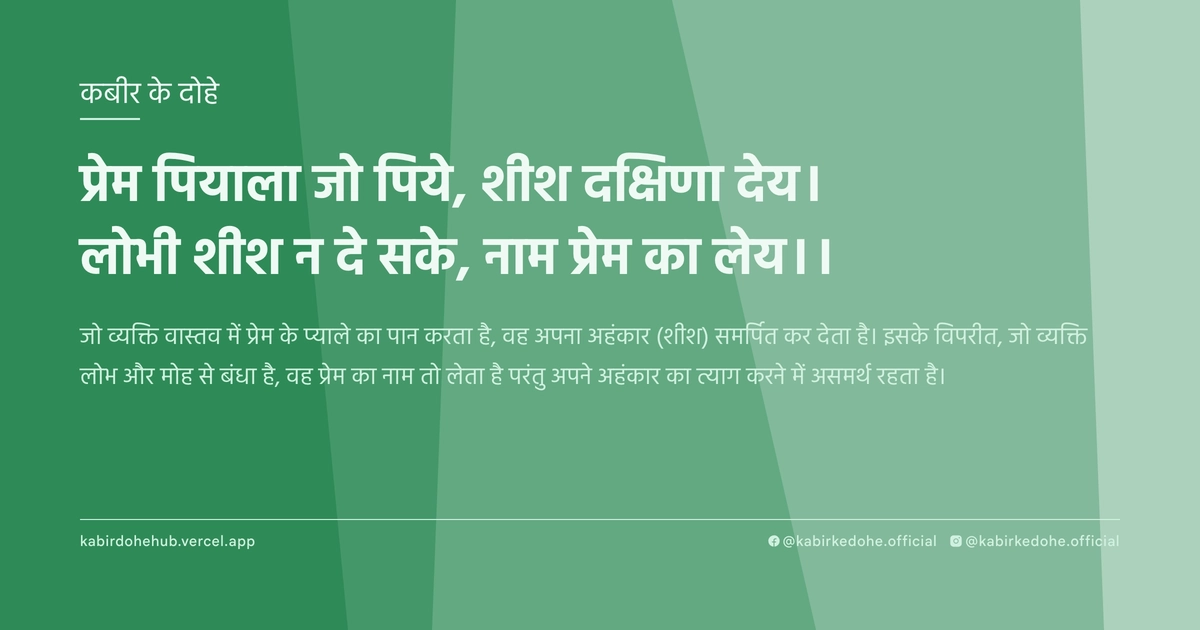
प्रेम पियाला जो पिये, शीश दक्षिणा देय।
लोभी शीश न दे सके, नाम प्रेम का लेय।।
Prem piyala jo piye, sheesh dakshina dey. Lobhi sheesh na de sake, naam prem ka ley.
इस पृष्ठ पर इस कबीर दोहे का अर्थ (meaning), हिंदी व्याख्या और अंग्रेज़ी अनुवाद, दार्शनिक विश्लेषण और व्यावहारिक जीवन सीख दी गई है। यह दोहा भक्ति (Bhakti) विषय से जुड़ा है — Kabir doha meaning and explanation in Hindi and English.
अर्थ (Meaning):
जो व्यक्ति वास्तव में प्रेम के प्याले का पान करता है, वह अपना अहंकार (शीश) समर्पित कर देता है। इसके विपरीत, जो व्यक्ति लोभ और मोह से बंधा है, वह प्रेम का नाम तो लेता है परंतु अपने अहंकार का त्याग करने में असमर्थ रहता है।
Whoever truly drinks from the cup of divine love offers their head—their ego—as a tribute. In contrast, the greedy person may claim to love or chant the name of love, but they are incapable of sacrificing their pride and sense of self.
व्याख्या (Interpretation):
यहाँ 'प्रेम का प्याला' परमात्मा के प्रति अनन्य भक्ति का प्रतीक है। 'शीश' का अर्थ भौतिक सिर नहीं, बल्कि 'अहंकार' और 'मैं' की भावना है। यह दोहा निरगुण भक्ति की उस अवस्था को दर्शाता है जहाँ साधक और ईश्वर के बीच का द्वैत समाप्त हो जाता है। माया के प्रभाव में मनुष्य स्वयं को शरीर और पद मानता है, जबकि अद्वैत वेदांत के अनुसार आत्मा और ब्रह्म एक हैं। जब तक 'मैं' जीवित है, तब तक 'वह' (परमात्मा) प्रकट नहीं हो सकता। यह विरोधाभास है कि जिसे हम अपना सबसे मूल्यवान हिस्सा (अहंकार) मानते हैं, वही आध्यात्मिक जागृति के मार्ग में सबसे बड़ी बाधा है।
The 'cup of love' symbolizes absolute devotion to the Formless Divine. The 'head' does not refer to a physical organ but to the 'ego' and the illusory sense of 'I'. This verse illustrates the state of Nirgun Bhakti where the duality between the seeker and the Divine dissolves. Under the influence of Maya, humans identify with the body and social status, whereas Advaita Vedanta posits the non-duality of Atman and Brahman. As long as the 'I' persists, the 'Divine' cannot be realized. It is a profound paradox that the very thing we guard most fiercely—our identity and pride—is the primary obstacle to spiritual liberation.
दार्शनिक विश्लेषण (Philosophical Analysis):
कबीर का यह दोहा मध्यकालीन भारत के उस सामाजिक-धार्मिक परिवेश से उपजा है जहाँ कर्मकांड और बाहरी आडंबर चरम पर थे। कबीर ने स्पष्ट किया कि ईश्वर की प्राप्ति किसी मंदिर, मस्जिद या कठिन अनुष्ठान से नहीं, बल्कि हृदय की शुद्धता और पूर्ण समर्पण से होती है। यहाँ 'शीश' देना वास्तव में 'अहंकार की मृत्यु' (Fana) है, जो सूफीवाद का एक केंद्रीय सिद्धांत है। सूफी मत में 'फना' का अर्थ है स्वयं को ईश्वर की इच्छा में विलीन कर देना।
अद्वैत वेदांत के दृष्टिकोण से, यह दोहा अविद्या के विनाश की बात करता है। जब तक व्यक्ति स्वयं को कर्ता मानता है, वह माया के जाल में फँसा रहता है। प्रेम का प्याला पीना उस ज्ञानोदय की प्रक्रिया है जहाँ साधक यह अनुभव करता है कि वह अलग नहीं, बल्कि उसी अनंत चेतना का हिस्सा है। यह प्रक्रिया मनोवैज्ञानिक रूप से अत्यंत कठिन है क्योंकि मनुष्य अपनी पहचान खोने से डरता है।
कबीर जातिगत श्रेष्ठता और धार्मिक कट्टरता का विरोध करते हैं क्योंकि ये दोनों ही अहंकार के विभिन्न रूप हैं। एक ब्राह्मण का अपना ज्ञान और एक मुल्ला का अपना धर्म—दोनों ही 'शीश' हैं जिन्हें दक्षिणा के रूप में देना होगा। यदि कोई केवल शब्दों से प्रेम का दावा करता है, तो वह 'लोभी' है, क्योंकि वह अपनी झूठी पहचान को छोड़ने का साहस नहीं जुटा पाता।
यह शिक्षण हमें सिखाता है कि वास्तविक भक्ति 'पाने' के बारे में नहीं, बल्कि 'खोने' के बारे में है। जब हम अपनी इच्छाओं, धारणाओं और श्रेष्ठता के बोध को त्याग देते हैं, तभी हम उस शून्य में प्रवेश करते हैं जहाँ परमात्मा निवास करता है। यह शून्य ही पूर्णता है।
अंततः, कबीर यह संदेश देते हैं कि प्रेम कोई भावना नहीं, बल्कि एक कठोर अनुशासन है। यह स्वयं को मिटाने की प्रक्रिया है। जो स्वयं को मिटा देता है, वह वास्तव में अमर हो जाता है क्योंकि वह अब व्यक्तिगत सीमित अस्तित्व से ऊपर उठकर सार्वभौमिक चेतना का हिस्सा बन चुका है।
This verse emerges from the socio-religious climate of medieval India, where ritualism and external displays of piety were rampant. Kabir asserts that the Divine is not attained through temples, mosques, or rigorous rituals, but through purity of heart and absolute surrender. The act of 'giving the head' is essentially the 'death of the ego' (Fana), a central tenet of Sufism. In the Sufi tradition, Fana represents the annihilation of the individual self in the will of the Beloved.
From the lens of Advaita Vedanta, this doha speaks to the destruction of Avidya (ignorance). As long as an individual perceives themselves as the 'doer' or the center of the universe, they remain trapped in the web of Maya. Drinking the cup of love is the process of enlightenment where the seeker realizes they are not separate but an integral part of the infinite consciousness.
Psychologically, this transition is arduous because the human mind clings to its identity. Kabir critiques caste superiority and religious bigotry as mere extensions of the ego. Whether it is a priest's pride in scripture or a cleric's pride in dogma, both are 'heads' that must be offered as tribute. One who claims to love through words alone is 'greedy' because they lack the courage to relinquish their false identity.
The teaching emphasizes that true devotion is not about 'acquisition' but about 'loss'. When we discard our desires, preconceived notions, and sense of superiority, we enter the void where the Divine resides. This void is, in fact, the ultimate fullness (Purnam).
Ultimately, Kabir conveys that love is not a mere emotion but a rigorous spiritual discipline. It is the process of self-effacement. He who erases himself becomes immortal, for they have transcended the limited personal existence to merge with the universal consciousness.
मूल संदेश (Core Message):
- अहंकार वह पर्दा है जो ईश्वर और आत्मा के बीच खड़ा है।
- प्रेम केवल भावना नहीं, बल्कि स्वयं के विसर्जन की प्रक्रिया है।
- बिना समर्पण के भक्ति केवल एक मानसिक व्यायाम है।
- सच्ची प्राप्ति केवल पूर्ण त्याग के बाद ही संभव है।
- जब 'मैं' मिटता है, तभी 'वह' अनंत प्रकट होता है।
- The ego is the veil standing between the Soul and the Divine.
- Love is not a mere emotion, but the process of self-dissolution.
- Devotion without surrender is nothing more than a mental exercise.
- True attainment is possible only after absolute renunciation.
- Only when the 'I' vanishes does the Infinite manifest.
व्यावहारिक उदाहरण (Practical Example):
वाराणसी के एक पुराने घाट पर माधव नाम का एक वृद्ध बुनकर रहता था। माधव अपनी कला में इतना निपुण था कि पूरे शहर में उसके बनाए कपड़ों की चर्चा थी। उसकी इस ख्याति ने उसके भीतर एक सूक्ष्म अहंकार भर दिया था। वह मानता था कि उसकी कला उसे अन्य बुनकरों से श्रेष्ठ बनाती है। वह नियमित रूप से सत्संग में जाता और प्रेम की बातें करता, लेकिन जब कोई उससे उसकी तकनीक सीखने आता, तो वह उसे नीचा दिखाता था।
एक दिन एक फकीर उसके पास आया और उससे एक साधारण सा कपड़ा माँगा। माधव ने गर्व से अपना सबसे महंगा कपड़ा दिखाया और कहा, "इसे देखो, ऐसी बारीकी कोई और नहीं ला सकता।"
फकीर मुस्कुराया और बोला, "कपड़ा तो सुंदर है, लेकिन इसे बनाने वाला अभी भी एक छोटे से धागे की तरह उलझा हुआ है। तुम प्रेम का नाम लेते हो, पर क्या तुमने अपना वह 'मैं' दिया जो तुम्हें दूसरों से बड़ा दिखाता है?"
माधव को पहले तो गुस्सा आया, लेकिन फकीर की आँखों में एक अजीब सी शांति थी। वह रात भर सो नहीं सका। उसे महसूस हुआ कि वह जिसे अपनी 'उपलब्धि' समझ रहा था, वह वास्तव में उसकी बेड़ियाँ थीं। उसने महसूस किया कि वह प्रेम का प्याला तो पीना चाहता था, लेकिन अपना 'शीश' (अहंकार) देने को तैयार नहीं था।
अगली सुबह, माधव ने अपनी सारी श्रेष्ठता का त्याग कर दिया। उसने अपने प्रतिद्वंद्वियों को बुलाया और उन्हें अपनी गुप्त तकनीकें सिखाने लगा। उसने महसूस किया कि जब उसने 'मैं श्रेष्ठ हूँ' का विचार छोड़ा, तो उसे एक ऐसी शांति मिली जो उसने कभी नहीं जानी थी।
उसने देखा कि अब वह केवल कपड़े नहीं बुन रहा था, बल्कि लोगों के दिलों को जोड़ रहा था। उसकी कला अब उसकी पहचान नहीं, बल्कि उसकी सेवा बन गई थी।
उसकी पत्नी ने देखा कि माधव अब पहले से अधिक खुश और शांत था। उसका चेहरा चमकने लगा था क्योंकि उसके भीतर का संघर्ष समाप्त हो गया था।
माधव ने समझ लिया कि वास्तविक प्रेम वह नहीं जो हमें विशिष्ट बनाए, बल्कि वह है जो हमें सबके साथ एक कर दे।
उसने फकीर के चरणों में झुककर कहा, "आज मैंने वास्तव में प्रेम का प्याला पिया है, क्योंकि अब मेरा 'मैं' मर चुका है।"
यह बदलाव उसके जीवन में एक स्थायी शांति लेकर आया और वह वास्तव में एक मुक्त आत्मा बन गया।
In the ancient ghats of Varanasi lived an elderly weaver named Madhav. Madhav was so skilled in his craft that his fabrics were renowned throughout the city. This fame had quietly seeded a subtle ego within him. He believed his artistry made him superior to all other weavers. He attended spiritual gatherings and spoke of love, yet whenever a peer sought to learn his technique, he would subtly belittle them.
One day, a wandering fakir approached him and asked for a simple piece of cloth. Madhav proudly displayed his most expensive work and declared, "Look at this; no one else can achieve such intricacy."
The fakir smiled and replied, "The cloth is beautiful, but the maker is still entangled like a small, knotted thread. You speak the name of love, but have you offered your 'head'—that pride which makes you feel greater than others?"
Initially, Madhav felt insulted, but the profound peace in the fakir's eyes haunted him. He could not sleep that night. He realized that what he considered his 'achievement' was actually his shackle. He understood that while he desired the bliss of divine love, he was unwilling to sacrifice his ego.
The next morning, Madhav renounced his sense of superiority. He invited his rivals and began teaching them his secret techniques without reservation.
He discovered that the moment he let go of the thought "I am the best," he experienced a tranquility he had never known before.
He noticed that he was no longer just weaving fabric; he was weaving connections between hearts. His art ceased to be his identity and became his service.
His wife observed that Madhav was now happier and more serene. His face glowed because the internal conflict between his image and his reality had vanished.
Madhav realized that true love is not that which makes us distinct or special, but that which merges us with everyone.
He bowed before the fakir and said, "Today, I have truly drunk from the cup of love, for my 'I' has finally died."
This transformation brought a permanent peace to his life, and he truly became a liberated soul.
अभ्यास मार्गदर्शन (Practice Guidance):
- प्रतिदिन 20 मिनट मौन ध्यान करें, जहाँ आप अपने भीतर उठने वाले 'मैं' (अहंकार) के विचारों को केवल एक साक्षी की तरह देखें, बिना उनसे जुड़े।
- स्व-पूछताछ जर्नल: प्रतिदिन लिखें कि आज किस क्षण में मुझे लगा कि मैं दूसरों से श्रेष्ठ हूँ या मुझे मान्यता (Validation) चाहिए थी।
- अहंकार-त्याग अभ्यास: सप्ताह में एक बार ऐसा कार्य करें जिसमें आप अपनी पहचान छिपाकर किसी की निस्वार्थ सेवा करें, ताकि 'कर्ता' होने का भाव मिट सके।
- डायग्नोस्टिक चेकलिस्ट: क्या मैं किसी की आलोचना सुनकर विचलित होता हूँ? क्या मैं अपनी उपलब्धियों का श्रेय लेने के लिए उत्सुक रहता हूँ? यदि हाँ, तो समझें कि 'शीश' अभी समर्पित नहीं हुआ है।
- Practice 20 minutes of silent meditation daily, observing the arising thoughts of 'I' (ego) as a witness without attaching yourself to them.
- Self-Inquiry Journaling: Record daily instances where you felt superior to others or felt a craving for external validation.
- Ego-Dissolution Exercise: Once a week, perform an act of selfless service anonymously, ensuring that the sense of being the 'doer' is completely removed.
- Diagnostic Checklist: Do I feel disturbed by criticism? Am I eager to take credit for my achievements? If yes, recognize that the 'head' has not yet been surrendered.
चिंतन प्रश्न (Reflection Questions):
- मेरी वह कौन सी पहचान है जिसे खोने के विचार से ही मुझे डर लगता है?
- क्या मेरा 'प्रेम' वास्तव में दूसरे के लिए है, या यह मेरी अपनी छवि को बेहतर बनाने का एक तरीका है?
- जब मैं दूसरों की मदद करता हूँ, तो क्या मैं गुप्त रूप से अपनी श्रेष्ठता का आनंद ले रहा होता हूँ?
- मेरे जीवन का वह कौन सा 'शीश' (अहंकार) है जिसे मैं आज भी दक्षिणा के रूप में देने से बच रहा हूँ?
- यदि मेरी सारी उपलब्धियाँ और पद छीन लिए जाएँ, तो क्या मेरे भीतर कुछ बचेगा जिसे मैं 'मैं' कह सकूँ?
- Which part of my identity am I most terrified of losing?
- Is my 'love' truly for the other, or is it a tool to enhance my own self-image?
- When I help others, am I secretly enjoying the feeling of superiority?
- What is the specific 'head' (ego) in my life that I am still refusing to offer as a tribute?
- If all my achievements and titles were stripped away, would there be anything left that I could call 'I'?