
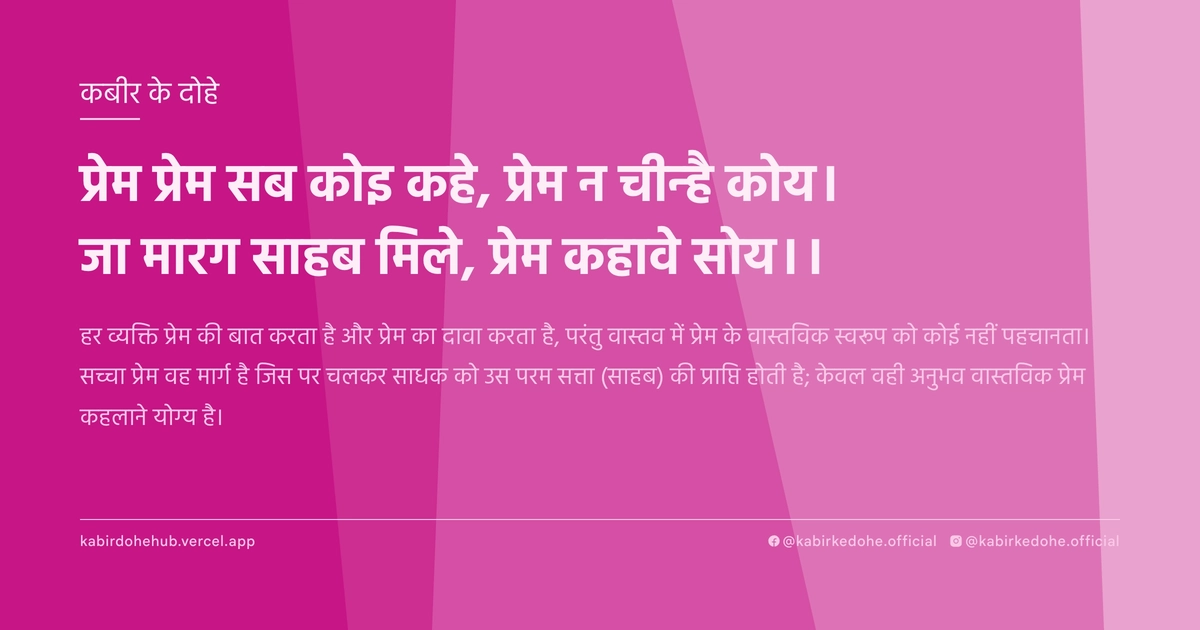
प्रेम प्रेम सब कोइ कहे, प्रेम न चीन्है कोय।
जा मारग साहब मिले, प्रेम कहावे सोय।।
Prem prem sab koi kahe, prem na chinne koy. Ja maarag sahab mile, prem kahaave soy.
इस पृष्ठ पर इस कबीर दोहे का अर्थ (meaning), हिंदी व्याख्या और अंग्रेज़ी अनुवाद, दार्शनिक विश्लेषण और व्यावहारिक जीवन सीख दी गई है। यह दोहा भक्ति (Bhakti) विषय से जुड़ा है — Kabir doha meaning and explanation in Hindi and English.
अर्थ (Meaning):
हर व्यक्ति प्रेम की बात करता है और प्रेम का दावा करता है, परंतु वास्तव में प्रेम के वास्तविक स्वरूप को कोई नहीं पहचानता। सच्चा प्रेम वह मार्ग है जिस पर चलकर साधक को उस परम सत्ता (साहब) की प्राप्ति होती है; केवल वही अनुभव वास्तविक प्रेम कहलाने योग्य है।
Everyone speaks of love and claims to know it, yet few truly recognize its essence. True love is not an emotion but a spiritual path; only that devotion which leads the seeker to the ultimate Divine (Sahab) can be rightfully called love.
व्याख्या (Interpretation):
कबीर यहाँ 'प्रेम' शब्द के सामाजिक और आध्यात्मिक विरोधाभास को उजागर करते हैं। शाब्दिक अर्थ में, वे कहते हैं कि लोग प्रेम को केवल एक शब्द या भावना मानते हैं, जबकि यह वास्तव में एक साधना है। आध्यात्मिक स्तर पर, यह 'प्रेम' कामुकता या मोह से परे 'निर्गुण भक्ति' की ओर संकेत करता है। यहाँ 'साहब' शब्द उस निराकार ब्रह्म का प्रतीक है जो व्यक्ति के भीतर स्थित है। माया के प्रभाव में मनुष्य बाहरी संबंधों को प्रेम समझ लेता है, जबकि वास्तविक प्रेम वह है जो अहंकार का विसर्जन कर आत्मा का परमात्मा से मिलन कराए। यह अद्वैत वेदांत के उस सिद्धांत को पुष्ट करता है जहाँ प्रेमी और प्रिय के बीच का अंतर समाप्त हो जाता है।
Kabir highlights the paradox between the social usage of 'love' and its spiritual reality. Literally, he asserts that people mistake love for a mere word or emotion, whereas it is actually a rigorous discipline. On a deeper level, this 'love' refers to Nirgun Bhakti, transcending lust and attachment. The term 'Sahab' symbolizes the formless Absolute residing within. Under the influence of Maya, humans mistake external attachments for love, while true love is the dissolution of the ego that merges the Atman with Brahman. This aligns with Advaita Vedanta, where the duality between the lover and the beloved vanishes in a state of non-dual oneness.
दार्शनिक विश्लेषण (Philosophical Analysis):
कबीर का यह दोहा उस युग की प्रतिक्रिया है जहाँ धर्म केवल कर्मकांडों और बाहरी दिखावे तक सीमित था। वे प्रेम को किसी मंदिर, मस्जिद या विशेष जाति के अधिकार से मुक्त कर इसे एक सार्वभौमिक आध्यात्मिक अनुभव बनाते हैं। उनके लिए प्रेम कोई भावना नहीं, बल्कि एक 'मार्ग' (रास्ता) है। यह सूफी मत के 'इश्क-ए-हकीकी' (दिव्य प्रेम) के अत्यंत निकट है, जहाँ साधक स्वयं को मिटाकर ईश्वर में विलीन हो जाता है।
यहाँ कबीर ritualism (कर्मकांड) का खंडन करते हैं। वे तर्क देते हैं कि यदि आपका प्रेम आपको सत्य और परमात्मा की ओर नहीं ले जा रहा, तो वह केवल एक मानसिक भ्रम है। यह विश्लेषण दर्शाता है कि प्रेम वास्तव में अहंकार की मृत्यु है। जब तक 'मैं' जीवित है, तब तक प्रेम संभव नहीं है, क्योंकि प्रेम में केवल 'वह' होना चाहिए।
अद्वैत वेदांत के परिप्रेक्ष्य में, यह दोहा जीव और ईश्वर की एकता की बात करता है। कबीर कहते हैं कि प्रेम वह सेतु है जो द्वैत (दो होने का भाव) को मिटाकर अद्वैत (एकता) की स्थापना करता है। यह मनोवैज्ञानिक रूपांतरण की प्रक्रिया है जहाँ व्यक्ति अपनी सीमित पहचान को त्यागकर अनंतता को अपनाता है।
सांस्कृतिक रूप से, कबीर ने उस समय के समाज को चुनौती दी जो प्रेम को केवल सांसारिक सुखों तक सीमित रखता था। उन्होंने प्रेम को एक क्रांतिकारी उपकरण के रूप में प्रस्तुत किया जो जाति, धर्म और सामाजिक स्तर की दीवारों को गिरा देता है।
अंततः, यह दोहा हमें चेतावनी देता है कि शब्दों का आडंबर सत्य का विकल्प नहीं हो सकता। वास्तविक प्रेम वह है जो अनुभव किया जाए, न कि वह जिसे केवल बोला जाए। यह 'अनुभव' ही वह कसौटी है जिससे प्रेम की शुद्धता जांची जाती है।
This couplet is a reaction to an era where religion was confined to rituals and external displays. Kabir liberates love from the confines of temples, mosques, or specific castes, transforming it into a universal spiritual experience. For him, love is not an emotion but a 'Maarag' (path), closely mirroring the Sufi concept of 'Ishq-e-Haqiqi' (divine love), where the seeker annihilates the self to merge with the Divine.
Kabir explicitly rejects ritualism here. He argues that if your love does not lead you toward Truth and the Absolute, it is merely a mental illusion. This analysis reveals that love is, in essence, the death of the ego. As long as the 'I' exists, true love is impossible, for love requires the total presence of the 'Other' or the Divine.
From the perspective of Advaita Vedanta, this doha speaks of the unity between the Jiva (individual soul) and Ishvara (Universal Soul). Kabir suggests that love is the bridge that erases duality (Dvaita) and establishes non-duality (Advaita). It is a process of psychological transformation where the individual sheds their limited identity to embrace infinity.
Culturally, Kabir challenged a society that restricted love to worldly pleasures. He presented love as a revolutionary tool capable of tearing down the walls of caste, creed, and social hierarchy.
Ultimately, the couplet warns that the ornamentation of words cannot substitute for Truth. Real love is that which is experienced, not merely spoken. This 'experience' is the only litmus test for the purity of love.
मूल संदेश (Core Message):
- प्रेम शब्दों में नहीं, बल्कि अनुभव की गहराई में बसता है।
- मोह और प्रेम के बीच का सूक्ष्म अंतर पहचानना ही पहली जागृति है।
- अहंकार का विसर्जन ही उस दिव्य मिलन का एकमात्र द्वार है।
- सच्चा प्रेम वह है जो आपको आपकी सीमित पहचान से मुक्त करे।
- परमात्मा की प्राप्ति किसी बाहरी कर्मकांड से नहीं, बल्कि हृदय की शुद्धता से होती है।
- Love resides not in words, but in the depths of direct experience.
- Recognizing the subtle gap between attachment and love is the first awakening.
- The dissolution of the ego is the only gateway to the Divine union.
- True love is that which liberates you from your limited identity.
- Realization of the Divine comes not through rituals, but through purity of heart.
व्यावहारिक उदाहरण (Practical Example):
एक समय की बात है, वाराणसी के घाटों पर माधव नाम का एक वृद्ध बुनकर रहता था। माधव अपनी पूरी जिंदगी रेशमी धागों से सुंदर वस्त्र बुनने में बिता चुका था, लेकिन उसका मन हमेशा अशांत रहता था। वह अक्सर मंदिर जाता और ईश्वर से प्रेम की याचना करता, यह मानते हुए कि प्रेम वह सुख है जो उसे बाहरी दुनिया से मिलेगा।
माधव का एक बेटा था, जो शहर जाकर बड़ा व्यापारी बन गया था। बेटा साल में एक बार आता, महंगे उपहार लाता और कहता, "पिताजी, मैं आपसे बहुत प्रेम करता हूँ।"
माधव को लगता कि यही प्रेम है। लेकिन उसके भीतर एक खालीपन था। एक दिन उसकी मुलाकात एक फकीर से हुई, जिसने माधव के चेहरे पर छिपी तड़प को पहचान लिया। फकीर ने उससे पूछा, "तुम प्रेम की बात करते हो, पर क्या तुमने उस प्रेम को देखा है जो तुम्हें तुम्हारे 'स्व' से अलग कर दे?"
माधव उलझन में पड़ गया। उसने कहा, "मेरा बेटा मुझे प्रेम करता है, वह मेरी सेवा करता है।"
फकीर मुस्कुराया और बोला, "वह प्रेम नहीं, वह केवल कर्तव्य और मोह है। सच्चा प्रेम वह है जहाँ तुम यह भूल जाओ कि तुम कौन हो, और केवल वह शेष रहे जिसे तुम खोज रहे हो।"
माधव ने इस बात पर विचार करना शुरू किया। उसने महसूस किया कि उसका अपने बेटे के प्रति प्रेम वास्तव में एक 'अधिकार' था, एक मोह था कि उसका बेटा उसकी विरासत को आगे बढ़ाए। वह प्रेम नहीं, बल्कि एक सूक्ष्म अहंकार था।
अगले कुछ महीनों तक, माधव ने अपने काम को ही प्रार्थना बना लिया। जब वह करघे पर धागे पिरोता, तो वह यह नहीं सोचता था कि वह कपड़ा बेचकर पैसे कमाएगा, बल्कि वह हर धागे में उस निराकार साहब को देखने की कोशिश करता।
धीरे-धीरे, उसका मोह कम होने लगा। उसने महसूस किया कि वह अपने बेटे से प्रेम नहीं करता था, बल्कि उस छवि से करता था जो उसने अपने बेटे के लिए बनाई थी। जब उसने इस भ्रम को तोड़ा, तो उसे एक असीम शांति का अनुभव हुआ।
एक दिन उसका बेटा आया और उसने फिर से वही औपचारिक प्रेम जताया। लेकिन इस बार माधव ने उसे एक अलग दृष्टि से देखा। उसने महसूस किया कि उसका बेटा भी उसी माया के जाल में फँसा है।
माधव ने अब अपने बेटे को नियंत्रित करना या उससे अपेक्षाएं रखना छोड़ दिया। उसने बिना किसी शर्त के, बिना किसी स्वार्थ के, उसे स्वीकार करना शुरू किया। यही वह 'कबीर ट्विस्ट' था—जब माधव का प्रेम 'पाने' की इच्छा से 'होने' की अवस्था में बदल गया। उसे अब मंदिर जाने की जरूरत नहीं थी; उसका करघा ही उसका मंदिर बन गया और उसका हर सांस उस 'साहब' का मिलन बन गया।
Once, in the ghats of Varanasi, lived an elderly weaver named Madhav. Madhav had spent his entire life weaving beautiful silk fabrics, yet his mind remained perpetually restless. He frequently visited temples, praying for love, believing love was a pleasure to be acquired from the external world.
Madhav had a son who had become a wealthy merchant in the city. The son visited once a year, bringing expensive gifts and saying, "Father, I love you very much."
Madhav believed this was love. However, an inner void persisted. One day, he met a wandering fakir who recognized the hidden longing in Madhav's eyes. The fakir asked, "You speak of love, but have you seen the love that separates you from your 'self'?"
Madhav was confused. He replied, "My son loves me; he serves me."
The fakir smiled and said, "That is not love; it is merely duty and attachment. True love is where you forget who you are, and only that which you seek remains."
Madhav began to contemplate this. He realized that his love for his son was actually a form of 'ownership'—an attachment to the idea that his son would carry forward his legacy. It wasn't love, but a subtle ego.
Over the next few months, Madhav turned his work into a prayer. As he threaded the loom, he stopped thinking about the profit from the cloth and instead tried to see the formless 'Sahab' in every thread.
Gradually, his attachment faded. He realized he didn't love his son, but rather the image he had created of his son. When he broke this illusion, he experienced an infinite peace.
One day his son returned and expressed the same formal love. But this time, Madhav looked at him with a different gaze. He realized his son was also trapped in the same web of Maya.
Madhav stopped trying to control his son or holding expectations. He began to accept him without condition or selfishness. This was the 'Kabir Twist'—when Madhav's love shifted from the desire to 'possess' to the state of 'being'. He no longer needed the temple; his loom became his sanctuary, and every breath became a union with the 'Sahab'.
अभ्यास मार्गदर्शन (Practice Guidance):
- प्रतिदिन 20 मिनट मौन ध्यान करें, जहाँ आप किसी भी भावना या विचार को पकड़ने के बजाय केवल अपनी सांसों के माध्यम से भीतर के 'साहब' को महसूस करें।
- स्व-पूछताछ जर्नल (Self-Inquiry Journal) लिखें: "मेरे जीवन में जिसे मैं प्रेम कहता हूँ, क्या वह वास्तव में दूसरे की भलाई है या मेरी अपनी इच्छाओं की संतुष्टि?"
- व्यवहार परिवर्तन: दिन में कम से कम एक ऐसा कार्य करें जिसमें आपका कोई निजी लाभ न हो और जिसे आप पूरी तरह से निस्वार्थ भाव से करें।
- निदान चेकलिस्ट (Diagnostic Checklist): क्या मैं प्रेम के नाम पर नियंत्रण चाहता हूँ? क्या मेरी शांति दूसरे के व्यवहार पर निर्भर है? यदि हाँ, तो यह मोह है, प्रेम नहीं।
- Practice 20 minutes of silent meditation daily, focusing on feeling the inner 'Sahab' through your breath rather than clinging to emotions or thoughts.
- Maintain a Self-Inquiry Journal: Ask, "Is what I call love in my life truly for the well-being of the other, or is it the satisfaction of my own desires?"
- Behavioral Shift: Perform at least one act daily that offers no personal gain and is done with absolute selflessness.
- Diagnostic Checklist: Do I seek control in the name of love? Is my peace dependent on another's behavior? If yes, it is attachment, not love.
चिंतन प्रश्न (Reflection Questions):
- क्या मेरा प्रेम वास्तव में दूसरे को स्वतंत्र करता है, या वह उन्हें मेरी उम्मीदों के पिंजरे में कैद करता है?
- यदि मेरी सामाजिक पहचान और उपलब्धियां छीन ली जाएं, तो क्या मैं अभी भी स्वयं को प्रेम करने योग्य पाऊंगा?
- मैं अपने डिजिटल व्यक्तित्व (Social Media Ego) के माध्यम से जिस प्रेम का प्रदर्शन करता हूँ, वह वास्तविकता से कितना दूर है?
- मेरे जीवन का वह कौन सा गुप्त पूर्वाग्रह (Hidden Bias) है जो मुझे वास्तव में निस्वार्थ प्रेम करने से रोकता है?
- क्या मैं 'साहब' को बाहर खोज रहा हूँ, या मैंने अपने भीतर के शोर को शांत कर उसे सुनने का साहस किया है?
- Does my love truly liberate the other, or does it imprison them within the cage of my expectations?
- If my social identity and achievements were stripped away, would I still find myself worthy of love?
- How far is the love I project through my digital persona (Social Media Ego) from my actual reality?
- What hidden bias in my life prevents me from loving with absolute selflessness?
- Am I searching for 'Sahab' externally, or have I dared to silence my inner noise to hear Him?