
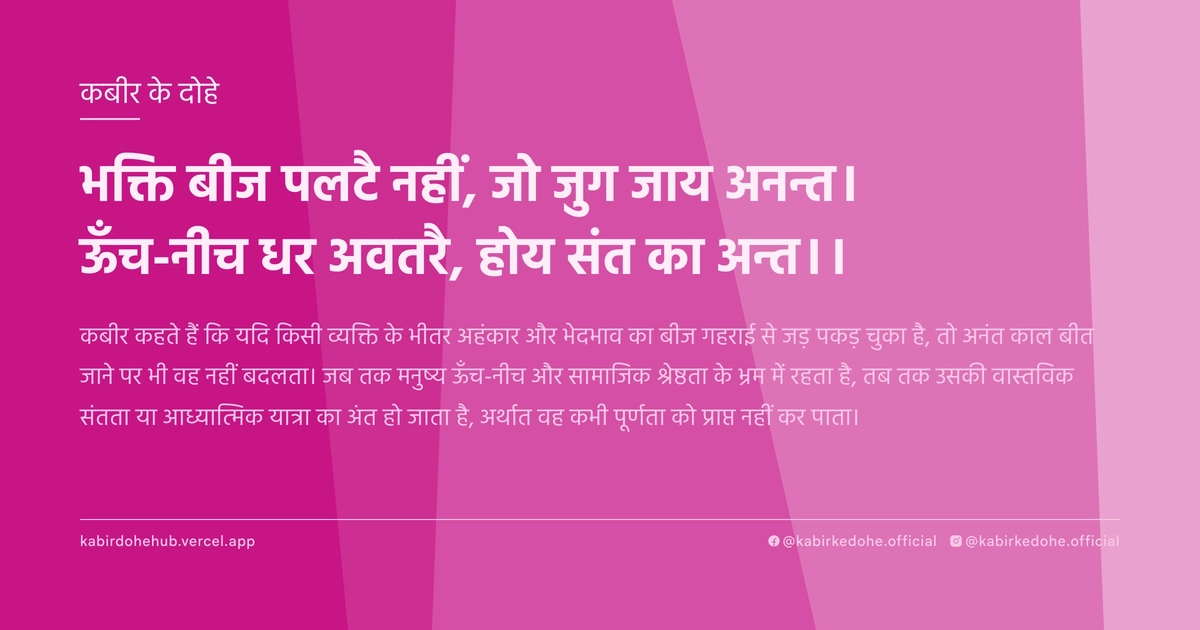
भक्ति बीज पलटै नहीं, जो जुग जाय अनन्त।
ऊँच-नीच धर अवतरै, होय संत का अन्त।।
Bhakti beej paltai nahi, jo jug jaaye anant. Oonch-neech dhar avtarai, hoye sant ka ant.
इस पृष्ठ पर इस कबीर दोहे का अर्थ (meaning), हिंदी व्याख्या और अंग्रेज़ी अनुवाद, दार्शनिक विश्लेषण और व्यावहारिक जीवन सीख दी गई है। यह दोहा अनित्य (Impermanence) विषय से जुड़ा है — Kabir doha meaning and explanation in Hindi and English.
अर्थ (Meaning):
कबीर कहते हैं कि यदि किसी व्यक्ति के भीतर अहंकार और भेदभाव का बीज गहराई से जड़ पकड़ चुका है, तो अनंत काल बीत जाने पर भी वह नहीं बदलता। जब तक मनुष्य ऊँच-नीच और सामाजिक श्रेष्ठता के भ्रम में रहता है, तब तक उसकी वास्तविक संतता या आध्यात्मिक यात्रा का अंत हो जाता है, अर्थात वह कभी पूर्णता को प्राप्त नहीं कर पाता।
Kabir asserts that if the seed of ego and discrimination is deeply embedded within a person, it remains unchanged even as infinite ages pass. As long as one clings to the delusions of high and low status or social hierarchy, the true essence of a saint—the spiritual culmination—remains unattainable, effectively ending the journey toward liberation.
व्याख्या (Interpretation):
इस दोहे का शाब्दिक अर्थ है कि स्वभाव का बीज अपरिवर्तनीय है यदि वह अज्ञान से सिंचित हो। यहाँ 'बीज' व्यक्ति के संस्कारों और गहरे मानसिक प्रवृत्तियों का प्रतीक है। कबीर निरगुण भक्ति के माध्यम से समझाते हैं कि जब तक आत्मा स्वयं को शरीर, जाति या पद (ऊँच-नीच) से जोड़ती है, वह माया के जाल में फंसी रहती है। यह द्वैतवाद ही वह बाधा है जो आत्मा और ब्रह्म के मिलन को रोकती है। जब तक 'मैं' और 'तू' का भेद बना रहता है, तब तक साधक केवल पाखंडी रहता है, वास्तविक संत नहीं। अंततः, यह दोहा इस विरोधाभास को उजागर करता है कि जो स्वयं को ऊँचा मानता है, वही आध्यात्मिक रूप से सबसे नीचे गिरता है।
Literally, the verse suggests that the seed of one's nature is immutable if nourished by ignorance. Here, the 'seed' symbolizes the deep-seated impressions (Samskaras) and mental tendencies of an individual. Through the lens of Nirgun Bhakti, Kabir explains that as long as the Atman identifies itself with the physical body, caste, or social rank (high and low), it remains trapped in Maya. This duality is the primary obstacle preventing the union of the individual soul with the formless Brahman. Until the distinction between 'I' and 'Other' persists, the seeker remains a pretender rather than a realized saint. Ultimately, the doha highlights the paradox that those who perceive themselves as superior are, in spiritual terms, the furthest from the truth.
दार्शनिक विश्लेषण (Philosophical Analysis):
कबीर का यह दोहा उस सामाजिक और धार्मिक परिवेश की प्रतिक्रिया है जहाँ जातिगत श्रेष्ठता और कर्मकांडीय शुद्धता को मोक्ष का मार्ग माना जाता था। कबीर ने इस व्यवस्था को पूरी तरह नकारते हुए 'सहज मार्ग' पर बल दिया। वे तर्क देते हैं कि बाहरी दिखावा या ऊँचे कुल में जन्म लेना आध्यात्मिक प्रगति की गारंटी नहीं है।
अद्वैत वेदांत के परिप्रेक्ष्य में, यह 'बीज' अविद्या (ignorance) है। जब तक जीव यह मानता है कि वह दूसरों से भिन्न या श्रेष्ठ है, वह द्वैत में जीता है। अद्वैत का मूल सिद्धांत 'अहं ब्रह्मास्मि' (मैं ही ब्रह्म हूँ) है, जिसका अर्थ है कि सबमें एक ही चेतना है। यदि कोई व्यक्ति ऊँच-नीच का भाव रखता है, तो वह इस सार्वभौमिक सत्य को नकार रहा है।
सूफीवाद के साथ इसका गहरा संबंध 'फना' (अहंकार का विनाश) की अवधारणा से है। सूफी संत मानते हैं कि जब तक 'नफ्स' (अहंकार) जीवित है, खुदा की प्राप्ति असंभव है। कबीर का 'बीज' वही नफ्स है जिसे नष्ट करना अनिवार्य है।
मनोवैज्ञानिक स्तर पर, यह दोहा संज्ञानात्मक पूर्वाग्रहों (cognitive biases) की बात करता है। मनुष्य अपनी पहचान को बाहरी उपाधियों से जोड़ लेता है, जिससे उसका वास्तविक स्वरूप ढक जाता है। यह पहचान एक मानसिक कारागार बन जाती है जो उसे परिवर्तन से रोकती है।
अंततः, कबीर यह स्पष्ट करते हैं कि संतता किसी उपाधि या कुल से नहीं, बल्कि अहंकार के पूर्ण विसर्जन से आती है। जो व्यक्ति स्वयं को शून्य कर लेता है, वही अनंत को प्राप्त करता है। ritualism (कर्मकांड) केवल बाहरी आवरण है, जबकि आंतरिक शुद्धि ही वास्तविक धर्म है।
This doha is a visceral reaction to the socio-religious climate of Kabir's era, where caste superiority and ritual purity were erroneously equated with spiritual liberation. Kabir rejects this framework entirely, emphasizing the 'Sahaj Marg' (the natural path). He argues that external appearances or birth into a 'high' lineage provide no guarantee of spiritual advancement.
From the perspective of Advaita Vedanta, this 'seed' represents Avidya (primordial ignorance). As long as the Jiva believes it is distinct from or superior to others, it exists in a state of duality. The core tenet of Advaita, 'Aham Brahmasmi' (I am Brahman), posits a single universal consciousness. To maintain a sense of hierarchy is to deny this fundamental reality.
There is a profound connection here with the Sufi concept of 'Fana' (the annihilation of the self). Sufi mystics believe that as long as the 'Nafs' (ego) survives, the realization of the Divine is impossible. Kabir's 'seed' is that very Nafs which must be utterly destroyed to achieve union.
Psychologically, the verse addresses the danger of identity attachment. When a human ties their worth to external titles or social standing, they create a mental construct that obscures their true essence. This identity becomes a psychological prison, preventing genuine transformation and growth.
Ultimately, Kabir clarifies that sainthood is not a title to be claimed or a status to be inherited, but a state achieved through the total dissolution of the ego. Only when one becomes 'zero' can they encompass the 'infinite'. Ritualism is merely a facade; internal purification is the only true religion.
मूल संदेश (Core Message):
- अहंकार का बीज आत्मा की प्रगति को अवरुद्ध करता है।
- सामाजिक श्रेष्ठता का भ्रम एक आध्यात्मिक कारागार है।
- सच्ची संतता विनम्रता और समानता के बोध में निहित है।
- जब तक 'मैं' जीवित है, तब तक 'परमात्मा' अदृश्य है।
- बाहरी पहचान का त्याग ही आंतरिक सत्य की प्राप्ति है।
- The seed of ego obstructs the soul's spiritual evolution.
- The illusion of social superiority is a spiritual prison.
- True sainthood resides in humility and the realization of equality.
- As long as the 'I' survives, the 'Divine' remains invisible.
- Renouncing external identity is the only path to internal truth.
व्यावहारिक उदाहरण (Practical Example):
वाराणसी के एक पुराने घाट पर रामदीन नाम का एक वृद्ध नाविक रहता था। वह अपनी नाव चलाने की कला में निपुण था, लेकिन उसका स्वभाव अत्यंत अहंकारी था। वह मानता था कि क्योंकि वह गंगा के पवित्र जल का रक्षक है, वह शहर के अन्य मजदूरों से श्रेष्ठ है।
रामदीन अक्सर अन्य नाविकों का अपमान करता और उन्हें 'अछूत' या 'अकुशल' कहकर पुकारता। उसके मन में यह 'बीज' गहराई से बैठा था कि उसकी सामाजिक और धार्मिक स्थिति उसे दूसरों से ऊपर रखती है।
एक दिन, एक साधारण सा दिखने वाला साधु उसकी नाव पर सवार हुआ। साधु ने रामदीन की बातचीत सुनी और मुस्कुराते हुए पूछा, 'नाविक, यदि गंगा का पानी केवल ऊँचे कुल के लोगों के लिए पवित्र होता, तो क्या यह नदी कभी बहती?'
रामदीन ने गर्व से कहा, 'पवित्रता तो संस्कारों से आती है, महाराज!' साधु ने शांति से जवाब दिया, 'संस्कार तो उस मिट्टी के हैं जो सबके पैरों तले कुचली जाती है, फिर भी वह सबको जीवन देती है। तुम्हारा अहंकार वह बीज है जो तुम्हें इस नदी की तरह बहने से रोक रहा है।'
साधु ने उसे एक चुनौती दी: एक सप्ताह तक वह हर उस व्यक्ति की मदद करेगा जिसे वह खुद से 'नीचा' समझता है, और बदले में वह उसे एक गुप्त मंत्र देगा। रामदीन ने इसे एक खेल समझा और मान लिया।
पहले दिन उसने एक बूढ़ी विधवा की भारी पोटली उठाई। दूसरे दिन उसने एक बीमार रिक्शावाले को पानी पिलाया। तीसरे दिन उसने एक छोटे बच्चे को नाव पर मुफ्त में पार कराया।
जैसे-जैसे दिन बीते, रामदीन ने महसूस किया कि जब वह दूसरों की सेवा करता है, तो उसके मन का भारीपन कम हो रहा है। उसे एहसास हुआ कि जिस 'श्रेष्ठता' के गर्व में वह जी रहा था, वह वास्तव में एक अकेलापन था।
सातवें दिन जब वह साधु के पास गया, तो उसने देखा कि साधु गायब था, लेकिन उसकी नाव पर एक छोटी सी पर्ची लिखी थी: 'बीज अब फट चुका है, अब तुम वास्तव में नाविक बन गए हो।'
रामदीन का व्यवहार पूरी तरह बदल गया। अब वह घाट पर सबसे विनम्र व्यक्ति था। उसने समझ लिया कि ऊँच-नीच का भ्रम ही उसकी आध्यात्मिक मृत्यु थी, और विनम्रता ही उसका वास्तविक जीवन है।
On an ancient ghat in Varanasi lived an elderly boatman named Ramdeen. He was a master of his craft, but his nature was profoundly arrogant. He believed that because he was a guardian of the sacred waters of the Ganges, he was superior to all other laborers in the city.
Ramdeen frequently insulted other boatmen, calling them 'untouchable' or 'unskilled.' The 'seed' of superiority was deeply embedded in his psyche, convincing him that his social and religious standing placed him above the rest.
One day, a simple-looking monk boarded his boat. The monk overheard Ramdeen's condescending remarks and asked with a smile, 'Boatman, if the waters of the Ganges were sacred only for those of high birth, would this river ever flow?'
Ramdeen replied proudly, 'Purity comes from lineage and tradition, Maharaj!' The monk calmly responded, 'Purity belongs to the soil that is trampled by everyone's feet, yet gives life to all. Your ego is the seed that prevents you from flowing like this river.'
The monk offered a challenge: for one week, Ramdeen must help every person he considered 'inferior' to himself, and in return, the monk would grant him a secret mantra.
On the first day, he carried a heavy bundle for an elderly widow. On the second, he provided water to a sick rickshaw puller. On the third, he gave a free ride to a small child.
As the days passed, Ramdeen noticed a strange lightness in his heart. He realized that the 'superiority' he had cherished was actually a profound and suffocating loneliness.
On the seventh day, when he went to find the monk, the man had vanished. In his place was a small note on the boat: 'The seed has now burst; you have finally become a true boatman.'
Ramdeen's behavior underwent a complete transformation. He became the most humble man on the ghats. He understood that the illusion of hierarchy was his spiritual death, and humility was his true awakening.
अभ्यास मार्गदर्शन (Practice Guidance):
- प्रतिदिन 15 मिनट मौन रहकर यह विचार करें कि आपकी कौन सी पहचान (पद, जाति, संपत्ति) आपको दूसरों से अलग या श्रेष्ठ महसूस कराती है।
- एक 'अहंकार डायरी' लिखें: दिन भर में जब भी आप किसी के प्रति श्रेष्ठता या हीनता का भाव महसूस करें, उसे लिखें और विश्लेषण करें कि वह भावना कहाँ से आई।
- सचेत सेवा: सप्ताह में एक बार ऐसे व्यक्ति की निस्वार्थ मदद करें जिसे समाज 'नीचा' मानता है, और इस दौरान अपने मन में उठने वाले प्रतिरोध को महसूस करें।
- निदान चेकलिस्ट: क्या मैं दूसरों को सलाह देते समय उनके स्तर को देखता हूँ? क्या मैं अनजाने में अपनी उपलब्धियों का उपयोग दूसरों को छोटा महसूस कराने के लिए करता हूँ? यदि हाँ, तो 'बीज' अभी भी सक्रिय है।
- Spend 15 minutes in daily silence contemplating which identity (rank, caste, wealth) makes you feel distinct or superior to others.
- Maintain an 'Ego Journal': Record every instance during the day when you felt a sense of superiority or inferiority toward someone, and analyze the root of that emotion.
- Conscious Service: Once a week, selflessly help someone whom society deems 'inferior,' and consciously observe the internal resistance that arises during the act.
- Diagnostic Checklist: Do I consider the other person's status before offering advice? Do I unconsciously use my achievements to make others feel small? If yes, the 'seed' is still active.
चिंतन प्रश्न (Reflection Questions):
- यदि आपसे आपकी सारी उपाधियाँ, संपत्ति और सामाजिक प्रतिष्ठा छीन ली जाए, तो आपके पास क्या बचेगा?
- क्या आपकी करुणा वास्तव में निस्वार्थ है, या यह आपकी श्रेष्ठता की भावना को संतुष्ट करने का एक तरीका है?
- आप अपने उन लोगों के प्रति कैसा व्यवहार करते हैं जिनसे आपको जीवन में कुछ भी मिलने की उम्मीद नहीं है?
- आपके भीतर का वह कौन सा 'बीज' है जिसे आप बदलना चाहते हैं लेकिन डरते हैं कि आपकी पहचान खो जाएगी?
- क्या आप वास्तव में समानता में विश्वास करते हैं, या आप केवल उन लोगों के साथ समानता चाहते हैं जो आपके जैसे हैं?
- If all your titles, wealth, and social prestige were stripped away, what would actually remain of you?
- Is your compassion truly selfless, or is it a tool to satisfy your own sense of superiority?
- How do you treat those from whom you expect absolutely nothing in return throughout your life?
- What is the 'seed' within you that you wish to change but fear would erase your identity?
- Do you truly believe in equality, or do you only desire equality with those who are similar to you?