
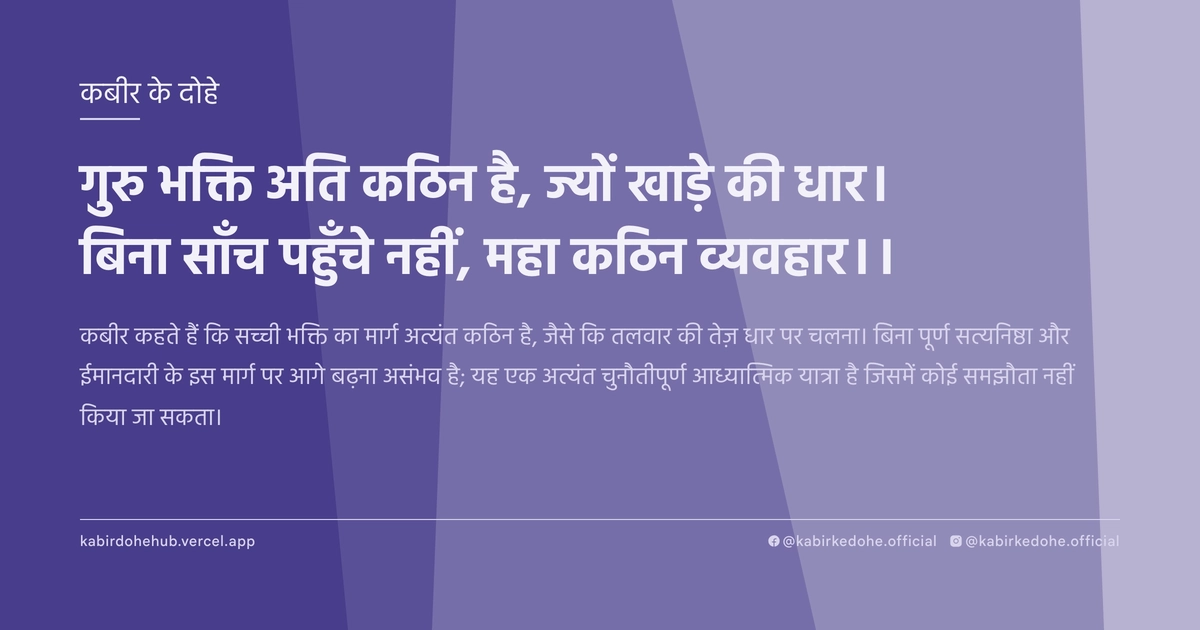
गुरु भक्ति अति कठिन है, ज्यों खाड़े की धार।
बिना साँच पहुँचे नहीं, महा कठिन व्यवहार।।
Guru bhakti ati kathin hai, jyon khade ki dhaar. Bina saanch pahuche nahi, maha kathin vyavhar.
इस पृष्ठ पर इस कबीर दोहे का अर्थ (meaning), हिंदी व्याख्या और अंग्रेज़ी अनुवाद, दार्शनिक विश्लेषण और व्यावहारिक जीवन सीख दी गई है। यह दोहा भक्ति (Bhakti) विषय से जुड़ा है — Kabir doha meaning and explanation in Hindi and English.
अर्थ (Meaning):
कबीर कहते हैं कि सच्ची भक्ति का मार्ग अत्यंत कठिन है, जैसे कि तलवार की तेज़ धार पर चलना। बिना पूर्ण सत्यनिष्ठा और ईमानदारी के इस मार्ग पर आगे बढ़ना असंभव है; यह एक अत्यंत चुनौतीपूर्ण आध्यात्मिक यात्रा है जिसमें कोई समझौता नहीं किया जा सकता।
Kabir asserts that the path of true devotion is exceedingly difficult, comparable to walking upon the razor-sharp edge of a sword. Without absolute truthfulness and unwavering sincerity, one cannot reach the destination; it is a profoundly challenging spiritual endeavor that permits no compromise.
व्याख्या (Interpretation):
शाब्दिक अर्थ यह है कि भक्ति सरल नहीं है। रूपक के तौर पर 'खाड़े की धार' (तलवार की धार) उस सूक्ष्म संतुलन को दर्शाती है जहाँ एक तरफ अहंकार है और दूसरी तरफ पूर्ण समर्पण। यह निर्गुण भक्ति का सार है, जहाँ साधक को माया के भ्रम और सांसारिक मोह के बीच एक अत्यंत संकीर्ण मार्ग खोजना होता है। यहाँ 'साँच' का अर्थ केवल सच बोलना नहीं, बल्कि आत्मा का परमात्मा के साथ पूर्ण सामंजस्य है। अद्वैत वेदांत के अनुसार, जब तक 'मैं' का भाव जीवित है, तब तक सत्य तक पहुँचना असंभव है। यह विरोधाभास है कि जिसे हम सबसे सरल मार्ग समझते हैं, वह वास्तव में सबसे कठिन है क्योंकि इसमें स्वयं का विसर्जन करना पड़ता है।
Literally, the verse warns that devotion is not easy. Metaphorically, the 'razor's edge' represents the precarious balance between the ego and total surrender. This is the essence of Nirgun Bhakti, where the seeker must navigate a narrow path between the illusions of Maya and worldly attachments. Here, 'Truth' (Saanch) refers not merely to honest speech, but to the ontological alignment of the Atman with Brahman. According to Advaita Vedanta, as long as the sense of 'I' persists, the ultimate truth remains unreachable. It is a profound paradox: the path that seems simplest—love—is the most difficult because it demands the complete annihilation of the self.
दार्शनिक विश्लेषण (Philosophical Analysis):
कबीर का यह दोहा उस युग की प्रतिक्रिया है जहाँ धर्म केवल कर्मकांडों और बाहरी दिखावे तक सीमित हो गया था। उन्होंने मंदिर, मस्जिद और तीर्थयात्राओं के खोखलेपन को चुनौती दी और यह स्थापित किया कि ईश्वर की प्राप्ति किसी बाहरी अनुष्ठान से नहीं, बल्कि आंतरिक शुद्धि से होती है। यह दृष्टिकोण सूफी मत के 'फना' (अहंकार का विनाश) और अद्वैत वेदांत के 'अहं ब्रह्मास्मि' के करीब है।
भक्ति को 'कठिन' कहना वास्तव में मनोवैज्ञानिक युद्ध की बात है। मनुष्य स्वभाव से सुख और सुविधा खोजता है, जबकि आध्यात्मिक प्रगति के लिए असुविधा और अनुशासन अनिवार्य है। कबीर यहाँ यह स्पष्ट कर रहे हैं कि भक्ति कोई भावनात्मक पलायन नहीं है, बल्कि एक कठोर अनुशासन है।
यहाँ 'साँच' (सत्य) का अर्थ है वह स्थिति जहाँ विचार, शब्द और कर्म एक हो जाएँ। जब तक साधक के भीतर द्वंद्व है, वह तलवार की धार पर नहीं चल सकता। यह द्वंद्व ही माया है, जो हमें सत्य से दूर रखती है।
कबीर का विरोध जाति और संप्रदाय से अधिक उस पाखंड से था जो सत्य को सरल बनाकर बेचता था। वे चेतावनी देते हैं कि जो लोग भक्ति को केवल माला जपने या तिलक लगाने तक सीमित रखते हैं, वे वास्तव में उस कठिन मार्ग पर कदम भी नहीं रख पाए हैं।
अंततः, यह विश्लेषण हमें बताता है कि मोक्ष कोई पुरस्कार नहीं है जिसे प्राप्त किया जाए, बल्कि एक प्रक्रिया है जिसमें पुराने 'स्व' को जलाकर नया 'सत्य' प्रकट होता है। यह पूर्ण समर्पण की वह अवस्था है जहाँ भक्त और भगवान के बीच की दूरी समाप्त हो जाती है।
Kabir’s couplet is a visceral reaction to an era where religion had devolved into mere ritualism and outward display. He challenged the emptiness of temples, mosques, and pilgrimages, establishing that the realization of the Divine is achieved not through external rites, but through internal purification. This perspective aligns closely with the Sufi concept of 'Fana' (annihilation of the ego) and the Advaita Vedanta realization of 'Aham Brahmasmi'.
Describing Bhakti as 'difficult' is essentially a commentary on the psychological war within. Humans naturally seek comfort and ease, whereas spiritual evolution necessitates discomfort and rigorous discipline. Kabir clarifies that devotion is not an emotional escape but a stringent discipline of the soul.
In this context, 'Truth' (Saanch) signifies a state where thought, word, and action are unified. As long as duality exists within the seeker, they cannot traverse the razor's edge. This duality is Maya, the cosmic illusion that veils the ultimate reality.
Kabir’s opposition was directed less at caste or sect and more at the hypocrisy of those who marketed spirituality as an easy path. He warns that those who limit devotion to the rote repetition of mantras or wearing sacred marks have not even stepped onto the true path.
Ultimately, this analysis reveals that liberation is not a reward to be earned, but a process of burning away the old 'self' to reveal the inherent 'Truth'. It is the state of total surrender where the distinction between the devotee and the Divine dissolves completely.
मूल संदेश (Core Message):
- भक्ति कोई सरल रास्ता नहीं, बल्कि एक आंतरिक युद्ध है।
- सत्य के बिना आध्यात्मिक प्रयास केवल एक मानसिक भ्रम हैं।
- अहंकार का विसर्जन ही वास्तविक भक्ति की पहली सीढ़ी है।
- बाहरी कर्मकांड आंतरिक रूपांतरण का विकल्प नहीं हो सकते।
- परमात्मा से मिलन के लिए 'मैं' का मिटना अनिवार्य है।
- Devotion is not an easy path, but an internal war.
- Spiritual efforts without absolute truth are mere mental illusions.
- The dissolution of ego is the first step of true devotion.
- External rituals cannot substitute for internal transformation.
- The annihilation of 'I' is mandatory to unite with the Divine.
व्यावहारिक उदाहरण (Practical Example):
वाराणसी के एक पुराने घाट पर रहने वाले एक वृद्ध विधवा, जानकी, का जीवन इस दोहे का जीवंत उदाहरण है। जानकी ने अपना पूरा जीवन दूसरों की सेवा और कठिन तपस्या में बिताया था, लेकिन उनके मन में एक गहरा दुख था कि उन्हें अभी तक 'ईश्वर के दर्शन' नहीं हुए।
वे प्रतिदिन घंटों जाप करती थीं और कठोर व्रत रखती थीं, यह सोचकर कि यही भक्ति का मार्ग है। उनके लिए भक्ति एक 'कार्य' बन गया था जिसे पूरा करने पर फल मिलेगा।
एक दिन उनकी मुलाकात एक घुमंतू साधु से हुई, जिसने उन्हें देखा और मुस्कुराकर कहा, 'माँ, तुम पत्थर की दीवार को धक्का दे रही हो, जबकि दरवाजा खुला है।'
जानकी ने पूछा, 'दरवाजा कौन सा?' साधु ने उत्तर दिया, 'तुम्हारी वह धारणा कि तुम कुछ 'हासिल' कर रही हो। जब तक तुम यह सोचोगी कि तुम भक्ति 'कर' रही हो, तब तक तुम अहंकार की धार पर हो, सत्य की नहीं।'
यह बात जानकी के हृदय में चुभ गई। उन्होंने महसूस किया कि उनकी तपस्या वास्तव में उनके अहंकार को पोषण दे रही थी—यह अहंकार कि 'मैं कितनी महान साधिका हूँ'।
अगले कुछ महीनों तक, जानकी ने सभी बाहरी दिखावे छोड़ दिए। उन्होंने केवल एक बात का अभ्यास किया: जो भी सेवा करें, उसमें यह भूल जाएँ कि वे कर रही हैं।
एक बार एक बीमार भिखारी उनके द्वार पर आया। जानकी ने बिना किसी विचार के, बिना यह सोचे कि यह उनके व्रत के समय का उल्लंघन है, उसकी सेवा की। उस क्षण, उनके भीतर का 'मैं' पूरी तरह मिट गया।
उसी क्षण उन्हें वह शांति महसूस हुई जिसे वे वर्षों के जाप में खोज रही थीं। उन्होंने अनुभव किया कि 'साँच' (सत्य) बाहरी क्रियाओं में नहीं, बल्कि उस पूर्ण निस्वार्थता में है जहाँ कर्ता का अस्तित्व ही समाप्त हो जाए।
जानकी का जीवन अब एक सहज प्रवाह बन गया था। उन्होंने सीखा कि भक्ति वास्तव में कठिन है क्योंकि यह हमें हमारे सबसे प्रिय हिस्से—हमारे अहंकार—से अलग करती है।
अंत में, उन्होंने पाया कि तलवार की धार पर चलना वास्तव में स्वयं को मिटा देना है, ताकि केवल वह अनंत सत्य शेष रहे।
The life of Janaki, an elderly widow living on an ancient ghat in Varanasi, serves as a living embodiment of this Doha. Janaki had spent her entire life in service to others and rigorous penance, yet she harbored a deep sorrow that she had not yet 'seen' God.
She spent hours daily in chanting and observed strict fasts, believing this to be the path of devotion. For her, Bhakti had become a 'task' to be completed in exchange for a spiritual reward.
One day, she encountered a wandering monk who looked at her and smiled, saying, 'Mother, you are pushing against a stone wall while the door is wide open.'
Janaki asked, 'Which door?' The monk replied, 'The belief that you are 'achieving' something. As long as you think you are 'practicing' devotion, you are walking on the edge of ego, not the edge of truth.'
These words pierced Janaki's heart. She realized that her penance was actually feeding her ego—the pride of thinking, 'I am such a great seeker.'
For the next few months, Janaki abandoned all outward displays of piety. She practiced only one thing: to serve others while completely forgetting that she was the one serving.
Once, a sick beggar arrived at her door. Without a second thought, and without considering that it violated the timing of her fast, she tended to him. In that moment, the 'I' within her vanished completely.
At that very instant, she felt the peace she had sought through years of chanting. She experienced that 'Truth' (Saanch) lies not in external rituals, but in that absolute selflessness where the doer ceases to exist.
Janaki's life became a seamless flow. She learned that Bhakti is indeed difficult because it separates us from our most cherished possession—our ego.
Ultimately, she discovered that walking the razor's edge is actually the act of erasing oneself, so that only the infinite Truth remains.
अभ्यास मार्गदर्शन (Practice Guidance):
- प्रतिदिन 20 मिनट मौन अभ्यास करें, जहाँ आप अपने विचारों के प्रति केवल एक साक्षी (Witness) बनें, उनमें शामिल न हों।
- स्व-पूछताछ जर्नल: प्रतिदिन लिखें कि आज किस क्षण में मेरा 'अहंकार' (जैसे कि सही होने की जिद या प्रशंसा की इच्छा) हावी हुआ और उसने सत्य को कैसे ढका।
- एक 'निस्वार्थ सेवा' का कार्य करें, लेकिन शर्त यह हो कि किसी को पता न चले और आप स्वयं भी उस कार्य के प्रति मोह न रखें।
- निदान चेकलिस्ट: क्या मैं भक्ति को एक सौदे की तरह देख रहा हूँ? क्या मेरी आध्यात्मिक प्रगति मुझे दूसरों से श्रेष्ठ महसूस करा रही है? यदि हाँ, तो मैं अभी भी अहंकार की धार पर हूँ।
- Practice 20 minutes of daily silence, acting solely as a witness to your thoughts without becoming entangled in them.
- Self-Inquiry Journal: Record daily instances where your 'ego' (e.g., the need to be right or the desire for praise) dominated and how it veiled the truth.
- Perform one act of 'anonymous service,' ensuring no one knows and that you maintain no emotional attachment to the outcome.
- Diagnostic Checklist: Am I viewing devotion as a transaction? Does my spiritual progress make me feel superior to others? If yes, I am still walking the edge of ego.
चिंतन प्रश्न (Reflection Questions):
- क्या मेरी धार्मिक पहचान वास्तव में मुझे विनम्र बना रही है, या यह मेरे अहंकार को एक नया 'आध्यात्मिक मुखौटा' दे रही है?
- मैं सत्य की बात करता हूँ, लेकिन क्या मैं उन सत्यों को स्वीकार करने का साहस रखता हूँ जो मेरी सुखद छवि को नष्ट कर देते हैं?
- मेरे जीवन का वह कौन सा 'आराम' है जिसे मैं आध्यात्मिक प्रगति के नाम पर छोड़ने से डरता हूँ?
- क्या मैं ईश्वर को खोज रहा हूँ, या मैं केवल उस 'अहसास' को खोज रहा हूँ जो मुझे विशेष महसूस कराए?
- यदि मेरी सारी धार्मिक पहचान छीन ली जाए, तो मेरे भीतर क्या शेष बचेगा?
- Is my religious identity truly making me humble, or is it providing my ego with a new 'spiritual mask'?
- I speak of truth, but do I possess the courage to accept truths that shatter my comfortable self-image?
- What is that specific 'comfort' in my life that I fear sacrificing in the name of spiritual progress?
- Am I seeking the Divine, or am I merely seeking the 'feeling' that makes me feel special?
- If all my religious identities were stripped away, what would remain within me?