
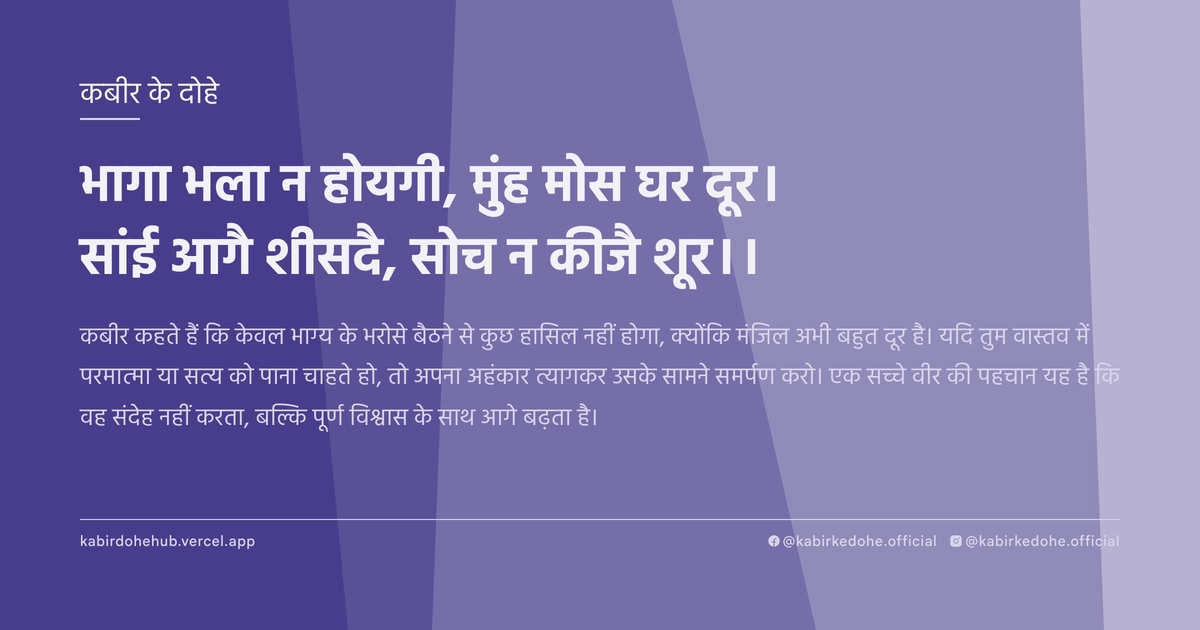
भागा भला न होयगी, मुंह मोस घर दूर।
सांई आगै शीसदै, सोच न कीजै शूर।।
Bhaga bhala na hoyegi, munh mos ghar dur. Sai aage sheesdai, soch na kije shur.
इस पृष्ठ पर इस कबीर दोहे का अर्थ (meaning), हिंदी व्याख्या और अंग्रेज़ी अनुवाद, दार्शनिक विश्लेषण और व्यावहारिक जीवन सीख दी गई है। यह दोहा प्रपत्ति (Surrender) विषय से जुड़ा है — Kabir doha meaning and explanation in Hindi and English.
अर्थ (Meaning):
कबीर कहते हैं कि केवल भाग्य के भरोसे बैठने से कुछ हासिल नहीं होगा, क्योंकि मंजिल अभी बहुत दूर है। यदि तुम वास्तव में परमात्मा या सत्य को पाना चाहते हो, तो अपना अहंकार त्यागकर उसके सामने समर्पण करो। एक सच्चे वीर की पहचान यह है कि वह संदेह नहीं करता, बल्कि पूर्ण विश्वास के साथ आगे बढ़ता है।
Kabir asserts that relying solely on fate will yield no fruit, as the spiritual destination remains distant. If one truly desires to reach the Divine or the Ultimate Truth, they must surrender their ego completely. A true spiritual warrior is defined not by physical strength, but by the absence of doubt and the presence of unwavering faith in the journey.
व्याख्या (Interpretation):
शाब्दिक अर्थ यह है कि भाग्य के भरोसे घर (ईश्वर) नहीं मिलता। यहाँ 'घर' आत्मा के मूल स्रोत, ब्रह्म का प्रतीक है। 'शीश देना' केवल शारीरिक मृत्यु नहीं, बल्कि 'अहंकार की मृत्यु' है। यह निर्गुण भक्ति का सार है जहाँ भक्त अपनी व्यक्तिगत पहचान को शून्य कर देता है। माया हमें यह भ्रम देती है कि हम भाग्य के शिकार हैं, जबकि वास्तव में हम अपनी ही मानसिक जड़ता के कारण बंधे हैं। जब साधक 'शूर' (वीर) बनकर संदेह को मिटाता है, तब द्वैत समाप्त होता है और वह अद्वैत की स्थिति में पहुँचता है जहाँ वह स्वयं ब्रह्ममय हो जाता है।
Literally, the verse suggests that fate cannot bring one home. Here, 'home' symbolizes the soul's origin, the Brahman. 'Offering the head' does not imply physical sacrifice, but the 'death of the ego'. This is the essence of Nirgun Bhakti, where the devotee annihilates their individual identity. Maya creates the illusion that we are victims of destiny, whereas we are actually bound by our own mental inertia. When the seeker becomes a 'Shoor' (warrior) by eradicating doubt, duality vanishes, leading to the state of Advaita where the self merges with the Universal Consciousness.
दार्शनिक विश्लेषण (Philosophical Analysis):
कबीर का यह दोहा उस समय के सामाजिक और धार्मिक परिवेश पर प्रहार करता है जहाँ लोग कर्मकांडों और भाग्यवादिता (Fatalism) में डूबे थे। कबीर भाग्य को एक मानसिक बाधा मानते हैं जो मनुष्य को प्रयास करने से रोकती है। उनका दर्शन अद्वैत वेदांत से मेल खाता है, जहाँ जीव और ब्रह्म की एकता पर बल दिया गया है, लेकिन वे इसे किसी शास्त्र के बजाय अनुभव (Anubhav) के माध्यम से प्राप्त करने की बात करते हैं।
यहाँ 'शूर' शब्द का प्रयोग मनोवैज्ञानिक रूपांतरण के लिए किया गया है। आध्यात्मिक मार्ग पर सबसे बड़ा शत्रु बाहरी दुनिया नहीं, बल्कि आंतरिक संदेह और भय है। सूफीवाद के 'फना' (Fana) की अवधारणा यहाँ स्पष्ट दिखती है, जहाँ खुदा के सामने खुद को मिटा देना ही वास्तविक प्राप्ति है। कबीर ritualism का विरोध करते हुए कहते हैं कि मंदिर-मस्जिद जाने से अधिक महत्वपूर्ण है आंतरिक समर्पण।
यह दोहा यह भी स्पष्ट करता है कि भक्ति कोई निष्क्रिय प्रक्रिया नहीं है। यह एक सक्रिय युद्ध है—अपने स्वयं के अहंकार के विरुद्ध। जब तक व्यक्ति यह सोचता है कि वह 'कर्ता' है, वह माया के जाल में है। जैसे ही वह समर्पण करता है, वह कर्ता से हटकर केवल एक माध्यम बन जाता है।
ऐतिहासिक रूप से, कबीर ने जाति और धर्म की दीवारों को तोड़कर एक ऐसे मार्ग का 제시 किया जो सार्वभौमिक था। उन्होंने सिखाया कि ईश्वर किसी विशेष समुदाय का नहीं, बल्कि उस शून्य का है जिसे केवल प्रेम और साहस से भरा जा सकता है।
अंततः, यह विश्लेषण हमें बताता है कि मोक्ष कोई बाहरी पुरस्कार नहीं है जिसे भाग्य से पाया जाए, बल्कि यह एक आंतरिक जागृति है जो तब होती है जब हम अपनी सीमित पहचान (Ego) को अनंत (Infinite) में विलीन कर देते हैं।
This couplet strikes at the social and religious climate of Kabir's era, where people were immersed in ritualism and fatalism. Kabir views 'fate' as a psychological barrier that prevents a human from taking conscious action. His philosophy aligns with Advaita Vedanta, emphasizing the oneness of Jiva and Brahman, yet he insists on achieving this through direct experience (Anubhav) rather than scriptural study.
The use of the word 'Shoor' (warrior) refers to a psychological transformation. On the spiritual path, the greatest enemy is not the external world, but internal doubt and fear. The Sufi concept of 'Fana' (annihilation of the self) is evident here; erasing oneself before the Divine is the only way to truly find oneself. Kabir opposes ritualism, suggesting that internal surrender is far more potent than visiting temples or mosques.
This verse clarifies that devotion is not a passive process. It is an active war—a struggle against one's own ego. As long as a person believes they are the 'doer' (Karta), they remain trapped in Maya. The moment they surrender, they cease to be the actor and become a mere instrument of the Divine.
Historically, Kabir dismantled the walls of caste and creed to present a universal path. He taught that God does not belong to a specific community but to the 'Void' (Shunya), which can only be filled with love and courage.
Ultimately, this analysis reveals that liberation (Moksha) is not an external reward granted by fate, but an internal awakening that occurs when we dissolve our limited identity (Ego) into the Infinite.
मूल संदेश (Core Message):
- भाग्य एक मानसिक भ्रम है जो कर्म को रोकता है।
- सच्ची आध्यात्मिक प्रगति अहंकार के पूर्ण विसर्जन में है।
- संदेह का त्याग ही एक साधक को 'शूर' बनाता है।
- परमात्मा तक पहुँचने का मार्ग समर्पण से होकर जाता है।
- अद्वैत की प्राप्ति तब होती है जब 'मैं' समाप्त हो जाता है।
- Fate is a mental illusion that obstructs conscious action.
- True spiritual progress lies in the complete dissolution of the ego.
- The abandonment of doubt is what transforms a seeker into a warrior.
- The path to the Divine is paved with absolute surrender.
- Non-duality is realized only when the 'I' ceases to exist.
व्यावहारिक उदाहरण (Practical Example):
एक समय की बात है, वाराणसी के घाटों पर माधव नाम का एक वृद्ध बुनकर रहता था। माधव अपनी कला में निपुण था, लेकिन उसका जीवन गहरे अवसाद और निराशा से भरा था। वह मानता था कि उसका जन्म एक गरीब परिवार में हुआ है, इसलिए उसकी किस्मत में केवल संघर्ष लिखा है। वह अक्सर कहता, "मेरे भाग्य में सुख नहीं है, ईश्वर ने मुझे यही जीवन दिया है।"
वह दिन भर कपड़े बुनता, लेकिन उसके मन में हमेशा यह मलाल रहता कि वह कभी बड़ा कलाकार नहीं बन पाया क्योंकि उसके पास संसाधनों की कमी थी। वह अपनी विफलता का दोष अपने 'भाग्य' को देता रहा और इसी कारण उसने नई तकनीकों को सीखना या नए बाजारों की तलाश करना छोड़ दिया था।
एक शाम, वह कबीर के एक अनुयायी के पास बैठा था। उस अनुयायी ने माधव की आँखों में छिपी निराशा को देखा और उसे यह दोहा सुनाया: "भागा भला न होयगी..."। उसने माधव से कहा, "तुम भाग्य की बात कर रहे हो, लेकिन क्या तुमने कभी अपने भीतर के उस डर को देखा है जो तुम्हें नया प्रयास करने से रोकता है? तुम्हारा भाग्य तुम्हारी जंजीर नहीं, बल्कि तुम्हारा डर तुम्हारी जंजीर है।"
माधव को पहले तो यह बात समझ नहीं आई। उसने तर्क दिया कि गरीबी उसका भाग्य है। लेकिन अनुयायी ने मुस्कुराते हुए कहा, "गरीबी बाहरी स्थिति है, लेकिन 'मैं गरीब हूँ' यह सोचना एक मानसिक अवस्था है। जिस दिन तुम इस पहचान को ईश्वर के चरणों में समर्पित कर दोगे, उस दिन तुम मुक्त हो जाओगे।"
माधव ने गहराई से सोचना शुरू किया। उसने महसूस किया कि वह वास्तव में गरीबी से नहीं, बल्कि अपनी उस छवि से डरा हुआ था जो उसने खुद के लिए बनाई थी। उसने तय किया कि वह अब भाग्य का रोना नहीं रोएगा। उसने अपने अहंकार को—कि वह 'सब कुछ जानता है' या 'वह कुछ नहीं कर सकता'—पूरी तरह त्याग दिया।
अगले कुछ महीनों में, माधव ने अपनी पुरानी बुनकरी शैली में कुछ नए प्रयोग किए। उसने उन रंगों का उपयोग करना शुरू किया जिन्हें लोग 'अशुभ' मानते थे, लेकिन उसने उन्हें एक आध्यात्मिक दृष्टिकोण से पेश किया। उसने अपनी कला को केवल जीविका का साधन नहीं, बल्कि ईश्वर की प्रार्थना बना लिया।
धीरे-धीरे, उसके काम में एक ऐसी चमक आई जो पहले कभी नहीं थी। लोग उसकी कला की सादगी और गहराई की ओर आकर्षित होने लगे। अब वह केवल एक बुनकर नहीं था, बल्कि एक साधक था जो धागों के माध्यम से सत्य को बुन रहा था।
एक दिन एक बड़ा व्यापारी उसके पास आया और उसे बहुत बड़ा प्रस्ताव दिया। माधव ने उसे स्वीकार किया, लेकिन इस बार उसने यह नहीं कहा कि "मेरा भाग्य चमक गया है।" इसके बजाय, उसने कहा, "मैंने केवल अपने भीतर के संदेह को मारा है।"
माधव का जीवन बदल गया था। उसने सीखा कि जब हम भाग्य के भरोसे बैठना छोड़कर पूर्ण समर्पण और साहस के साथ कर्म करते हैं, तो हम केवल अपनी परिस्थितियों को ही नहीं, बल्कि अपनी चेतना को भी बदल देते हैं।
यह माधव की कहानी नहीं, बल्कि हर उस व्यक्ति की कहानी है जो अपनी सीमाओं को 'नियति' मान लेता है। कबीर का यह संदेश उसे याद दिलाता रहा कि असली वीरता भाग्य से लड़ने में नहीं, बल्कि अहंकार को मिटाकर सत्य में विलीन होने में है।
Once, in the ghats of Varanasi, lived an elderly weaver named Madhav. Madhav was skilled in his craft, but his life was filled with deep depression and hopelessness. He believed that because he was born into a poor family, only struggle was written in his destiny. He often lamented, "Happiness is not in my fate; God has given me this life of hardship."
He spent his days weaving cloth, but his heart was always heavy with the regret that he never became a great artist due to a lack of resources. He continued to blame his 'fate' for his failures, and because of this, he stopped learning new techniques or seeking new markets.
One evening, he sat with a follower of Kabir. The follower noticed the hidden despair in Madhav's eyes and recited the doha: "Bhaga bhala na hoygi..." He told Madhav, "You speak of fate, but have you ever looked at the fear within you that prevents you from trying something new? Your fate is not your chain; your fear is your chain."
At first, Madhav didn't understand. He argued that poverty was his destiny. But the follower smiled and said, "Poverty is an external condition, but thinking 'I am poor' is a mental state. The day you surrender this identity at the feet of the Divine, you will be free."
Madhav began to reflect deeply. He realized that he wasn't actually afraid of poverty, but of the image of himself that he had constructed. He decided that he would no longer cry over his fate. He completely renounced his ego—the belief that he 'knew everything' or 'could do nothing'.
Over the next few months, Madhav began experimenting with his old weaving style. He started using colors that people considered 'inauspicious,' presenting them through a spiritual lens. He stopped viewing his art as a mere means of livelihood and turned it into a prayer to the Divine.
Gradually, a brilliance emerged in his work that was never there before. People were drawn to the simplicity and depth of his art. He was no longer just a weaver, but a seeker weaving truth through threads.
One day, a wealthy merchant approached him with a grand proposal. Madhav accepted it, but this time he did not say, "My luck has turned." Instead, he said, "I have simply slain the doubt within me."
Madhav's life had changed. He learned that when we stop relying on fate and instead act with total surrender and courage, we change not only our circumstances but our very consciousness.
This is not just Madhav's story, but the story of everyone who mistakes their limitations for 'destiny'. Kabir's message reminded him that true bravery lies not in fighting fate, but in annihilating the ego to merge with the Truth.
अभ्यास मार्गदर्शन (Practice Guidance):
- दैनिक चिंतन: प्रतिदिन 15 मिनट मौन बैठें और विचार करें कि आप किन क्षेत्रों में 'भाग्य' को दोष देकर अपनी जिम्मेदारी से बच रहे हैं।
- आत्म-पूछताछ जर्नल: लिखें कि "यदि मेरा अहंकार (मेरी पहचान, मेरा पद, मेरा दुख) आज पूरी तरह मिट जाए, तो मैं कौन हूँ?"
- व्यवहारिक परिवर्तन: जब भी मन में संदेह या डर आए, तो उसे एक 'शूर' की तरह स्वीकार करें और बिना किसी परिणाम की चिंता किए छोटे कदम उठाएं।
- डायग्नोस्टिक चेकलिस्ट: क्या मैं अपनी असफलताओं के लिए बाहरी परिस्थितियों को जिम्मेदार ठहरा रहा हूँ? क्या मैं बदलाव से डरता हूँ? यदि हाँ, तो आप अभी भी भाग्य के भ्रम में हैं।
- Daily Contemplation: Sit in silence for 15 minutes daily and observe where you are avoiding responsibility by blaming 'fate' or 'destiny'.
- Self-Inquiry Journal: Write a response to the prompt: "If my ego (my identity, my status, my suffering) were to completely vanish today, who would I be?"
- Behavioral Shift: Whenever doubt or fear arises, acknowledge it as a warrior would, and take small steps forward without attachment to the outcome.
- Diagnostic Checklist: Am I blaming external circumstances for my failures? Am I afraid of change? If yes, you are still trapped in the illusion of fate.
चिंतन प्रश्न (Reflection Questions):
- वह कौन सी 'पहचान' है जिसे आप इतनी मजबूती से पकड़े हुए हैं कि वह आपके विकास में बाधा बन रही है?
- क्या आपका 'दुख' वास्तव में आपकी परिस्थिति है, या वह आपकी ईगो का एक हिस्सा है जिसे सहानुभूति चाहिए?
- यदि आपको पता चले कि आपका भाग्य आपके नियंत्रण में नहीं है, तो क्या आप फिर भी पूरी शक्ति से प्रयास करेंगे?
- आपकी सार्वजनिक छवि और आपके आंतरिक डर के बीच कितना बड़ा अंतर है?
- क्या आप वास्तव में सत्य की खोज कर रहे हैं, या आप केवल अपनी मान्यताओं की पुष्टि करना चाहते हैं?
- What is the 'identity' you are clinging to so tightly that it has become an obstacle to your growth?
- Is your 'suffering' truly a result of your circumstances, or is it a part of your ego seeking sympathy?
- If you knew for certain that fate was not in your control, would you still strive with all your might?
- How wide is the gap between your public persona and your internal shadows?
- Are you truly seeking the Truth, or are you merely seeking confirmation of your own beliefs?