
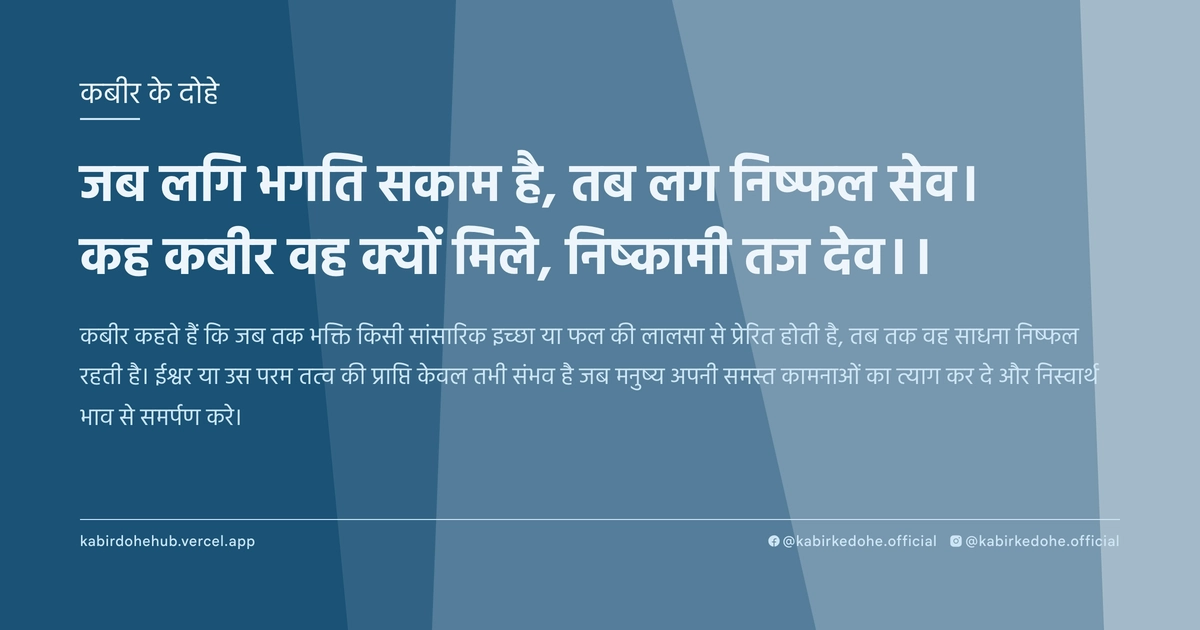
जब लगि भगति सकाम है, तब लग निष्फल सेव।
कह कबीर वह क्यों मिले, निष्कामी तज देव।।
Jab lagi bhagati sakaam hai, tab lag nishphal sev. Kah Kabir vah kyon mile, nishkaami taj dev.
इस पृष्ठ पर इस कबीर दोहे का अर्थ (meaning), हिंदी व्याख्या और अंग्रेज़ी अनुवाद, दार्शनिक विश्लेषण और व्यावहारिक जीवन सीख दी गई है। यह दोहा प्रपत्ति (Surrender) विषय से जुड़ा है — Kabir doha meaning and explanation in Hindi and English.
अर्थ (Meaning):
कबीर कहते हैं कि जब तक भक्ति किसी सांसारिक इच्छा या फल की लालसा से प्रेरित होती है, तब तक वह साधना निष्फल रहती है। ईश्वर या उस परम तत्व की प्राप्ति केवल तभी संभव है जब मनुष्य अपनी समस्त कामनाओं का त्याग कर दे और निस्वार्थ भाव से समर्पण करे।
Kabir asserts that as long as devotion is driven by worldly desires or the hope of a reward, the spiritual practice remains fruitless. The realization of the Divine or the Ultimate Truth is only attainable when one renounces all selfish cravings and surrenders with absolute selflessness.
व्याख्या (Interpretation):
इस दोहे का शाब्दिक अर्थ है कि कामनापूर्ण भक्ति व्यर्थ है। आध्यात्मिक स्तर पर, 'सकाम' वह अवस्था है जहाँ साधक ईश्वर को एक साधन मानता है, साध्य नहीं। यह माया का सूक्ष्म जाल है जहाँ अहंकार 'भक्ति' के मुखौटे में छिपा होता है। निर्गुण भक्ति के अनुसार, परमात्मा कोई बाहरी व्यक्ति नहीं बल्कि अंतरात्मा का विस्तार है। जब तक 'मैं' और 'मेरा' का भाव रहता है, तब तक द्वैत बना रहता है। अद्वैत वेदांत के अनुसार, जब कामनाएँ समाप्त होती हैं, तब केवल शुद्ध चेतना बचती है। यही वह बिंदु है जहाँ साधक और साध्य एक हो जाते हैं, और द्वैत का भ्रम मिट जाता है।
Literally, the verse states that desire-driven devotion is futile. On a deeper level, 'Sakaam' represents a state where the seeker treats the Divine as a means to an end rather than the end itself. This is a subtle trap of Maya, where the ego hides behind the mask of piety. In Nirgun Bhakti, the Divine is not an external entity but an expansion of the inner self. As long as the notions of 'I' and 'Mine' persist, duality remains. According to Advaita Vedanta, when all desires cease, only pure consciousness remains. This is the precise point where the seeker and the sought merge, and the illusion of separation dissolves.
दार्शनिक विश्लेषण (Philosophical Analysis):
कबीर का यह दोहा मध्यकालीन भारत के उस दौर की प्रतिक्रिया है जहाँ धर्म केवल कर्मकांड और वरदान मांगने का जरिया बन गया था। कबीर ने पुरोहितवाद और उन रीतियों का खंडन किया जो ईश्वर को एक 'सौदेबाज' के रूप में प्रस्तुत करती थीं। उनका दर्शन सूफीवाद के 'फना' (अहंकार का विनाश) और वेदांत के 'अहं ब्रह्मास्मि' का संगम है।
यहाँ 'सकाम' का अर्थ केवल भौतिक सुख नहीं, बल्कि आध्यात्मिक अहंकार भी है—जैसे स्वर्ग की इच्छा या मोक्ष का लालच। कबीर तर्क देते हैं कि यदि आप मोक्ष के लिए साधना कर रहे हैं, तो वह भी एक सूक्ष्म इच्छा है जो आपको बंधन में रखती है। वास्तविक भक्ति वह है जो बिना किसी शर्त के हो, जैसे एक नदी बिना किसी लाभ के समुद्र में विलीन हो जाती है।
यह विश्लेषण मनोवैज्ञानिक रूपांतरण की बात करता है। जब तक मन में 'प्राप्ति' की इच्छा है, तब तक मन बाहरी दुनिया की ओर उन्मुख है। निष्कामता का अर्थ निष्क्रियता नहीं, बल्कि कर्म करते हुए फल से विरक्त होना है। यह मानसिक अवस्था अहंकार के उस केंद्र को नष्ट कर देती है जो हमेशा 'लेने' की कोशिश करता है।
सूफी परंपरा में इसे 'इश्क-ए-हकीकी' कहा गया है, जहाँ प्रेमी अपने अस्तित्व को मिटाकर केवल प्रिय को देखता है। कबीर इसी विलायती और भारतीय संश्लेषण के माध्यम से यह समझाते हैं कि ईश्वर कोई वस्तु नहीं जिसे पाया जाए, बल्कि वह एक अवस्था है जिसे जिया जाए।
अंततः, यह दोहा हमें सिखाता है कि ritualism (कर्मकांड) केवल बाहरी आवरण है। वास्तविक धर्म आंतरिक शुद्धि है। जब तक हृदय में कामनाओं का शोर है, तब तक परमात्मा की मौन वाणी सुनाई नहीं दे सकती। निष्कामता ही वह कुंजी है जो द्वैत के द्वार खोलकर अद्वैत के प्रकाश में ले जाती है।
This couplet is a reaction to the medieval Indian era where religion had devolved into mere ritualism and a transactional tool for seeking boons. Kabir rejected the priestly class and the traditions that portrayed the Divine as a 'bargainer.' His philosophy is a confluence of the Sufi concept of 'Fana' (annihilation of the ego) and the Vedantic realization of 'Aham Brahmasmi.'
Here, 'Sakaam' does not merely refer to material luxury, but also to spiritual ego—such as the desire for heaven or the craving for liberation. Kabir argues that if one practices spirituality for the sake of Moksha, that too is a subtle desire that keeps one bound. True devotion is unconditional, much like a river merging into the ocean without expecting anything in return.
This analysis focuses on psychological transformation. As long as the mind is preoccupied with 'attainment,' it remains oriented toward the external world. Selflessness does not mean inactivity, but acting while remaining detached from the fruits of action. This mental state destroys the center of the ego that is always in a mode of 'taking.'
In the Sufi tradition, this is termed 'Ishq-e-Haqiqi,' where the lover erases their own existence to see only the Beloved. Through this synthesis of mystical traditions, Kabir explains that God is not an object to be acquired, but a state of being to be lived.
Ultimately, the verse teaches that ritualism is merely an outer shell. True religion is inner purification. As long as the noise of desires echoes in the heart, the silent voice of the Divine cannot be heard. Selflessness is the key that opens the doors of duality to lead one into the light of non-duality.
मूल संदेश (Core Message):
- कामनाएं आध्यात्मिक मार्ग की सबसे बड़ी बाधाएं हैं।
- ईश्वर कोई वस्तु नहीं, बल्कि एक निस्वार्थ अवस्था है।
- सच्ची भक्ति में 'मैं' का विलोपन अनिवार्य है।
- फल की इच्छा ही साधना को बंधन बना देती है।
- जब माँग समाप्त होती है, तब प्राप्ति शुरू होती है।
- Desires are the greatest obstacles on the spiritual path.
- The Divine is not an object to acquire, but a selfless state of being.
- The dissolution of the 'I' is essential for true devotion.
- The craving for results turns spiritual practice into a bondage.
- When the demanding ends, the receiving begins.
व्यावहारिक उदाहरण (Practical Example):
वाराणसी के घाटों पर रहने वाली एक वृद्ध विधवा, जानकी, अपना पूरा दिन मंदिर में बिताती थी। वह घंटों मंत्र जाप करती और दान देती, लेकिन उसके मन में एक ही प्रार्थना थी—कि उसका बेटा, जो विदेश में है, वापस आए और उसकी सेवा करे। वह मानती थी कि उसकी भक्ति का फल उसके बेटे की वापसी होगी।
वर्षों बीत गए, लेकिन उसका बेटा नहीं लौटा। जानकी का क्रोध और दुख बढ़ता गया। वह ईश्वर को कोसने लगी कि उसकी इतनी सेवा के बाद भी उसे वह नहीं मिला जो वह चाहती थी। उसकी भक्ति एक सौदे की तरह थी, जहाँ वह 'सेवा' दे रही थी और 'बेटा' मांग रही थी।
एक दिन उसकी मुलाकात एक फकीर से हुई जिसने उसे कबीर का यह दोहा सुनाया। फकीर ने पूछा, 'क्या तुम ईश्वर को प्यार करती हो या उस इनाम को जो तुम्हें ईश्वर से चाहिए?' जानकी स्तब्ध रह गई। उसे एहसास हुआ कि उसने कभी ईश्वर को नहीं चाहा, बल्कि अपनी इच्छाओं को ईश्वर के नाम पर पुकारा।
उसने अपनी प्रार्थनाएं बदल दीं। अब वह यह नहीं मांगती थी कि बेटा आए, बल्कि यह मांगती थी कि उसका हृदय इतना विशाल हो जाए कि वह हर संतान में अपने बेटे को देख सके। उसने अपनी सेवा को 'फल' से अलग कर दिया।
धीरे-धीरे, जानकी ने घाट पर आने वाले अनाथ बच्चों को पालना शुरू किया। उसने अपनी सारी जमापूंजी उनके भोजन और शिक्षा पर लगा दी। अब वह मंदिर इसलिए नहीं जाती थी कि कुछ मिले, बल्कि इसलिए जाती थी क्योंकि उसे उस शांति में आनंद मिलता था।
अजीब बात यह हुई कि जब उसने बेटे की इच्छा पूरी तरह त्याग दी, तब उसे एक दिन पत्र मिला कि उसका बेटा गंभीर बीमारी से उबरकर वापस आ रहा है। लेकिन अब जानकी को उसकी वापसी से वह बेचैनी नहीं थी जो पहले थी।
उसने पाया कि जब वह 'सकाम' थी, तब वह दुखी थी। जब वह 'निष्काम' हुई, तब वह स्वतंत्र हो गई। उसकी भक्ति अब बोझ नहीं, बल्कि उत्सव बन गई थी।
उसने सीखा कि ईश्वर को पाने का एकमात्र तरीका यह है कि हम उस 'पाने' की इच्छा को ही मिटा दें। अब वह जानती थी कि असली फल बेटा नहीं, बल्कि वह आंतरिक शांति थी जो निस्वार्थता से आई थी।
जानकी का जीवन अब एक उदाहरण बन गया कि कैसे कामनाओं का त्याग ही वास्तविक प्राप्ति है। उसने अपनी व्यक्तिगत पीड़ा को सार्वभौमिक प्रेम में बदल दिया था।
Janaki, an elderly widow living on the ghats of Varanasi, spent her entire day at the temple. She chanted mantras for hours and gave donations, but her heart held only one prayer—that her son, who lived abroad, would return and serve her. She believed the fruit of her devotion would be his return.
Years passed, but her son did not return. Janaki's anger and sorrow grew. She began to resent the Divine, feeling that despite her immense service, she had not received what she desired. Her devotion was like a business transaction, where she offered 'service' and demanded a 'son.'
One day, she met a wandering dervish who recited this Doha of Kabir. The dervish asked, 'Do you love the Divine, or do you love the reward you want from the Divine?' Janaki was stunned. She realized she had never actually sought God, but had merely called out to her own desires in God's name.
She changed her prayers. She no longer asked for her son's return; instead, she asked for a heart wide enough to see her son in every child she encountered. She detached her service from the expectation of a result.
Gradually, Janaki began caring for orphaned children who came to the ghats. She spent all her savings on their food and education. She no longer visited the temple to get something, but because she found joy in the silence of the space.
Strangely, once she completely relinquished the desire for her son, she received a letter stating that he had recovered from a serious illness and was returning. However, Janaki no longer felt the desperate anxiety she once had.
She discovered that when she was 'Sakaam' (desire-driven), she was miserable. When she became 'Nishkaam' (desireless), she became free. Her devotion was no longer a burden, but a celebration.
She learned that the only way to find the Divine is to erase the very desire to 'find.' She realized the true reward was not her son, but the inner peace born of selflessness.
Janaki's life became a testament to the fact that the renunciation of desire is the only true attainment. She had transformed her personal grief into universal love.
अभ्यास मार्गदर्शन (Practice Guidance):
- दैनिक साक्षी भाव: दिन भर में जब भी कोई इच्छा जागे, उसे एक तीसरे व्यक्ति की तरह देखें और पूछें, 'क्या यह मेरी आत्मा की आवश्यकता है या अहंकार की मांग?'
- निस्वार्थ सेवा अभ्यास: सप्ताह में एक बार ऐसा कार्य करें जिसके बदले में आप किसी से कोई प्रशंसा, धन्यवाद या भौतिक लाभ की उम्मीद न करें।
- आत्म-पूछताछ जर्नल: हर रात लिखें कि आज आपने कितनी बार 'मुझे यह चाहिए' सोचा और उस इच्छा के पीछे छिपा डर या लालच क्या था।
- निदान चेकलिस्ट: यदि आप प्रार्थना के बाद निराश महसूस करते हैं, तो इसका अर्थ है कि आपकी भक्ति 'सकाम' है। यदि आप केवल देने में आनंद पाते हैं, तो आप 'निष्काम' मार्ग पर हैं।
- Daily Witness Consciousness: Whenever a desire arises during the day, observe it as a third person and ask, 'Is this a need of my soul or a demand of my ego?'
- Selfless Service Practice: Once a week, perform an act of kindness where you expect absolutely no praise, gratitude, or material gain in return.
- Self-Inquiry Journaling: Every night, record how many times you thought 'I want this' and identify the fear or greed hidden behind that desire.
- Diagnostic Checklist: If you feel frustrated or resentful after prayer, your devotion is 'Sakaam' (transactional). If you find joy solely in the act of giving, you are on the 'Nishkaam' (selfless) path.
चिंतन प्रश्न (Reflection Questions):
- क्या मेरी आध्यात्मिकता वास्तव में ईश्वर के प्रति प्रेम है, या यह केवल मेरे जीवन की समस्याओं का समाधान पाने का एक तरीका है?
- यदि मुझे पता चले कि मेरी सारी प्रार्थनाएं कभी स्वीकार नहीं होंगी, तो क्या मैं फिर भी भक्ति करना जारी रखूंगा?
- मेरे 'परोपकार' के पीछे कितनी सूक्ष्म इच्छा छिपी है कि लोग मुझे एक 'अच्छे इंसान' के रूप में देखें?
- क्या मैं अपनी शांति को बाहरी परिस्थितियों या लोगों के व्यवहार पर निर्भर रखता हूँ?
- मेरे जीवन का वह कौन सा क्षेत्र है जहाँ मैं अभी भी ईश्वर के साथ 'सौदेबाजी' कर रहा हूँ?
- Is my spirituality truly love for the Divine, or is it merely a tool to solve my life's problems?
- If I knew that none of my prayers would ever be answered, would I still continue my devotion?
- How much subtle desire for being seen as a 'good person' is hidden behind my acts of charity?
- Do I depend on external circumstances or the behavior of others for my inner peace?
- In which area of my life am I still 'bargaining' with the Divine?