
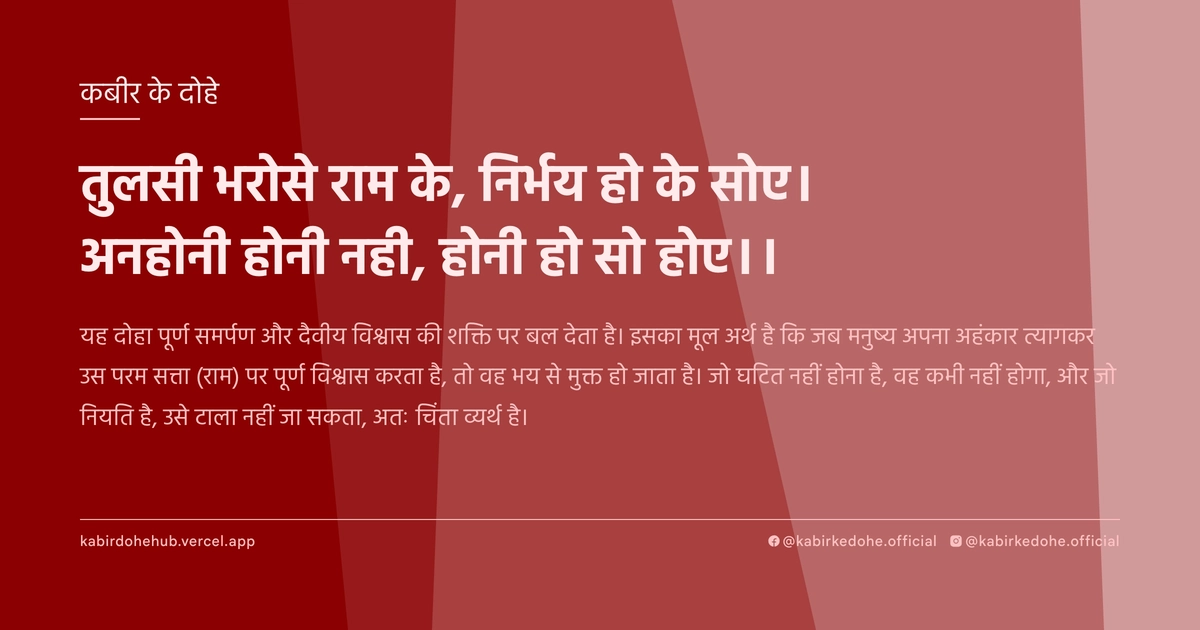
तुलसी भरोसे राम के, निर्भय हो के सोए।
अनहोनी होनी नही, होनी हो सो होए।।
Tulsi bharose Ram ke, nirbhay ho ke soye. Anhonī honī nahi, honī ho so hoye.
इस पृष्ठ पर इस कबीर दोहे का अर्थ (meaning), हिंदी व्याख्या और अंग्रेज़ी अनुवाद, दार्शनिक विश्लेषण और व्यावहारिक जीवन सीख दी गई है। यह दोहा प्रपत्ति (Surrender) विषय से जुड़ा है — Kabir doha meaning and explanation in Hindi and English.
अर्थ (Meaning):
यह दोहा पूर्ण समर्पण और दैवीय विश्वास की शक्ति पर बल देता है। इसका मूल अर्थ है कि जब मनुष्य अपना अहंकार त्यागकर उस परम सत्ता (राम) पर पूर्ण विश्वास करता है, तो वह भय से मुक्त हो जाता है। जो घटित नहीं होना है, वह कभी नहीं होगा, और जो नियति है, उसे टाला नहीं जा सकता, अतः चिंता व्यर्थ है।
This couplet emphasizes the power of absolute surrender and divine faith. Its fundamental message is that when a human relinquishes the ego and places complete trust in the Supreme Reality (Ram), they become liberated from fear. That which is not destined to happen will never occur, and that which is destined is inevitable; therefore, anxiety is futile.
व्याख्या (Interpretation):
शाब्दिक रूप से यह ईश्वर पर भरोसे की बात करता है, परंतु आध्यात्मिक स्तर पर यह 'राम' को किसी व्यक्ति विशेष के बजाय 'परम चेतना' या 'ब्रह्म' के रूप में देखता है। यहाँ 'निर्भय' होने का अर्थ केवल बाहरी डर से मुक्ति नहीं, बल्कि अस्तित्वगत भय (existential dread) का अंत है। यह निर्गुण भक्ति के उस सिद्धांत से जुड़ता है जहाँ भक्त यह समझता है कि उसकी व्यक्तिगत इच्छाएँ माया का खेल हैं। जब आत्मा यह जान लेती है कि वह ब्रह्मांडीय इच्छा (Universal Will) का हिस्सा है, तो द्वंद्व समाप्त हो जाता है। यह अद्वैत वेदांत के उस सत्य को दर्शाता है जहाँ ज्ञाता और ज्ञेय एक हो जाते हैं। अंततः, यह दोहा हमें सिखाता है कि समर्पण का अर्थ निष्क्रियता नहीं, बल्कि कर्म करते हुए परिणाम की चिंता से मुक्त होना है।
Literally, it speaks of trust in God, but on a spiritual level, 'Ram' is viewed not as a person but as the 'Supreme Consciousness' or 'Brahman'. Being 'fearless' here does not merely mean freedom from external threats, but the cessation of existential dread. This aligns with the principle of Nirgun Bhakti, where the devotee realizes that individual desires are but a play of Maya (illusion). When the Atman recognizes itself as a part of the Universal Will, all internal conflict vanishes. It mirrors the truth of Advaita Vedanta, where the knower and the known merge into one. Ultimately, this verse teaches that surrender is not passivity, but performing one's duty while remaining detached from the outcome.
दार्शनिक विश्लेषण (Philosophical Analysis):
कबीर और तुलसी के समय का भारत धार्मिक कट्टरता और कर्मकांडों के जाल में फँसा था। यह दोहा उस समय की सामाजिक चिंता और असुरक्षा के विरुद्ध एक मनोवैज्ञानिक उपचार है। यह कर्मकांडीय धर्म के बजाय 'अनुभव' और 'विश्वास' को प्राथमिकता देता है। यहाँ 'राम' शब्द का प्रयोग सूफीवाद के 'वह्दत-अल-वुजूद' (अस्तित्व की एकता) के समान है, जहाँ केवल एक ही सत्य व्याप्त है।
दार्शनिक रूप से, यह 'नियतिवाद' (Determinism) और 'पुरुषार्थ' के बीच के संतुलन को समझाता है। यह तर्क देता है कि भय का मूल कारण हमारा यह भ्रम है कि हम परिस्थितियों के पूर्ण नियंत्रक हैं। जब हम इस नियंत्रण के भ्रम (Ego) को तोड़ते हैं, तो हम उस शांति को प्राप्त करते हैं जिसे बुद्ध ने 'निर्वाण' और कबीर ने 'शून्य' कहा है।
यह विश्लेषण हमें बताता है कि 'अनहोनी' का डर वास्तव में हमारी आसक्ति (Attachment) का परिणाम है। हम उन चीजों को खोने से डरते हैं जो वास्तव में हमारी हैं ही नहीं। अद्वैत वेदांत के अनुसार, चूंकि आत्मा अविनाशी है, इसलिए वास्तव में खोने के लिए कुछ भी नहीं है।
सूफी परंपरा में इसे 'तवक्कुल' (पूर्ण भरोसा) कहा जाता है। यह वह अवस्था है जहाँ साधक अपनी इच्छा को ईश्वर की इच्छा में विलीन कर देता है। यह अहंकार का विलोपन है, क्योंकि 'मैं' की जगह 'वह' ले लेता है।
अतः, यह दोहा केवल सांत्वना नहीं है, बल्कि एक गहन आध्यात्मिक सर्जरी है जो मनुष्य को उसके सीमित व्यक्तित्व से निकालकर उसे अनंत ब्रह्मांडीय चेतना से जोड़ता है। यह सिखाता है कि शांति बाहरी परिस्थितियों के बदलने से नहीं, बल्कि आंतरिक दृष्टिकोण के बदलने से आती है।
The India of Kabir and Tulsi's era was entangled in religious bigotry and the web of ritualism. This verse serves as a psychological remedy against the social anxiety and insecurity of that time. It prioritizes 'experience' and 'faith' over ritualistic religion. The use of 'Ram' here is akin to the Sufi concept of 'Wahdat-al-Wujud' (Unity of Existence), where only one Truth pervades all.
Philosophically, it explains the balance between 'Determinism' and 'Human Effort'. It argues that the root of fear is the delusion that we are the absolute controllers of circumstances. When we shatter this illusion of control (the Ego), we attain the peace that Buddha termed 'Nirvana' and Kabir called 'Shunya' (the Void).
This analysis reveals that the fear of the 'unlikely' (anhoni) is actually a result of our attachment. We fear losing things that were never truly ours. According to Advaita Vedanta, since the Atman is indestructible, there is nothing to actually lose.
In the Sufi tradition, this is called 'Tawakkul' (absolute trust). It is a state where the seeker merges their will into the Divine Will. This is the annihilation of the ego, as the 'I' is replaced by 'He'.
Therefore, this verse is not mere consolation, but a profound spiritual surgery that moves a human from their limited personality to the infinite cosmic consciousness. It teaches that peace comes not from the changing of external circumstances, but from the transformation of the internal perspective.
मूल संदेश (Core Message):
- भय केवल नियंत्रण खोने का भ्रम है।
- समर्पण कमजोरी नहीं, बल्कि सर्वोच्च मानसिक शक्ति है।
- नियति को स्वीकार करना ही वास्तविक स्वतंत्रता है।
- अहंकार का अंत ही शांति का प्रारंभ है।
- ब्रह्मांडीय प्रवाह के साथ बहना ही जीवन का सत्य है।
- Fear is merely the illusion of losing control.
- Surrender is not weakness, but the highest mental strength.
- Accepting destiny is the only true liberation.
- The end of ego is the beginning of peace.
- Flowing with the cosmic current is the ultimate truth of life.
व्यावहारिक उदाहरण (Practical Example):
एक समय की बात है, बनारस के घाटों पर रहने वाली एक वृद्ध विधवा, जानकी, थी। उसका जीवन अभावों से भरा था और उसका एकमात्र सहारा उसका छोटा सा मिट्टी का बर्तन बनाने का काम था।
एक भीषण बाढ़ आई जिसने शहर के कई हिस्सों को डुबो दिया। जानकी की छोटी सी झोपड़ी और उसके सारे बर्तन पानी में बह गए। उसके पास अब न रहने को घर था और न ही आजीविका का कोई साधन।
उसके आस-पास के लोग विलाप कर रहे थे और अपनी किस्मत को कोस रहे थे। जानकी भी डरी हुई थी, लेकिन उसने इस दोहे को अपने जीवन का मंत्र बना लिया था।
उसने सोचा, "जो बह गया, वह मेरा था ही नहीं। जो होना था, वह हो गया। अब जो होगा, वह उस परम सत्ता की इच्छा होगी।"
उसने रोने के बजाय, राहत शिविर में अन्य लोगों की मदद करना शुरू किया। उसने अपनी कला का उपयोग करके शिविर के बच्चों के लिए मिट्टी के छोटे खिलौने बनाना शुरू किया, जो उसने वहां उपलब्ध गीली मिट्टी से बनाए थे।
धीरे-धीरे, उसकी इस निस्वार्थ सेवा और शांत स्वभाव ने लोगों का ध्यान खींचा। एक धनी व्यापारी ने उसकी कला और उसकी मानसिक शांति को देखा और उसे एक नई कार्यशाला खोलने में मदद की।
जानकी ने महसूस किया कि यदि वह बाढ़ के डर में डूबी रहती, तो वह कभी भी उस नई शुरुआत की ओर नहीं बढ़ पाती।
उसका 'कबीर ट्विस्ट' यह था कि उसने अपनी हानि को 'ईश्वर की इच्छा' मानकर स्वीकार कर लिया, जिससे उसका मानसिक बोझ हल्का हो गया और वह रचनात्मकता की ओर मुड़ सकी।
अंत में, जानकी ने पाया कि जिस 'अनहोनी' से वह डरती थी, उसने वास्तव में उसे एक अधिक सम्मानित और शांतिपूर्ण जीवन की ओर धकेल दिया।
उसकी कहानी यह सिद्ध करती है कि जब हम परिणाम का मोह छोड़कर वर्तमान में समर्पण करते हैं, तो जीवन हमें अप्रत्याशित रूप से संवार देता है।
Once, on the ghats of Varanasi, lived an elderly widow named Janaki. Her life was filled with scarcity, and her only sustenance was her small craft of making clay pots.
A devastating flood struck, submerging many parts of the city. Janaki's tiny hut and all her pots were swept away by the current. She now had neither a home nor a means of livelihood.
People around her were wailing and cursing their fate. Janaki was also afraid, but she had made this doha her life's mantra.
She thought, "What has flowed away was never truly mine. What was destined to happen, has happened. Now, whatever occurs will be the will of the Supreme Power."
Instead of weeping, she began helping others in the relief camp. Using the wet clay available there, she started making small clay toys for the children in the camp.
Gradually, her selfless service and calm demeanor drew attention. A wealthy merchant noticed her art and her mental peace, and helped her establish a new workshop.
Janaki realized that if she had remained drowned in the fear of the flood, she would never have moved toward this new beginning.
Her 'Kabir Twist' was that by accepting her loss as 'Divine Will', her mental burden lightened, allowing her to pivot toward creativity.
In the end, Janaki found that the 'unlikely disaster' she feared had actually pushed her toward a more respected and peaceful life.
Her story proves that when we relinquish the attachment to outcomes and surrender to the present, life unexpectedly refines us.
अभ्यास मार्गदर्शन (Practice Guidance):
- प्रतिदिन 15 मिनट मौन ध्यान करें, जहाँ आप अपनी सभी चिंताओं को एक काल्पनिक पात्र के रूप में देखें और उन्हें 'परम सत्ता' को सौंप दें।
- एक 'समर्पण जर्नल' लिखें: उन घटनाओं की सूची बनाएं जिनसे आप डरते हैं, और उनके सामने लिखें, "यदि यह मेरी उन्नति के लिए है, तो यह होगा; यदि नहीं, तो यह नहीं होगा।"
- जब भी घबराहट महसूस हो, गहरी सांस लें और मन में दोहराएं: "मैं केवल माध्यम हूँ, कर्ता नहीं।"
- डायग्नोस्टिक चेकलिस्ट: क्या मैं छोटी समस्याओं पर अत्यधिक प्रतिक्रिया करता हूँ? क्या मैं भविष्य के डर के कारण वर्तमान का आनंद नहीं ले पा रहा हूँ? यदि हाँ, तो समर्पण का अभ्यास बढ़ाएं।
- Practice 15 minutes of silent meditation daily, visualizing your anxieties as external objects and consciously surrendering them to the 'Supreme Power'.
- Maintain a 'Surrender Journal': List the events you fear and write beside them, "If this is for my growth, it shall happen; if not, it shall not."
- Whenever anxiety arises, take a deep breath and repeat internally: "I am merely the instrument, not the doer."
- Diagnostic Checklist: Do I overreact to minor problems? Am I unable to enjoy the present due to fear of the future? If yes, increase the practice of surrender.
चिंतन प्रश्न (Reflection Questions):
- मेरे जीवन में वह कौन सा 'नियंत्रण' है जिसे मैं छोड़ने से सबसे ज्यादा डरता हूँ?
- क्या मेरा डर वास्तव में किसी घटना से है, या उस घटना के बाद मेरी सामाजिक छवि (image) के बिगड़ने से?
- यदि आज सब कुछ समाप्त हो जाए, तो मेरे भीतर ऐसा क्या बचेगा जिसे कोई आपदा नहीं छीन सकती?
- मैं अपनी सफलता का श्रेय खुद को देता हूँ, लेकिन क्या मैं अपनी असफलताओं के लिए नियति को दोष देता हूँ?
- क्या मेरी भक्ति केवल संकट के समय काम आती है, या यह मेरे अस्तित्व का स्थायी आधार है?
- What is that one 'control' in my life that I am most afraid to relinquish?
- Is my fear truly about an event, or about the damage to my social image following that event?
- If everything were to vanish today, what remains within me that no disaster can take away?
- Do I take full credit for my successes, yet blame destiny for my failures?
- Is my faith merely a refuge during crises, or is it the permanent foundation of my existence?